

Subscribe to receive new articles by e-mail. It’s free, but if you like, you can pledge a donation:
Everyone wants to be happy, but due to ignorance, we try to find happiness through processes that ultimately bring us misery. One example of this is given in the Srimad Bhāgavatam in the story of King Prācīnabarhi. He was carefully following the process of frutive activity (karma-kanda) prescribed in the Vedas, and still, the result would be just more birth and death. Ordinary materialistic people don’t even follow this pious process; they just work hard trying to directly obtain money to then spend on various types of vices and sinful activities. As a result, they can’t even hope to achieve the celestial planets like Prācīnabarhi; they are suffering now, dealing with stress and anxiety, and in the future, they will suffer more as the results of the current activities fructify. We can see how powerful and dangerous a force illusion is, binding so powerfully the pure soul to the hardships of this material world.
To save the King, Nārada Muni appeared to him and told him the allegory of Purañjana, which is nothing more than the story of the King as a soul entering the material body. This is also the story of every other conditioned soul. We are all “Purañjanas”, souls living in the body.
The body is compared to a city, because just like a city is formed by different structures and citizens, a body is formed by many different cells, microbes, etc., who are also alive. There is also one soul for each cell and microorganism in the body, each one with its own subordinate existence, enjoying its own small body, and one soul that predominates over all others and becomes the ruler of the city, reigning over the whole body. The soul inside the body becomes thus a purañjana, becoming free to use this body for one’s purposes and enjoy or suffer the results.
The soul thus travels from one city to the other, all over creation, together with a friend, called Avijñāta (the unknown one), who is none else than the Supersoul. Avijñāta is mentioned a single time in the whole description, in text 4.25.10. He is there the whole time, but no one, including Purañjana, is aware of Avijñāta’s presence, and no one could understand his activities, just as the Supersoul is always with us, but because of our fixation on the external world, we are not aware of Him.
Together with his friend Avijñāta, Purañjana traveled for a very long time:
“King Purañjana began to search for a suitable place to live, and thus he traveled all over the world. Even after a great deal of traveling, he could not find a place just to his liking. Finally he became morose and disappointed.” (SB 4.25.11)
This describes the transmigration of the soul, going from one body to the other, but never becoming satisfied due to unlimited material desires. Although no one wants to die, we still don’t find complete satisfaction in any type of body. All our material suffering is unnecessary; we are children of a rich father, but in our foolishness, we decide to abandon His shelter and instead experience hardships in the material world. Worse than that, we fail to notice His presence, even though He is always with us, trying to bring us back home.
Purañjana finds a human body
While traveling, Purañjana finally came to a place different from the others:
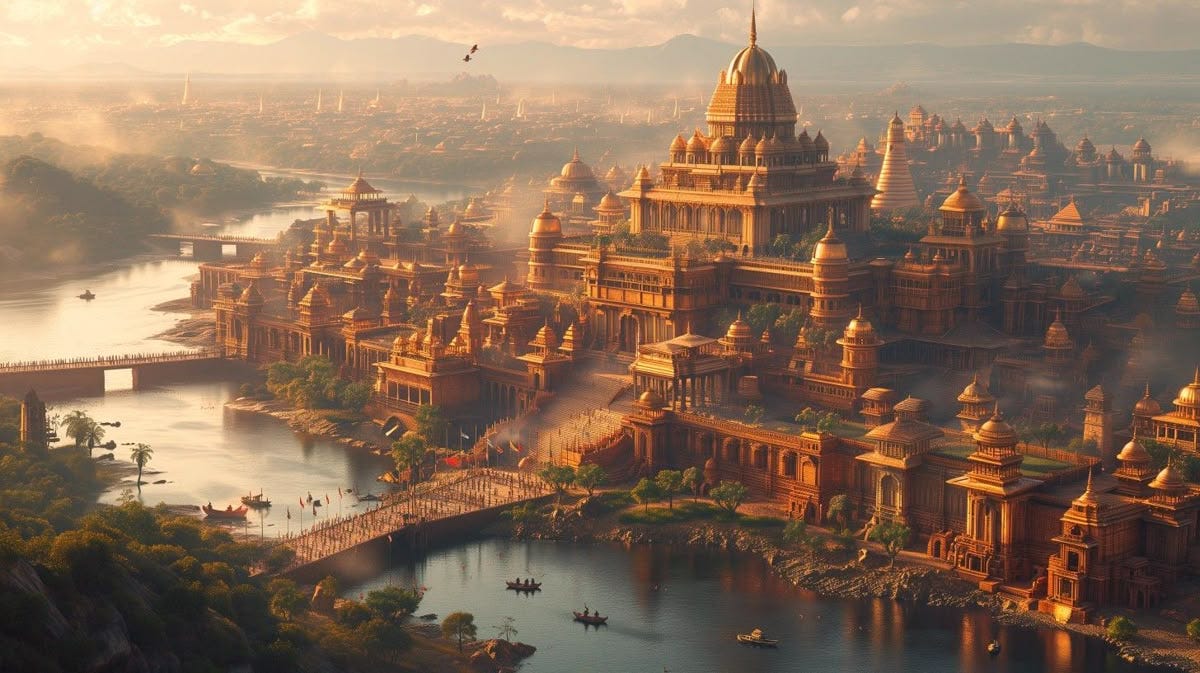
“King Purañjana began to search for a suitable place to live, and thus he traveled all over the world. Even after a great deal of traveling, he could not find a place just to his liking. Finally he became morose and disappointed. King Purañjana had unlimited desires for sense enjoyment; consequently he traveled all over the world to find a place where all his desires could be fulfilled. Unfortunately he found a feeling of insufficiency everywhere.Once, while wandering in this way, he saw on the southern side of the Himālayas, in a place named Bhārata-varṣa [India], a city that had nine gates all about and was characterized by all auspicious facilities.” (SB 4.25.11-13)
Sometimes, the term Bhārata-varṣa is used to indicate our whole planet, and sometimes to specifically indicate India. In this case, it is specifically described that Purañjana came to a body in the south of the Himalayas, in India, taking birth in a society where people followed Vedic culture. This is the most desired type of birth, because it gives access to spiritual knowledge and the possibility of progressing spiritually and sharing it with others, as indicated by Mahāprabhu in the verse bhārata-bhūmite haila manuṣya janma yāra, janma sārthaka kari’ kara para-upakāra (One who has taken his birth as a human being in the land of India [Bhārata-varṣa] should make his life successful and work for the benefit of all other people.)
The city is described as having nine gates, which are the nine openings of the body (mouth, nostrils, eyes, ears, anus, and genital), and possessing all auspicious qualities. It is described that amongst all types of bodies, the best are bodies with the human form (as either human beings or demigods), because they offer better facilities.
The human body is compared to a beautiful city. Most of these descriptions are not directly connected to different parts of the body, but with situations, experiences, and facilities we enjoy at different stages of life.
a) The city was surrounded by walls and parks, and within it were towers, canals, windows, and outlets.
This is the part that is directly connected with the physical structures of the body. Skin is compared to walls that protect the body from the external environment; bodily hairs with parks full of trees, the nose and head with towers, the eyes with windows, and the eyelids with protective glasses.
b) The houses there were decorated with domes made of gold, silver, and iron.
Here, the description becomes more symbolic. The different desires, activities, etc., connected with the body are compared with houses with domes made of three types of metals, referring to the influence of the three modes. Gold represents goodness; silver, passion; and iron, ignorance. The same person may be influenced by different combinations of the modes in different activities.
c) The floors of the houses in that city were made of sapphire, crystal, diamonds, pearls, emeralds, and rubies.
The heart is not only the seating place of the soul and the Supersoul, but also for the mind and desires, as well as the intelligence and all plans for material enjoyment. Both material desires and plans are attractive to the conditioned soul, and they are thus compared to valuable jewels that decorate the floors of the different houses, just as desires and plans permeate all spheres of our material activities.
d) The city includes many assembly houses, street crossings, streets, restaurants, gambling houses, markets, resting places, flags, festoons, and beautiful parks.
The vital airs flow inside the body through the nāḍis, which are subtle energetic pathways. There are thousands of nāḍis in the body, and they intersect in the chakras. Because they are very subtle pathways, the nāḍis are not understood in modern medicine, which is limited to the study of the nerves and the circulatory system. However, the nāḍis receive great importance in the Vedic sciences. Just as the roads to the different provinces of a country are connected to the capital, all the nāḍis are connected to the heart, the seat of the soul and the center of energy for the whole body. In this way, all the different organs and faculties of the body are connected to the center through the pathways of the nadis, and through them, the soul has access to everything.
e) On the outskirts of that city were many beautiful trees and creepers encircling a nice lake, with many birds and bees chanting and humming.
This attractive lake represents favorable conditions for sex life, which may present themselves at certain stages of life. Becoming attracted to it is compared to gaining access to this attractive lake, where one may enjoy for some time. However, the staying of the soul in this city is time-limited; therefore, spending too much time enjoying in this lake is not advisable.
f) Waterfalls with strings of water coming from an icy mountain, spraying the branches of the trees with particles of water, carried by the spring air.
The waterfall represents material rasa, the chief of which is the sexual mellow (ādi-rasa). This ādi-rasa is activated by Cupid, leading one to want to enjoy sensual pleasures. The other components of the descriptions symbolize the five objects of the senses: the branches and leaves of the trees are sight (rūpa), the waterfall is taste (rasa), the spring air is smell (gandha), the sounds from the lake are hearing (śabda), and the wind is touch (sparśa). The conditioned soul uses the five senses to enjoy this rūpa, rasa, gandha, śabda, and sparśa, and in this way becomes completely captivated by material life.
g) In such a peaceful atmosphere, the animals become nonviolent and nonenvious and don’t attack anyone. Over and above everything is the cooing of the cuckoos.
Sexual desire and romantic relationships lead to family life, where one may have the opportunity to live peacefully for some time, enjoying a peaceful atmosphere at home, with well-behaved children. This situation is compared to living by this beautiful lake, hearing the pleasant, gentle chanting of the cuckoos. Often, however, things don’t go as expected, and the family becomes a source of anxiety.
As we can see, the human body certainly offers many possibilities, but it is up to us to decide how to use it. That’s why Kṛṣṇa leaves us the Vedas, so we can find our path.
You can also donate using Buy Me a Coffee, PayPal, Wise, Revolut, or bank transfers. There is a separate page with all the links. This helps me enormously to have time to write instead of doing other things to make a living. Thanks!