

Subscribe to receive new articles by e-mail. It’s free, but if you like, you can pledge a donation:
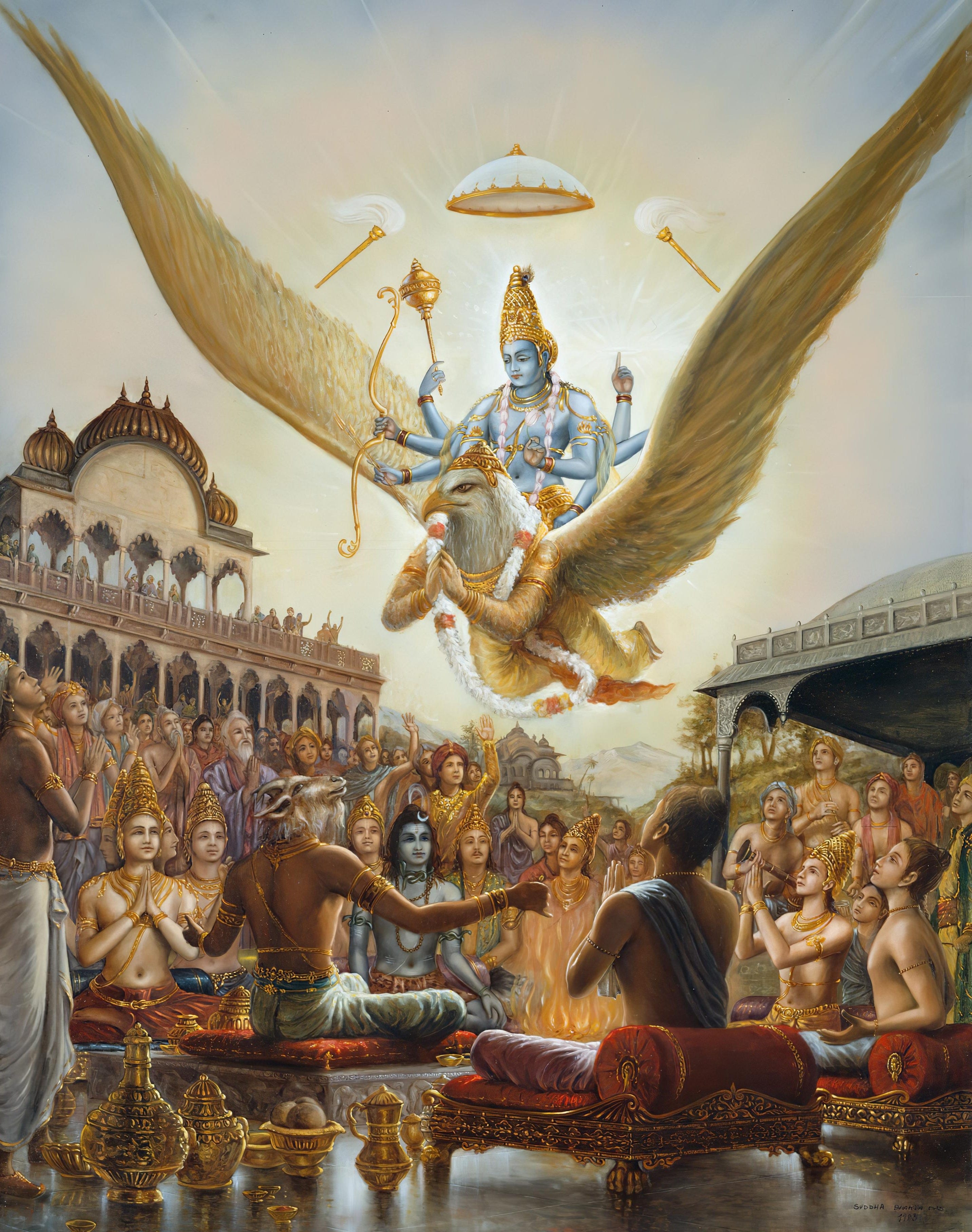
In the 4th canto of Śrīmad Bhāgavatam, there is an interesting passage where the leaders of different groups and species that inhabit different parts of our universe offer their sincere prayers to the Lord when He personally appears at the conclusion of the second sacrifice of Daksa.
This is the same sacrifice that had been previously frustrated due to the offenses he committed against Lord Śiva. Because of these offenses, Satī left her body; the sacrifice was stormed by Vīrabhadra and the other followers of Lord Śiva, Daksa lost his head, and so on. However, after the demigods begged forgiveness for their offenses, Daksa was revived with the head of a goat, the arena was purified, and the sacrifice was resumed. This time, the Lord appeared personally to instruct Daksa.
The glories of the Lord are unlimited, and therefore it’s not possible for anyone to fully describe them. As the Lord appeared in the arena, all the demigods, sages, and others present offered their dandavats and prepared to glorify the Lord according to their respective capacities.
These prayers give us an insight into how the Lord is understood by different inhabitants of the universe.
a) Daksa, who is mainly involved in fruitive sacrifices, shares his realization that the Lord can’t be understood by the use of material intelligence and philosophical speculation. The Lord is fully transcendental and beyond the comprehension of materialists.
b) The brāhmaṇas engaged in performing the sacrifice lament their own attachment to fruitive activities and their incapacity to properly understand the Lord. Engaged in performing rituals according to the direction of the scriptures, they see the Lord as the initiator of this system of Vedic sacrifices. They thus confess their incapacity to fully understand Him.
c) The members of the assembly described the Lord as the deliverer of all suffering souls entangled in the constant dangers of material life. They describe material life as a formidable fort from which it is very difficult to escape. This fort is full of ditches of material happiness and distress, which keep the soul bound to the mirage of material joy and the fire of lamentation, both always present. There are many ferocious animals always ready to attack, causing one pain, and the snake of time is always looking for an opportunity to strike, bringing unavoidable death. People live in this cycle of birth and death, overburdened by the performance of their material duties, or in an even worse situation, by not performing them. They could very easily become free from this entanglement if they would simply surrender to the Lord, but unfortunately, there is no information on when they may do so.
d) Bhṛgu Muni expresses that under the influence of material energy, everyone in the material world is in ignorance of their constitutional position. Seeing themselves as the body, they fail to see the Lord present in the heart of everyone as the Supersoul, and thus they commit violence against others. He refers to the Lord as the friend and protector of all surrendered souls, and thus asks Him to forgive them for all offenses they had committed.
e) Brahma mentions that the Lord is transcendental and thus can’t be understood by people using their material intelligence or different material processes for obtaining knowledge. Indirectly, he points to the process of devotional service as the only means to obtain perfect knowledge about the Lord, as confirmed by many other passages of the Srimad Bhāgavatam.
f) Lord Vishnu appeared in the arena in a form displaying eight hands, instead of the usual four. Indra glorified His form in his prayers, mentioning that this form was very pleasing to the mind and eyes and appeared for the welfare of the entire universe. Brahma mentioned in his prayers that realizing the transcendental form of the Lord is beyond the power of the senses, and Indra added that even though the transcendental form of the Lord is not perceivable by the material senses, when He appears in this world as an incarnation, His form, activities, and uncommon beauty can be appreciated even by common men.
g) The wives of the Brāhmaṇas prayed for the Lord to bring back to life the sacrificial animals killed during the storming of the arena and restore the sanctity of the place. In Vedic sacrifices, animals are routinely killed to test the efficacy of the mantras, but since these animals are immediately brought back to life in a rejuvenated state, the scene is pleasing. However, after the attack, animals were lying dead everywhere like in a crematorium, something the Lord could easily fix.
h) The Lord processes unlimited potencies, and through them He executes wonderful activities, but He is, however, completely unattached from both the activities and potencies, and in fact He is not even attached to the goddess of fortune, who offers Him so many services and is so exalted, prayed the sages. The central point is that the Lord is different from conditioned living entities who are attached to material results.
i) The inhabitants of Siddhaloka prayed that although they possess all mystic perfections, they find real pleasure in discussing the Lord's transcendental pastimes, just like an elephant scorched by a forest fire forgets his misery by entering into a river. In this way, they confirm the superexcellence of the transcendental form of the Lord, who is capable of attracting all classes of transcendentalists.
j) Prasūti, the wife of Daksa, also prayed to the Lord, mentioning that the sacrificial arena was not beautiful without Him, just as a body without the head. This simple prayer reveals a very deep meaning: anything performed without Krsna consciousness has no value. Daksa had previously excluded Lord Śiva from the sacrifice, and thus the Lord also refused to attend, and the sacrifice was a fiasco. Similarly, all activities of a materialist, or of a materialistic society, simply lead to ultimate destruction if performed without connection to the Lord. Indirectly, she also implored the Lord to turn the priests into Vaishnavas instead of simply fruitive workers performing fruitive sacrifices.
k) The governors of different planets revealed their incapacity to perceive the transcendental form of the Lord. Enjoying their senses in great opulence, they can’t see beyond the cosmic manifestation, and even when the Lord appears as an incarnation, they think He appears as a product of the material world. However, they question their own intelligence by doubting the correctness of their understanding, concluding that, being the Lord the possessor of the universe, He must be different from his own creation, beyond the five material elements.
l) The great mystics emphasized the protection of the Lord to His devotees, mentioning that the Lord is always inclined in their favor. Yogis generally meditate on the Lord as Paramātmā, and frequently become Brahmavādīs, understanding that they are one with the Lord in quality, but not being able to fully understand His opulences and activities. However, because they always think of the Lord with faith, understanding they are His eternal servants, the Lord favors them, different from Māyāvādīs and mental speculators, who are condemned.
m) The personified Vedas, the predominating deities of Vedic knowledge, prayed that the Lord is the shelter of the mode of goodness, and the source of all religious principles and good qualities. Although conditioned souls can’t understand the Lord, by following these principles and accepting the shelter of the mode of goodness, we can gradually ascend to the platform of devotional service, and thus gradually come to understand our own position and the transcendental position of the Lord.
n) Agni, the fire-god, reveals his realization of the Lord being the source of his powers. Acting as a servant of the Lord, he accepts the offerings of ghee and other ingredients offered to the fire in Vedic sacrifices. These offerings are nothing more than the energy of the Lord, and the essence of the whole arrangement is the worship of the Lord, who is the personification of all sacrifice.
o) The demigods reiterated their position as the servants of the Lord and prayed for His protection. In this way, they reinforced the idea that any type of worship should be performed only for the Lord. Instead of wasting time worshiping demigods separately, one should go directly to the Lord and ask whatever he needs, be he full of material desires, without material desires of hoping for liberation.
p) The Gandharvas, the celestial musicians who perform for the demigods, acknowledged that although the demigods may occupy positions of authority, they are not supreme. Real supremacy belongs to Krsna, and all others are just plenary portions or part of plenary portions of Him. Even great demigods such as Lord Brahma are just limbs of the universal form of the Lord created from His external potency.
q) The Vidyādharas mentioned that the human form is meant to perform devotional service and thus attain the highest perfection, but people miss the opportunity by being concerned only with sense gratification, attracted to the temporary. This happens under the spell of the material energy, which overpowers the soul. However, one can be saved from this illusion by simply hearing and chanting the glories of the Lord.
r) The Brāhmaṇas stated that the Lord is everything, and that therefore all the ingredients of the sacrifice, including themselves as the priests, are parts and parcels of the Lord. Just as fire, although situated in one place, emanates light and heat, everything is in the Lord, although the Lord is not in everything. The form of the Lord is also not different from the Vedas, and therefore anyone who is fully engaged in worshiping the transcendental form of the Lord is understood to be studying all the Vedas twenty-four hours a day. They then concluded the prayers by revealing their desire to continue the performance of sacrifice and their hope that with the presence of the Lord, they would be able to conclude the sacrifice without impediment.
You can also donate using Buy Me a Coffee, PayPal, Wise, Revolut, or bank transfers. There is a separate page with all the links. This helps me enormously to have time to write instead of doing other things to make a living. Thanks!