

Subscribe to receive new articles by e-mail. It’s free, but if you like, you can pledge a donation:
🔉 Audio of the lesson »
🎙Podcast (Search for “Mysteries of the Vedas” on Spotify, iTunes, etc. to hear all the lessons
Join the Telegram group if you would like to join the live lessons. This course is maintained with your donations. Click here to donate.
💬 Text of the lesson
The lifestyle and opulence of the inhabitants of Jambūdvīpa
“On the side of Supārśva Mountain stands a big tree called Mahākadamba, which is very celebrated. From the hollows of this tree flow five rivers of honey, each about five vyāmas wide. This flowing honey falls incessantly from the top of Supārśva Mountain and flows all around Ilāvṛta-varṣa, beginning from the western side. Thus the whole land is saturated with the pleasing fragrance. The air carrying the scent from the mouths of those who drink that honey perfumes the land for a hundred yojanas around.” (SB 5.16.22-23)
To the west, a complex of five rivers of celestial honey flows from the great kadamba tree situated on top of Supārśva Mountain. These five rivers flow around the whole Ilāvṛta-varṣa. The special characteristic of this honey is a very pleasing fragrance that perfumes not only the environment, but also the bodies of the inhabitants of these places. Instead of depending on artificial perfumes and cosmetics, they maintain their beauty in attractiveness by simply consuming the products of their celestial abode.
“Similarly, on Kumuda Mountain there is a great banyan tree, which is called Śatavalśa because it has a hundred main branches. From those branches come many roots, from which many rivers are flowing. These rivers flow down from the top of the mountain to the northern side of Ilāvṛta-varṣa for the benefit of those who live there. Because of these flowing rivers, all the people have ample supplies of milk, yogurt, honey, clarified butter [ghee], molasses, food grains, clothes, bedding, sitting places and ornaments. All the objects they desire are sufficiently supplied for their prosperity, and therefore they are very happy.” (SB 5.16.24)
The great banyan tree on top of Kumuda Mountain is the source of many rivers, which are described as “kāma-dughāḥ” (fulfilling all desires). The verse lists a long list of desirable items (milk, yogurt, honey, ghee, molasses, grains, clothing, bedding, seats, ornaments, etc.) that are directly connected with these rivers. This appears to indicate that these rivers are the direct source of all these objects, which are supplied for the happiness and prosperity of the inhabitants of Ilāvṛta-varṣa. In other words, these rivers are like kalpa-vṛkṣa trees that supply everything desirable. In this way, no one there has to work to obtain all the necessities of life.
In his purport, Prabhupāda connects it with our reality, stating that natural products such as foodstuffs, clothes, etc., are the real necessities of life, and not industrial production. Food can be produced from agriculture, and clothes can be manufactured from natural fibers. By following this simple, natural process, starting from the performance of sacrifices, we can have peaceful and happy lives, just as the inhabitants of Ilāvṛta-varṣa.
As he mentions:
“The prosperity of humanity does not depend on a demoniac civilization that has no culture and no knowledge but has only gigantic skyscrapers and huge automobiles always rushing down the highways. The products of nature are sufficient. When there is a profuse supply of milk, yogurt, honey, food grains, ghee, molasses, dhotis, saris, bedding, sitting places and ornaments, the residents are actually opulent. When a profuse supply of water from the river inundates the land, all these things can be produced, and there will not be scarcity. This all depends, however, on the performance of sacrifice as described in the Vedic literature.”
We come then to the next verse:
“The residents of the material world who enjoy the products of these flowing rivers have no wrinkles on their bodies and no grey hair. They never feel fatigue, and perspiration does not give their bodies a bad odor. They are not afflicted by old age, disease or untimely death, they do not suffer from chilly cold or scorching heat, nor do their bodies lose their luster. They all live very happily, without anxieties, until death.” (SB 5.16.25)
The literal meaning of this verse is that by consuming these products supplied by these rivers, the inhabitants of Ilāvṛta-varṣa remain young, strong, and attractive for the entire duration of their lives. They don’t feel fatigue, have no bad bodily odors, and so on. They have long lives and remain happy and without anxiety until the end.
There is a higher meaning, however, that is invoked by Prabhupāda in his purport: An artificial lifestyle reduces our standard of living instead of increasing it. Modern life brought more stress and anxiety, which diminishes our perception of happiness. Artificial food diminishes our vitality and invokes disease, and toxic substances such as alcohol degrade our consciousness, produce bad body odors, and so on. Natural food and natural living, on the other hand, bring us closer to the celestial standard of living of the inhabitants of Ilāvṛta-varṣa.
As Prabhupāda phrases it:
“This verse hints at the perfection of human society even within this material world. The miserable conditions of this material world can be corrected by a sufficient supply of milk, yogurt, honey, ghee, molasses, food grains, ornaments, bedding, sitting places and so on. This is human civilization. Ample food grains can be produced through agricultural enterprises, and profuse supplies of milk, yogurt and ghee can be arranged through cow protection. Abundant honey can be obtained if the forests are protected. Unfortunately, in modern civilization, men are busy killing the cows that are the source of yogurt, milk and ghee, they are cutting down all the trees that supply honey, and they are opening factories to manufacture nuts, bolts, automobiles and wine instead of engaging in agriculture. How can the people be happy? They must suffer from all the misery of materialism. Their bodies become wrinkled and gradually deteriorate until they become almost like dwarves, and a bad odor emanates from their bodies because of unclean perspiration resulting from eating all kinds of nasty things. This is not human civilization. If people actually want happiness in this life and want to prepare for the best in the next life, they must adopt a Vedic civilization. In a Vedic civilization, there is a full supply of all the necessities mentioned above.”
The description continues:
“There are other mountains beautifully arranged around the foot of Mount Meru like the filaments around the whorl of a lotus flower. Their names are Kuraṅga, Kurara, Kusumbha, Vaikaṅka, Trikūṭa, Śiśira, Pataṅga, Rucaka, Niṣadha, Sinīvāsa, Kapila, Śaṅkha, Vaidūrya, Jārudhi, Haṁsa, Ṛṣabha, Nāga, Kālañjara and Nārada.
On the eastern side of Sumeru Mountain are two mountains named Jaṭhara and Devakūṭa, which extend to the north and south for 18,000 yojanas [144,000 miles]. Similarly, on the western side of Sumeru are two mountains named Pavana and Pāriyātra, which also extend north and south for the same distance. On the southern side of Sumeru are two mountains named Kailāsa and Karavīra, which extend east and west for 18,000 yojanas, and on the northern side of Sumeru, extending for the same distance east and west, are two mountains named Triśṛṅga and Makara. The width and height of all these mountains is 2,000 yojanas [16,000 miles]. Sumeru, a mountain of solid gold shining as brilliantly as fire, is surrounded by these eight mountains.” (SB 5.16.26-27)
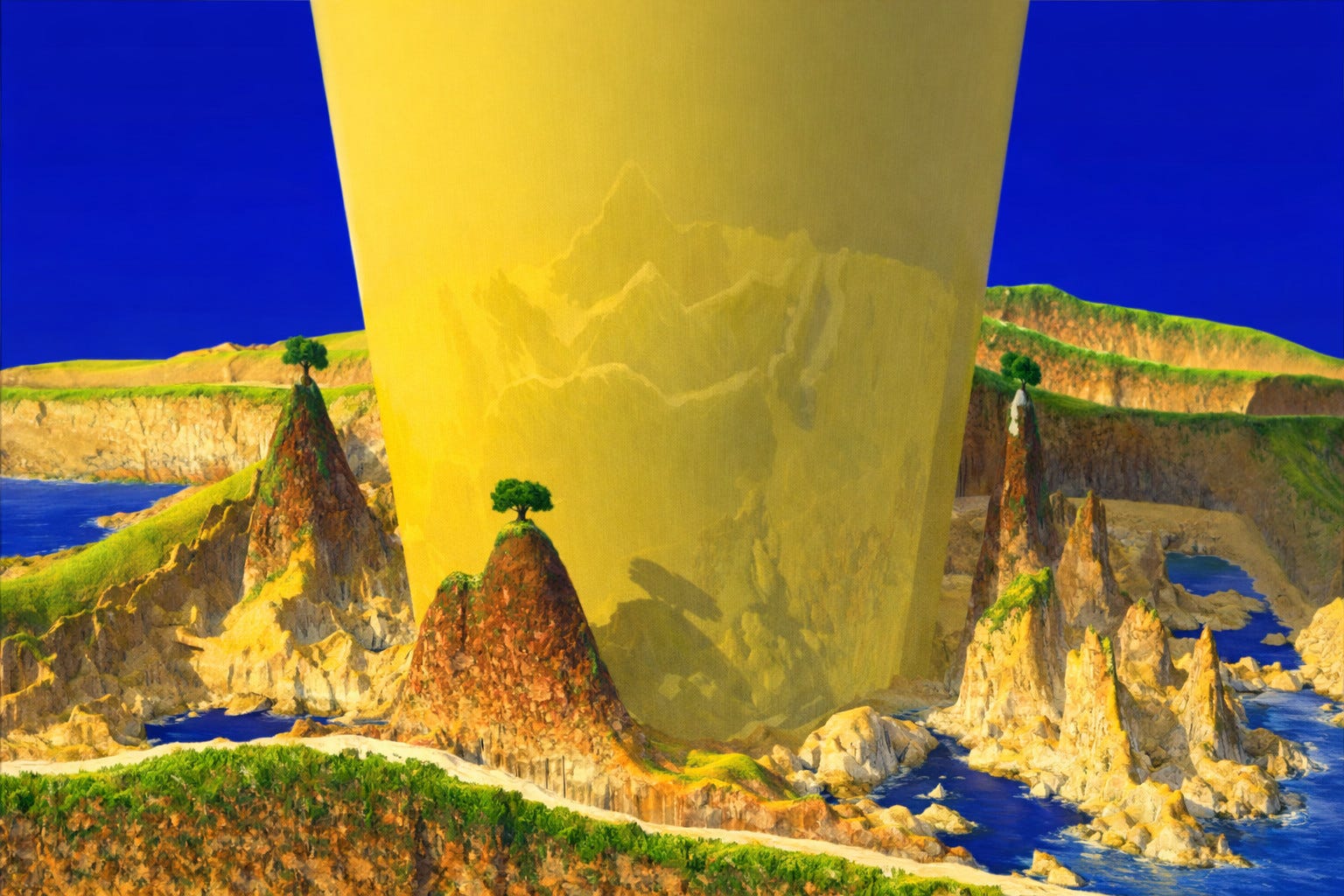
Sumeru Mountain is like the pericarp of the lotus-like Bhū-mandala. Apart from the four sustaining mountains, there are eight other great mountains around it in Ilāvṛta-varṣa, that are like the filaments around the pericarp in a lotus flower. This again emphasizes that this structure didn’t appear by chance: it is the deliberate creation of the Supreme Person, highlighting His artistic sense.
Text 5.17.5 adds to this description, mentioning that these mountains, collectively called Kesarācala (the filament mountains), are almost as tall as Mount Sumeru itself, looking exactly like the filaments around the pericarp of a lotus flower. In this way, the whole Bhū-mandala looks exactly like a lotus.
Although our planet is somehow part of this structure (being situated to the south of Jambūdvīpa, in the region of Bhārata-varṣa), we don’t have the necessary qualification to experience the other abodes. Just as prisoners are separated from the rest of society by high walls and can’t even see outside, we are isolated from the rest of Bhū-mandala, and can gain access only by reforming ourselves by following the precepts of the scriptures.
We are bound to our small planet by the law of gravity, a potency of Lord Ananta Śeṣa, and even if we try to escape using a spaceship, we can’t break free from the gross reality in which we live, and thus see only dust, rock, radiation, and extremes of temperature wherever we go.
Modern theorists interpret these hazards as signs that the universe appeared by chance, as a result of the interaction of mechanical physical laws, but the Vedas give another view: these are intentional features of the reality we live in, designed to discourage us from unlawful space exploration. It is perfectly possible for us to go to other planets and assume appropriate bodies to comfortably live there, but for that, we must follow the process given in the scriptures.
“In the middle of the summit of Meru is the township of Lord Brahmā. Each of its four sides is calculated to extend for ten million yojanas [eighty million miles]. It is made entirely of gold, and therefore learned scholars and sages call it Śātakaumbhī.
Surrounding Brahmapurī in all directions are the residences of the eight principal governors of the planetary systems, beginning with King Indra. These abodes are similar to Brahmapurī but are one fourth the size.” (SB 5.16.28-29)
In a lotus, the pericarp is dotted with small openings with seeds inside. Similarly, the top of Mount Sumeru, which has a width of 32,000 yojanas, is populated with the cities of Brahma and the principal demigods. Brahma’s city, called Śātakaumbhī, is at the center, and the cities of the demigods, one fourth in size, are positioned around it.
Prabhupāda gives the size for Brahmapurī in the summary of the chapter as 10,000 yojanas on each side, which fits the description of the summit of Sumeru being 32,000 yojanas in width. In the verse itself, however, he gives the measure of ten million yojanas. The Sanskrit itself is ambiguous, mentioning ayuta-yojana-sāhasrīṁ sama-caturasrāṁ, which can be translated as both ten million, literally, or as “ten thousands in size, thousands of yojanas on each side”.
Each of these demigods, starting with Brahma have their own planets, but these cities on top of Mount Sumeru function like administrative centers where they oversee the maintenance of the different varṣas that compose Bhū-mandala. They double as summer villas, where they can reside when they desire to enjoy the facilities offered by Ilāvṛta-varṣa and other parts of Bhū-mandala.
Does the description of Bhū-mandala indicate that the earth is flat?
We come then to a pressing question related to this description. Some take the description of Bhū-Mandala as meaning that the earth is flat, but it is a little more complicated than this.
Nowhere in the sastras is it directly stated that the earth, as the planet where we walk, is flat. This idea is purely interpretative, and contradict a number of direct passages. In the Surya-siddhanta (1.59), for example, which was commented on by Śrīla Bhaktisiddhānta Sarasvatī Thākura, it is mentioned:
yojanāni śatānyastau bhukarmo dviguṇānitu
tadvargato daśaguṇāt padam bhūparidhirbhavet“The earth’s diameter (bhukarna) is 1600 (2 x 800) yojanas. The square root of 10 times the square of earth’s diameter is earth’s circumference.”
As mentioned, there is no single fixed length for a yojana; different sources define it differently. In the Śrīmad Bhāgavatam, Prabhupāda takes the measure of the yojana as eight miles, which is consistent with the descriptions of the Puranas. It appears, however, that the Surya-siddhanta uses a different measure for the yojana, of about five miles. We can see that in this particular verse, the diameter of the Earth is given as 1600 yojanas. If we take the yojana as five miles, we have 8000 miles, which is extremely close to the 7,918 miles for the average diameter of the Earth in modern calculations. Similarly, the distances and circumference of the planets in the Surya-siddhanta match modern estimates closely when the yojana is taken as five miles. If we take it as slightly less, then the agreement becomes even closer. Similarly, the formula given for calculating the Earth’s circumference (the square root of 10 times the square of the Earth’s diameter) is very close to modern estimates.
The measure of the Earth’s diameter and circumference clearly indicates the earth we live on is a globe, which is consistently confirmed in other passages of the Surya-siddhanta and of the Puranas.
Śrīmad Bhāgavatam 5.21.9, for example, mentions:
yatrodeti tasya ha samāna-sūtra-nipāte nimlocati yatra kvacana syandenābhitapati tasya haiṣa samāna-sūtra-nipāte prasvāpayati tatra gataṁ na paśyanti ye taṁ samanupaśyeran
“People living in countries at points diametrically opposite to where the sun is first seen rising will see the sun setting, and if a straight line were drawn from a point where the sun is at midday, the people in countries at the opposite end of the line would be experiencing midnight. Similarly, if people residing where the sun is setting were to go to countries diametrically opposite, they would not see the sun in the same condition.”
This describes our practical experience on earth. When it is midday in Japan, it is midnight in Brazil, which is located on the diametrically opposite side of the globe. If the earth were flat, the sun would circle overhead, just as it does at the north pole.
We can also see that Prabhupāda consistently identifies the earth as a globe in his translations and commentaries of the Śrīmad Bhāgavatam. He even instructed his disciples to depict Varāhadeva lifting a spherical earth from the ocean to illustrate the third canto, where the pastime is described.
At the same time, however, there is the description of an extended earth, formed by the collective of all the intermediate planetary systems, called Bhū-Mandala. This is a gigantic flat structure of which the planet earth is part.
The orbit of the sun is perceived very differently by the inhabitants of this flat structure. See SB 5.21.8, for example:
tatratyānāṁ divasa-madhyaṅgata eva sadādityas tapati savyenācalaṁ dakṣiṇena karoti
“The living entities residing on Sumeru Mountain are always very warm, as at midday, because for them the sun is always overhead. Although the sun moves counterclockwise, facing the constellations, with Sumeru Mountain on its left, it also moves clockwise and appears to have the mountain on its right because it is influenced by the dakṣiṇāvarta wind.”
Different from us, the demigods living on top of the Sumeru Mountain always see the sun circling overhead and always feel its warmth. For them, there is no night, just as expected from a flat structure. If the earth were flat, it would be the same for us.
It is described that inhabitants of previous ages somehow had access to other parts of Bhū-mandala, but this is not possible for us. As inhabitants of Kali-yuga, all we have access to is our small and blue planet. Just because we can’t see something, however, it does not mean it doesn’t exist. I may not be able to see Kṛṣṇa’s pastimes when I go to Vṛndāvana, but it doesn’t mean they are not happening.
There are thus two cosmological models described in the Vedas: the cosmos of our practical experience, centered around our small planet, and the higher-dimensional universe experienced by demigods and other higher beings, which is centered around Bhū-Mandala, the extended earth, of which our planet is part.
Bhū-Mandala is composed of seven concentric islands, separated by concentric oceans. We just studied the central island, Jambūdvīpa, and there are six other islands around it.
It appears that each of the seven islands is somehow formed by several different planets. Earth, or Bharata-varṣa, comprises the southern part of Jambūdvīpa, separated from the rest by the higher-dimensional Himalayas. Some interpret our planet as not even the whole Bharata-varṣa, but just part of it, since the dimensions given for Bharata-varṣa are much greater than our planet.
The Descent of the River Ganges (chapter 5.17)
After describing Jambūdvīpa, which is the center of the intermediate planetary system of Bhū-mandala, Śukadeva Goswami describes the descent of the river Ganges, passing through the higher planets of the universe until reaching the top of Mount Sumeru, and from there, the other parts of Jambūdvīpa.
“Śukadeva Gosvāmī said: My dear King, Lord Viṣṇu, the enjoyer of all sacrifices, appeared as Vāmanadeva in the sacrificial arena of Bali Mahārāja. Then He extended His left foot to the end of the universe and pierced a hole in its covering with the nail of His big toe. Through the hole, the pure water of the Causal Ocean entered this universe as the Ganges River. Having washed the lotus feet of the Lord, which are covered with reddish powder, the water of the Ganges acquired a very beautiful pink color. Every living being can immediately purify his mind of material contamination by touching the transcendental water of the Ganges, yet its waters remain ever pure. Because the Ganges directly touches the lotus feet of the Lord before descending within this universe, she is known as Viṣṇupadī. Later she received other names like Jāhnavī and Bhāgīrathī. After one thousand millenniums, the water of the Ganges descended to Dhruvaloka, the topmost planet in this universe. Therefore all learned sages and scholars proclaim Dhruvaloka to be Viṣṇupada [“situated on Lord Viṣṇu’s lotus feet”].” (SB 5.17.1)
The pastime of Lord Vāmanadeva is described in detail in the Eighth Canto. Different from most of the pastimes described in the 3rd and 4th cantos (which happened in the first Manvantara), the descent of the river Ganges happened relatively recently in cosmic scale, at the beginning of the current manvantara (Vaivasvata).
At a certain point, having secured the blessings of the brāhmanas, Bali Maharaja was able to defeat the demigods and take possession of the celestial planets. Defeated, the demigods appealed to Lord Viṣnu, who appeared as Vāmanadeva, who is both a lila-avatāra and the current manvantara-avatāra.
This is described by Prabhupāda in his summary of the chapter:
“Lord Viṣṇu once approached Bali Mahārāja while the King was performing a sacrifice. The Lord appeared before him as Trivikrama, or Vāmana, and begged alms from the King in the form of three steps of land. With two steps, Lord Vāmana covered all three planetary systems and pierced the covering of the universe with the toes of His left foot. A few drops of water from the Causal Ocean leaked through this hole and fell on the head of Lord Śiva, where they remained for one thousand millenniums. These drops of water are the sacred Ganges River. It first flows onto the heavenly planets, which are located on the soles of Lord Viṣṇu’s feet. The Ganges River is known by many names, such as the Bhāgīrathī and the Jāhnavī. It purifies Dhruvaloka and the planets of the seven sages because both Dhruva and the sages have no other desire than to serve the Lord’s lotus feet.”
Vāmanadeva covered the whole universe with two steps by increasing His size. The Lord can be simultaneously the smallest and the biggest. With the first step, he covered the entire surface of the earth, and when he raised his foot to take his second step, his foot hit the coverings of the universe and opened a crack through which the water of the causal ocean leaked inside. It is described that “a few drops” of the causal ocean entered the universe, but this is from the perspective of someone almost as big as the universe itself.
Each material universe is like a coconut, with a hollow central part half-filled with water and surrounded by seven coverings. Outside of these coverings are the spiritual waters of the causal ocean, where Lord Mahā-Viṣṇu stays. This water is pure in itself, but it became even more sacred after touching the lotus feet of the Lord, becoming the transcendental river Ganges.
This stream of water then falls through the universe, reaching Svargaloka and then Bhū-Mandala after passing through Dhruvaloka (the Polestar). Dhruvaloka is described in the verse as the topmost planet in this universe, because it is a Vaikuṇṭha planet, and the abode of the Lord. Geographically speaking, however, Dhruvaloka is situated above Svargaloka and the Saptarṣi constellation (the seven sages), but below the planetary systems of Maharloka, Janaloka, Tapoloka, and Satyaloka.
The verse also describes that the waters take a long time to cross the universe and reach Dhruvaloka, and Prabhupāda adds in his introduction to the chapter that the waters fall first on the head of Lord Śiva, before reaching there. Later in the Śrīmad Bhāgavatam (9.9.9), another pastime is described, when Lord Śiva agrees to absorb the impact of the waters when they reach our planet. It seems thus that Lord Śiva is involved in both steps.
Another detail to consider is that text 5.17.1 describes that the water took one thousand millenniums to reach Dhruvaloka (ati-mahatā kālena yuga-sahasra-upalakṣaṇena: after a long time, consisting of one thousand yugas). This appears to just indicate a long time, since one thousand yugas, taken literally, mean a full day of Brahma.
“Dhruva Mahārāja, the famous son of Mahārāja Uttānapāda, is known as the most exalted devotee of the Supreme Lord because of his firm determination in executing devotional service. Knowing that the sacred Ganges water washes the lotus feet of Lord Viṣṇu, Dhruva Mahārāja, situated on his own planet, to this very day accepts that water on his head with great devotion. Because he constantly thinks of Kṛṣṇa very devoutly within the core of his heart, he is overcome with ecstatic anxiety. Tears flow from his half-open eyes, and eruptions appear on his entire body.
The seven great sages [Marīci, Vasiṣṭha, Atri and so on] reside on planets beneath Dhruvaloka. Well aware of the influence of the water of the Ganges, to this day they keep Ganges water on the tufts of hair on their heads. They have concluded that this is the ultimate wealth, the perfection of all austerities, and the best means of prosecuting transcendental life. Having obtained uninterrupted devotional service to the Supreme Personality of Godhead, they neglect all other beneficial processes like religion, economic development, sense gratification and even merging into the Supreme. Just as jñānīs think that merging into the existence of the Lord is the highest truth, these seven exalted personalities accept devotional service as the perfection of life.” (SB 5.17.2-3)
These two verses describe the spiritual potency of the water of the Ganges, whose waters are accepted by both Dhruva and the sages with great respect. Because these great sages keep the water on the tufts of hair on their heads with such great respect, they obtain uninterrupted devotional service to the Lord, and lose interest in the materialistic process of karma-kanda and economic development, culminating in impersonal liberation.
This shows how the waters are spiritually powerful. If even such great sages derive such great benefit, what to say about us? This also reveals the true benefit of bathing in the Ganges: ultimately, it’s not just about becoming free of sins, but attaining pure devotional service to the Lord.
“After purifying the seven planets near Dhruvaloka [the polestar], the Ganges water is carried through the spaceways of the demigods in billions of celestial airplanes. Then it inundates the moon [Candraloka] and finally reaches Lord Brahmā’s abode atop Mount Meru.” (SB 5.17.4)
Dhruvaloka and the abode of the Seven Ṛṣis are far above Svargaloka (which starts from the sun, which is 100,000 yojanas above our planet). In his purport to SB 5.23.9, Prabhupāda gives the distances: “Viśvanātha Cakravartī Ṭhākura estimates that Dhruvaloka, the polestar, is 3,800,000 yojanas above the sun. Above Dhruvaloka by 10,000,000 yojanas is Maharloka, above Maharloka by 20,000,000 yojanas is Janaloka, above Janaloka by 80,000,000 yojanas is Tapoloka, and above Tapoloka by 120,000,000 yojanas is Satyaloka.”
How to make a river flow through space over such a great distance? The solution found by the demigods is to carry the waters on their vimānas. The verse mentions that an army of thousands and millions of vimānas (sahasra-koṭi-vimānānīka) is constantly engaged in this service of carrying the waters of the Ganges all the way to Candra-loka (the moon). From there, the water flows into Brahmapurī, the abode of Lord Brahma on top of Mount Meru.
Prabhupāda describes the whole process in his purport:
“We should always remember that the Ganges River comes from the Causal Ocean, beyond the covering of the universe. After the water of the Causal Ocean leaks through the hole created by Lord Vāmanadeva, it flows down to Dhruvaloka (the polestar) and then to the seven planets beneath Dhruvaloka. Then it is carried to the moon by innumerable celestial airplanes, and then it falls to the top of Mount Meru, which is known as Sumeru-parvata. In this way, the water of the Ganges finally reaches the lower planets and the peaks of the Himālayas, and from there it flows through Hardwar and throughout the plains of India, purifying the entire land. How the Ganges water reaches the various planets from the top of the universe is explained herein. Celestial airplanes carry the water from the planets of the sages to other planets.”
The next verses describe how the waters of the Ganges flow into the different tracts of land in Jambūdvīpa, including our planet:
“On top of Mount Meru, the Ganges divides into four branches, each of which gushes in a different direction [east, west, north and south]. These branches, known by the names Sītā, Alakanandā, Cakṣu and Bhadrā, flow down to the ocean.
The branch of the Ganges known as the Sītā flows through Brahmapurī atop Mount Meru, and from there it runs down to the nearby peaks of the Kesarācala Mountains, which stand almost as high as Mount Meru itself. These mountains are like a bunch of filaments around Mount Meru. From the Kesarācala Mountains, the Ganges falls to the peak of Gandhamādana Mountain and then flows into the land of Bhadrāśva-varṣa. Finally it reaches the ocean of salt water in the west.
The branch of the Ganges known as Cakṣu falls onto the summit of Mālyavān Mountain and from there cascades onto the land of Ketumāla-varṣa. The Ganges flows incessantly through Ketumāla-varṣa and in this way also reaches the ocean of salt water in the west.
The branch of the Ganges known as Bhadrā flows from the northern side of Mount Meru. Its waters fall onto the peaks of Kumuda Mountain, Mount Nīla, Śveta Mountain and Śṛṅgavān Mountain in succession. Then it runs down into the province of Kuru and, after crossing through that land, flows into the saltwater ocean in the north.
Similarly, the branch of the Ganges known as Alakanandā flows from the southern side of Brahmapurī [Brahma-sadana]. Passing over the tops of mountains in various lands, it falls down with fierce force upon the peaks of the mountains Hemakūṭa and Himakūṭa. After inundating the tops of those mountains, the Ganges falls down onto the tract of land known as Bhārata-varṣa, which she also inundates. Then the Ganges flows into the ocean of salt water in the south. Persons who come to bathe in this river are fortunate. It is not very difficult for them to achieve with every step the results of performing great sacrifices like the Rājasūya and Aśvamedha yajñas.
Many other rivers, both big and small, flow from the top of Mount Meru. These rivers are like daughters of the mountain, and they flow to the various tracts of land in hundreds of branches. (SB 5.17.5-10)
In Brahmapurī, the city of Lord Brahmā on top of Mount Sumeru, the waters of the Ganges divide into four streams, which go into the four directions, flowing through Bhadrāśva-varṣa to the east, Ketumāla-varṣa to the west, Ramyaka, Hiraṇmaya, and Uttarakuru to the north, and Hari-varṣa, Kimpuruṣa, and Bhārata-varṣa to the south. These four principal streams ramify into many, bathing many different tracts of land.
Just as the continents of our planet are surrounded by the ocean, Jambūdvīpa is surrounded by a salt ocean that has the same breadth as the island itself. Therefore, it is said that all these different streams of water flow into the salt ocean.
On our planet, the Ganges appears to originate from melted ice in the Himalayan region, but this is just the apparent cause. Somehow, the subtle waters flow from other regions of Bhū-mandala and mix with this gross water coming from the Himalayas, producing the river we can bathe in to become free from all material contamination.
This is a publication for thoughtful readers who want to go deeper into Kṛṣṇa consciousness. I publish daily, and all posts are available to free subscribers. If you wish, you can also choose a paid subscription to support this work. By subscribing, you also gain access to the manuscripts of the books I’m currently working on.
If you would like to contribute further, you can find the donation links here.