

Subscribe to receive new articles by e-mail. It’s free, but if you like, you can pledge a donation:
Join the Telegram group if you would like to join the live lessons. This course is maintained with your donations. Click here to donate.
💬 Text of the lesson
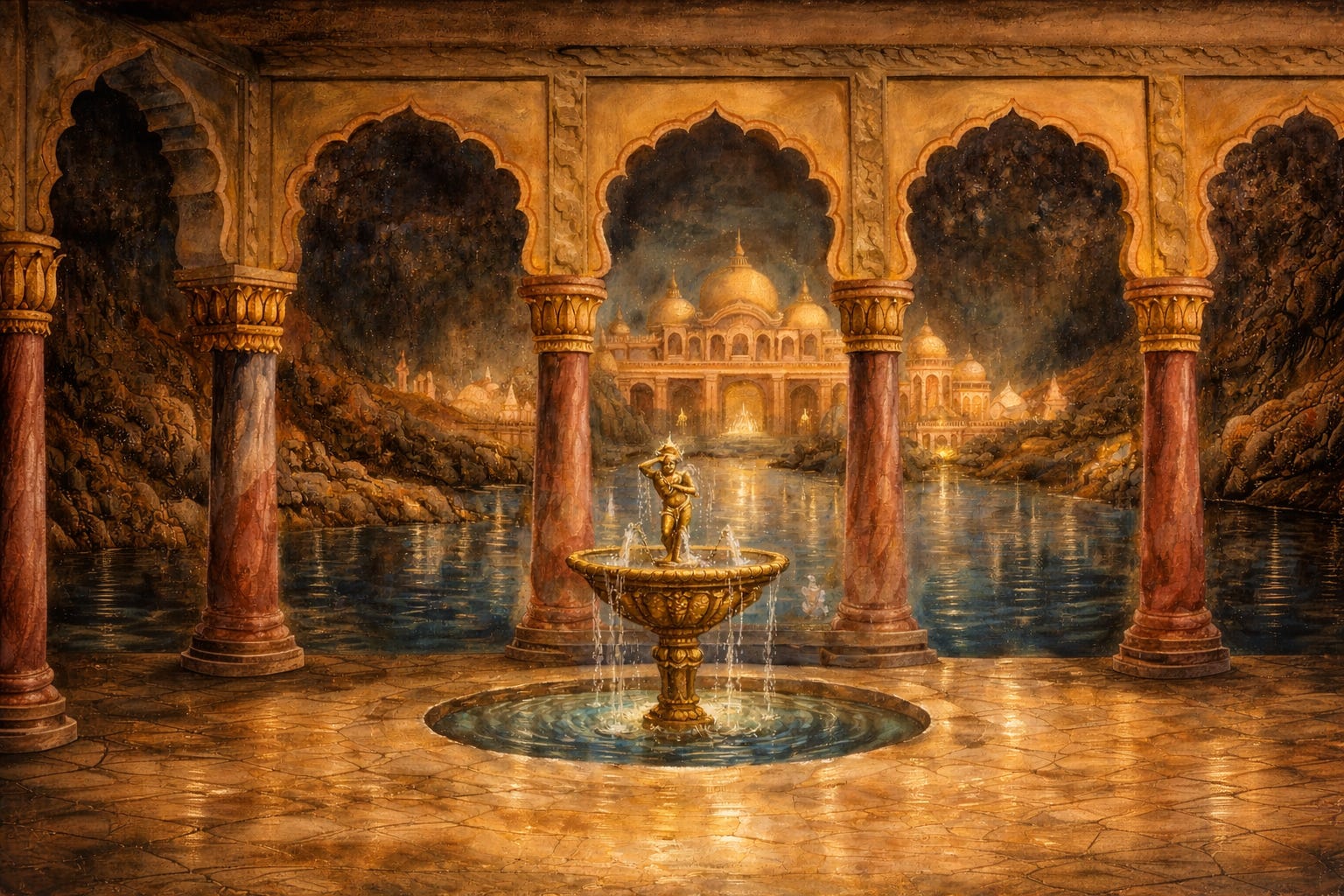
Atala, the abode of Bala
Being these lower planetary systems composed of many planets, they must surely contain all sorts of varied manifestations. However, the Śrīmad Bhāgavatam describes only a few prominent details. As in other passages, the main focus is not to give an academic presentation, but to elevate our consciousness, helping us to understand the shortcomings of this materialistic lifestyle.
“My dear King, now I shall describe to you the lower planetary systems, one by one, beginning from Atala. In Atala there is a demon, the son of Maya Dānava named Bala, who created ninety-six kinds of mystic power. Some so-called yogīs and svāmīs take advantage of this mystic power to cheat people even today. Simply by yawning, the demon Bala created three kinds of women, known as svairiṇī, kāmiṇī and puṁścalī. The svairiṇīs like to marry men from their own group, the kāmiṇīs marry men from any group, and the puṁścalīs change husbands one after another. If a man enters the planet of Atala, these women immediately capture him and induce him to drink an intoxicating beverage made with a drug known as hāṭaka [cannabis indica]. This intoxicant endows the man with great sexual prowess, of which the women take advantage for enjoyment. A woman will enchant him with attractive glances, intimate words, smiles of love and then embraces. In this way she induces him to enjoy sex with her to her full satisfaction. Because of his increased sexual power, the man thinks himself stronger than ten thousand elephants and considers himself most perfect. Indeed, illusioned and intoxicated by false pride, he thinks himself God, ignoring impending death.” (SB 5.24.16)
Maya Dānava has a very talented son called Bala, who creates the conditions for the enjoyment of the demons living in Atala, the first of the seven lower planetary systems.
Material enjoyment is based on two fundamental principles: control over matter and other people, and sexual life. To facilitate the first, Bala created ninety-six types of mystic illusory arts that are used by the inhabitants of Atala. Prabhupāda adds that these mystical powers are also used by yogīs and svāmīs to cheat their followers even on our planet, by producing gold and other magical feats.
Next, to facilitate their sexual enjoyment, he created three types of women that are easily accessible. Sexual enjoyment is the greatest allurement of material existence. The thrill of getting new partners one after the other keeps us completely absorbed in material existence, life after life. Another problem with sexual life, when practiced without a higher purpose, is that it is exploitative. The idea is to take something, to get enjoyment and other desirable things from the partner, and not to serve. The idea is to take instead of giving. To regulate it and control its negative aspects, the scriptures prescribe fidelity, chastity, modesty and other qualities and duties. The basic idea is that one should get a single partner for life and dedicate oneself to this relationship, instead of jumping here and there. Inside of this framework, we then try to develop spiritual principles, such as cooperating in spiritual practice, bringing Kṛṣṇa to the center, etc.
Responsible and religious men and chaste women are the basic foundation of this progressive lifestyle, therefore this is something demons want to demolish to establish their hedonistic lifestyle. We can see this at play in the creation of Bala. He created three types of seductive and manipulative women who keep men under their control, away from the goal of life. Using these women, he makes sure that the men in his dominions remain under illusion, far from the path of self-realization. The men think they are enjoying, but in reality they are just being used, their lusty desires turned against them, transformed into instruments for control.
This same dynamic can also be found in this planet, appearing whenever societies abandon the idea of pious marriages and go instead in the direction of hedonism. When this happens, this pattern of exploitation, sometimes on the part of the man, and sometimes from the part of the women, becomes prominent. The final result is that people become intoxicated by false pride and lose track of the goal of life.
Vitala
“The next planet below Atala is Vitala, wherein Lord Śiva, who is known as the master of gold mines, lives with his personal associates, the ghosts and similar living entities. Lord Śiva, as the progenitor, engages in sex with Bhavānī, the progenitress, to produce living entities, and from the mixture of their vital fluid the river named Hāṭakī is generated. When fire, being made to blaze by the wind, drinks of this river and then sizzles and spits it out, it produces gold called Hāṭaka. The demons who live on that planet with their wives decorate themselves with various ornaments made from that gold, and thus they live there very happily.” (SB 5.24.17)
Lord Śiva appears to be simultaneously present in several places in creation, associating with different sets of associates and performing different activities. Previously, it was mentioned that Lord Śiva lives in Ilāvṛta-varṣa, where he meditates on the Supreme Lord and have philosophical discussions with great devotees such as Nārada Muni and the four Kumāras. In that celestial abode, Bhavānī serves him with her billions of lady associates.
Now it is mentioned that Lord Śiva simultaneously lives in Vitala, where he gives association to the ghosts and other lower entities, thus creating a path for their deliverance. In this manifestation, Lord Śiva performs his duty of engaging in sex life with his consort to increase the population of living entities. This produces a river that is used by the inhabitants of this planetary system to produce huge quantities a type of gold.
Therefore, the two characteristics of Vitala mentioned in the description is the association of Lord Śiva as Bhūtanātha, the Lord of the spirits, and the presence of great material opulence, fruit of the almost unlimited quantity of gold available there.
In his purport, Prabhupāda connects this with another process of transformation: initiation. Just as the inhabitants of Vitala can produce unlimited quantities of gold, a pure devotee can produce Vaiṣnavas out of common men by initiating them on the spiritual path and engaging them in devotional service. As he mentions:
“As one can transform kaṁsa, or bell metal, into gold by treating it with mercury, one can also turn a lowborn man into a brāhmaṇa by initiating him properly into Vaiṣṇava activities.” The International Society for Krishna Consciousness is trying to turn mlecchas and yavanas into real brāhmaṇas by properly initiating them and stopping them from engaging in meat-eating, intoxication, illicit sex and gambling. One who stops these four principles of sinful activity and chants the Hare Kṛṣṇa mahā-mantra can certainly become a pure brāhmaṇa through the process of bona fide initiation, as suggested by Śrīla Sanātana Gosvāmī.”
Compared with the miracle of transforming a mleccha into a brāhmana, producing gold sounds trivial.
Sutala, the abode of Bali Mahārāja
“Below the planet Vitala is another planet, known as Sutala, where the great son of Mahārāja Virocana, Bali Mahārāja, who is celebrated as the most pious king, resides even now. For the welfare of Indra, the King of heaven, Lord Viṣṇu appeared in the form of a dwarf brahmacārī as the son of Aditi and tricked Bali Mahārāja by begging for only three paces of land but taking all the three worlds. Being very pleased with Bali Mahārāja for giving all his possessions, the Lord returned his kingdom and made him richer than the opulent King Indra. Even now, Bali Mahārāja engages in devotional service by worshiping the Supreme Personality of Godhead in the planet of Sutala.” (SB 5.24.18)
Ultimately, the Lord creates the material universes to give an opportunity for the conditioned souls to regain their original nature of service to Him. To fulfill this purpose, He sends His pure devotees to take birth in this place and spread the culture of love of Godhead.
Pure devotees are free to take birth anywhere, and some of them, such as Prahlāda Maharaja and Bali Mahārāja, are sent in special missions to give association to the demons living in the lower planetary systems.
Prahlāda Maharaja became the king of Sutala after Lord Nṛsiṁhadeva killed Hiraṇyakaśipu. Later, the throne was passed to Virocana and then to Bali, who eventually became the king of the three worlds after defeating the demigods. After donating the three planetary systems to Vāmanadeva, Bali Maharaja was reinstalled as the king of Sutala, where he continues to worship the Lord while living in great material opulence. Since he desired to control the celestial planetary system, he was blessed by the Lord to become the next Indra (in the 8th Manvantara), reigning over the celestial sphere without opposition for an entire Manvantara, before going back to Godhead. In the meantime, the Lord stays continuously with Him, serving him as his doorman.
Prabhupāda describes it beautifully in his purport:
“Bali Mahārāja offered everything to the Lord — his wealth, his kingdom and even his own body (sarvātma-nivedane baliḥ). The Lord appeared before Bali Mahārāja as a brāhmaṇa beggar, and Bali Mahārāja gave Him everything he had. However, Bali Mahārāja did not become poor; by donating all his possessions to the Supreme Personality of Godhead, he became a successful devotee and got everything back again with the blessings of the Lord. Similarly, those who give contributions to expand the activities of the Kṛṣṇa consciousness movement and to accomplish its objectives will never be losers; they will get their wealth back with the blessings of Lord Kṛṣṇa.”
Before progressing to the description of Talātala, the next planetary system, Śukadeva Goswami uses the next nine verses to describe the glories of Bali Maharaja, who spreads the glories of the Lord amongst the demons, giving them the opportunity to also come to the platform of devotional service to the Lord.
“My dear King, Bali Mahārāja donated all his possessions to the Supreme Personality of Godhead, Vāmanadeva, but one should certainly not conclude that he achieved his great worldly opulence in bila-svarga as a result of his charitable disposition. The Supreme Personality of Godhead, who is the source of life for all living entities, lives within everyone as the friendly Supersoul, and under His direction a living entity enjoys or suffers in the material world. Greatly appreciating the transcendental qualities of the Lord, Bali Mahārāja offered everything at His lotus feet. His purpose, however, was not to gain anything material, but to become a pure devotee. For a pure devotee, the door of liberation is automatically opened. One should not think that Bali Mahārāja was given so much material opulence merely because of his charity. When one becomes a pure devotee in love, he may also be blessed with a good material position by the will of the Supreme Lord. However, one should not mistakenly think that the material opulence of a devotee is the result of his devotional service. The real result of devotional service is the awakening of pure love for the Supreme Personality of Godhead, which continues under all circumstances.
If one who is embarrassed by hunger or who falls down or stumbles chants the holy name of the Lord even once, willingly or unwillingly, he is immediately freed from the reactions of his past deeds. Karmīs entangled in material activities face many difficulties in the practice of mystic yoga and other endeavors to achieve that same freedom.” (SB 5.24.19)
Bali Maharaja was a disciple of Śukrācārya, the seminal guru of the demons. Śukrācārya certainly instructed him in politics, fruitive activities and so on. However, Bali Maharaja understood that everything should be offered to Lord Viṣnu. When the Lord appeared before him as Vāmanadeva, Śukrācārya revealed his true face, telling Bali to withdraw his promise of giving Him three steps of land and justify it politically. Bali, however, was determined to surrender everything to the Lord and rejected the so-called guru. Bali Maharaja became thus a perfect devotee, accepted as one of the twelve Mahājanas.
Being reinstalled as the ruler of Sutala and being scheduled to become the next Indra are not results of Bali having surrendered his possessions. These are just token blessings from the Lord because of his previous material desires, just as Dhruva Maharaja became a king after his father. The real result is his pure love of Godhead. This pure love, in turn, makes the Lord never desire to leave his company.
As Prabhupāda explains in his purport to text 20:
“A devotee automatically attains liberation without separate endeavors. Bali Mahārāja did not get back all his material possessions merely because of his charity to the Lord. One who becomes a devotee, free from material desires and motives, regards all opportunities, both material and spiritual, as benedictions from the Lord, and in this way his service to the Lord is never hampered. Bhukti, material enjoyment, and mukti, liberation, are only by-products of devotional service.”
This brings us to the next verse:
“The Supreme Personality of Godhead, who is situated in everyone’s heart as the Supersoul, sells Himself to His devotees such as Nārada Muni. In other words, the Lord gives pure love to such devotees and gives Himself to those who love Him purely. Great, self-realized mystic yogīs such as the four Kumāras also derive great transcendental bliss from realizing the Supersoul within themselves.
The Supreme Personality of Godhead did not award His mercy to Bali Mahārāja by giving him material happiness and opulence, for these make one forget loving service to the Lord. The result of material opulence is that one can no longer absorb his mind in the Supreme Personality of Godhead.” (SB 5.22.21-22)
In his purport to text 22, Prabhupāda explains:
“There are two kinds of opulence. One, which results from one’s karma, is material, whereas the other is spiritual. A surrendered soul who fully depends upon the Supreme Personality of Godhead does not want material opulence for sense gratification. Therefore when a pure devotee is seen to possess exalted material opulence, it is not due to his karma. Rather, it is due to his bhakti. In other words, he is in that position because the Supreme Lord wants him to execute service to Him very easily and opulently.”
Material opulence that comes as a result of ordinary karma is often an obstacle to the practice of devotional service, because it tends to make us forget Kṛṣṇa. Therefore, when a devotee is especially sincere, the Lord often takes such material opulence away, so the devotee can advance swiftly. As Prabhupāda mentions, when a neophyte devotee is materially opulent, he forgets the service of the Lord.
There is, however, another type of opulence that is directly given by the Lord for pure devotees who are ready to engage it in His service. By engaging these material facilities, these pure devotees can then expand their devotional service to the Lord. Prabhupāda thus concludes that the material opulences offered to Bali Maharaja, in becoming even more opulent than the demigods as the ruler of the Sutala planetary system, are not material.
At first, it appears that there is a contradiction in the verse, since the verse says that the Lord did not award His mercy to Bali Mahārāja by giving him material happiness and opulence, when in fact He did, but this apparent contradiction is solved when we examine it from the perspective of these two types of opulence:
a) The Lord, in fact, didn’t give material opulence to Bali; He gave him spiritual opulences.
b) These opulences were not given as a result of his charity, as in ordinary karma. They were given because of his love and devotion.
c) They were not given to Bali to increase his material happiness (which is an obstacle to pure devotional service). They were given to facilitate his devotional service.
d) In this way, Bali’s opulence in Sutala is simply to facilitate his devotional service. This spiritual opulence given by the Lord is free from material inebriety. In other words, this opulence of Bali Maharaja does not manifest from the illusory potency; it manifests from yoga-maya, the spiritual potency that connects us with Kṛṣṇa.
e) Even this spiritual opulence is not the real gift. The real result is pure devotional service. The opulence is just to facilitate that.
“When the Supreme Personality of Godhead could see no other means of taking everything away from Bali Mahārāja, He adopted the trick of begging from him and took away all the three worlds. Thus only his body was left, but the Lord was still not satisfied. He arrested Bali Mahārāja, bound him with the ropes of Varuṇa and threw him in a cave in a mountain. Nevertheless, although all his property was taken and he was thrown into a cave, Bali Mahārāja was such a great devotee that he spoke as follows.
Alas, how pitiable it is for Indra, the King of heaven, that although he is very learned and powerful and although he chose Bṛhaspati as his prime minister to instruct him, he is completely ignorant concerning spiritual advancement. Bṛhaspati is also unintelligent because he did not properly instruct his disciple Indra. Lord Vāmanadeva was standing at Indra’s door, but King Indra, instead of begging Him for an opportunity to render transcendental loving service, engaged Him in asking me for alms to gain the three worlds for his sense gratification. Sovereignty over the three worlds is very insignificant because whatever material opulence one may possess lasts only for an age of Manu, which is but a tiny fraction of endless time.” (SB 5.24.23-24)
The traditional process for testing the purity of gold is to rub it against a testing stone. When gold is pure, it is quite soft, and when rubbed, it would leave a golden mark on the stone. Kṛṣṇa is sometimes compared to a testing stone, because He sometimes tests His devotees to show their devotion. Why does He do that? For two purposes: to show the extent of the devotion of His pure devotees, giving the example to others, and to glorify His devotees, making their fame well known all over the universe. We can see that we still draw inspiration from the stories of the Pandavas, Prahlāda Maharaja, and so on, devotees who went through this rubbing treatment and demonstrated the extent of their devotion.
Because Vāmanadeva wanted Bali to show the real extent of his devotion, He didn’t become satisfied when Bali surrendered his possessions and even his own body. To show the extent of Bali’s devotional sentiments, he bound him with ropes and threw him inside a mountain cave, just as an ordinary prisoner. Bali, however, didn’t protest. He felt fortunate for receiving the reciprocation of the Lord and instead felt pity for Indra, who, instead of asking the Lord for pure devotional service, engaged Him in getting the three planetary systems back.
The first verse mentions that Kṛṣṇa could see no other means of taking everything away from Bali Mahārāja. What does it mean? When Hiraṇyakaśipu took heaven away from the demigods and threatened Prahlāda, Kṛṣṇa appeared as Nṛsiṁhadeva to kill him. However, Bali is a pure devotee; therefore, Kṛṣṇa can’t fight him due to affection. The only way left to give back the three planetary systems to the demigods was to appear in the form of a brāhmana and beg it from him.
As Vāmanadeva, the Lord appeared as the son of Aditi, the brother of Indra. Instead of asking for pure devotional service, however, the demigods engaged him in getting the three worlds back from Bali Maharaja. Even Bṛhaspati, their spiritual master, did not protest. Bali Mahārāja thus pities both, considering them unintelligent and unaware of the true goal of life. Even bound in ropes inside of the cave, he is satisfied, being situated in his pure devotional sentiments.
In His Śikṣāṣṭakam, Śrī Caitanya Mahāprabhu prays: “I know no one but Krsna as my Lord, and He shall remain so even if He handles me roughly by His embrace or makes me brokenhearted by not being present before me. He is completely free to do anything and everything, for He is always my worshipful Lord, unconditionally.”
These prayers reveal the platform of ātma-nivedana, the platform of surrendering everything to the Lord, unconditionally. Bali Maharaja was situated in this platform, and the Lord appeared to act roughly with him by binding him with ropes, etc. to demonstrate it. Rubbed against the testing stone, Bali Maharaja showed them his true value, and purchased the Lord by his devotion. Indra got back his temporary material possessions, as he desired, but Bali Maharaja gained the eternal company of the Lord.
As Prabhupāda mentions in his purport to text 24:
“The demigods own their material possessions only within the limits of time. Therefore Bali Mahārāja lamented that although Indra was very learned, he did not know how to use his intelligence properly, for instead of asking Vāmanadeva to allow him to engage in His service, Indra used Him to beg Bali Mahārāja for material wealth. Although Indra was learned and his prime minister, Bṛhaspati, was also learned, neither of them begged to be able to render loving service to Lord Vāmanadeva. Therefore Bali Mahārāja lamented for Indra.”
Bali then contrasts the attitude of Indra with that of his grandfather, Prahlāda, but in his humility, refuses to acknowledge that he is also following the same path of perfect devotion.
“Bali Mahārāja said: My grandfather Prahlāda Mahārāja is the only person who understood his own self-interest. Upon the death of Prahlāda’s father, Hiraṇyakaśipu, Lord Nṛsiṁhadeva wanted to offer Prahlāda his father’s kingdom and even wanted to grant him liberation from material bondage, but Prahlāda accepted neither. Liberation and material opulence, he thought, are obstacles to devotional service, and therefore such gifts from the Supreme Personality of Godhead are not His actual mercy. Consequently, instead of accepting the results of karma and jñāna, Prahlāda Mahārāja simply begged the Lord for engagement in the service of His servant.
Bali Mahārāja said: Persons like us, who are still attached to material enjoyment, who are contaminated by the modes of material nature and who lack the mercy of the Supreme Personality of Godhead, cannot follow the supreme path of Prahlāda Mahārāja, the exalted devotee of the Lord.
Śukadeva Gosvāmī continued: My dear King, how shall I glorify the character of Bali Mahārāja? The Supreme Personality of Godhead, the master of the three worlds, who is most compassionate to His own devotee, stands with club in hand at Bali Mahārāja’s door. When Rāvaṇa, the powerful demon, came to gain victory over Bali Mahārāja, Vāmanadeva kicked him a distance of eighty thousand miles with His big toe. I shall explain the character and activities of Bali Mahārāja later [in the Eighth Canto of Śrīmad-Bhāgavatam].” (SB 5.24.25-27)
Talātala, the abode of Maya Dānava
“Beneath the planet known as Sutala is another planet, called Talātala, which is ruled by the Dānava demon named Maya. Maya is known as the ācārya [master] of all the māyāvīs, who can invoke the powers of sorcery. For the benefit of the three worlds, Lord Śiva, who is known as Tripurāri, once set fire to the three kingdoms of Maya, but later, being pleased with him, he returned his kingdom. Since that time, Maya Dānava has been protected by Lord Śiva, and therefore he falsely thinks that he need not fear the Sudarśana cakra of the Supreme Personality of Godhead.” (SB 5.24.28)
Maya Dānava was previously mentioned in the context of being the architect of the lower planetary systems. Apart from this function, he rules the planetary system of Talātala. Maya is not just an architect; he is a powerful sorcerer, with many followers, called māyāvīs. He thus combines technical and mystical knowledge.
In the Seventh Canto, for example, it is described how once the demons, after being defeated by the demigods, took shelter of Maya, who constructed three powerful flying cities, imbued with many illusory powers, including invisibility. Boarding these cities, the demons started destroying the three worlds until Lord Śiva joined the battle and killed many of them. Maya, however, was able to counteract this by resurrecting the slain demons using a well of nectar he had created. Only after Lord Viṣnu interfered, coming together with Brahmā in the form of a cow and a calf to drink the nectar, was Lord Śiva able to defeat them.
Later, however, Maya surrendered to Lord Śiva, who returned his kingdom and offered him protection. Because of that, Maya lives under the false hope that the protection of Lord Śiva will protect him from death.
Another similar incident is described in SB 2.7.37. In a past Kali-yuga, human beings were able to contact Maya, who constructed invisible aerial fortresses that allowed them to attack other planets. The massacre was then stopped by another appearance of Buddha, who appeared in an attractive form to teach them non-violence.
Maya is also the transmitter of the Surya-siddhanta, the classical astronomical treatise used to calculate celestial motions, eclipses, calendars, and so on. It is described that Maya practiced great austerities, leading the sun-god to appear to him and describe to him this science, which he then transmitted to the sages.
Different from the Śrīmad Bhāgavatam, which contains descriptions focused on spiritual development, the Surya-siddhanta focuses on practical calculations of the structure and positions of the planets. In some parts, it appears to contradict the Śrīmad Bhāgavatam (in the descriptions of the moon, for example), but this is because it describes our gross dimension, while the Bhāgavatam describes the subtle dimension of the demigods. It is also an important book, but for different reasons. This also shows the difference in mentality of the asuras. Maya is interested in understanding the physical universe we live in, while Parīkṣit and the sages in Naimiṣāraṇya are interested in becoming free from it.
In this way, Maya illustrates the difference between knowledge and wisdom. He is extraordinarily talented in terms of technical knowledge, simultaneously mastering the sciences of architecture and engineering, weapons, illusion, urban design, astronomy, and so on. However, he is blind in terms of spiritual knowledge. He can manipulate material energy, but he is still under illusion and fear of death. In this sense, he is very similar to modern scientists and all sorts of materialists, who become absorbed in material knowledge, forgetting that death is coming near, or sometimes get caught in the illusory hope that progress in material knowledge can somehow save them from death.
On the bright side, Maya constructed the assembly house of Maharaja Yudhiṣṭhira in Indraprastha due to his debt of gratitude to Arjuna for saving his life. This shows that sometimes the technical knowledge of the asuras can be used in the service of Kṛṣṇa and His pure devotees. In general, a pure life in contact with cows and nature is the best option for developing spiritually, but if one is going to live in a city, using the material facilities created by the demons to serve Kṛṣṇa is the second-best option.
This is a publication for thoughtful readers who want to go deeper into Kṛṣṇa consciousness. I publish daily, trying to offer high-quality spiritual content, and all posts are available to free subscribers. If you wish, you can support this work with a monthly contribution. When you subscribe, you can choose between a free subscription and a monthly contribution, and you can switch from a free subscriber to a supporter at any time.
If you would like to contribute further, you can find the donation links here.