

Subscribe to receive new articles by e-mail. It’s free, but if you like, you can pledge a donation:
🔉 Audio of the lesson »
🎙Podcast (Search for “Mysteries of the Vedas” on Spotify, iTunes, etc. to hear all the lessons
Join the Telegram group if you would like to join the live lessons. This course is maintained with your donations. Click here to donate.
💬 Text of the lesson
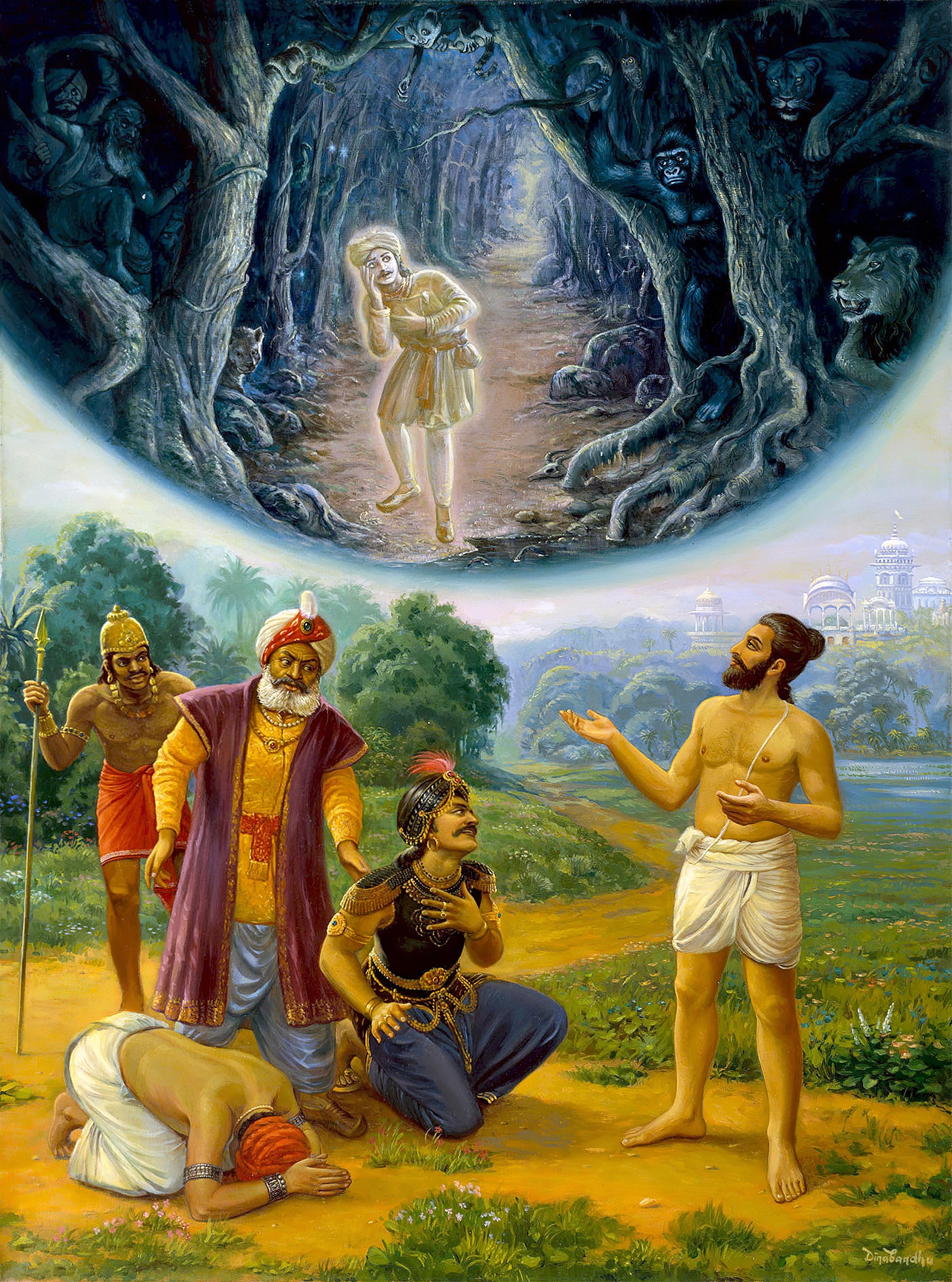
The material world, as the great forest of enjoyment
In chapter 13, Jaḍa Bharata further instructs King Rahūgaṇa, describing the features of this material world figuratively in his analogy of the material world as the great forest of enjoyment. Originally, this passage is quite cryptic, but the meaning is explained in detail in chapter 14, where the conversation goes back to Śukadeva Goswami and Parīkṣit Maharaja. The King enquires about the direct meaning of this analogy, leading Śukadeva Goswami to explain it more elaborately. The meaning is then further expanded by Śrīla Prabhupāda in his purports. Here, I combine the two chapters, merging the description of the forest from chapter 13 and the explanations of their meaning from chapter 14.
One could question what is the necessity of Jaḍa Bharata coming back to a discussion about the material world after revealing that the ultimate goal is Kṛṣṇa, but the point is that fixing ourselves on the spiritual platform is not so easy. Even after attaining an advanced platform, like Bharata Maharaja, there is still the risk of falling into bad association. As long as we have a naive understanding of this material world, seeing it as a place of enjoyment, we will always remain attracted to it, and thus propense to fall back into bad association. Jaḍa Bharata thus describes different situations we experience at different points of our lives and their outcomes, helping us to develop a more realistic understanding of the struggles of materialistic life. This understanding can help us to disassociate ourselves from it.
We can see that by the end of chapter 13, Mahārāja Rahūgaṇa’s illusion was over, and he revived his original Kṛṣṇa Consciousness. As explained by Mahāprabhu, love for Kṛṣṇa is eternally present in the soul. As soon as the material contamination is completely removed, this love of Godhead automatically manifests. Often, we think that love of Godhead is something that is magically granted and can coexist with material desires and worldly habits, but this is actually the interpretation of the sahajiyās. As Kṛṣṇa explains in the Bhagavad-gītā (18.54), one must first become purified of all material contamination, ascending to the stage of liberation, and from this platform one can come to the platform of pure devotional service.
Understanding the allegory
“Jaḍa Bharata, who had fully realized Brahman, continued: My dear King Rahūgaṇa, the living entity wanders on the path of the material world, which is very difficult for him to traverse, and he accepts repeated birth and death. Being captivated by the material world under the influence of the three modes of material nature (sattva-guṇa, rajo-guṇa, and tamo-guṇa), the living entity can see only the three fruits of activities under the spell of material nature. These fruits are auspicious, inauspicious, and mixed. He thus becomes attached to religion, economic development, sense gratification, and the monistic theory of liberation (merging with the Supreme). He works very hard day and night, exactly like a merchant who enters a forest to acquire some articles to sell later for profit. However, he cannot really achieve happiness within this material world.” (SB 5.13.1)
Because at present we are conditioned, covered by different layers in the form of body, senses, mind, intelligence, and ego, spiritual practice may appear to be difficult, but if we insist on the process, it becomes quite natural over time. This is connected to what Kṛṣṇa describes in the Gītā:
“That which in the beginning may be just like poison but at the end is just like nectar and which awakens one to self-realization is said to be happiness in the mode of goodness. That happiness which is derived from contact of the senses with their objects and which appears like nectar at first but poison at the end, is said to be of the nature of passion. And that happiness which is blind to self-realization, which is delusion from beginning to end and which arises from sleep, laziness, and illusion, is said to be of the nature of ignorance.”
When we are in the conditioned state, spiritual activities taste bitter, just as sweets taste bitter to a person with jaundice, but these same practices are the medicine for our disease. As our condition improves, the constitutional bliss of the soul manifests, and the same activities that once tasted bitter become a source of happiness.
Material activities, on the other hand, may taste sweet at first, but soon this superficial layer fades, and we feel the piercing thrusts of material miseries. Living under material duality, we work very hard to obtain material happiness and avoid distress, but most of the time, we get the opposite of what we are seeking. As Jaḍa Bharata concludes, we cannot really achieve happiness within this material world. Material life is by nature very difficult, an ocean of sorrow with just a few fleeting moments of illusory happiness. Even if we find a situation in which we feel happy, the laws of nature soon force us to accept another body, and we have no idea in which situation.
Most people nowadays live sinful lives, which will bring them to lower births in the animal species. The Vedas offer a pious path of material enjoyment in the karma-kanda section, but even in this case, the results are ultimately not positive. As Jaḍa Bharata mentions, these fruitive actors become attached to the Vedic process of religion, economic development, sense gratification, and impersonal liberation, and thus miss the true goal of human life.
The analogy of the soul as a merchant that enters a forest in search of riches but finds only misery there is described in detail by Śukadeva Goswami on 5.14.1:
“A man belonging to the mercantile community [vaṇik] is always interested in earning money. Sometimes he enters the forest to acquire some cheap commodities like wood and earth and sell them in the city at good prices. Similarly, the conditioned soul, being greedy, enters this material world for some material profit. Gradually he enters the deepest part of the forest, not really knowing how to get out. Having entered the material world, the pure soul becomes conditioned by the material atmosphere, which is created by the external energy under the control of Lord Viṣṇu. Thus the living entity comes under the control of the external energy, daivī māyā. Living independently and bewildered in the forest, he does not attain the association of devotees who are always engaged in the service of the Lord. Once in the bodily conception, he gets different types of bodies one after the other under the influence of material energy and impelled by the modes of material nature [sattva-guṇa, rajo-guṇa and tamo-guṇa]. In this way the conditioned soul goes sometimes to the heavenly planets, sometimes to the earthly planets and sometimes to the lower planets and lower species. Thus he suffers continuously due to different types of bodies. These sufferings and pains are sometimes mixed. Sometimes they are very severe, and sometimes they are not. These bodily conditions are acquired due to the conditioned soul’s mental speculation. He uses his mind and five senses to acquire knowledge, and these bring about the different bodies and different conditions. Using the senses under the control of the external energy, māyā, the living entity suffers the miserable conditions of material existence. He is actually searching for relief, but he is generally baffled, although sometimes he is relieved after great difficulty. Struggling for existence in this way, he cannot get the shelter of pure devotees, who are like bumblebees engaged in loving service at the lotus feet of Lord Viṣṇu.”
As Prabhupāda explains in his introduction to the chapter, when the soul wants to give up the Lord’s service to enjoy the material world, Kṛṣṇa gives him the opportunity of doing so. Kṛṣṇa-bahirmukha hañā bhoga vāñchā kare: When the soul turns away from Kṛṣṇa, one desires material enjoyment. Prabhupāda points to this turning away from Kṛṣṇa as the reason for the pure soul coming in contact with matter. Then, as we get involved in the material nature and perform activities under the three modes, we acquire different types of material bodies, sometimes as a demigod, sometimes as an insignificant creature.
In this way, we forget our relationship with Kṛṣṇa and become used to just seeking bodily comforts, wandering in material existence. In many situations, material nature conditions us through scarcity, but even when we have enough of everything, our material intelligence creates a new layer of artificial necessities, causing us to continue pursuing material goals without limit until death.
How to get out? In his purport to 5.14.1, Prabhupāda emphasizes that the goal of life can be achieved by accepting a bona fide spiritual master. That’s the way of being relieved of the struggle of material life. This is our first business in human life. Without this, we will keep just changing from one material position to another, without ever being able to find our way out.
The analogy of the merchant and the thieves
“O King Rahūgaṇa, in this forest of material existence there are six very powerful plunderers. When the conditioned soul enters the forest to acquire some material gain, the six plunderers misguide him. Thus the conditioned merchant does not know how to spend his money, and it is taken away by these plunderers. Like tigers, jackals and other ferocious animals in a forest that are ready to take away a lamb from the custody of its protector, the wife and children enter the heart of the merchant and plunder him in so many ways.” (SB 5.13.2)
The conditioned soul is compared to a merchant who enters a forest in the hope of obtaining some valuable items to sell. When money and other material assets are used in Kṛṣṇa Consciousness, they can bring us to the goal of life. That’s the only proper use for material assets. However, the material forest is full of dangers that can take everything away.
First, there are six plunderers in the form of the senses and the mind that take away all the resources that are meant for the service of the Lord and force us to squander everything in sense gratification. This is described in 5.14.2:
“In the forest of material existence, the uncontrolled senses are like plunderers. The conditioned soul may earn some money for the advancement of Kṛṣṇa consciousness, but unfortunately, the uncontrolled senses plunder his money through sense gratification. The senses are plunderers because they make one spend his money unnecessarily for seeing, smelling, tasting, touching, hearing, desiring and willing. In this way the conditioned soul is obliged to gratify his senses, and thus all his money is spent. This money is actually acquired for the execution of religious principles, but it is taken away by the plundering senses.”
Material facilities are acquired by executing pious deeds. When they are properly utilized, they can bring us further advancement, but uncontrolled senses take everything away. There is plenty of opportunity to enjoy our senses in Kṛṣṇa Consciousness, by tasting prasāda, hearing kīrtanas, and so on; we just need to do a little bit of austerity to adjust ourselves to these activities. As Prabhupāda explains:
“One should practice a little austerity and not spend money on anything other than the regulative life of devotional service. The senses demand that one see beautiful things; therefore money should be spent for decorating the Deity in the temple. Similarly, the tongue has to taste good food, which should be bought and offered to the Deity. The nose can be utilized in smelling the flowers offered to the Deity, and the hearing can be utilized by listening to the vibration of the Hare Kṛṣṇa mantra. In this way the senses can be regulated and utilized to advance Kṛṣṇa consciousness. Thus a good position might not be spoiled by material sense gratification in the form of illicit sex, meat-eating, intoxication and gambling. One spoils an opulent position in the material world by driving cars, spending time in nightclubs or tasting abominable food in restaurants.”
The second aspect of the allegory is the description of family members as dangerous animals that attack the merchant in the forest. This is a graphic analogy of the shortcomings of materialistic life. Whatever is left after the attack of the six plunderers is taken away by them:
“My dear King, family members in this material world go under the names of wife and children, but actually they behave like tigers and jackals. A herdsman tries to protect his sheep to the best of his ability, but the tigers and foxes take them away by force. Similarly, although a miserly man wants to guard his money very carefully, his family members take away all his assets forcibly, even though he is very vigilant.”
In materialistic life, a man becomes attached to dependents, such as his wife and children. However, pure love is not found in this material world. It’s very rare to find a woman who serves a man simply out of love. Usually, a wife follows her husband based on his capacity to maintain her. At the moment, there is no money, no house, etc., the relationship breaks. Even children become rebellious when their parents cannot fulfill their wishes, and nowadays, the situation is so degraded that sometimes even men demand money from their wives. Family life is thus based on securing material resources to maintain the household. As soon as the money stops coming, family life is disturbed. Wife and children are thus compared to jackals who cry constantly, forcing a man to work hard in this material world to satisfy their desires.
In Kṛṣṇa Consciousness, we have the ideal of family life as a platform for cooperating in Kṛṣṇa’s service. When the attitude of service is present, money becomes secondary, and husband and wife can focus on living a simple life and developing their Kṛṣṇa Consciousness, as a sacrifice of the Lord, instead of simply demanding material resources from one another. In mundane relationships, however, one is advised to retire from family life at the age of fifty to dedicate his remaining years to developing his Kṛṣṇa Consciousness, since a materialistic family will always be an obstacle to his spiritual progress.
However, this is easier said than done. The desire for material relationships that leads us to seek a spouse and then children is very deeply rooted in the heart. Unless these desires are completely uprooted, they keep returning. As Prabhupāda explains in his purport:
“Every year the plowman plows over his grain field, completely uprooting all weeds. Nonetheless, the seeds lie there and, not being completely burned, again come up with the plants sown in the field. Even after being plowed under, the weeds come up densely. Similarly, the gṛhastha-āśrama [family life] is a field of fruitive activity. Unless the desire to enjoy family life is completely burned out, it grows up again and again. Even though camphor may be removed from a pot, the pot nonetheless retains the aroma of camphor. As long as the seeds of desire are not destroyed, fruitive activities are not destroyed.”
What is the solution? As Prabhupāda explains in his purport to 5.14.4, the only way out is to be fully engaged in the service of the Lord. This platform is not easy to achieve, demanding lots of practice and persistence, but that’s the only way of completely uprooting material desire out of the heart. As long as we are not fully and consistently engaged, material desires will remain. The general idea is that we should practice in young age, and thus continue practicing as we go through family life. If we learn to remain fixed even when difficulties appear, we have a chance of attaining a platform of renunciation at the end, when our family duties are completed.
“In this forest there are dense bowers composed of thickets of bushes, grass and creepers. In these bowers the conditioned soul is always disturbed by cruelly biting mosquitoes [envious people]. Sometimes he sees an imaginary palace in the forest, and sometimes he is bewildered by seeing a fleeting fiend or ghost, which appears like a meteor in the sky.” (SB 5.13.3)
The bowers, or groves in the forest, are compared to different professions and trades where people can take shelter to try to earn their livelihood. However, even though they appear inviting from the outside, they are full of mosquitoes, which correspond to the many unkind and envious people we have to deal with daily in the course of our activities. Thus, we have to face so many inconveniences just to get basic resources to continue living.
The whole material environment of home and family, which is centered around the material body, is compared to a gandharva-pura, an imaginary castle in the sky. We chase the illusion of building a permanent place in this material world, but this is not possible. However, because we become attached, we chase after these imaginary goals, just like a person chasing a mirage in the desert. As Prabhupada explains in his purport to text 5.14.6:
“There are two worlds — the spiritual and the material. The material world is false like a mirage in the desert. In the desert, animals think they see water, but actually there is none. Similarly, those who are animalistic try to find peace within the desert of material life. It is repeatedly said in different śāstras that there is no pleasure in this material world. Furthermore, even if we agree to live without pleasure, we are not allowed to do so. In Bhagavad-gītā, Lord Kṛṣṇa says that the material world is not only full of miseries (duḥkhālayam) but also temporary (aśāśvatam). Even if we want to live here amid miseries, material nature will not allow us to do so. It will oblige us to change bodies and enter another atmosphere full of miserable conditions.”
It may sound overly pessimistic, but as time passes and we gain experience in life, we are eventually forced to admit it is true. Some rare people can fully realize the illusion of material existence by just hearing from the scriptures and observing others, but most of us have to go through the process of hope and frustration that comprises the material existence to eventually realize it.
The next component of the allegory is gold, or money. Money is very bewildering because it brings us the possibility of satisfying our material desires. Materialists are thus very attracted to it. However, its nature is fleeting; it comes and goes. Its presence or absence can take away our peace of mind, and it is thus compared to a bad spirit or a meteor in the sky.
Śukadeva Goswami compares gold with stool, because just like stool is the symbol of impurity, gold is the concentrated focus of sinful activities, such as illicit sex, intoxication, and gambling. These activities are rejected by pure devotees, but materialistic people are very attracted to them and to the golden metal facilitates it. As Prabhupāda explains in his purport to 5.14.7:
“Parīkṣit Mahārāja told Kali-yuga to leave his kingdom immediately and reside in four places: brothels, liquor shops, slaughterhouses and gambling casinos. However, Kali-yuga requested him to give him only one place where these four places are included, and Parīkṣit Mahārāja gave him the place where gold is stored. Gold encompasses the four principles of sin, and therefore, according to spiritual life, gold should be avoided as far as possible. If there is gold, there is certainly illicit sex, meat-eating, gambling and intoxication. Because people in the Western world have a great deal of gold, they are victims of these four sins. The color of gold is very glittering, and a materialistic person becomes very much attracted by its yellow color.”
In another verse, gold is also compared to a will-o’-the-wisp, the fluorescence that appears in marshlands that can be deadly to travelers who, feeling cold, confuse it with a source of heat and end up falling into the swamp.
“My dear King, the merchant on the forest path of the material world, his intelligence victimized by home, wealth, relatives and so forth, runs from one place to another in search of success. Sometimes his eyes are covered by the dust of a whirlwind — that is to say, in his lust he is captivated by the beauty of his wife, especially during her menstrual period. Thus his eyes are blinded, and he cannot see where to go or what he is doing.” (SB 5.13.4)
Sexual attraction is compared to a whirlwind that can blind and confuse us. When a man becomes too agitated sexually, he loses all good sense. In general, materialistic life orbits around sexual attraction; that’s what makes people work hard day and night. Due to this whirlwind, people remain blinded, forgotten of the real goal of life.
Because sexual life is so bewildering, it is restricted in different ways in the scriptures. The dharma sastras prescribe that one should avoid all sexual activities during the five days of the menstrual period, and then one can engage in sex once per month, choosing any day from the 6th to the 16th day of the cycle. People in Vedic societies would follow these rules strictly, and thus, the men would be naturally attracted to their wives during the menstrual period, understanding that the monthly time was coming close.
As long as one is engaged in material life, it is practically impossible to avoid attraction to sex life, since the whole material existence orbits around it. We can also see how it is very efficiently used in modern propaganda to sell all kinds of products and services. This makes people more inclined to act sinfully and skip all forms of regulation, engaging in different forms of illicit sex. This is, however, not a very wise choice. As Prabhupāda alerts in his purport to 5.14.9, these activities lead to karmic results one has to suffer in future lives:
“A person enjoys illicit sex, and due to his blind, lusty desire, he thinks that no one can see him, but this illicit sex is thoroughly observed by the agents of the Supreme Personality of Godhead. Therefore the person is punished in so many ways. Presently in Kali-yuga there are many pregnancies due to illicit sex, and sometimes abortions ensue. These sinful activities are witnessed by the agents of the Supreme Personality of Godhead, and a man and woman who create such a situation are punished in the future by the stringent laws of material nature”
Considering that it is very difficult for people to rigidly follow Vedic principles, and the results of illicit sex are very negative, what is the solution? “All these things can be avoided by remaining on the transcendental platform of Kṛṣṇa consciousness. In this way, one does not commit sinful activity.” When we are able to fix ourselves in the practice of Kṛṣṇa Consciousness, we get the high taste that allows us to follow spiritual principles. Without this high taste, it is practically impossible. It is not by chance that Śrī Caitanya Mahāprabhu establishes His movement in Kali-yuga. That is the only solution in the age we live in.
Navigating the pains of material existence
“Wandering in the forest of the material world, the conditioned soul sometimes hears an invisible cricket making harsh sounds, and his ears become very much aggrieved. Sometimes his heart is pained by the sounds of owls, which are just like the harsh words of his enemies. Sometimes he takes shelter of a tree that has no fruits or flowers. He approaches such a tree due to his strong appetite, and thus he suffers. He would like to acquire water, but he is simply illusioned by a mirage, and he runs after it.” (SB 5.13.5)
The material world is the place for envious people. The constant backbiting and criticism are compared to the harsh sounds of an unseen cricket, and the direct words of enemies and opposing elements are compared to the fearful sounds of an owl. Nowadays, we tend to see the owl as a cute bird, but in Vedic culture, owls are connected with darkness, inauspicious omens, and fear. The hoot of an owl is a sound that brings anxiety. The text describes it as ulūka-vāgbhir vyathitāntarātmā: these sounds make one’s heart and mind very disturbed. As Prabhupāda explains, “this is the nature of the world; one cannot avoid mental distress due to the backbiting of envious people.”
In the allegory, one is already disturbed by the biting of mosquitoes, the attacks of ferocious animals, etc., and now becomes fearful and disheartened by the ominous sounds of owls. All of this adds to one’s suffering. Distressed and hungry, one then tries to take shelter of apuṇya-vṛkṣān, impious trees that give no fruit, which correspond to other sinful materialists, like political leaders, who can’t offer him any real relief and just engage him in further sinful activities.
One also looks for water (the relief of all these material pains), but unfortunately is illusioned by a mirage, and runs after it. This point is significant because water factually exists; the problem is that under illusion, we look for it in the wrong place. We hanker for real relief and shelter, and this is found in devotional service. The problem is that most refuse the real water, and instead go after many mirages, guided by the illusory potency.
All of us are eternally connected with Kṛṣṇa, and thus we hanker for Him, our real shelter. However, under ignorance, we interpret this hankering as the need for more money, a better social position, a bigger apartment, a newer car, etc. These are like the mirages that prevent us from finding the real water. What is the solution? Prabhupāda repeats the same formula he has been presenting since the beginning: “If one engages his possessions in the service of the Lord under the guidance of a proper spiritual master, he will attain happiness both in this life and the next.”
In short, it all resides in finding a pure devotee who can teach us the spiritual science and help us apply it in practice, navigating the complexities of material life, and in our capacity to follow his or her guidance.
Another meaning for the mirage is given in text 5.14.10:
“The conditioned soul sometimes personally appreciates the futility of sense enjoyment in the material world, and he sometimes considers material enjoyment to be full of miseries. However, due to his strong bodily conception, his memory is destroyed, and again and again he runs after material enjoyment, just as an animal runs after a mirage in the desert.”
After repeated failures in material enterprises, a person may come in contact with devotees, but still not be able to give up material engagements, and thus later go again after the mirage of material happiness. As Prabhupāda mentions in his purport, however, in such cases the Lord can take away all material possessions from the devotee, removing the obstacles on his spiritual path.
“Sometimes the conditioned soul jumps into a shallow river, or being short of food grains, he goes to beg food from people who are not at all charitable. Sometimes he suffers from the burning heat of household life, which is like a forest fire, and sometimes he becomes sad to have his wealth, which is as dear as life, plundered by kings in the name of heavy income taxes.” (SB 5.13.6)
Jumping into a shallow river is compared to going after atheistic philosophies, which simply add to our miseries. As Śukadeva Goswami explains in 5.14.13:
“Sometimes, to mitigate distresses in this forest of the material world, the conditioned soul receives cheap blessings from atheists. He then loses all intelligence in their association. This is exactly like jumping in a shallow river. As a result one simply breaks his head. He is not able to mitigate his sufferings from the heat, and in both ways he suffers. The misguided conditioned soul also approaches so-called sādhus and svāmīs who preach against the principles of the Vedas. He does not receive benefit from them, either in the present or in the future.”
The relationship of a person with these spiritual cheaters is exploitative in both ways. One approaches such personalities in search of some material benefit, becoming attracted by displays of magic or power from the so-called guru. Believing the “guru” has supernatural powers, he worships him in the hope of obtaining material blessings or positions of prestige. This is very different from a proper guru/disciple relationship, which is based on love and service. The so-called guru, on the other hand, uses the follower to satisfy his own interests. Even if speaking about God, such persons are actually atheists who act against the principles of the scriptures.
Prabhupāda also compares jumping into a shallow river with going to inconsiderate friends in a moment of difficulty. In both cases, it reinforces the image of someone looking for shelter and relief, and coming into positions that just add to one’s suffering.
Another analogy is family life being compared to a forest fire. No one looks for fire, but it starts automatically from natural causes. “Family life” is used in many passages to mean worldly life, contrasted with renounced life. In this sense, living with or without a spouse doesn’t make much of a difference because the anxieties caused by bills, debts, unemployment, taxes, etc., are similar. No one is happy about having a quarter or more of one’s salary being taken away as income tax, on top of all the other taxes charged on day-to-day transactions.
If one is living a renounced life, without much of an income, taxes are not a big problem, but as soon as one has to maintain a household and is already struggling to pay rent and other necessities, excessive taxes become painful. In the Twelfth Canto, it is described that in the later stages of Kali-yuga, people will be so oppressed by taxation that, in desperation, they will leave their homes and seek shelter in forests.
This is a publication for thoughtful readers who want to go deeper into Kṛṣṇa consciousness. I publish daily, and all posts are available to free subscribers. If you wish, you can also choose a paid subscription to support this work. By subscribing, you also gain access to the manuscripts of the books I’m currently working on.
If you would like to contribute further, you can find the donation links here.