

« The ‘Fall’ of the Jīva, as Explained by Śrīla Prabhupāda
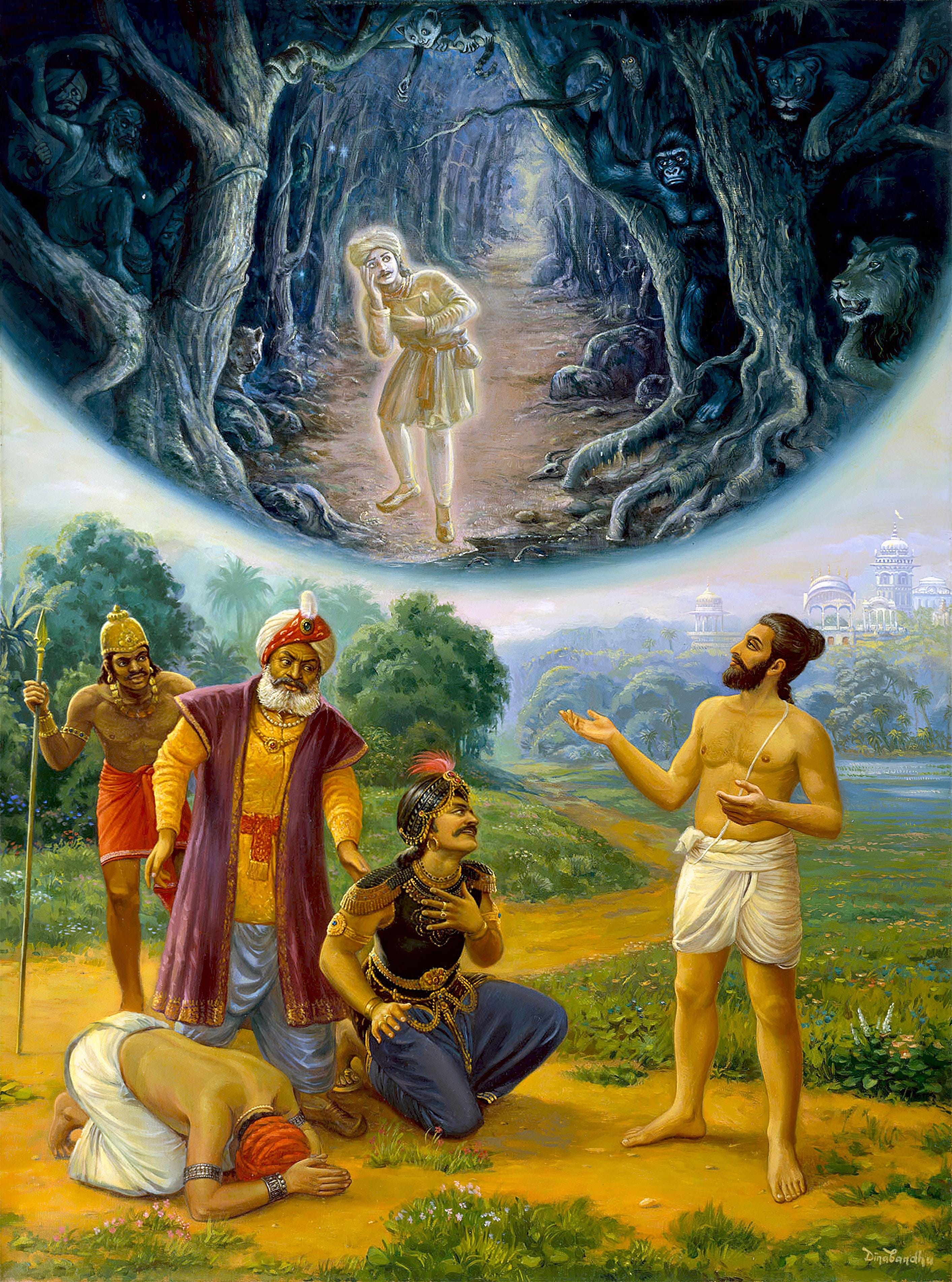
The material world is only material when we want to imitate the Lord
“My dear Lord, You are the only Supreme Person, the cause of all causes. Before the creation of this material world, Your material energy remains in a dormant condition. When Your material energy is agitated, the three qualities — namely goodness, passion and ignorance — act, and as a result the total material energy — egotism, ether, air, fire, water, earth and all the various demigods and saintly persons — becomes manifest. Thus the material world is created.” (SB 4.24.63)
Everything that exists comes from the Lord, including this cosmic manifestation, as declared in both the Vedanta-sutra (janmādy asya yataḥ) and the Bhagavad-gītā (aham sarvasya prabhavo). Therefore, the Lord is the cause of all causes. Before the current cycle of creation, the Lord (as Mahā-Viṣṇu) was sleeping on the causal ocean, and the material potency was dormant. Then, when the energy is agitated by the glance of the Lord, the three material modes manifest, and from them all the material elements, culminating with the creation of Brahmā and the appearance of all demigods and other living beings. As Prabhupāda explains in his purport:
“It is by the glance of the Lord that the material energy is activated. At that time the three material qualities are set into motion, and the material energy is manifested first in the form of the mahat-tattva, then egotism, then ether, then air, fire, water and earth. After the creation, the living entities are impregnated in the cosmic manifestation, and they emerge as Lord Brahmā and the seven great ṛṣis, then as different demigods. From the demigods come human beings, animals, trees, birds, beasts and everything else. The original cause, however, is the Supreme Personality of Godhead”
Since the Lord is self-satisfied and untouched by the material modes, what is the need for the material creation? What is the force that impels the Lord to act in such a way? This is also explained by Prabhupāda:
“The distinction between matter and spirit is created by the sleeping energy of the Lord when the Lord wants to give some facility to those living entities who want to imitate the Lord in His enjoyment. It is only for them that this material world is created by the dormant energy of the Lord. For instance, sometimes children want to imitate their mother and cook in the kitchen, and at such a time the mother supplies them with some toys so that the children can imitate her cooking. Similarly, when some of the living entities want to imitate the activities of the Lord, this material cosmic manifestation is created for them by the Lord.”
The Lord is also the foundation of the spiritual world and all spiritual manifestations. While it is sometimes said that the Lord is the “creator” of the spiritual realm, this is just to make us understand that He is the foundation, since there is no creation in the spiritual world. Prabhupāda also makes this point in the same purport, “When Kṛṣṇa says that He is the origin of everything (aham sarvasya prabhavaḥ), He means that He is even the source of Lord Brahmā, Lord Śiva, the puruṣa-avatāras, the material manifestation and all the living entities within the material world. Actually the word prabhava, “creation,” refers only to this material world, for since the spiritual world is eternally existing, there is no question of creation.”
There are thus two separate realities, the spiritual realm and the material cosmos, and both are manifestations of the Lord. The spiritual realm is for the pure souls engaged in the service of the Lord, while the material cosmos is reserved for the rebellious souls who want to act as His competitors.
At the end, however, all potencies of the Lord are spiritual. The cosmic manifestation is the combination of the external potency of the Lord, the glance of Mahā-Viṣṇu (personified in the form of Lord Sadāśiva), the souls who want to take part in the material creation, and the time energy of the Lord. All these ingredients are spiritual; therefore, where is the material world?
The Lord gives us the clue in the second verse of the catuḥ-ślokī (SB 2.9.34):
“O Brahmā, whatever appears to be of any value, if it is without relation to Me, has no reality. Know it as My illusory energy, that reflection which appears to be in darkness.”
Since the Lord is spiritual, all His potencies are also spiritual. What makes it appear to be material for us is our idea of this world being separate from the Lord, a place for our enjoyment.
As Prabhupāda explains in his purport:
“There is only a material world for those who want to imitate the Lord and become enjoyers. Indeed, the material world is nothing but forgetfulness of the original Supreme Personality of Godhead, the creator of everything. The distinction between matter and spirit is created by the sleeping energy of the Lord when the Lord wants to give some facility to those living entities who want to imitate the Lord in His enjoyment. It is only for them that this material world is created by the dormant energy of the Lord.”
Later, still in the purport for 4.24.64, he confirms: “Since all the activities of Nārāyaṇa are spiritual, when Nārāyaṇa said, ‘Let there be creation,’ that creation was all-spiritual. The ‘material’ only exists for those who have forgotten that Nārāyaṇa is the original cause.”
Lord Śiva continues his prayers:
“My dear Lord, after creating by Your own potencies, You enter within the creation in four kinds of forms. Being within the hearts of the living entities, You know them and know how they are enjoying their senses. The so-called happiness of this material creation is exactly like the bees’ enjoyment of honey after it has been collected in the honeycomb. (SB 4.24.64)
The purpose of the creation of the cosmic manifestation is to give the jīvas the possibility of satisfying their desires and gradually coming to the platform of devotional service to the Lord. For this purpose, after creating the universe, the Lord enters it as Paramātmā and accompanies the souls in four types of bodies (born from a womb, like humans and mammals; born from eggs, like birds and reptiles; born from sweat, like germs and insects; and born from seeds, like trees and plants). Not only does the Lord follow each individual soul, but He also provides the conditions for them to enjoy their senses.
However, enjoyment in this material world is never free from suffering. Both are already present, and therefore, to enjoy materially, we also have to accept suffering. This idea is explained by Lord Śiva with the example of the bee trying to enjoy the honey collected in the honeycomb and being bitten by the other bees in the process. Prabhupāda explains this analogy in his purport:
“The example of the bees is appropriate because when bees try to enjoy their honeycomb, they have to suffer the bites of other bees. Because bees bite one another when they enjoy honey, they are not exclusively enjoying the sweetness of the honey, for there is also suffering. In other words, the living entities are subjected to the pains and pleasures of material enjoyment, whereas the Supreme Personality of Godhead, knowing their plans for sense enjoyment, is aloof from them.”
“Human society is exactly like a beehive, for everyone is engaged in collecting honey from various flowers, or collecting money from various sources, and creating large empires for common enjoyment. However, after these empires are created, the bites of other nations have to be suffered. Sometimes nations declare war upon one another, and the human beehives become sources of misery.”
Happiness is available all over creation, in all the spiritual planets. It is not easily available to us simply because we are looking for it in the wrong place. Real happiness is spiritual enjoyment, and spiritual enjoyment means pure enjoyment under the protection of the Lord.
“My dear Lord, Your absolute authority cannot be directly experienced, but one can guess by seeing the activities of the world that everything is being destroyed in due course of time. The force of time is very strong, and everything is being destroyed by something else — just as one animal is being eaten by another animal. Time scatters everything, exactly as the wind scatters clouds in the sky.” (SB 4.24.65)
Ordinarily, we can’t directly see the Lord in this material world, but we can see and experience His power through unstoppable time, or kāla, which moves swiftly, like winds scattering clouds, destroying everything, both individually and collectively. Time wears out and eventually destroys everything, even the greatest empires.
Time is the energy of the Lord that puts the material energy in motion, creating a temporary reality where everything has a beginning and an end. Because of time, nothing within this material world can be permanent; everything moves, grows, decays, and perishes. Another feature of time is death, which comes for everyone without exception, taking away everything. This death is also a manifestation of Kṛṣṇa: mṛtyuḥ sarva-haraś cāham: “I am all-devouring death.” Therefore, if one is not ready to accept God in His beautiful personal form, he can’t avoid submitting to the authority of God in the form of time and death.
As Prabhupāda explains in his purport: “Although we do not see the hand of the Supreme Lord directly, we can feel the presence of that hand through the Lord’s process of destruction. We can see the clouds scattered by the wind, although we cannot see how this is being done because it is not possible to see the wind. Similarly, although we do not directly see the Supreme Personality of Godhead, we can see that He controls the process of destruction. The destructive process is going on fiercely under the control of the Lord, but the atheists cannot see it.”
“My dear Lord, all living entities within this material world are mad after planning for things, and they are always busy with a desire to do this or that. This is due to uncontrollable greed. The greed for material enjoyment is always existing in the living entity, but Your Lordship is always alert, and in due course of time You strike him, just as a snake seizes a mouse and very easily swallows him.” (SB 4.24.66)
Because of greed and desire for material enjoyment, people are madly making plans. “Mad” implies being in an abnormal state of consciousness, and that’s precisely our situation in this material world, having forgotten our true nature as eternal servants of the Lord. The Lord, however, is never affected by material duality and remains sober in His transcendental position.
The living entity has permission to pursue material enjoyment for some time, according to one’s desires, but because nothing can be eternal in this illusory world, one is eventually forced to move. The Lord Himself, in the form of time, strikes him. This bite of time comes without warning in the form of death, just like a snake attacking a mouse. In this way, materialists who are greedy and plan without Kṛṣṇa Consciousness find only defeat and death.
In the Gītā (3.27), the Lord declares: “The bewildered spirit soul, under the influence of the three modes of material nature, thinks himself to be the doer of activities which are in actuality carried out by nature.” In his purport, Prabhupāda confirms that everything is enacted by the laws of nature, and these laws are under the direction of the Supreme Personality of Godhead. Material nature is moving everything, but foolish people think “I am the doer.”
How does it work? In reality, the soul has no potency to act in the material world, nor does it have any relationship with matter. We become attached to a particular body and think that “this is me”, and due to this affection, we desire to see this body performing different types of activities, which are carried out by the three modes of material nature, under the sanction of the Lord. We see thus the body growing, constituting a family, building an empire, and so on, and feel some satisfaction, even though we have no actual relationship with it. However, because we see ourselves as the enjoyers of the body and the performers of actions, we become implicated in the karmic consequences. Eventually, death comes and takes everything away, leaving us with just the accumulated karmic reactions, which in turn carry us to another body. We are saved from this unlimited chain of actions and reactions only when we accept the authority of the Lord and surrender unto Him.
“My dear Lord, any learned person knows that unless he worships You, his entire life is spoiled. Knowing this, how could he give up worshiping Your lotus feet? Even our father and spiritual master, Lord Brahmā, unhesitatingly worshiped You, and the fourteen Manus followed in his footsteps.” (SB 4.24.67)
The real purpose of life is to know Kṛṣṇa and worship Him. Without practicing it, our life is simply spoiled. Any learned person can understand this and will thus worship the Lord. Great personalities such as Brahmā and the Manus worship Him, understanding their long duration of life to be finite. Everyone, therefore, should follow their example by simply chanting the holy name of the Lord constantly and teaching others about Kṛṣṇa, as recommended by Lord Caitanya Mahāprabhu. Even though others may create problems for us, we should just tolerate them.
Lord Śiva concludes his prayers exalting the fearlessness of the Lord’s devotees:
“My dear Lord, all actually learned persons know You as the Supreme Brahman and the Supersoul. Although the entire universe is afraid of Lord Rudra, who ultimately annihilates everything, for the learned devotees You are the fearless destination of all.” (SB 4.24.68)
Persons who are truly learned know Kṛṣṇa as the Supreme Personality of Godhead, who also manifests as Brahman and Paramātmā. Rudra is the principle of destruction; there are 11 Rudras, who are expansions of Lord Śiva, but different from him. Because the Rudras are so powerful, one Rudra fears the other, but devotees are not fearful of the Rudras, nor of death, because they are always secure, being protected by the Lord. When death finally comes, a devotee remains peaceful and happy, understanding that death has come to take him to Kṛṣṇa.
You can also donate using Buy Me a Coffee, PayPal, Wise, Revolut, or bank transfers. There is a separate page with all the links. This helps me enormously to have time to write instead of doing other things to make a living. Thanks!