


You can receive new articles directly in your inbox. Subscription is free; donations are welcome.
Vṛndāvana is not an ordinary geographical place. That’s the place where the material and the spiritual touch, a portal to the central part of the spiritual world, where Kṛṣṇa plays His intimate pastimes. Anyone can join, but the price is total surrender.
However, when we go to Vṛndāvana, it is not easy to access this spiritual reality. The place appears to be covered by a busy and noisy city, with burglar monkeys trying to snatch anything we carry, murderous auto-rickshaws ready to run over us at the smallest distraction, and, most dangerous at all, the presence of many spiritual scammers ready to exploit the innocent. However, the place remains spiritually potent, despite all these apparent covers; it just depends on our sincerity.
The atmosphere of the holy dhāma helps us to attain ecstatic love, but we need to enter Kṛṣṇa’s abode with reverence and humility. We should not go there with a kingly attitude, expecting to be served by anyone, nor as a spiritual tourist, just eating in restaurants and taking selfies; otherwise, the real Vṛndāvana will remain hidden from our eyes.
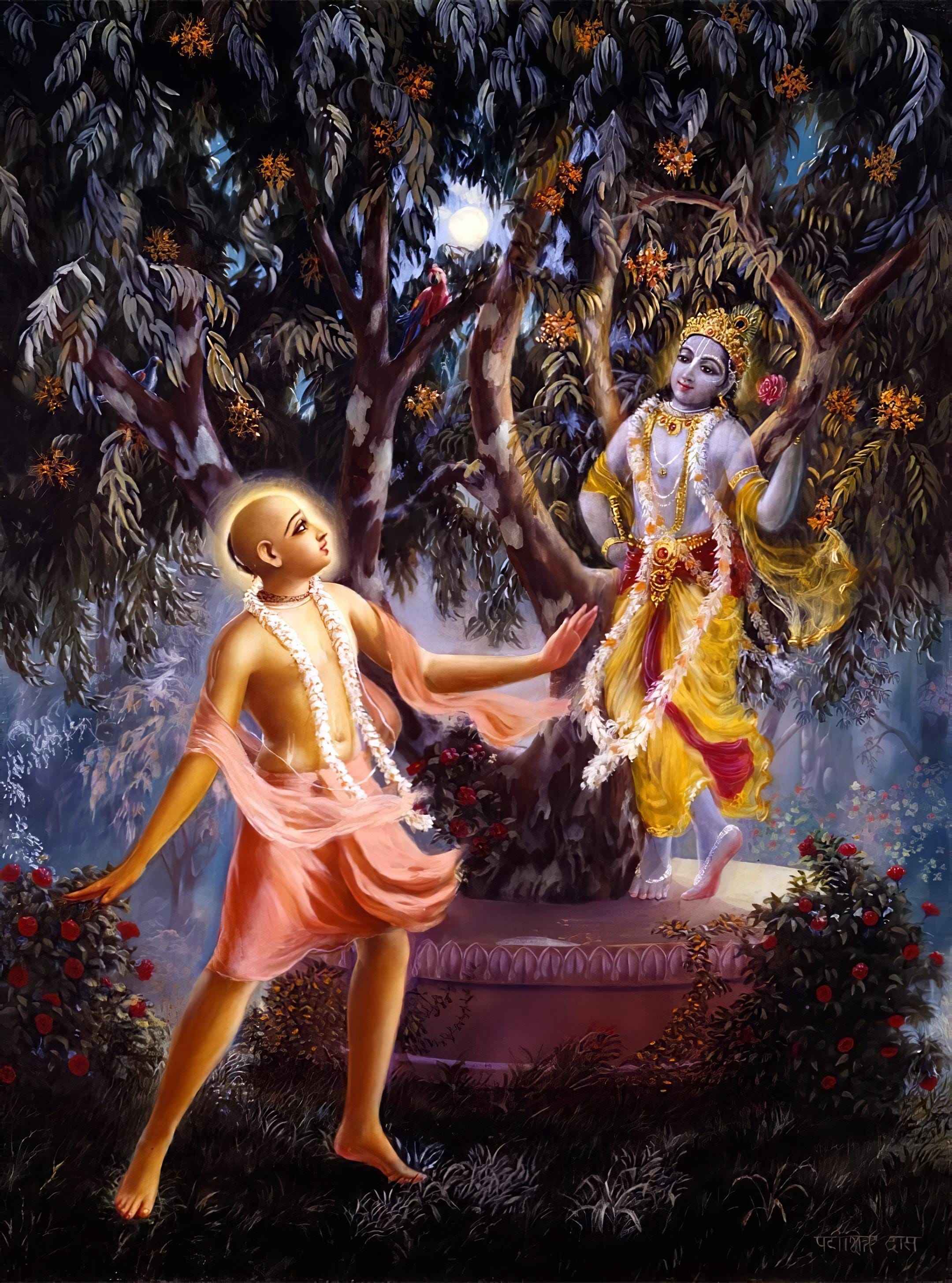
Ordinary people may see trees, fields, animals, and dust, but a pure devotee sees the spiritual reality behind these external coverings. This contrast is exemplified in the visit of Mahāprabhu, described in CC Madhya 18:
“Śrī Caitanya Mahāprabhu traveled all over Vṛndāvana and pleased all living entities, moving and nonmoving, with His glances. The Lord took much personal pleasure in seeing everyone. In this way Lord Gaurāṅga traveled in Vṛndāvana.
All glories to Lord Gauracandra! All glories to Nityānanda Prabhu! All glories to Advaita Prabhu! And all glories to all the devotees of Lord Caitanya, headed by Śrīvāsa Ṭhākura!
Śrī Caitanya Mahāprabhu danced in ecstasy, but when He arrived at Āriṭ-grāma, His sense perception was awakened.
Śrī Caitanya Mahāprabhu asked the local people, “Where is Rādhā-kuṇḍa?” No one could inform Him, and the brāhmaṇa accompanying Him did not know either.
The Lord then understood that the holy place called Rādhā-kuṇḍa was no longer visible. However, being the omniscient Supreme Personality of Godhead, He discovered Rādhā-kuṇḍa and Śyāma-kuṇḍa in two paddy fields. There was only a little water, but He took His bath there.” (CC Madhya 18.1-5)
Mahāprabhu was already absorbed in ecstatic love while residing at Jagannātha Purī. However, even the mere mention of the name “Vṛndāvana” was enough to send Him into a trance. This shows us that Vṛndāvana is not merely a geographical place; it is a state of consciousness that comes from our remembrance of Kṛṣṇa.
One of the great dangers of Vṛndāvana, or any other holy place, is to think that just by visiting or living there, we automatically become advanced. If we go there to sincerely hear, chant, learn, and serve, we can benefit tremendously, but if we go there to get involved in politics, indulge in criticism, etc., then the holy place will just make us even more accountable to it. The mercy of the dhāma is manifested more in terms of purification than immediate mystical experiences.
To live in Vṛndāvana, especially, is both a blessing and a great danger. The more sacred a place is, the more careful we should be. Vṛndāvana is the most sacred place, so we can get the idea.
We should approach Vṛndāvana with humility. Instead of thinking that I’m living in Vṛndāvana because I’m advanced or that I have become advanced because I’m living in Vṛndāvana, our mentality should be that we are unqualified but somehow have received the mercy to be living there. From this mentality, we can seek the service of other devotees instead of personal prestige, chant sincerely instead of enjoying life, and learn the spiritual truths about Kṛṣṇa instead of simply following out of sentiment.
Ordinary sinful activity is bad anywhere, but sinful activity in the dhāma is especially dangerous. We should approach the holy place as a place of service, not a place for enjoyment or spiritual showmanship.
To live in Vṛndāvana while focusing on ourselves instead of Kṛṣṇa is contradictory. The dhāma may eventually purify us, but this process can be quite painful. We are even warned that one may take birth as a monkey, pig, or another animal in Vṛndāvana if we misuse our time there. This also gives us the realization that in Vṛndāvana, even a pig or a monkey may be a devotee who practiced Kṛṣṇa consciousness in the past but ended up receiving an animal body due to serious mistakes. We should thus be respectful and, at the same time, be attentive to not end up in the same position.
Another interesting detail from this chapter is that by the time of Mahāprabhu’s visit, the Rādhā-kuṇḍa and Śyāma-kuṇḍa had practically disappeared, becoming just two small ponds in the middle of paddy fields. Mahāprabhu, however, immediately understood their real identity and bathed there in great ecstasy. Later, the Gosvāmīs excavated and developed the kuṇḍas, making them visible for future generations. This shows that holy places may become hidden externally but never lose their spiritual potency. They simply wait until Kṛṣṇa Himself or great ācāryas rediscover them.
One analogy that can be made is that if a nuclear bomb is detonated somewhere, the effects may remain long after people forget the event. Even if the explosion is forgotten, the radiation will remain and will continue to affect people. Similarly, people may forget, but the places of Kṛṣṇa’s pastimes remain charged with transcendental energy. Even people who just pass there without being aware are affected; so what to say about devotees who deliberately go there to come closer to Kṛṣṇa?
A pure devotee can perceive this potency, just as someone with a Geiger counter can detect radiation. Of course, spiritual potency is very different from ordinary radiation, but this can help us understand how these places remain powerful even after thousands of years have passed.
Read also:

This is a publication for thoughtful readers who want to go deeper into Kṛṣṇa consciousness. I publish daily, trying to offer high-quality spiritual content, and all posts are available to free subscribers. If you wish, you can also choose a paid subscription to support this work.
You can also receive the updates on WhatsApp or Telegram.
If you would like to contribute further, you can find the donation links here.