

The mysterious commentary by Śrīla Viśvanātha Cakravartī Ṭhākura included on SB 5.20.38
In his purport to SB 5.20.38, Śrila Prabhupāda quotes a long Sanskrit commentary by Śrīla Viśvanātha Cakravartī Ṭhākura, without including a translation for it. What does it say?
Subscribe to receive new articles by e-mail. It’s free, but if you like, you can pledge a donation:
In his purport to SB 5.20.38, Śrila Prabhupāda quotes a long Sanskrit commentary by Śrīla Viśvanātha Cakravartī Ṭhākura:
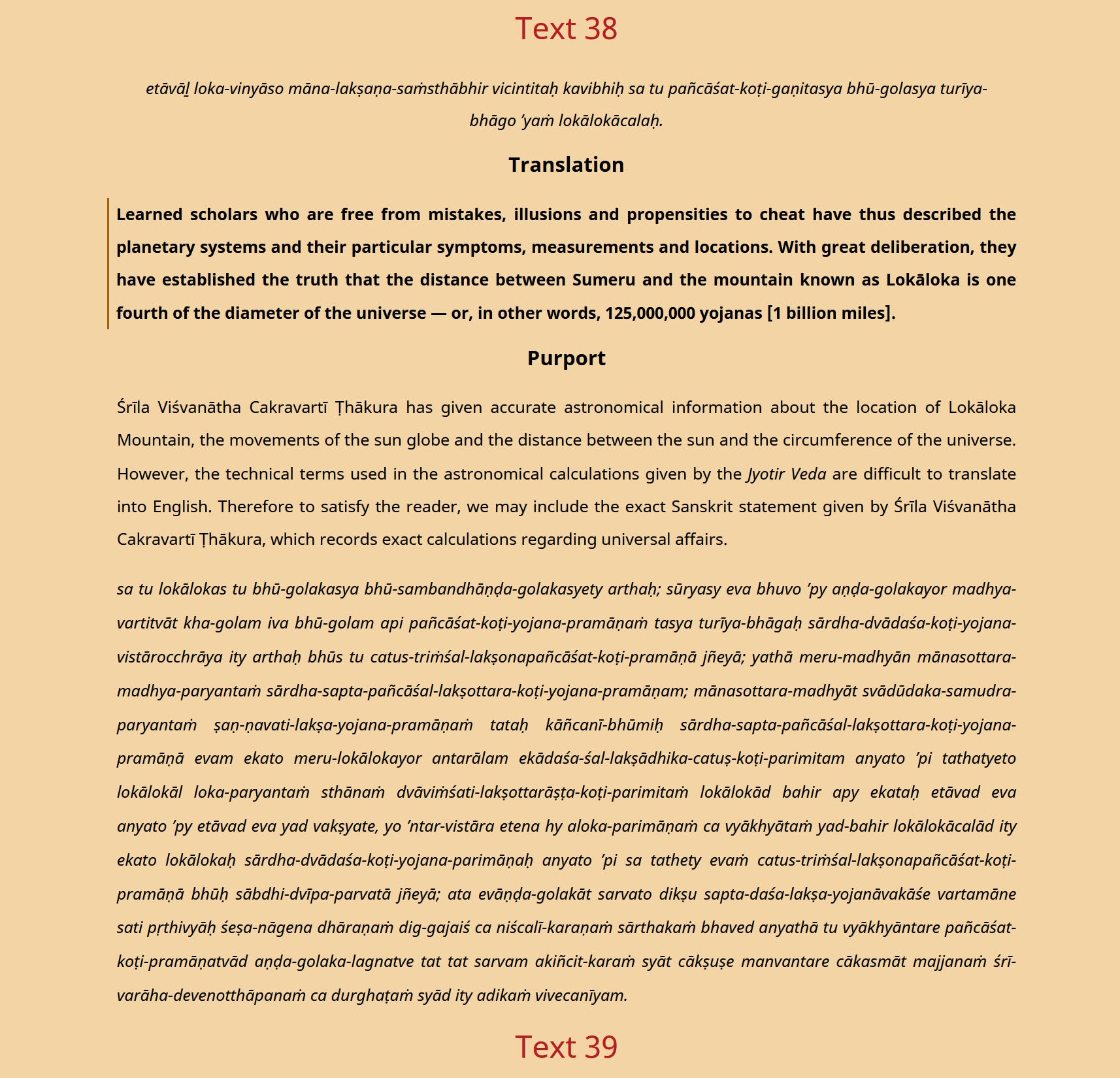
Prabhupada doesn’t include a translation for it in the text, maybe because it explains points that he already mentions in his translation for other verses, or maybe because it is very technical. However, since the text was important enough to be included in the purport, maybe you are curious. If that’s the case, you can continue reading.
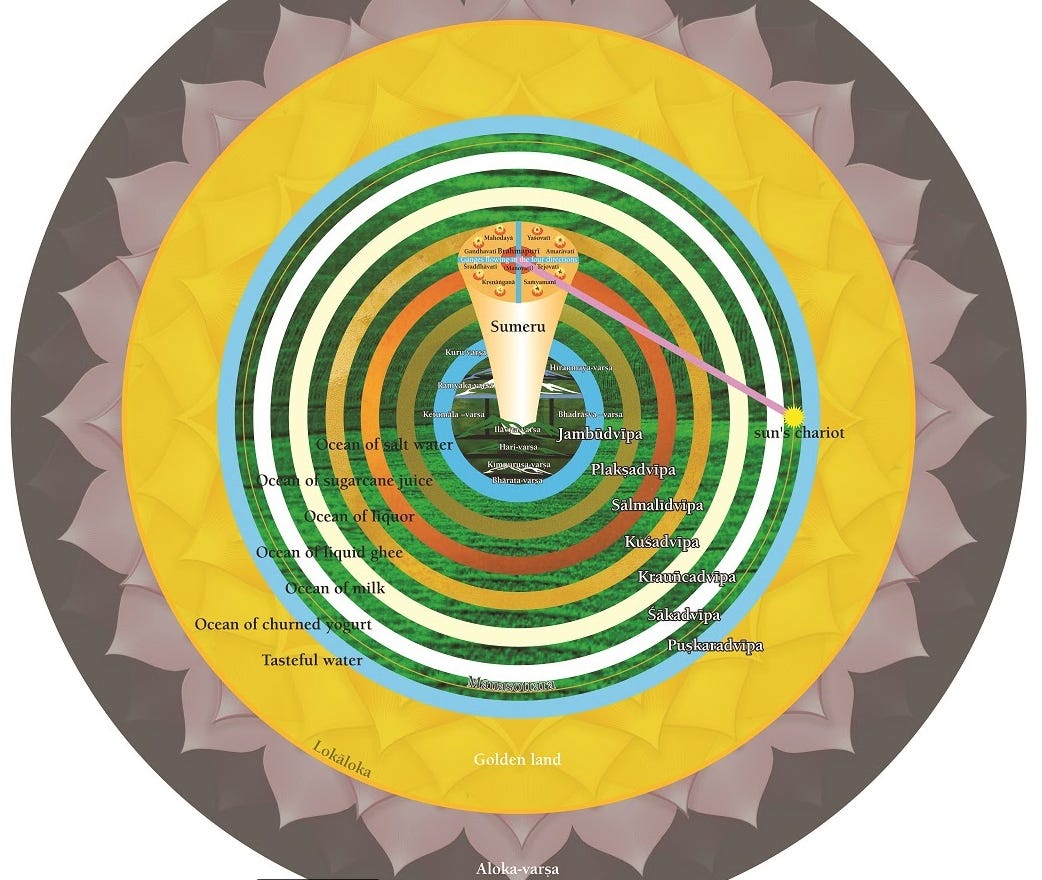
This commentary goes into detail on the breadth of the different islands that compose Bhū-mandala, and raises a small detail not mentioned in the main text of Śrīmad Bhāgavatam: the existence of a small gap between the borders of Bhū-mandala and the coverings of the universe. Here is a tentative translation and explanation of it, keeping it to the distances mentioned in the text, without trying to explain the model of Bhū-mandala, which will be a topic for other articles.
What does the text say?
sa tu lokālokas tu bhū-golakasya bhū-sambandhāṇḍa-golakasyety arthaḥ;
sūryasy eva bhuvo ’py aṇḍa-golakayor madhya-vartitvāt kha-golam iva bhū-golam api pañcāśat-koṭi-yojana-pramāṇaṁ tasya turīya-bhāgaḥ sārdha-dvādaśa-koṭi-yojana-vistārocchrāya ity arthaḥ bhūs tu catus-triṁśal-lakṣonapañcāśat-koṭi-pramāṇā jñeyā;
“Here, Lokāloka is to be understood to be the boundary between the bhū-golaka and the aṇḍa-golaka. Both the sun and the earth are situated in the vertical middle of the universe. The area occupied by both Bhū-mandala and the kha-gola spread for fifty koṭi yojanas (500,000,000 yojanas). One quarter of this is twelve-and-a-half koṭi yojanas in extent (125,000,000 yojanas). However, the whole Bhū-mandala should be known as having the measure of 49 koṭi plus 34 lakṣas yojanas (493,400,000 yojanas).”
The word bhū-golaka indicates Bhū-mandala, and aṇḍa-golaka refers to cosmic egg-sphere, or the covering of the universe, more specifically to the internal border of the coverings, that functions as the barrier-limit of the universe. The Lokāloka mountains are the border between the inhabited areas of the universe and the coverings. Kha-gola means the celestial sphere, or Svargaloka, which is positioned just above Bhū-mandala.
The values of 500 million and 125 million yojanas are given in the Śrīmad Bhāgavatam as, respectively, the total breadth of the universe and the distance between Mount Sumeru and Lokāloka (one quarter of the diameter). Śrīla Viśvanātha Cakravartī Ṭhākura, however, argues that Bhū-mandala is a little smaller than that, as he will explain.
yathā meru-madhyān mānasottara-madhya-paryantaṁ sārdha-sapta-pañcāśal-lakṣottara-koṭi-yojana-pramāṇam; mānasottara-madhyāt svādūdaka-samudra-paryantaṁ ṣaṇ-ṇavati-lakṣa-yojana-pramāṇaṁ tataḥ kāñcanī-bhūmiḥ sārdha-sapta-pañcāśal-lakṣottara-koṭi-yojana-pramāṇā evam ekato meru-lokālokayor antarālam ekādaśa-śal-lakṣādhika-catuṣ-koṭi-parimitam anyato ’pi tathā
“The individual distances are as follows: The distance from the middle of Meru up to the middle of Mānasottara is 1 koṭi plus 57½ lakṣas (15,750,000 yojanas). Then, the distance from the middle of Mānasottara to the ocean of sweet-water is 96 lakṣas (9,600,000 yojanas). Then, the distance up to the golden land is again 1 koṭi plus 57½ lakṣas (15,750,000 yojanas). Thus, the total distance comes to 4 koṭis plus 11 lakṣas (41,100,000 yojanas) and the measure of the opposite side is the same.”
The distance from the middle of Mānasottara mountain up to the end of the ocean of sweet water is 9,600,000 yojanas, which is followed by the inhabited tract of land beyond it (mentioned in ŚB 5.20.35) that measures 15,750,000 yojanas more. In this way, the total distance between Meru and the end of the inhabited part of the universe comes to 41,100,000 yojanas (15,750,000 + 9,600,000 + 15,750,000).
ty eto lokālokāl loka-paryantaṁ sthānaṁ dvāviṁśati-lakṣottarāṣṭa-koṭi-parimitaṁ
lokālokād bahir apy ekataḥ etāvad eva anyato ’py etāvad eva yad vakṣyate
yo ’ntar-vistāra etena hy aloka-parimāṇaṁ ca vyākhyātaṁ yad-bahir lokālokācalād
“The next expanse of land, reaching as far as Lokāloka is then 8 koṭis plus 22 lakṣas (82,200,000 yojanas). The other side extends for exactly this much, and on the other side, again we have the same amount. Thus, since the measurement of the inner size is given, the breadth of Aloka-varṣa, which lies outside the Lokāloka mountain, can be also inferred.”
Prabhupāda mentions in his translation of SB 5.20.35 that “Beyond the ocean of sweet water is a tract of land as broad as the area between the middle of Mount Sumeru and the boundary of Mānasottara Mountain. In that tract of land there are many living beings. Beyond it, extending to Lokāloka Mountain, is another land, which is made of gold.”
The great island after the ocean of sweet water is divided into two parts, one inhabited and the other not. According to this, the word bhūmiḥ kāñcanī applies to the next land, which is golden and uninhabited. As stated, the inhabited part goes for 15,750,000 yojanas, and then there are 82,200,000 yojanas more of the golden land that extends up to the Lokāloka mountains. Total thus comes to 123,300,000 yojanas in the calculation given.
ity ekato lokālokaḥ sārdha-dvādaśa-koṭi-yojana-parimāṇaḥ anyato ’pi sa tatheti
evaṁ catus-triṁśal-lakṣonapañcāśat-koṭi-pramāṇā bhūḥ sābdhi-dvīpa-parvatā jñeyā
“Thus, twelve-and-a-half koṭi (125,000,000 yojanas) is the total measure up to Lokāloka, and the other side is also the same. In this way, the total measure of Bhū-mandala, with all its oceans, islands, and mountains, should be understood as measuring 49 koṭi plus 34 lakṣas 493,400,000 yojanas.”
Twelve-and-a-half koṭ (125,000,000 yojanas) is the round value mentioned in the Śrīmad Bhāgavatam, a quarter of the total length of the universe, which is why it is different from the result of the previous calculation. These should not be taken as mistakes.
Following the numbers given, we have thus 123,300,000 yojanas up to the Lokāloka mountain, and the same extent for Aloka-varṣa. This is half of the breadth of the universe. Adding the other half, we come to the 493,400,000 yojanas mentioned by him.
ata evāṇḍa-golakāt sarvato dikṣu sapta-daśa-lakṣa-yojanāvakāśe vartamāne sati pṛthivyāḥ śeṣa-nāgena dhāraṇaṁ dig-gajaiś ca niścalī-karaṇaṁ sārthakaṁ bhaved anyathā tu vyākhyāntare pañcāśat-koṭi-pramāṇatvād aṇḍa-golaka-lagnatve tat tat sarvam akiñcit-karaṁ syāt cākṣuṣe manvantare cākasmāt majjanaṁ śrī-varāha-devenotthāpanaṁ ca durghaṭaṁ syād ity adikaṁ vivecanīyam.
“Therefore, there is an open space of 17 lakṣas (1,700,000 yojanas) within the aṇḍa-golaka on all sides. Understanding that, the description of Bhū-mandala being held by Śeṣanāga and balanced by the directional elephants becomes meaningful. Otherwise, if we take the measure as exactly fifty koṭis (500 million yojanas) with Bhū-mandala being fixed to the outer covering, this description would be pointless. Another point is that the account of Bhū-mandala sinking and being lifted up by Śrī Varāhadeva would be difficult to explain without this being considered.”
Aṇḍa-golaka means the outer cover of the universe. He argues that Bhū-mandala doesn’t extend all the way to the covering, leaving a small gap. This gap explains how Bhū-mandala can submerge into the causal ocean and be rescued by Varāhadeva, and the necessity of the four universal elephant-deities balancing it. As he argues, without this gap, these descriptions would not make sense. From these numbers, it appears that 500 million yojanas for the breadth of the universe is also a rounded number. Following this calculation, the total would be 496,8 million.
You can also donate using Buy Me a Coffee, PayPal, Wise, Revolut, or bank transfers. There is a separate page with all the links. This helps me enormously to have time to write instead of doing other things to make a living. Thanks!