

Subscribe to receive new articles by e-mail. It’s free, but if you like, you can pledge a donation:
Join the Telegram group if you would like to join the live lessons. This course is maintained with your donations. Click here to donate.
💬 Text of the lesson
The orbit of the sun
The orbit of the sun around Bhū-mandala takes one year for us and is divided into two halves (when the sun moves through the south and north of the planetary system). For us, these two halves represent summer and winter, but for the demigods, it represents day and night. In this way, one year for the demigods equals 360 years for us, and the 10,000 years of a lifetime in Svargaloka equals 3,600,000 years of our time.
This is confirmed by Prabhupāda in his purport:
“The movement of the sun is confirmed in the Brahma-saṁhitā (5.52): yasyājñāya bhramati saṁbhṛta-kāla-cakraḥ. The sun orbits around Mount Sumeru, for six months on the northern side and for six months on the southern. This adds up to the duration of a day and night of the demigods in the upper planetary systems.”
As Prabhupāda mentions in his purport to text 30, this movement of the sun is described by Lord Brahmā himself in his prayers in the Śrī Brahma-saṁhitā: yasyājñayā bhramati sambhṛta-kāla-cakro. The sun performs its journey mounting the wheel of time. This movement of the sun around Mount Sumeru is thus a key element in Vedic cosmology, because it is connected with the very passage of time due to the influence of kāla (time), the divine potency of the Lord.
In modern cosmology, the movements of the planets are explained from a heliocentric perspective, where the sun is orbited by the planets of our solar system, while simultaneously wobbling in an almost circular orbit around the center of the galaxy. Vedic cosmology also gives us a valid model for explaining days and nights, as well as the passages of the seasons and the movements of the stars. It is, however, based on a geocentric model that puts our planet at the center, as part of Bhū-mandala, with the sun, all the stars and other cosmic structures, as well as the other planets of the solar system orbiting this structure.
This may sound illogical at first. Why believe that the whole universe orbits around our planet? Doesn’t it make more sense to believe the opposite, as in modern cosmology?
Here is a point one may consider: when we look to the sky, we see only the relative motions of the sun, moon, stars, and planets, but practically speaking, we can’t tell experimentally what is orbiting around what.
Modern cosmology concludes that the earth orbits the sun based on the study of gravity. The Vedas also accept the influence of gravity, defining it as the potency of Lord Ananta, which maintains all the planets in their particular orbits. However, the Vedas make the point that the universe operates under the will of the Lord, not under mechanical forces. Our planet has a central role in the cosmos, because it is the place where the souls create a new set of karma that will define their destiny. It is also the place chosen by the Lord when He personally descends to play His pastimes, and the place where His divine abodes of Vṛndāvana, Jagannātha Pūri, Navadvīpa, etc. manifest. If He decides that the intermediate planetary system will have the form of a cosmic lotus and not only the sun but all the stars should orbit around it, who can prevent it?
Prabhupāda makes the point that the descriptions given in the Vedas should be given precedence over empirical observations, since, even though empirical observation is also a valid method for obtaining knowledge, it is imperfect, and it often results in errors, while the statements of the Vedas come from perfect sources, starting from God himself.
A few points that can be mentioned to support this point:
a) During medieval times, many believed the earth was flat, while the Vedas explained it as a sphere since the beginning, giving formulas to calculate its circumference and the distance to the moon and other astral bodies.
b) In 1929, Hubble calculated the age of our universe at about 2 billion years. Later, in 1958, Sandage put it between 4 and 18 billion years. In 2003, a study conducted by Spergel brought it to 13.7 billion years, a number that was raised to 13.75 billion in 2011 (Komatsu), 13.772 billion in 2013 (Bennet et al.), 13.799 billion in 2015 (Lawrence), and finally 13.801 billion in 2018 (Aghanim et al.). The value given in the Vedas, however, remains constant since the beginning: 13.819 billion years.
As we can see, the number given in different studies has gradually increased over time, as the methodology and data of the studies were improved. The difference is already less than 0.15% from the value given in the Vedas. It may be that in the future new studies put the numbers even closer, or even give exactly the same number.
c) The idea of multiple universes has existed for a long time in the field of science fiction, but it started gaining serious traction in scientific circles only in the 1980s, with the development of inflationary cosmology. Guth introduced the idea of cosmic inflation in 1981, and later developments by Linde showed that inflation can naturally produce multiple bubble universes. The multiverse theory gained further traction in the 1990s and 2000s, as string theory evolved. The Vedas, however, have been stating since the beginning that, vast as it may be, our universe is just one amongst millions of other bubble-like universes floating in the causal ocean.
Just as the idea of our universe existing for billions of years and being just one amongst millions of other universes would sound utterly absurd to a medieval mind, other ideas proposed in the Vedas may sound incoherent to us. However, as our understanding increases, not only in terms of experimental knowledge, but in terms of spiritual insight, the explanations given in the Vedas start to make more sense to us.
In any case, even if one is more comfortable with the universal model given in modern cosmology, with the earth orbiting the sun and the sun orbiting the center of the galaxy, it is undeniable that the cosmological model of the Vedas still corresponds to what we see when we look into the sky, and therefore, it is still a valid description of the universe. One can thus still appreciate the practical way it describes the movements of the sun, planets, and other luminaries, and its spiritual significance.
Ultimately, the goal of the description of the universe given in the Vedas is to help us to see Kṛṣṇa, the Absolute Truth, behind everything, just as He describes in the Gītā:
“I am the Supersoul, O Arjuna, seated in the hearts of all living entities. I am the beginning, the middle and the end of all beings. Of the Ādityas I am Viṣṇu, of lights I am the radiant sun, of the Maruts I am Marīci, and among the stars I am the moon. Of the Vedas I am the Sāma Veda; of the demigods I am Indra, the king of heaven; of the senses I am the mind; and in living beings I am the living force [consciousness]. Of all the Rudras I am Lord Śiva, of the Yakṣas and Rākṣasas I am the Lord of wealth [Kuvera], of the Vasus I am fire [Agni], and of mountains I am Meru. Of priests, O Arjuna, know Me to be the chief, Bṛhaspati. Of generals I am Kārttikeya, and of bodies of water I am the ocean. Of the great sages I am Bhṛgu; of vibrations I am the transcendental oṁ. Of sacrifices I am the chanting of the holy names [japa], and of immovable things I am the Himālayas. Of all trees I am the banyan tree, and of the sages among the demigods I am Nārada. Of the Gandharvas I am Citraratha, and among perfected beings I am the sage Kapila.”(Bg 10.20-26)
Kṛṣṇa is the essence of everything, and the chief amongst all classes and groups. When we start seeing Him in all powerful material manifestations, we start seeing the reality behind this illusory cosmic manifestation. The sun as orbiting the earth, or the earth as orbiting the sun is just a matter of convention, since in any case these are relative motions. It doesn’t change the fact that the goal of life is self-realization.
The periodic table in multiple dimensions
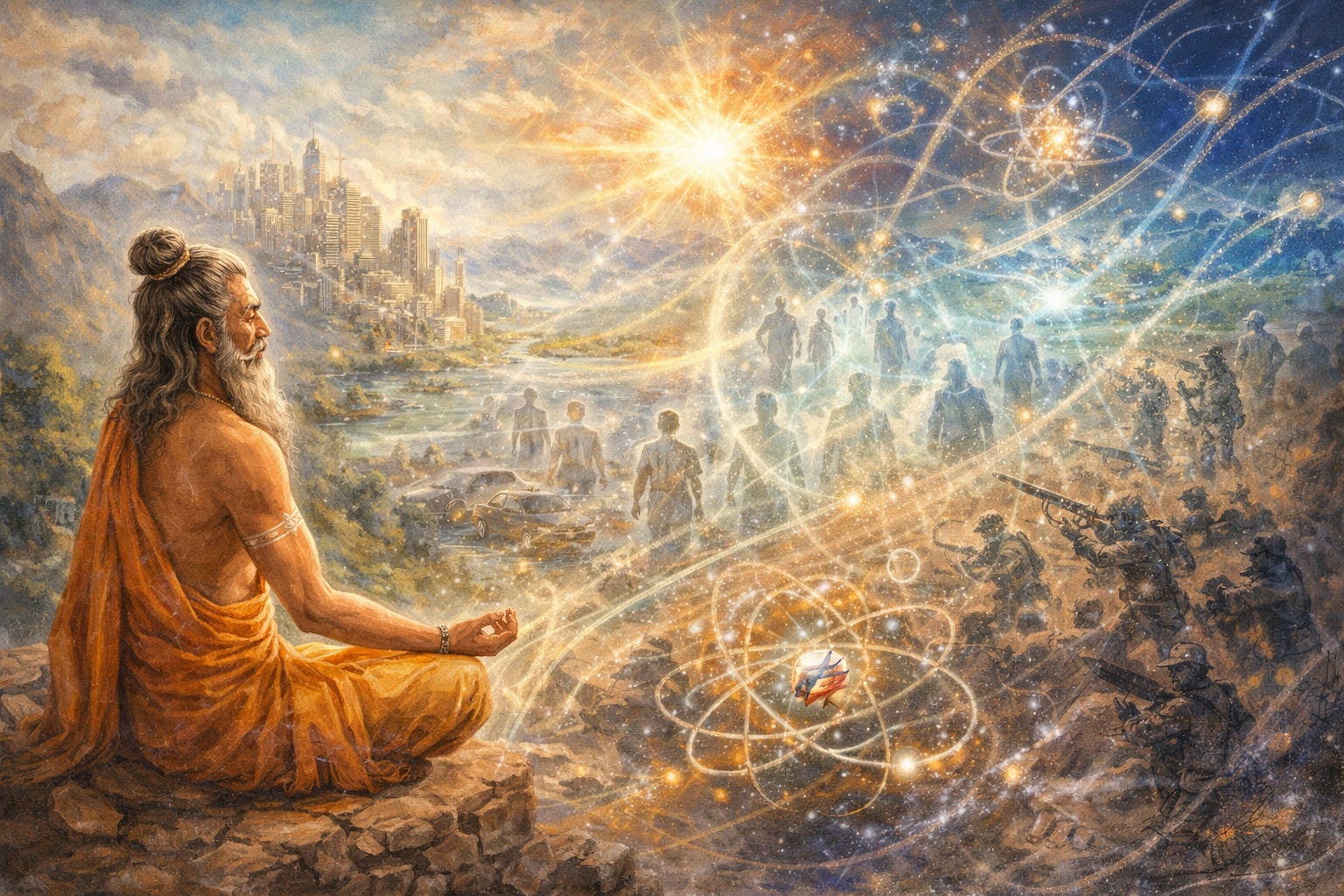
One central idea in the model of the Vedic universe that is different from what is believed in modern science is the concept of different dimensions, from gross to subtle, which explains the existence of the different structures and planetary systems described in the Vedas, such as Bhū-mandala, and their connection with our gross reality.
For example, the Śrīmad Bhāgavatam describes the structure of matter in several passages, but it is always described in terms of the five elements (earth, water, fire, air, and ether) instead of a periodic table, as in modern chemistry. As already mentioned, the reason for that is that it’s the only model that makes it possible to describe matter at all levels, not only in our gross reality.
According to the Vedas, reality exists on several different levels, going from gross (where matter is composed of atoms) to subtle (where matter assumes more refined forms). We live on a gross material level, and the demigods live on different gradations of subtle material levels. Just as we can’t see demigods such as Indra and Surya unless they assume forms visible to us, they can’t see higher beings such as Nārada or the Four Kumāras unless they assume forms visible to them. The subtlest material level exists in Brahmaloka, where reality is so subtle that there is practically no matter at all. Outside the universe, there is the spiritual level, which is still higher and subtler, inaccessible even to the inhabitants of Brahmaloka.
For example, in the Vedas, the moon is described as a celestial planet, higher than the sun in the subtle scale. However, when we go there, we see only rocks and dust, because the matter that composes that level of reality is too subtle for us to experience.
In each separate level of existence, matter exists in a form that is not recognizable to inhabitants of the previous level. We have thus the gross level, observable to us, where matter is composed of atoms, as studied in chemistry; we have the subtle level of the demigods and demons; we have the still subtler level of the hellish planets, controlled by Yamarāja; and then the astral levels of Maharloka, Janaloka, Tapoloka, and Satyaloka, which offer progressively subtler reality. To advance to each subsequent level, one has to elevate his consciousness accordingly and assume an appropriate body. However, although matter assumes more refined forms as we go upwards, it still conserves the same properties; people still see, touch, hear, etc., even in the highest level of Satyaloka. That’s thus the only reliable way to classify matter over the different parts of the cosmos.
This concept is indirectly supported in modern cosmology by the concept of dark matter. According to recent studies, about 85% to 95% of our universe is composed of dark matter and dark energy, different types of matter not composed of atoms or detectable forms of energy. The Vedas explain it in terms of the subtle forms of matter that compose the abodes of the demigods and structures like Bhū-mandala, while modern science is still trying to figure out what it may be.
The idea of multiple dimensions (as different levels of reality in the same space) is currently discussed only in science fiction, but it may be the next Vedic concept to be acknowledged in scientific circles, just as the concept of multiple universes is.
What matter really is?
The idea of an illusory universe composed of multiple dimensions may sound hard to believe at first. We tend to see things around us as tangible objects composed of solid matter. When we see things in this way, they appear to be very real, and we may question how other levels of reality can exist at all. We may be able to accept the difference between matter and spirit, accepting that the soul is something else entirely, but accepting that someone can have a body that is invisible to us may sound too much to believe. However, this is supported by material science itself.
We learn in school that atoms are actually mostly empty space, electrons circling a nucleus like a mini-solar system. However, even this picture is outdated. The nucleus is not a solid core, and the electrons are not really particles circling it. The current view is that electrons are not like tiny balls, but more like waves of electric charge (quantum objects that appear in certain regions around the nucleus), and the nucleus itself is also not solid matter, but also composed of smaller components held together by powerful interactions. In other words, an atom is not a little mechanical solar system, but mostly empty space structured by fields and interactions. It feels solid when we touch things, but in reality that solidity is mostly the result of electromagnetic forces and quantum effects acting within atoms that are almost entirely empty space.
When I hold a metal ball in my hand, it feels solid, but it feels that way because my hand is made of matter with the same basic atomic structure. The atoms in the ball resist being compressed by the atoms in my hand. If my hand were made of the same ultra-dense matter that physicists believe exists inside black holes, the ball of metal would not feel solid at all. It would simply collapse and almost disappear before I would even touch it, like a ball of styrofoam in contact with fire. If my hand were made of neutrinos or gamma rays, it would pass through the ball without affecting it much, just like the hand of a ghost, and these are just two examples based on types of matter that are studied in modern physics. If we accept the version of the Vedas, of different types of matter that have entirely different structures that don’t at all interact, the idea of people with bodies that are invisible to us sounds even more natural. We think of matter around us as something solid and real, but in reality, it is nothing like this.
Modern physics also explains that a vacuum is also not simply nothing. That’s another idea we learn in school that is outdated. What we call a vacuum may contain no ordinary matter, but the underlying fields of nature are still present. Even in their lowest state, these fields can fluctuate and produce measurable effects. So, what appears as empty space can still have physical properties: it is not a solid substance, but it is not mere nothingness either. It is the structured background in which particles, forces, and interactions appear, like a stage with no actors currently standing on it. The stage may be empty, but it still has structure, rules, and possibilities, and can influence how the actors move and interact. If we think about it, it sounds a lot like the explanation of the ether element given in the Vedas.
So, modern physics explains that matter is not really solid, and space is not really empty. That sounds quite similar to what we study in Vedic metaphysics, as explained by Lord Kapila in the Third Canto.
But it gets better. Imagine a second kind of matter that does not use the same forces that ordinary atoms use to resist contact. It’s not like antimatter, which destroys ordinary matter, but something neutral that would just not directly interact with it. This type of matter would not push back against the atoms in a wall because there would be almost no interaction between them. As a result, it would pass through ordinary matter like a ghost. Still, it would not be unreal: its particles could still interact strongly with one another through a different set of forces, allowing it to form solid objects of its own kind. People living in a world composed of this different type of matter would touch things and interact with other people; their reality would feel solid to them, just as our reality feels solid to us, but we would not be able to see them at all.
Now, imagine several other kinds of matter, some that do not interact at all with matter in our plane, others that interact weakly, some that interact with others but not with us, and so on. It starts getting quite close to the concept of the different planetary systems as different levels of reality which I have been describing here.
Lokāloka: The edge of the observable universe
“Thereafter, beyond the ocean of sweet water and fully surrounding it, is a mountain named Lokāloka, which divides the countries that are full of sunlight from those not lit by the sun.Beyond the ocean of sweet water is a tract of land as broad as the area between the middle of Mount Sumeru and the boundary of Mānasottara Mountain. In that tract of land there are many living beings. Beyond it, extending to Lokāloka Mountain, is another land, which is made of gold. Because of its golden surface, it reflects light like the surface of a mirror, and any physical article that falls on that land can never be perceived again. All living entities, therefore, have abandoned that golden land.
Between the lands inhabited by living entities and those that are uninhabited stands the great mountain which separates the two and which is therefore celebrated as Lokāloka.
By the supreme will of Kṛṣṇa, the mountain known as Lokāloka has been installed as the outer border of the three worlds — Bhūrloka, Bhuvarloka and Svarloka — to control the rays of the sun throughout the universe. All the luminaries, from the sun up to Dhruvaloka, distribute their rays throughout the three worlds, but only within the boundary formed by this mountain. Because it is extremely high, extending even higher than Dhruvaloka, it blocks the rays of the luminaries, which therefore can never extend beyond it.
Learned scholars who are free from mistakes, illusions and propensities to cheat have thus described the planetary systems and their particular symptoms, measurements and locations. With great deliberation, they have established the truth that the distance between Sumeru and the mountain known as Lokāloka is one fourth of the diameter of the universe — or, in other words, 125,000,000 yojanas [1 billion miles]. (SB 5.20.34-38)
Outside of Puṣkaradvīpa, there is an ocean of sweet water, which is, again, as broad as the island itself. Beyond this ocean, there is another island, the largest of all, which extends all the way to the Lokāloka mountains that mark the boundary of the illuminated part of the universe.
This huge island is, in turn, divided into two areas, without a new ocean between them. The internal part is inhabited land, the abode of many living entities, while the outer part is deserted.
The inhabited part of the island is as broad as the area from Mount Sumeru to the middle of Mānasottara Mountain in Puṣkaradvīpa, and the uninhabited part, the bhūmiḥ kāñcanī (golden land) mentioned in the text, is even broader.
This mysterious, uninhabited land is described in the text as “adarśa-talopamā yasyāṁ prahitaḥ padārtho na kathañcit punaḥ pratyupalabhyate”. The first quality is that the surface is perceived as being just like the surface of a mirror. This indicates one can’t properly see while there. The second is that although one can perceive an object held in one’s hand, as soon as this object is dropped, it can’t be again found by any means. The word kathañcit indicates that not only vision fails, but other senses, like touch, hearing, and taste, become unusable.
This indicates that this is not simple a place with a gold-like surface, but a place where ordinary sense perception fails. Due to this, it is described that no one lives there. This indicates that this mysterious golden marks a place where the conditions that sustain ordinary life cease to exist.
Outside of it are what are described as a cosmic range of mountains, the mysterious Lokāloka. These mountains are described as going as high as Dhruvaloka. In other words, they encapsulate the whole inhabited area of the universe, both horizontally and vertically. It is clear that these are not ordinary mountains composed of rock, but some kind of structure composed of some very subtle form of matter or energy, rather than a solid barrier.
Beyond Lokāloka is Aloka-varṣa, a completely uninhabited region that is not reached by the light of the sun or none of the stars. Lokāloka is thus similar in concept to what is discussed in modern cosmology as the Cosmic light horizon, the very edge of the universe. Beyond that is an area beyond ordinary illumination, perception, and habitation. Beyond this area are the coverings of the universe, and beyond the last covering is the Causal ocean (Kāraṇodaka), where Lord Mahā-Viṣnu resides.
In the pastime in which Arjuna brings back the sons of the brāhmaṇa who had been taken by Mahā-Viṣnu, Krsna guides Arjuna through this whole region, reaching the causal ocean, where Kṛṣṇa gives darśana to Mahā-Viṣnu Himself.
This episode is described in the Tenth Canto:
“Having thus advised Arjuna, the Supreme Personality of Godhead had Arjuna join Him on His divine chariot, and together they set off toward the west. The Lord’s chariot passed over the seven islands of the middle universe, each with its ocean and its seven principal mountains. Then it crossed the Lokāloka boundary and entered the vast region of total darkness.
In that darkness the chariot’s horses — Śaibya, Sugrīva, Meghapuṣpa and Balāhaka — lost their way. Seeing them in this condition, O best of the Bhāratas, Lord Kṛṣṇa, the supreme master of all masters of yoga, sent His Sudarśana disc before the chariot. That disc shone like thousands of suns. The Lord’s Sudarśana disc penetrated the darkness with its blazing effulgence. Racing forward with the speed of the mind, it cut through the fearsome, dense oblivion expanded from primeval matter, as an arrow shot from Lord Rāma’s bow cuts through His enemy’s army. Following the Sudarśana disc, the chariot went beyond the darkness and reached the endless spiritual light of the all pervasive brahmajyoti. As Arjuna beheld this glaring effulgence, his eyes hurt, and so he shut them.
From that region they entered a body of water resplendent with huge waves being churned by a mighty wind. Within that ocean Arjuna saw an amazing palace more radiant than anything he had ever seen before. Its beauty was enhanced by thousands of ornamental pillars bedecked with brilliant gems. Lord Kṛṣṇa offered homage to Himself in this boundless form, and Arjuna, astonished at the sight of Lord Mahā-Viṣṇu, bowed down as well.” (SB 10.89.46-52,57)
This same pastime is described more vividly by Śrila Prabhupāda in chapter 89 to Kṛṣṇa Book, where he also gives us extra insight in his view of the islands of Bhū-mandala and their surrounding planets:
“Seated on His chariot with Arjuna, Kṛṣṇa proceeded north, crossing over many planetary systems. These are described in Śrīmad-Bhāgavatam as sapta-dvīpa. Dvīpa means “island.” These planets are sometimes described in the Vedic literature as dvīpas. The planet on which we are living is called Jambūdvīpa. Outer space is taken as a great ocean of air, and within that great ocean of air there are many islands, which are the different planets. On each and every planet there are oceans also. On some of the planets the oceans are of salt water, and on some of them there are oceans of milk. On others there are oceans of liquor, and on others there are oceans of ghee or oil. There are different kinds of mountains also. Each and every planet has a different type of atmosphere.”
He gives a similar account in his purport to SB 3.23.43:
“All the planets are here described as gola, round. Every planet is round, and each planet is a different shelter, just like islands in the great ocean. Planets are sometimes called dvīpa or varṣa. This earth planet is called Bhārata-varṣa because it was ruled by King Bharata. Another significant word used in this verse is bahv-āścaryam, “many wonderful things.” This indicates that the different planets are distributed all over the universe in the eight directions, and each and every one of them is wonderful in itself. Each planet has its particular climatic influences and particular types of inhabitants and is completely equipped with everything, including the beauty of the seasons. In the Brahma-saṁhitā (5.40) it is similarly stated, vibhūti-bhinnam: on each and every planet there are different opulences. It cannot be expected that one planet is exactly like another. By God’s grace, by nature’s law, each and every planet is made differently and has different wonderful features.”
These two passages combine with other references where Prabhupāda states his view of the planetary system of Bhū-mandala as a collective of different types of planets, and the surrounding oceans as nothing more than different types of oceans surrounding their respective continents, just as on earth.
The way this structure is perceived by other inhabitants of the universe is certainly different from what we see. By the description of the Śrīmad Bhagavad, it appears that they perceive it as a more or less continuous structure, just like many islands connected by causeways. However, from our perspective, these islands and oceans appear in the form of numerous planets spread through the cosmos. These planets are connected to each other by the branches of the cosmic tree, but they can’t be perceived by us, giving us the impression they are unrelated.
This is a publication for thoughtful readers who want to go deeper into Kṛṣṇa consciousness. I publish daily, and all posts are available to free subscribers. If you wish, you can also choose a paid subscription to support this work. By subscribing, you also gain access to the manuscripts of the books I’m currently working on.
If you would like to contribute further, you can find the donation links here.