

« The ‘Fall’ of the Jīva, as Explained by Śrīla Prabhupāda
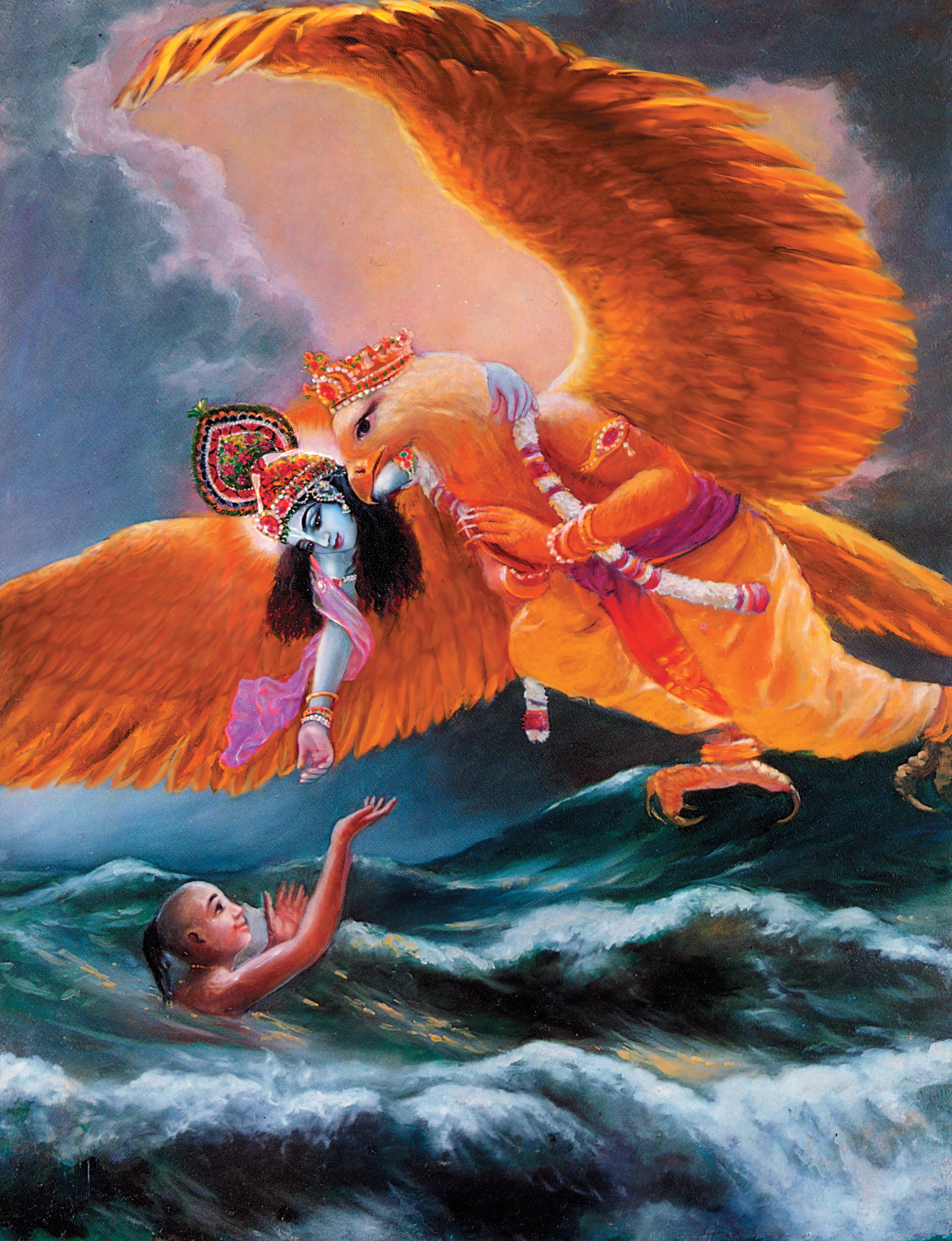
The original home
One can argue that there is no influence of the material energy in the spiritual world, and therefore, there is no possibility of the jīva falling from there. Certainly, the idea that māyā could extend her hand and forcibly drag the jīvas out of the spiritual world against their will is completely absurd. However, there is another factor that many forget to take into consideration: free will. The soul is endowed with free will because this is the very characteristic that allows us to love Kṛṣṇa. As Śrīla Bhaktivinoda Thākura argues in his Jaiva Dharma, without free will, the soul would be no different from ordinary material objects.
Love can only be voluntary, and thus when the soul uses its free will improperly and rejects the service of Kṛṣṇa, He respects one’s choice, observing as His part and parcel falls into duality and develops the propensity of enjoying separately from Him in this material world. As Prabhupāda explains:
“When the living entities desire to enjoy themselves, they develop a consciousness of duality and come to hate the service of the Lord. In this way the living entities fall into the material world. In the Prema-vivarta it is said: kṛṣṇa-bahirmukha hañā bhoga-vāñchā kare, nikaṭa-stha māyā tāre jāpaṭiyā dhare
The natural position of the living entity is to serve the Lord in a transcendental loving attitude. When the living entity wants to become Kṛṣṇa Himself or imitate Kṛṣṇa, he falls down into the material world. Since Kṛṣṇa is the supreme father, His affection for the living entity is eternal. When the living entity falls down into the material world, the Supreme Lord, through His svāmśa expansion (Paramātmā), keeps company with the living entity. In this way the living entity may some day return home, back to Godhead.
By misusing his independence, the living entity falls down from the service of the Lord and takes a position in this material world as an enjoyer — that is to say, the living entity takes his position within a material body. Wanting to take a very exalted position, the living entity instead becomes entangled in a repetition of birth and death. He selects his position as a human being, a demigod, a cat, a dog, a tree, etc. In this way the living entity selects a body out of the 8,400,000 forms and tries to satisfy himself by a variety of material enjoyment. The Supersoul, however, does not like him to do this. Consequently, the Supersoul instructs him to surrender unto the Supreme Personality of Godhead. The Lord then takes charge of the living entity. But unless the living entity is uncontaminated by material desires, he cannot surrender to the Supreme Lord.”
“When the living entities desire to enjoy themselves, they develop a consciousness of duality and come to hate the service of the Lord. In this way the living entities fall into the material world.”
When the function of free will is understood, the explanations given by Śrīla Prabhupāda make complete sense, and it is the only natural explanation that can be given without violating the previous points already explained in the Śrīmad-Bhāgavatam. Certainly, Prabhupāda had more than enough spiritual realization to back it up.
“My dear gentle friend, both you and I are exactly like two swans. We live together in the same heart, which is just like the Mānasa Lake. Although we have been living together for many thousands of years, we are still far away from our original home.” (SB 4.28.54)
Prabhupāda translates the word “okaḥ” in this verse as “original home”. Ordinarily, okaḥ means “dwelling place”, but since the Lord uses the words aham ca tvam ca (both you and I), it means that the dwelling place of the soul and the Lord is the same. From the description in the Second Canto, as well as the Brahma-samhitā and other references, we understand that the Lord has His eternal residence in the spiritual world, and this is also the original home of the soul. The Lord and the jīva originally live together in their eternal home, and when the jīva misuses his free will and ends up entangled in this material world, the Lord accompanies him, creating a replica of His original home inside the heart, as described in detail by Śrīla Baladeva Vidyābhūṣaṇa in the third pāda of his Govinda Bhāṣya.
In this way, even in the conditioned state, we live with the Lord and are never separated from Him, although due to illusion we may think so. Due to the influence of illusion, we may think we are not with Kṛṣṇa, we were never with Kṛṣṇa, we have no relationship with Kṛṣṇa, that we are products of this material world, etc. All of this is due to illusion, and that’s precisely the type of answer we come to when we try to find answers using our materially conditioned intelligence. To find the answer, we need to accept the conclusions of a self-realized soul who can practically see. That’s what Prabhupāda offers in his purports.
The Mandūkya Upaniṣad explains this point of the soul living together with the Lord in more detail, by explaining the four states of consciousness of the soul: viśva, taijasa, prājña, and turīya. Viśva is the waking state, where we become busy enjoying the physical universe using our senses. The senses are presided over by the Lord and offered to the soul as an opportunity to come to the platform of devotional service, but we often miss this purpose and become fixed in sense gratification. After each period of physical activity, we enter into the dream state, taijasa, where we act within, in the realm of dreams, experiencing the subtle impressions stored in the mind. This dream state is enjoyed by all kinds of living entities. It is not a luxury, but a non-negotiable aspect of bodily existence. Without sleep, no one can maintain their life. After the jīva enjoys the realm of dreams, the Lord blocks all consciousness, pulling us into a state of unconscious bliss, called prājña. In this state, we enter into the transcendental abode of the Lord inside the heart, forgetting our material identity. Without a separate material identity and material consciousness, there is no separation from Him, just like at the dissolution of the universe. Because we remain forgetful of our eternal relationship with the Lord, however, we return to material activity after enjoying this state of deep sleep for a short time. The last stage, turīya, is our original state of Kṛṣṇa Consciousness; it is called the Fourth because it transcends the previous states. It is beyond the perception of the senses, mind, or intelligence and can’t even be perceived by material consciousness. This is the original, pure state of the soul as an eternal, blissful servant of the Lord.
These ideas are explored in more detail by Prabhupāda in his purport:
“The original home of the living entity and the Supreme Personality of Godhead is the spiritual world. In the spiritual world both the Lord and the living entities live together very peacefully. Since the living entity remains engaged in the service of the Lord, they both share a blissful life in the spiritual world. However, when the living entity wants to enjoy himself, he falls down into the material world. Even while he is in that position, the Lord remains with him as the Supersoul, his intimate friend. Because of his forgetfulness, the living entity does not know that the Supreme Lord is accompanying him as the Supersoul. In this way the living entity remains conditioned in every millennium. Although the Lord follows him as a friend, the living entity, because of forgetful material existence, does not recognize Him.”
This is further corroborated by Śrīla Bhaktivinoda Thākura, who wrote:
“The independent jiva is a beloved servant of Kṛṣṇa, and thus Kṛṣṇa is kind and compassionate towards him. Seeing the misfortune of the jiva, as he misuses his independence and becomes attached to māyā, He chases after him, weeping and weeping, and appears in the material world to deliver him. Sri Kṛṣṇa, the ocean of compassion, His heart melting with mercy for the jivas, manifests His acintya-lila in the material world, thinking that His appearance will enable the jiva to see His nectarean pastimes. However, the jiva does not understand the truth about Kṛṣṇa’s pastimes, even after being showered by so much mercy, so Kṛṣṇa then descends in Sri Navadvipa in the form of guru. He personally describes the supreme process of chanting His name, form, qualities and pastimes, and personally instructs and inspires the jivas to take to this path by practicing it Himself. Baba, how can you accuse Kṛṣṇa of being at fault in any way when He is so merciful? His mercy is unlimited, but our misfortune is lamentable.” (Jaiva Dharma, ch. 16)
Does our relationship with Kṛṣṇa change when we come to the material world? The answer is no. Even though we may forget Kṛṣṇa, He never forgets us, and in the absolute platform, this eternal relationship is still existing, and can be fully revived when we turn our face to Him.
“My dear friend, you are now My very same friend. Since you left Me, you have become more and more materialistic, and not seeing Me, you have been traveling in different forms throughout this material world, which was created by some woman.” (SB 4.28.55)
Kṛṣṇa uses the words “vihāya mām bandho“ (since you left Me). Kṛṣṇa never left us. He was just forced to accept our decision. However, as a true friend, He continues to follow us, waiting for the moment we will finally turn again to Him. The woman described here is the external potency, and the verse describes our hopeless condition, embraced by material illusion and going from one material body to another. Because in each body we find only a new temporary situation, we are forced to continue moving, just like someone traveling from one place to another. We can find permanent shelter only when we return to our eternal home, together with our eternal friend.
Lord Kapila explains in his teachings that these travelings of the soul are not “physical”. In truth, the soul never leaves the spiritual sky; we are simply reflected in the material energy, just like the Lord is reflected as Garbhodakaśāyī Viṣṇu and Kṣīrodakaśāyī Viṣṇu. This is a concept Prabhupāda explains in his teachings, mentioning that material existence is just like a dream, and when we awaken from this dream, we are with Kṛṣṇa. As with other points, this is not his invention; he just follows the explanation given in the Śrīmad-Bhāgavatam through these different passages. The process of returning is thus based on reviving our original consciousness, which Prabhupāda defines as Kṛṣṇa Consciousness.
How can we return to this original consciousness? In his purport to text 55, Prabhupāda explains that this starts by receiving spiritual knowledge from Kṛṣṇa’s representative, the self-realized soul:
“When the living entity falls down, he goes into the material world, which was created by the external energy of the Lord. This external energy is described herein as “some woman,” or prakṛti. This material world is composed of material elements, ingredients supplied by the mahat-tattva, the total material energy. The material world, created by this external energy, becomes the so-called home of the conditioned soul. Within this material world the conditioned soul accepts different apartments, or different bodily forms, and then travels about. Sometimes he travels in the higher planetary systems and sometimes in the lower systems. Sometimes he travels in higher species of life and sometimes in lower species. He has been wandering within this material universe since time immemorial. As explained by Śrī Caitanya Mahāprabhu:
brahmāṇḍa bhramite kona bhāgyavān jīva
guru-kṛṣṇa-prasāde pāya bhakti-latā-bīja
The living entity wanders into many species of life, but he is fortunate when he once again meets his friend, either in person or through His representative.
Actually, it is Kṛṣṇa who personally advises all living entities to return home, back to Godhead. Sometimes Kṛṣṇa sends His representative, who, delivering Kṛṣṇa’s very message, canvasses all living entities to return home, back to Godhead. Unfortunately the living entity is so greatly attached to material enjoyment that he does not take the instructions of Kṛṣṇa or His representative very seriously. This material tendency is mentioned in this verse as grāmya-matiḥ, sense gratification. The word mahīm means “within this material world.” All living entities within this material world are sensually inclined. Consequently they become entangled in different types of bodies and suffer the pangs of material existence.”
The meaning of the allegory
The Lord then reveals the meaning of the allegory of the city of the body, in which Vaidarbhī was entangled in her past life as Purañjana and now as the daughter of the king, and the same prison we are all currently incarcerated in:
“In that city [the material body] there are five gardens, nine gates, one protector, three apartments, six families, five stores, five material elements, and one woman who is lord of the house.
My dear friend, the five gardens are the five objects of sense enjoyment, and the protector is the life air, which passes through the nine gates. The three apartments are the chief ingredients — fire, water and earth. The six families are the aggregate total of the mind and five senses.
The five stores are the five working sensory organs. They transact their business through the combined forces of the five elements, which are eternal. Behind all this activity is the soul. The soul is a person and an enjoyer in reality. However, because he is now hidden within the city of the body, he is devoid of knowledge.” (SB 4.28.56-58)
The allegorical city of the material body is composed of the senses, the objects of the senses, the mind, etc. The lady of the house is the material intelligence, to which the conditioned soul becomes very firmly connected. Once in material illusion, the soul becomes hidden inside the body, because the original symptoms of the soul practically disappear, and one acts simply moved by the three modes of material nature. The body is constituted by material elements, and to maintain it, we need to consume more material elements in the form of food and drink. Apart from food, we try to secure many other material objects to gratify our senses, pushed by our strong material desires. All of this together makes us completely absorbed in the bodily conception of life, just like Purañjana in the allegory.
Both the material energy and the soul are eternal, both being potencies of the Lord. However, the material manifestation, produced from the combination of these two eternal components, is temporary and ultimately illusory. As Prabhupāda explains: “Material nature and the living entities should be understood to be beginningless. Their transformations and the modes of matter are products of material nature.” Prakṛti, material nature, and puruṣa, the living entity, are eternal. When they both come in contact, there are different reactions and manifestations. All of them should be considered the results of the interaction of the three modes of material nature.”
How is it that the eternal soul can forget his relationship with the Lord and become so entangled by ignorance in this material world?
“My dear friend, when you enter such a body along with the woman of material desires, you become overly absorbed in sense enjoyment. Because of this, you have forgotten your spiritual life. Due to your material conceptions, you are placed in various miserable conditions.” (SB 4.28.59)
In the Bhagavad-gītā, Kṛṣṇa insists on the idea that the soul can’t be destroyed. The reason it can’t be destroyed is that it is sat: eternal and distinct from material objects, which are asat, or illusory. As He explains (Bg 2.16), nāsato vidyate bhāvo, nābhāvo vidyate sataḥ: everything that is spiritual is eternal, and therefore is never created and never destroyed, and everything that is material is ultimately illusory, because it has no permanence, being created at a certain point, and destroyed later in time. Just as the soul is spiritual and thus eternal, Kṛṣṇa is also eternal, and our relationship with Him is equally eternal. Because this transcendental relationship is eternally existent and has no beginning, it also has no end and can never be broken or destroyed.
Considering this point, how can it be that at the current moment we are not aware of this transcendental relationship? In philosophical terms, this is a very complicated question, and when we use the material intelligence to try to solve this apparent contradiction, we tend to try to fit it into the linear time we are used to dealing with in this material world. As a result, we come to the conclusion that we don’t have a relationship with Kṛṣṇa, and we are working to establish it for the first time. We forget, however, the famous passage of Mahāprabhu:
nitya-siddha kṛṣṇa-prema ‘sādhya’ kabhu naya
śravaṇādi-śuddha-citte karaye udaya
“Pure love for Kṛṣṇa is eternally established in the hearts of the living entities. It is not something to be gained from another source. When the heart is purified by hearing and chanting, this love naturally awakens.” (CC Madhya 22.108)
Considering that love for Kṛṣṇa is eternally established in the very core of the soul, how can we not have it now? The word Prabhupāda and other ācāryas use is “forgotten”. The relationship eternally exists, but falling under material illusion, we temporarily forget it. When I forget my phone somewhere, it doesn’t stop existing, nor does it stop being mine. I just become separated from it for the time being. As soon as it is found, it returns to my possession. Similarly, as Śrī Caitanya Mahāprabhu explains, it is not about creating something new, but just about remembering what we forgot. That’s what both Kṛṣṇa and the spiritual master try to do, from both the inside and the outside. All conditions are set, and all arrangements made; we just need to take the opportunity. By practicing Kṛṣṇa Consciousness, we gradually revive our spiritual intelligence, spiritual senses and desires, spiritual identity, and spiritual consciousness.
On the contrary, the more we become involved in material activities, the more this eternal blissful nature is suppressed, and the more we become entangled in ignorance. As Prabhupāda explains in his purport: “When a person becomes materially engrossed, he has no capacity to hear about spiritual existence. Forgetfulness of spiritual existence entangles a man more and more in material existence. Such is the result of sinful life. Various bodies are developed with the material ingredients because of different types of sinful activities. King Purañjana assumed the body of a woman, Vaidarbhī, as a result of his sinful activities. Bhagavad-gītā clearly says (striyo vaiśyās tathā śūdrāḥ) that such a body is lowborn. If one takes shelter of the Supreme Personality of Godhead, however, he can be elevated to the highest perfection, even though he be lowborn. One acquires lower births when one’s spiritual intelligence is reduced.”
You can also donate using Buy Me a Coffee, PayPal, Wise, Revolut, or bank transfers. There is a separate page with all the links. This helps me enormously to have time to write instead of doing other things to make a living. Thanks!
"The soul is endowed with free will" - indeed - the soul or Soul is pure untainted .When misued?? Who is the one misusing, who is in the "We" U mention- someone/something other than the soul?-or part of it? where does that come from, and if the soul gets'involved' in or with something, is not the soul exercising its own nature that is free will - the article sounds quite wordy, words heaped upon words-
when the the entire phnomena of the Supreme Being (whatever name and form used to delimit and define IT) and the world-universe is simply Leela- the Supreme sporting in multitude of names and forms(since everything manifests from IT/HIM.- and living beings endowed with very very limited tiny feeble consciousness can experience only at the same level as dream - yet feels entirely REAL while dreaming - Ha! the power of Maya-like dream- Jaya Jaya Param Brahma- Namasthe Namasthe.- shivaG