

« The Song of God—Volume 2, chapters 7-12

Introduction:
The path so far: a recap of the first six chapters
The Bhagavad-gītā begins with Arjuna prepared to fight. However, his determination shatters when he sees his relatives, teachers, friends, and well-wishers standing on the opposite side. Overwhelmed by attachment and compassion, he begins to calculate the consequences of the battle in terms of personal gain and loss, arguing that it will bring sinful reactions, destroy family traditions, and bring suffering to society as a whole. He concludes that it would be better to be killed on the battlefield without offering resistance than to engage in such an activity.
Kṛṣṇa, however, does not agree with this conclusion. Arjuna is a kṣatriya, and his dharma is to fight. Such weakness of heart is unbefitting, and avoiding the battle would bring only degradation. He condemns Arjuna’s hesitance and urges him to stand and fight. But how could he fight against his guru, grandfather, uncles, and other friends and relatives? Even if he were to win the battle, he felt that such a victory would be worse than defeat. Arjuna then takes an essential step: he recognizes the limits of his knowledge and his inability to find a solution through mere reasoning. He then surrenders to Kṛṣṇa, accepting Him as his spiritual master, and begs for instructions. Arjuna’s doubts are universal. We all come to moments in life when we become perplexed, overwhelmed by situations we cannot control, and unsure of what to do. Arjuna’s surrender to Kṛṣṇa shows us the essential step that brings us out of this bewilderment.
Up to this point, Kṛṣṇa has been speaking as a friend, but as soon as Arjuna surrenders, He assumes the position of teacher and points out the root cause of the problem: Arjuna’s grief is based on identification with the body. Knowing that the soul is immortal and independent of the body, who kills and who is killed? Weapons can destroy one’s material body, but no weapon can destroy the soul, who is never born and never dies. Instead of lamenting over the temporary body, Arjuna should consider what brings permanent benefit: the performance of dharma. He should thus abandon his lamentation based on bodily attachment and perform his duties without lamenting, for fighting in this detached consciousness will be beneficial in both victory and defeat. On the other hand, avoiding his duty will bring only ruin, both materially and spiritually. This is concluded with one of the most emblematic verses of the Gītā: “Do thou fight for the sake of fighting, without considering happiness or distress, loss or gain, victory or defeat—and by so doing you shall never incur sin.”
The path of devotional service
This analytical knowledge of the soul and the performance of duties described by Kṛṣṇa in the first half of the second chapter, concluding with text 2.38, is called sāṅkhya-yoga. Then, in the second part of the chapter, He describes the path of buddhi-yoga, action in Kṛṣṇa consciousness, which is the practical process that elevates us to the transcendental platform.
Buddhi-yoga means working for Him with steady intelligence, without attachment to the results. This path, as Kṛṣṇa explains, can directly elevate us to the spiritual platform, beyond ordinary piety or impiety. The point is thus not whether to work or to renounce, but to work for Kṛṣṇa, abandoning selfish desires for gratification of the senses or the ego and performing our activities as a loving offering to Him.
Arjuna then asks four very valuable questions: What are the symptoms of such a self-realized devotee? How does he speak? How does he sit, restraining his senses, remaining composed even when there is a temptation to act or react? And how does he walk, or act in the world?
Kṛṣṇa answers that a devotee remains detached from material happiness and distress and develops all good qualities because his consciousness is fixed in the Self. Because of this connection with Him, a devotee is stable in both loss and gain, free from material attachment, fear, and anger. He is fully in control of his senses, like a tortoise that can withdraw its limbs at will. When he acts, he does so in Kṛṣṇa’s service, remaining fully Kṛṣṇa conscious even while working in the material world.
With this, Kṛṣṇa introduces the path of devotional service, the practical path of Kṛṣṇa consciousness that is accessible to anyone. Instead of abandoning our responsibilities and pretending to be renunciants while thinking about sense gratification, we can attain perfection by directly engaging our natural talents and propensities in Kṛṣṇa’s service. This is the main message of the Gītā. Everything else is spoken to support this ultimate conclusion.
To use intelligence or to renounce?
Arjuna, however, becomes confused by this initial explanation of the path of devotional service. He misunderstands buddhi-yoga as a reason to avoid action, and is puzzled because, just before this, Kṛṣṇa had firmly urged him to fight. His question gives Kṛṣṇa the opportunity to explain the process of action in Kṛṣṇa consciousness in more detail in the third chapter.
He clarifies that no one can remain inactive even for a moment. The solution is not to abandon work but to purify it. Work performed for personal enjoyment binds us to the karmic results, while work performed as a sacrifice to Him frees us. In the beginning, one should work in Kṛṣṇa consciousness for self-purification, and later continue working to give an example to others. How? Ordinary persons act under the false ego, thinking of themselves as doers and enjoyers of their activities. A pure devotee does not tell them to stop working. Instead, by his own example, he tries to elevate them to the platform of Kṛṣṇa consciousness.
Kṛṣṇa gives us three injunctions: “Surrender all your works unto Me,” “Become free from desire for gain and possessiveness,” and “Fight without lethargy.” We should surrender our works unto Kṛṣṇa, but at the same time, we should work according to His injunctions, and according to our nature, rather than trying to imitate the path of others. Our path to perfection is not to renounce prematurely, but to work as an offering to Kṛṣṇa.
Kṛṣṇa also identifies the great enemy who can push us out of the process: lust. This powerful enemy can be defeated by transcendental knowledge. The mind is superior to the senses, and the intelligence is superior to the mind. However, because all three of them are dominated by lust, we cannot find our way out. Superior to the intelligence, however, is the soul, and Kṛṣṇa is supreme over all others. Therefore, when we understand ourselves as the soul, eternally connected with Him, the proper hierarchy is established, and lust can finally be controlled.
Transcendental knowledge
Kṛṣṇa expands this explanation of transcendental knowledge in the fourth chapter. First, He explains how transcendental knowledge is transmitted: through the disciplic succession. Without it, the text may remain, but the meaning is lost. What is the goal of this transcendental knowledge? To understand Him as the Supreme Personality of Godhead. Although unborn, He appears within this world by His internal potency whenever religious principles decline, protecting the devotees, curbing the demons, and restoring the path of dharma. And what is the result? One who understands the transcendental nature of His appearance and activities does not take birth again, attaining His eternal abode.
Kṛṣṇa reciprocates with everyone according to their level of surrender. To materialists who want to enjoy independently, He gives the results of their activities, while to devotees, who are anxious to serve Him, He reciprocates personally in loving exchanges. He is the creator of the varṇāśrama system, which regulates material activities, but He is transcendental to it. Kṛṣṇa also explains the intricacies of action: karma, akarma, and vikarma. By working with knowledge and detachment, offering everything to Him, we remain untouched by material reactions (inaction in action), but an artificial renunciant becomes entangled in reactions by neglecting his duties (action in inaction).
Ordinary people act due to attachment, and jñānis who become detached stop working. A devotee in full knowledge, however, works tirelessly, but without any desire for sense gratification. Firmly situated on the platform of Kṛṣṇa consciousness, he remains fully satisfied, independent of material association, and unaffected by success or failure. Because he works for Kṛṣṇa, his actions merge into transcendence. In other words, even while acting in this world, he remains completely pure.
What about other processes recommended in the Vedas, such as charity, penance, yoga, and study of the scriptures? All these sacrifices help one to control the senses and are designed to culminate in spiritual knowledge. When we finally come to understand our relationship with Kṛṣṇa, the same sacrifices lead us to the platform of devotional service. This is the key to progressing from ordinary karma or jñāna to bhakti-yoga. Transcendental knowledge of our relationship with Kṛṣṇa is thus the foundation of spiritual progress.
How can transcendental knowledge be obtained? That’s the essential question. We should learn the truth by approaching a self-realized spiritual master and learning the correct conclusions from him, for only one who has seen the truth can perfectly describe it. One has to inquire with submission and offer service. What is the benefit? Transcendental knowledge acts as a boat to cross the ocean of material miseries and as a blazing fire that destroys all karmic reactions.
Just as lust is the greatest enemy of the soul, doubt is the greatest obstacle to advancement in transcendental knowledge. Doubts prevent one from developing faith, and without faith, one cannot follow the process or control the senses. Doubt is thus the factor that can prevent us from advancing even after coming into contact with a genuine spiritual master. The doubting soul cannot make any real spiritual progress. Therefore, we should slash any doubts we have in our hearts with the weapon of transcendental knowledge and “stand up and fight,” working for Kṛṣṇa in devotional service.
Action in Kṛṣṇa consciousness
Chapter three speaks about karma-yoga, the process of action in Kṛṣṇa consciousness. Chapter four speaks about transcendental knowledge, the understanding of our eternal relationship with Kṛṣṇa, which leads us to the platform of devotional service. Chapter five combines the two, bringing us back to buddhi-yoga, the perfect form of karma-yoga, which Kṛṣṇa introduced in chapter two, and now explains in more detail.
Arjuna starts the chapter by again asking whether renunciation or work in devotion is better. This may appear repetitive at first, but it clarifies the essence of Kṛṣṇa’s message. In the philosophy of the Gītā, “work” and “renunciation” are not mutually exclusive. The whole purpose of the text is to teach us to be renounced while working for Kṛṣṇa.
Some may attain liberation by practicing renunciation, like a jñānī retiring from practical life, but devotional service is superior, safer, and more direct. Dry renunciation is based on the mistake of seeing oneself as the possessor of things that may be renounced. A devotee understands that everything belongs to Kṛṣṇa and should thus be used in His service. True renunciation thus means doing everything for Him. Without this understanding, we tend to see renunciation as merely abandoning external duties, while real renunciation means abandoning the claim to proprietorship and the desire to enjoy the results. When we act in Kṛṣṇa consciousness, we remain untouched by karma, just as a lotus leaf remains untouched by water.
How is it possible that a self-realized devotee can act without any claim of proprietorship? This comes from an important realization: the soul does not independently perform material activities. We may desire, but to perform actions, we need the cooperation of the three modes of material nature, which move under the sanction of the Supersoul. In other words, we are entirely dependent on Kṛṣṇa’s energy even to breathe. How can we claim the results?
Another symptom of a self-realized devotee is that he sees everyone with equal spiritual vision (paṇḍitāḥ sama-darśinaḥ), seeing the soul instead of the external body. This spiritual vision also makes one unaffected by pleasant and unpleasant situations. Such a sage finds happiness within and is not attracted to external sense gratification. He tolerates the urges of the senses and resists the forces of lust and anger. He works for the benefit of all and remains happy even while still living in this world.
The fifth chapter also summarizes the central message of the Gītā: Kṛṣṇa is the supreme enjoyer of all sacrifices, the supreme Lord of all planets and demigods, and the greatest friend and well-wisher of all living entities.
These three realizations work together. If Kṛṣṇa were simply the proprietor, we would fear, or perhaps envy Him. If He were only the enjoyer, one could feel exploited. But because He is the supreme friend, surrendering to Him becomes natural. Throughout the Gītā, Kṛṣṇa progressively leads us toward this platform of understanding our eternal relationship with Him and surrendering unto Him in pure love. This is the ultimate goal of all processes of yoga.
The path of meditation
In the sixth chapter, Kṛṣṇa explains the path of dhyāna-yoga, or meditation. At first, it may appear that Kṛṣṇa is presenting meditation as a progression from the path of action in Kṛṣṇa consciousness He has explained since chapter two, but in reality, He is introducing a parallel path. The ultimate goal of all the different yoga processes described in the Bhagavad-gītā is to bring us to the stage of complete absorption in Kṛṣṇa, in full realization of our constitutional position of service to Him. Karma-yoga, jñāna-yoga, dhyāna-yoga, buddhi-yoga, and the other processes described in the Gītā are different paths that lead us to this ultimate goal. Within these processes, however, there are natural paths of progression, forming the yoga ladder we studied in the first book of the series.
This yoga ladder of the Gītā has two parallel paths. Devotees who follow the path of karma-yoga advance through the path of sakāma-karma-yoga to niṣkāma-karma-yoga and then buddhi-yoga as they progress in detachment and transcendental knowledge, while devotees who come from the jñāna path often progress to the path of meditation. The goal of both paths, however, is the same: gradually advancing toward the platform of pure devotional service. Success is measured by how close one comes to this ultimate goal.
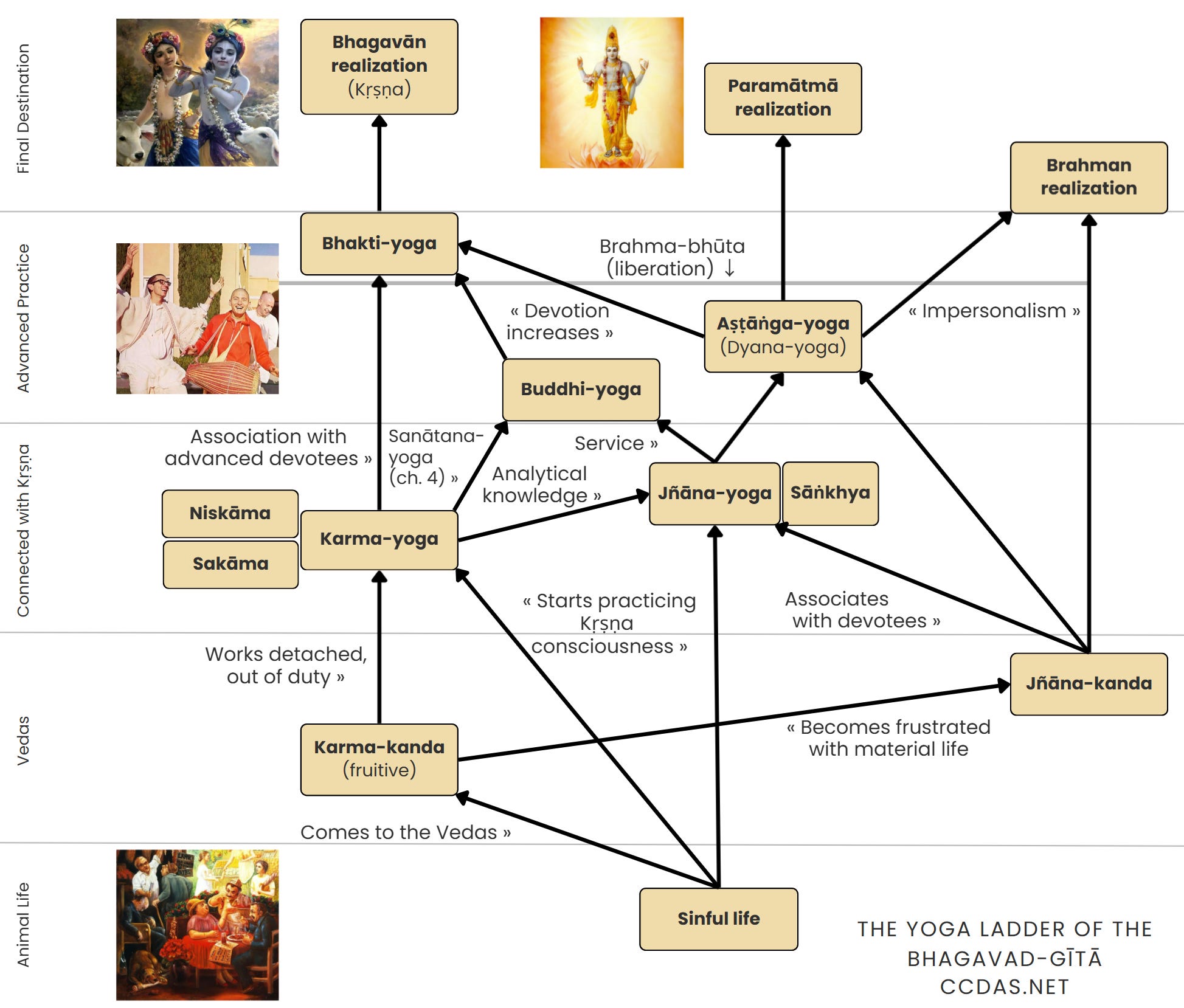
Concerning dhyāna-yoga, Kṛṣṇa explains the difference between the beginner and the advanced yogī, the discipline required for meditation, the need to control the mind, and the perfectional vision of one who sees the Supersoul everywhere. He also makes it clear that the real goal of yoga is not impersonal liberation or mystic perfection. Arjuna, however, puts this knowledge into perspective. Many great sages in the past attained perfection through this process of meditation, but it is ultimately not practical in the age we live in. This brings Kṛṣṇa to the explanation of the direct path of bhakti-yoga, which is the foundation of chapters seven to twelve. These six central chapters are the gravitational center of the Bhagavad-gītā, where we learn how to attain the goal of all Vedic knowledge: to always remember Kṛṣṇa and never forget Him.
In short, the first six chapters of the Gītā—discussed in the first volume—explain the yoga processes that elevate the soul, bringing us back to our original position of service to the Lord, while the next six—discussed in this second volume—explain both the goal itself and the process for attaining it: knowing Kṛṣṇa, always remembering Him, developing our natural love for Him, and serving Him through the process of devotional service.
We are now entering the heart of the Bhagavad-gītā.
Next: CHAPTER SEVEN
Read the entire book:
« The Song of God—Volume 2, chapters 7-12

This is a publication for thoughtful readers who want to go deeper into Kṛṣṇa consciousness. I publish daily, trying to offer high-quality spiritual content, and all posts are available to free subscribers. If you wish, you can also choose a paid subscription to support this work.
You can also receive the updates on WhatsApp or Telegram.
If you would like to contribute further, you can find the donation links here.