

« The Song of God—Volume 2, chapters 7-12
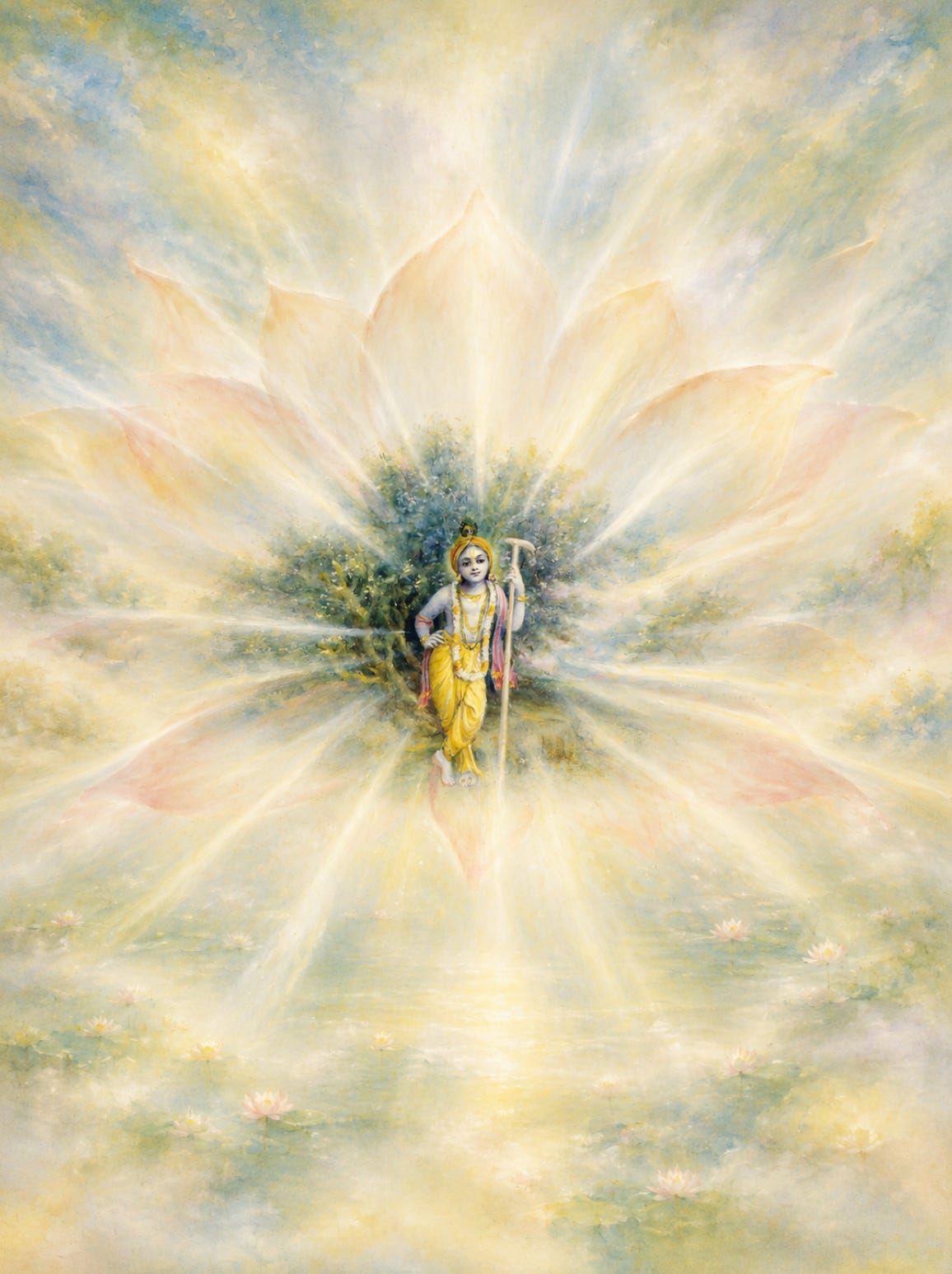
The power behind everything (Bg 7.8)
In the previous section, Kṛṣṇa established that everything that exists comes from His potencies and rests upon Him. Now He describes how He is the active principle behind everything. He is the potency by which everything functions and attracts us.
He is the force behind the radiance of the sun, extraordinary talents and abilities, and even the sound from which the cosmos itself manifests. Whatever attractive things we see, we should know they are just fragments of Kṛṣṇa’s attractiveness. Due to illusion, we may think we are attracted to certain material objects, but in reality the attractive potency in the object comes from Kṛṣṇa. The problem is that material illusion causes us to seek that potency separately from Him. When this material conditioning is cleared, we realize that what we had been seeking all along was ultimately Kṛṣṇa.
Text 8: raso ’ham apsu kaunteya, prabhāsmi śaśi-sūryayoḥ
praṇavaḥ sarva-vedeṣu, śabdaḥ khe pauruṣaṁ nṛṣu
O son of Kuntī, I am the taste of water, the light of the sun and the moon, the syllable oṁ in the Vedic mantras; I am the sound in ether and ability in man.
Kṛṣṇa means “the all-attractive.” It is not just a name; Kṛṣṇa truly attracts everyone. A materialist may say that he is not attracted to Kṛṣṇa, but the things he is attracted to, including cars, houses, money, or women, are nothing but the energy of Kṛṣṇa. Therefore, he is also attracted to Kṛṣṇa; it is just that due to a lack of knowledge, he is attracted indirectly. Let’s take a beautiful woman, the supreme object of attraction for a materialistic man, for example. This woman is a combination of a body composed of the five material elements, and an individual soul. Both are potencies of Kṛṣṇa. Her beauty and other assets are also nothing but small fragments of Kṛṣṇa’s opulence. The materialist is thus deeply attracted to Kṛṣṇa; it is just that this attraction manifests in an unhealthy way, as envy and a desire to enjoy Kṛṣṇa’s potencies separated from Kṛṣṇa as a person. When this tendency is purified, the soul again comes to its normal, healthy state, manifesting an attitude of love and service to Him.
In the previous section, Kṛṣṇa established Himself as the source of everything. Now, He explains how He is the essence of everything. This teaches us how to perceive His presence in practical life. This is the beginning of the process of seeing Kṛṣṇa everywhere.
To “see Kṛṣṇa everywhere” may at first sound like a lofty ideal, but it is not about mere imagination or sentiment. Kṛṣṇa points to specific principles and potencies and explains how they come from Him. When we realize that, we can see Kṛṣṇa’s presence behind all these different manifestations.
We normally think in terms of material objects. We drink water and think of the water; we see the sun and think of the sun. In the same way, we see an intelligent or beautiful person and relate the characteristic to the person, “He is intelligent,” “She is beautiful,” etc. This, however, is not entirely correct. Money, beauty, intelligence, and other assets are not permanent attributes; they can be gained or lost. The question is: from where do they come? Kṛṣṇa consciousness means learning to see the source behind these manifestations. The energy or potency should remind us of the energetic, just as sunlight reminds us of the sun.
The taste of water
The first manifestation Kṛṣṇa teaches us to see in connection with Him is water: raso ’ham apsu. Rasaḥ means taste, and apsu means water. Aham means “I.” Kṛṣṇa is the taste of water. Prabhupāda explains:
“The taste of water is the active principle of water. No one likes to drink sea water, because the pure taste of water is mixed with salt. Attraction for water depends on the purity of the taste, and this pure taste is one of the energies of the Lord. The impersonalist perceives the presence of the Lord in water by its taste, and the personalist also glorifies the Lord for His kindly supplying tasty water to quench man’s thirst. That is the way of perceiving the Supreme.”
Kṛṣṇa previously explained that ether, air, fire, water, and earth are His separated energies. There is a certain sequence in the creation of these elements. Ether introduces sound, air touch, fire form, and water taste. This original taste of pure water, the very essence of water, is a manifestation of Kṛṣṇa. Water can then be mixed with salt and other substances, just like our original Kṛṣṇa consciousness can be covered by lust, anger, and so on, but when this happens, it stops being attractive.
Although water is available for free almost everywhere, people still buy mineral water, because they prefer to drink pure water. Every time we drink pure water, we can remember Kṛṣṇa, and every time we are forced to drink stale or foul-tasting water, we can remember our contaminated condition and desire to return to our original consciousness of devotion to Kṛṣṇa.
In a few of his lectures, Prabhupāda expands the meaning of the word “apsu” to any liquid one may drink. Meditating in this way, even a drunkard can start his process of Kṛṣṇa consciousness by remembering Kṛṣṇa while he drinks. As he mentions:
“Even you drink wine, so you have got some taste in any liquid thing while drinking. So Kṛṣṇa says, raso ‘ham apsu kaunteya: “My dear Kaunteya, Arjuna, that taste in the liquid thing which you drink or use, that is I am.” Just see how it is easily can be done. Nobody is without drinking something liquid. Either Coca-Cola or water or this or that, something must be drinking. So Kṛṣṇa says that “I am the taste.” So where is the difficulty of understanding Kṛṣṇa? (February 23rd 1974, Bombay)
The light of the sun and the moon
The next description is prabhāsmi śaśi-sūryayoḥ (I am the light of the sun and the moon). The explanation for this is more metaphysical.
When physicists study the sun, they conclude that the sun emits light through a process of nuclear fusion. According to the Vedas, however, this is just the apparent process. Ultimately, all light is an emanation of Kṛṣṇa. It starts as the impersonal brahmajyoti, Kṛṣṇa’s spiritual effulgence that permeates the whole creation, penetrating even inside the material universes. If this transcendental light is everywhere, why is it that we see the sky dark at night? The point is that this is transcendental light, and we have material eyes. What the sun does is to reflect this spiritual light in a form that we can see. Superficially, it appears that the sun is generating light by a process of nuclear fusion, but the ultimate cause is this process of transcendental reflection.
This concept is explained by Lord Kapila in SB 3.26.3 by the words svayaṁ-jyotir viśvaṁ yena samanvitam. Prabhupāda explains the concept in more detail in his purport:
“It is explained here, svayaṁ-jyotiḥ: He is light Himself. We have experience in the material world of one light’s being a reflection of another, just as moonlight is a reflection of the sunlight. Sunlight is also the reflection of the brahmajyoti. Similarly, brahmajyoti, the spiritual effulgence, is a reflection of the body of the Supreme Lord. This is confirmed in the Brahma-saṁhitā: yasya prabhā prabhavataḥ. The brahmajyoti, or Brahman effulgence, is due to His bodily luster. Therefore it is said here, svayaṁ-jyotiḥ: He Himself is light. His light is distributed in different ways, as the brahmajyoti, as sunlight and as moonlight. Bhagavad-gītā confirms that in the spiritual world there is no need of sunlight, moonlight or electricity. The Upaniṣads also confirm this; because the bodily luster of the Supreme Personality of Godhead is sufficient to illuminate the spiritual world, there is no need of sunlight, moonlight or any other light or electricity. This self-illumination also contradicts the theory that the spirit soul, or the spiritual consciousness, develops at a certain point in material combination. The term svayaṁ-jyotiḥ indicates that there is no tinge of anything material or any material reaction. It is confirmed here that the concept of the Lord’s all-pervasiveness is due to His illumination everywhere. We have experience that the sun is situated in one place, but the sunlight is diffused all around for millions and millions of miles. That is our practical experience. Similarly, although the supreme light is situated in His personal abode, Vaikuṇṭha or Vṛndāvana, His light is diffused not only in the spiritual world but beyond that. In the material world also, that light is reflected by the sun globe, and the sunlight is reflected by the moon globe. Thus although He is situated in His own abode, His light is distributed all over the spiritual and material worlds.”
In this way, every time we see the light of the sun or the moon, or in fact any form of light, we can remember that this light is just an insignificant fraction of Kṛṣṇa’s effulgence. Behind this effulgence is Kṛṣṇa Himself, in His personal form. If the light of the sun is so dazzling, and the light of the moon so cooling, we can only imagine how attractive Kṛṣṇa is in His personal form.
The Omkāra
Next, Kṛṣṇa describes: praṇavaḥ sarva-vedeṣu. He is the Omkāra in the Vedic mantras. The Māṇḍūkya Upaniṣad declares:
om ity etad akṣaram idam sarvam
tasyopavyākhyānam bhūtam bhavad bhaviṣyad iti
sarvam onkāra eva
yac cānyat trikālātītam tad apy onkāra eva
“Om. Indeed, this imperishable syllable is everything. All that is material exists under the purview of past, present, and future, and all of that is Om. And everything that transcends space and time (the spiritual realm) is also Om. There is nothing apart from the Lord. He is full of all auspicious attributes, He is close to all, and He is unchangeable, beyond all transformations of matter.”
The syllable Om is the holy name of the Lord, non-different from the mantra Hare Kṛṣṇa. Om is the Lord Himself. It is not just a symbol or an impersonal manifestation. Just as there is no difference between Kṛṣṇa and His name, there is no difference between Kṛṣṇa and the Omkāra. All Vedic mantras develop from this original sound, and all the Lord’s potencies are present within it. An impersonalist may perceive Brahman in the syllable Oṁ, a yogī may perceive Paramātmā, but the devotee understands its complete meaning.
In a marriage ceremony, for example, a fire ceremony is performed to invoke the presence of the Lord to witness the vows made by the couple. However, in previous ages, marriages were sometimes performed by just invoking the syllable Om. When Om is chanted with faith, the Lord is personally present, just as He is when we chant the mahā-mantra Hare Kṛṣṇa.
In his purport to CC Adi 7.128, Prabhupāda mentions:
“All potencies are invested in the holy vibration of the holy name of the Lord. There is no doubt that the holy name of the Lord, or omkāra, is the Supreme Personality of Godhead Himself. In other words, anyone who chants omkāra and the holy name of the Lord, Hare Kṛṣṇa, immediately meets the Supreme Lord directly in His sound form. In the Nārada Pañcarātra it is clearly said that the Supreme Personality of Godhead Nārāyaṇa personally appears before the chanter who engages in chanting the aṣṭākṣara, or eight-syllable mantra, om namo nārāyaṇāya. A similar statement in the Māṇḍūkya Upaniṣad declares that whatever one sees in the spiritual world is all an expansion of the spiritual potency of omkāra.”
All the qualities of the Lord are present in the syllable Om, and similarly, all the qualities that are attributed to Om in this and other verses are personal attributes of the Lord. Omkāra is beginningless, changeless, supreme, and free from deterioration and external contamination. Because Omkāra is the sound incarnation of the Lord, it is the origin, middle, and end of everything.
All material bodies change over time, going through birth, death, and all transformations in between. In other words, all material creations exist under the influence of time, which is divided into past, present, and future. All of this is Brahman and has no separate existence. The Lord is everything, the Lord is everywhere, and the Lord transcends the division of time in terms of past, present, and future. These points are confirmed by the Lord Himself to Brahmā in the first three verses of the catuḥślokī Bhāgavatam:
“Brahmā, it is I, the Personality of Godhead, who was existing before the creation, when there was nothing but Myself. Nor was there the material nature, the cause of this creation. That which you see now is also I, the Personality of Godhead, and after annihilation what remains will also be I, the Personality of Godhead.
O Brahmā, whatever appears to be of any value, if it is without relation to Me, has no reality. Know it as My illusory energy, that reflection which appears to be in darkness.
O Brahmā, please know that the universal elements enter into the cosmos and at the same time do not enter into the cosmos; similarly, I Myself also exist within everything created, and at the same time I am outside of everything.” (SB 2.9.33-35)
It’s only due to the influence of the illusory energy that we see ourselves or other things as separate from Kṛṣṇa. In reality, not only does everything come from Him, but everything is part of His different energies, and therefore, everything should be used for Him in devotional service. When we adopt this process, then ceto-darpana-marjanam bhava-maha-davagni-nirvapanam: the mirror of the heart is cleansed and the fire of material existence extinguished. We can then see that we are always with the Lord, and only due to illusion did we previously think we were separated from Him.
Sound in ether
Kṛṣṇa also describes: śabdaḥ khe. He is sound in ether. This encapsulates a series of delicate concepts that can deepen our understanding of the cosmos and its relationship with Kṛṣṇa.
Sound is the principle of creation that precedes the creation of ether. The element ether is the fabric of the whole cosmic manifestation, and sound is the source of ether. Sound is thus the starting point of everything we see in this material world.
Lord Kapila mentions that “The activities and characteristics of the ethereal element can be observed as the accommodation of room for the external and internal existences of all living entities, namely the field of activities of the vital air, the senses and the mind.” (SB 3.26.34)
Before any physical object can be created, it has to exist as a subtle manifestation, as an idea or concept. This book you are reading now started as a set of ideas that were gradually transformed into text. Similarly, material experiences start as mental impressions and desires that are eventually transformed into physical forms and action. As Prabhupāda defines it, “Mental existence transforms into tangible form as soon as there is an opportunity due to contamination or development of the gross elements from subtle form.”
He also gives a didactic example of how it works practically: “That subtle forms exist in the ether has been proven by modern science by transmission of television, by which forms or photographs of one place are transmitted to another place by the action of the ethereal element.”
Nowadays, I can even download a 3D model from the web and transform it into a physical form using a 3D printer. The file of the model is thus a subtle form of the object that can be transmitted invisibly through space through a Wi-Fi signal, and later be printed into a physical form. Similarly, the entire cosmic existence started as sound. Brahmā received the Vedas, and created the universe by reciting the Vedic mantras. This point is explained in the Viṣṇu Purāṇa (1.5.64):
nāma rūpam ca bhūtānām, kṛtyānām ca prapañcanam
veda-śabdebhya evādau, devādīnām cakāra saḥ“By reciting the words of the Vedas, Lord Brahmā created the names and forms of the material elements, the rituals, the devas, and all other living entities in the beginning of creation.”
A more elaborate description of the nature of Vedic sound and how it is the basis for the whole material manifestation is found in the Eleventh Canto of Śrīmad-Bhāgavatam (11.21.36-40), where Kṛṣṇa describes to Uddhava:
“The transcendental sound of the Vedas is very difficult to comprehend and manifests on different levels within the prāṇa, senses and mind. This Vedic sound is unlimited, very deep and unfathomable, just like the ocean.
As the unlimited, unchanging and omnipotent Personality of Godhead dwelling within all living beings, I personally establish the Vedic sound vibration in the form of omkāra within all living entities. It is thus perceived subtly, just like a single strand of fiber on a lotus stalk.
Just as a spider brings forth from its heart its web and emits it through its mouth, the Supreme Personality of Godhead manifests Himself as the reverberating primeval vital air, comprising all sacred Vedic meters and full of transcendental pleasure. Thus the Lord, from the ethereal sky of His heart, creates the great and limitless Vedic sound by the agency of His mind, which conceives of variegated sounds such as the sparśas. The Vedic sound branches out in thousands of directions, adorned with the different letters expanded from the syllable om: the consonants, vowels, sibilants and semivowels. The Veda is then elaborated by many verbal varieties, expressed in different meters, each having four more syllables than the previous one. Ultimately the Lord again withdraws His manifestation of Vedic sound within Himself.”
In this way, sound is the source of the whole cosmic creation, and this sound is Kṛṣṇa. There is also another side. Sound can also bring our material entanglement to an end. This point is made in the last aphorism of the Vedānta-sūtra: anāvṛttiḥ śabdāt. Prabhupāda explains this point in his purport to SB 3.26.32:
“Anāvṛttiḥ śabdāt means “liberation by sound.” The entire material manifestation began from sound, and sound can also end material entanglement, if it has a particular potency. The particular sound capable of doing this is the transcendental vibration Hare Kṛṣṇa. Our entanglement in material affairs has begun from material sound. Now we must purify that sound in spiritual understanding. There is sound in the spiritual world also. If we approach that sound, then our spiritual life begins, and the other requirements for spiritual advancement can be supplied. We have to understand very clearly that sound is the beginning of the creation of all material objects for our sense gratification. Similarly, if sound is purified, our spiritual necessities also are produced from sound.”
By sound, Brahmā created the universe, and by receiving the Gāyatrī mantra from Kṛṣṇa’s flute, Brahmā attained perfection and offered the prayers recorded in the Brahma-saṁhitā. Similarly, by hearing many forms of material sound, our consciousness becomes entangled in matter, and we perform many material actions, but by hearing the transcendental vibration of the holy names, we become purified.
Ability in man
Kṛṣṇa concludes text 7.8 with the words pauruṣaṁ nṛṣu, “I am ability in man.” There are many persons who can achieve extraordinary things, but we should understand that this ability also comes from Kṛṣṇa. The word used is “vibhūti,” which indicates a manifestation of Kṛṣṇa’s potency. Kṛṣṇa later gives a series of examples. Even animals such as the shark and the lion are powerful only because they show a small fragment of Kṛṣṇa’s power.
In material consciousness, when we see someone showing some extraordinary talent, we either become envious, or glorify the person as the responsible for what was accomplished. In Kṛṣṇa consciousness, however, there is no need to envy anyone. We can respect and honor the person, but at the same time appreciate that the source of his or her talent is Kṛṣṇa. This soul is simply being empowered to achieve something due to His grace. Kṛṣṇa confirms this point later in the Gītā, by stating that “Know that all opulent, beautiful and glorious creations spring from but a spark of My splendor.”
One may desire, or even work hard to achieve something, but unless Kṛṣṇa agrees to empower this soul with a fragment of His power, one cannot accomplish anything. Many work hard, but that does not mean they all become millionaires.
The point is that together with a certain talent, Kṛṣṇa gives us free will. We can use it under the false ego, claiming the merits and results of what we do, or we can use it as an instrument to serve Kṛṣṇa and benefit others.
An interesting example of the contrast between these two mentalities is described in the Rāmāyana. Rāvana is the materialist, trying to capture Sītā, the eternal consort of Lord Rāma, while Hanumān is the devotee trying to reunite her with Him. Ability is the potency of Kṛṣṇa, and should be brought back to Him, being used in devotional service. Everyone has a certain talent that was given by Kṛṣṇa. Using this talent for Kṛṣṇa brings us to the perfection of life.
Main points in the purport of Śrīla Prabhupāda:
“O son of Kuntī, I am the taste of water, the light of the sun and the moon, the syllable oṁ in the Vedic mantras; I am the sound in ether and ability in man.”
a) When we see only the energies of Kṛṣṇa, we experience Him impersonally. However, behind the energy is the energetic. Just as the demigod of the sun is perceived by the energy of the solar globe, Kṛṣṇa lives in His eternal abode but is perceived through His all-pervading potencies.
b) Kṛṣṇa is the active principle of the water, its taste. When we see water, we may be absorbed in the impersonal conception, experiencing the energy through its taste, or we may remember Kṛṣṇa as the Supreme Person who supplies it. Both conceptions exist simultaneously in everything and are not contradictory. The main point is to learn to see Kṛṣṇa in everything.
c) Impersonalists prefer to address Kṛṣṇa through the oṁ-kāra instead of uttering His personal names, but the oṁ-kāra is also Kṛṣṇa, as His sound representation; therefore, even they glorify Kṛṣṇa. One who is truly blessed comes to Kṛṣṇa consciousness and becomes liberated from material illusion.
Next: Kṛṣṇa is the essence of everything (Bg 7.9 to 7.12)
Read the entire book:
« The Song of God—Volume 2, chapters 7-12

This is a publication for thoughtful readers who want to go deeper into Kṛṣṇa consciousness. I publish daily, trying to offer high-quality spiritual content, and all posts are available to free subscribers. If you wish, you can also choose a paid subscription to support this work.
You can also receive the updates on WhatsApp or Telegram.
If you would like to contribute further, you can find the donation links here.