

Subscribe to receive new articles by e-mail. It’s free, but if you like, you can pledge a donation:
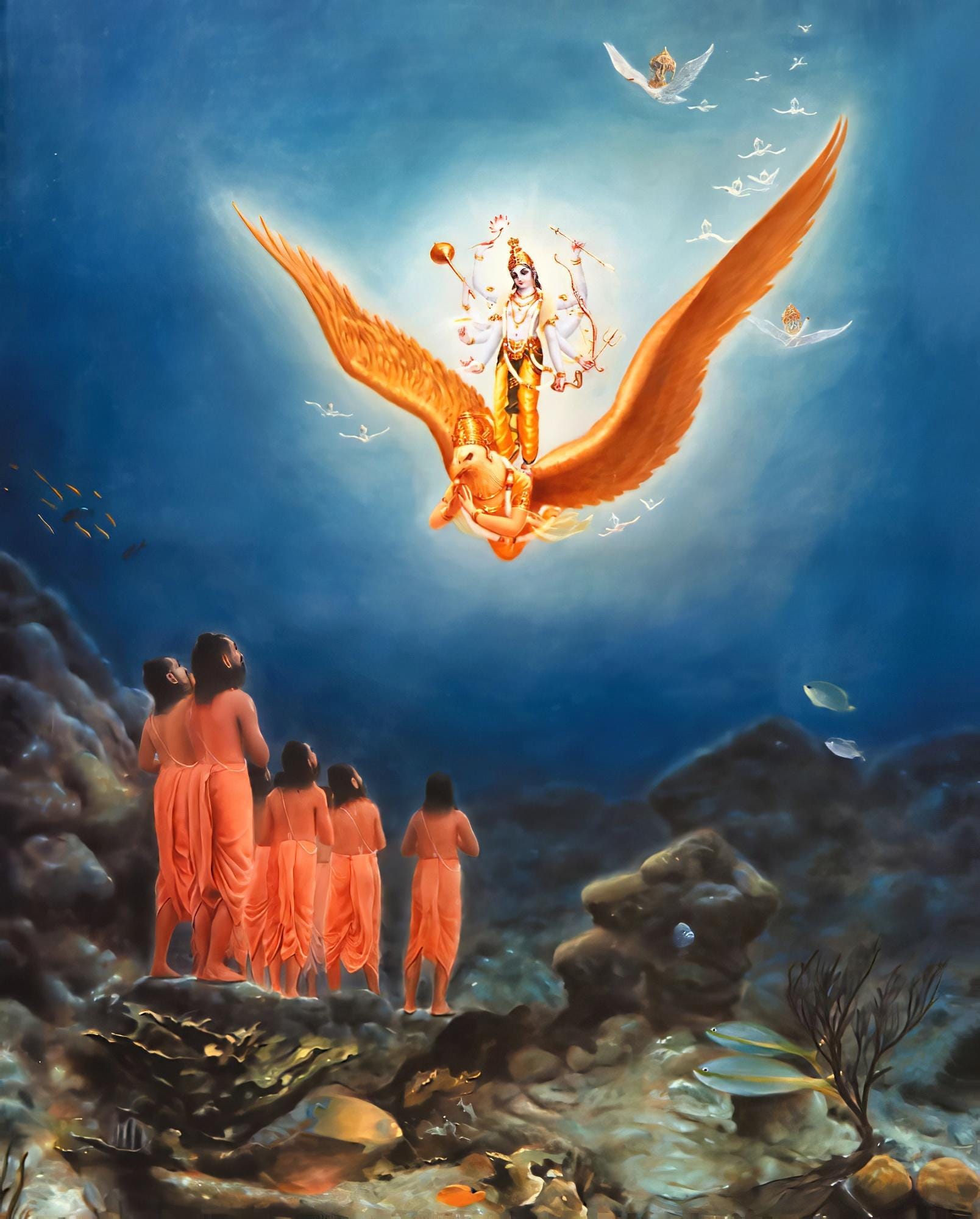
The Pracetas are the ten sons of King Prācīnabarhi. They lived a very long time ago, in the first Manvantara, and their story is described in the Śrīmad Bhāgavatam. The reason they are still remembered, even today, is because of their great austerities inside the water, which led them to personally meet the Supreme Lord, who desired to give them a benediction. They had great knowledge and understood who Lord Viṣṇu is. They understood that He is both infinitely powerful and the goal of life.
In reality, the true benediction is for the Lord to be satisfied with us. We may not think like this in our current, conditioned state, but when we speak about the eternal nature of the soul in his eternal transcendental service to the Lord, that’s the ultimate goal.
However, the Lord had already stated that He was satisfied with the Pracetas, and on their part, they also revealed that they were fully satisfied in having the Lord as the ultimate goal of life. When a devotee is fully engaged in the service of the Lord, he feels so satisfied that there is no need for any separate benediction, just as when one takes shelter of a transcendental pārijāta tree (a kalpa-vṛkṣa), he can get anything he desires to his full satisfaction, and, therefore, there is no need to approach any other tree.
The Pracetas thus revealed that they considered the presence of the Lord the most desirable benediction and that they didn’t desire anything more. However, since the Lord desired to give them yet another benediction, it would not be proper to reject it. The Pracetas were thus puzzled about what to ask. They considered, however, that the Lord is unlimited, and therefore it would be improper to ask for anything less than an unlimited benediction, something of infinite value. In this way, the Pracetas teach us how to pray to the Lord and how to ask for benedictions. Often, we go to the Lord to pray for some insignificant material blessing, such as a better financial position, material education, a husband or wife, etc., but this is just like going to a king to ask for a pinch of ashes. It is not only unintelligent but even offensive. Instead, we should go to the unlimited Person to ask for something of unlimited value.
What was the invaluable benediction asked by the Pracetas?
To be always able to associate with pure devotees, fully engaged in discussing the Lord’s pastimes, for as long as they had to remain in this material world.
Even a moment of this association is more valuable than anything in this material world, or even impersonal liberation; therefore, how could one calculate the value of continuously being in such an association? The Pracetas were thus not falsely modest in asking for it. They understood the value of what they were asking, and we should pray similarly.
A pure devotee does not pray for liberation or even for cessation of the cycle of birth and death because he does not consider that important. The most important thing for a devotee is getting a chance to hear about the pastimes and glories of the Lord. This is considered greater than even being elevated to Vaikuṇṭha, because a pure devotee can invoke the atmosphere of Vaikuṇṭha or Vṛndāvana anywhere simply by chanting the holy names or remembering the Lord.
The reason pure devotees do not desire even elevation to the spiritual planets is thus not just modesty, but the fact that they are already in direct association with Krsna. A person in such a platform already lives in the spiritual world; therefore, there is no need to ask for something one already has. Although a pure devotee considers himself contaminated and unfit for being transferred to the spiritual world, there is no question of being contaminated, because devotional service itself is the transcendental position.
The defining characteristic of pure devotees is that they are always eager to glorify the Lord, and thus, when they come together, the most powerful spiritual discussions take place. Such discussions create a transcendental atmosphere so powerful that even conditioned souls become spiritually aware, and therefore forget all their material hankerings, at least for the time being. This implies that in the beginning, one may again forget if he or she returns to his materialistic activities after hearing for some time, but if one stays in the company of such pure devotees and continues hearing, one will remain fixed on the spiritual platform.
If such discussions are so powerful that they can instantly elevate even conditioned souls to the Vaikuṇṭha platform, what to say about the benefit pure devotees derive from them? Therefore, being in the company of such pure devotees is the ultimate goal. Liberation is just a secondary result. As the Lord Himself explains: “My dear Nārada, actually I do not reside in My abode, Vaikuṇṭha, nor do I reside within the hearts of the yogīs, but I reside in that place where My pure devotees chant My holy name and discuss My form, pastimes and qualities.”
This same point is made by the Pracetas. The Lord, who is the ultimate goal of life, is present among devotees who are engaged in hearing and chanting the holy name. Therefore, by this simple process, they have already attained perfection.
One can also derive benefit from visiting holy places, but the reason the holy places have such a power is that they are visited by pure devotees of the Lord, who are so saintly that they are capable of purifying even the places of pilgrimage. One who thus visits holy places just to take a bath is compared to a donkey or a cow (sa eva go-kharaḥ). The real point is thus to associate with such pure devotees who mercifully travel around the world, preaching and bringing relief to all sincere souls who come in contact with them. The Pracetas themselves knew well their power.
We can’t imitate the Pracetas in their austerities, or in their meeting with Lord Śiva and later with Lord Viṣṇu, but we can follow their footsteps in practicing regulated devotional service in cooperation with other devotees, just as they did, accepting a spiritual master and learning the proper conclusions of the scriptures from him, performing prescribed austerities such as fasting on ekādasī, being respectful to others and so on, and offering all of this to the Lord. By doing so, we may obtain the opportunity of associating with pure devotees and, through their mercy, attain the Supreme Lord.
Prayers are also very important. Prabhupāda explains that offering prayers to the Lord is the living entity's constitutional right, and one may offer prayers in all circumstances of life. Even though we are not perfect in glorifying the Lord, we can offer our sincere prayers according to our capacity and appreciate the Lord’s glories. As Krsna explains in the Gītā (9.32), by taking shelter of Him, we can approach the supreme destination.
What was the reaction of the Lord? He was, of course, very pleased with the prayers of the Pracetas and satisfied by the benediction they had chosen. In the Seventh Canto, it is described that the Lord was not satisfied when, after being defeated by the demons, the demigods went to the Lord to pray for assistance in defeating the asuras, instead of pure devotional service. The Pracetas, however, being pure devotees, were able to fully satisfy the Lord, who said: “May whatever you have prayed for be fulfilled.”
If the Lord was so satisfied with the Pracetas, why did he leave afterwards? Prabhupāda explains: “According to Śrīla Jīva Gosvāmī, this is an exhibition of His kindness to innumerable other devotees. Although He was being attracted by the Pracetās, He left. This is an example of His renunciation. This renunciation was also exhibited by Lord Caitanya Mahāprabhu when He stayed with Advaita Prabhu after taking sannyāsa. All the devotees there wanted Him to stay a few days longer, but Lord Caitanya left without hesitation. The conclusion is that although the Supreme Lord has unlimited kindness for His devotees, He is not attached to anyone. He is equally kind to His innumerable devotees all over the creation.”
You can also donate using Buy Me a Coffee, PayPal, Wise, Revolut, or bank transfers. There is a separate page with all the links. This helps me enormously to have time to write instead of doing other things to make a living. Thanks!