

Subscribe to receive new articles by e-mail. It’s free, but if you like, you can pledge a donation:
Once, observing that King Prācīnabarhi, a descendant of Dhruva Maharaja, had become involved in materialistic activities, missing the ultimate goal of life, Nārada Muni became compassionate and spoke to him, using an allegory to explain our precarious condition of a person attached to material gratification.
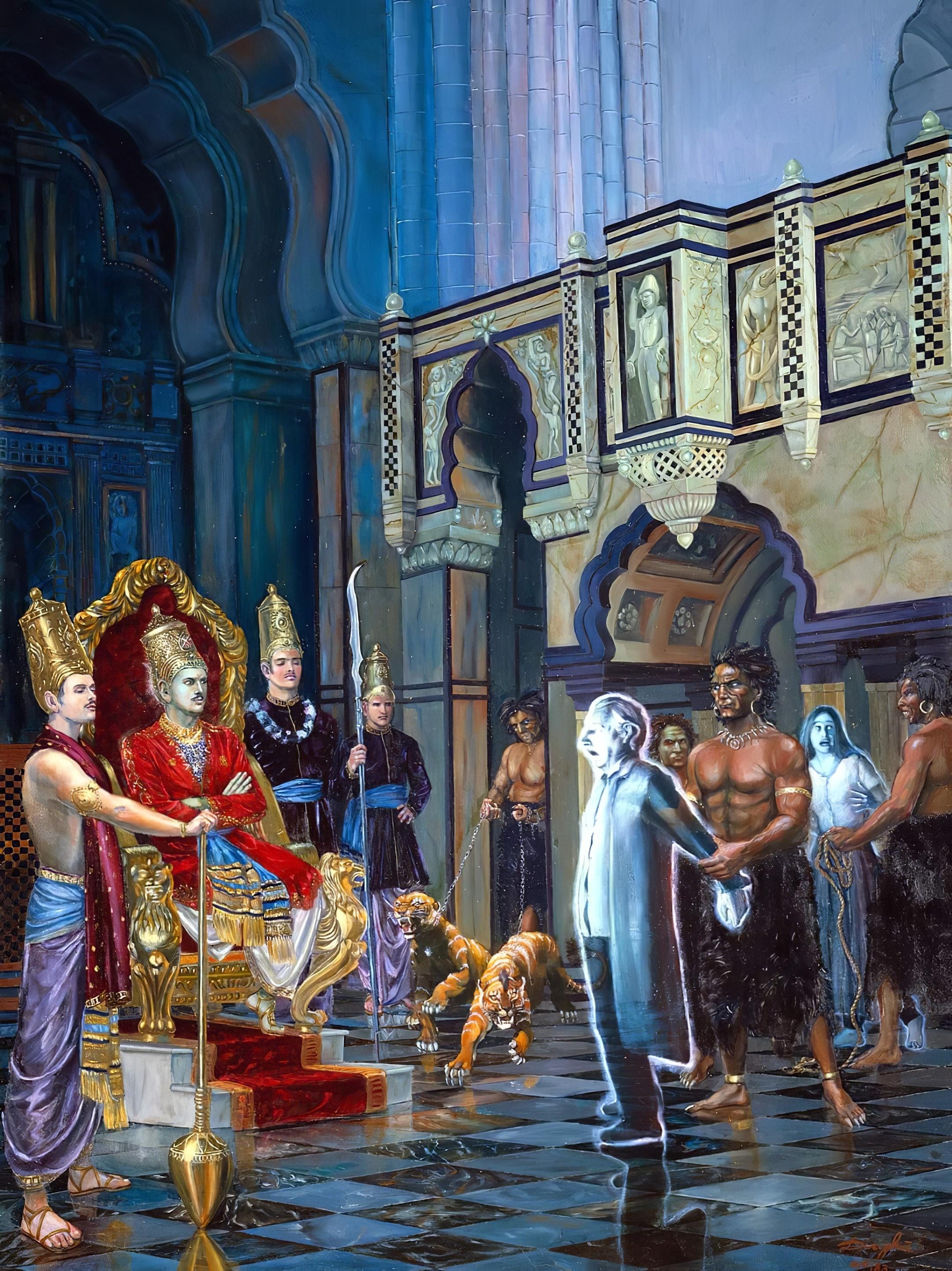
“My dear King, please search out that deer who is engaged in eating grass in a very nice flower garden along with his wife. That deer is very much attached to his business, and he is enjoying the sweet singing of the bumblebees in his garden. Just try to understand his position. He is unaware that before him is a tiger, which is accustomed to living at the cost of another’s flesh. Behind the deer is a hunter, who is threatening to pierce him with sharp arrows. Thus the deer’s death is imminent.” (SB 4.29.53-54)
What does it mean?
Just as a materialist, the deer is focused on momentary gratification, enjoying the garden with his family, peacefully eating grass, and hearing the sweet sounds of the bees. He doesn’t notice, however, that he is surrounded by death and his brief life is going to end in just a moment. When we do like this, we live in vain, and our destiny is uncertain.
Prabhupāda explains in his purport: “The human being, just like the deer, enjoys his family without knowing that before him is the factor of time, which is represented by the tiger. The fruitive activities of a living entity simply create another dangerous position and oblige him to accept different types of bodies. For a deer to run after a mirage of water in the desert is not unusual. The deer is also very fond of sex. The conclusion is that one who lives like a deer will be killed in due course of time. Vedic literatures therefore advise that we should understand our constitutional position and take to devotional service before death comes.”
In the scriptures, regulated family life is recommended as a progression from sinful life. However, as this passage makes clear, pious family life, even though a step in the right direction, is also not the ultimate goal of life. Unless we come to the platform of Krsna Consciousness, transforming our family life in an extension of our service to the Lord, it will still bring us to another body at the end. In his books, Prabhupāda explains about family life in Krsna Consciousness, centered around the service to the Lord, which is not contrary to our spiritual development. If we are able to build such a Krsna Conscious family, there is no need to leave it, but if we fail to do so, such a materialistic family will be always be a hindrance to our progress.
In materialistic life, relationships are established by interest. A man sees a lady as a source of gratification, and thus accepts to maintain her, while the lady sees a man as a source of material resources, and thus agrees to satisfy him. Once the relationship is established, one demands from the other, and when the demands are not satisfied, quarrel and divorce follow. Even if it works, the outcome is still not good, because it simply results in material illusion. A materialistic wife or husband is simply interested in increasing her or his sense gratification, and will simply try to use us for that purpose.
Prabhupāda emphasizes this point in his purport to SB 4.29.54: “Materialistic life means forgetting one’s constitutional position as the eternal servant of Kṛṣṇa, and this forgetfulness is especially enhanced in the gṛhastha-āśrama. In the gṛhastha-āśrama a young man accepts a young wife who is very beautiful in the beginning, but in due course of time, after giving birth to many children and becoming older and older, she demands many things from the husband to maintain the entire family. At such a time the wife becomes detestable to the very man who accepted her in her younger days. One becomes attached to the gṛhastha-āśrama for two reasons only: the wife cooks palatable dishes for the satisfaction of her husband’s tongue, and she gives him sexual pleasure at night. A person attached to the gṛhastha-āśrama is always thinking of these two things — palatable food and sex enjoyment. The talks of the wife, which are enjoyed as a family recreation, and the talks of the children both attract the living entity. He thus forgets that he has to die someday and has to prepare for the next life if he wants to be put into a congenial body.”
An important point is that in this passage, Nārada Muni speaks to King Prācīnabarhi. Therefore, he speaks from the point of view of a man who needs to renounce his attraction for mundane family life and progress to a platform of devotional service. However, the same instructions are also applicable to ladies. Ultimately, every conditioned soul is a male, in the sense that we all put ourselves in the position of enjoyers of the material world. For a man, “women” means materialistic ladies, while for a lady, “women” means materialistic men, who are interested in sense gratification. Both types of “women” are equally dangerous to one’s spiritual progress, and their association has to be eventually abandoned.
In his purport to 4.29.55, for example, Prabhupāda explains: “The great sage Nārada clearly instructs King Barhiṣmān not to remain his entire life in the gṛhastha-āśrama. Being in the gṛhastha-āśrama means being under the control of one’s wife. One has to give up all this and put himself into the āśrama of the paramahaṁsa, that is, put himself under the control of the spiritual master. The paramahaṁsa-āśrama is the āśrama of the Supreme Personality of Godhead, under whom the spiritual master has taken shelter.”
How does this apply to ladies? See how Prabhupāda explains it in his purport to CC Madhya 24.259: “This is the process of renunciation at the stage of vānaprastha. After enjoying householder life for some time, the husband and wife must leave home and distribute their riches to brāhmaṇas and Vaiṣṇavas. One can keep his wife as an assistant in the vānaprastha stage. The idea is that the wife will assist the husband in spiritual advancement. Therefore Nārada Muni advised the hunter to adopt the vānaprastha stage and leave home. It is not that a gṛhastha should live at home until he dies. Vānaprastha is preliminary to sannyāsa. In the Kṛṣṇa consciousness movement there are many young couples engaged in the Lord’s service. Eventually they are supposed to take vānaprastha, and after the vānaprastha stage the husband may take sannyāsa in order to preach. The wife may then remain alone and serve the Deity or engage in other activities within the Kṛṣṇa consciousness movement.”
A lady is not supposed to directly take sannyāsa, but she may accept a renounced life by residing in a temple, or returning home and living under the protection of grown-up children as a saintly lady, absorbed in her spiritual practice, aloof from family affairs. The specific details for a renounced life may be different for men and ladies, but the goal and mentality are the same. We may stay for some time in family life, growing our children and developing the foundations of our spiritual life, but in old age it’s recommended that we become free from the encumbrances of family life and dedicate our remaining time to perfecting our Krsna Consciousness.
As described in the first canto (SB 1.15.50), after the disappearance of Krsna, the five Pandavas left home for the Himalayas to perfect their devotional service, while Draupadī and Subhadrā attained the same results by staying home and absorbing themselves in tough of Krsna.
You can also donate using Buy Me a Coffee, PayPal, Wise, Revolut, or bank transfers. There is a separate page with all the links. This helps me enormously to have time to write instead of doing other things to make a living. Thanks!