

« Things I Wish Someone Had Taught Me When I Started Krishna Consciousness
The principle of authority is a central point in the scriptures
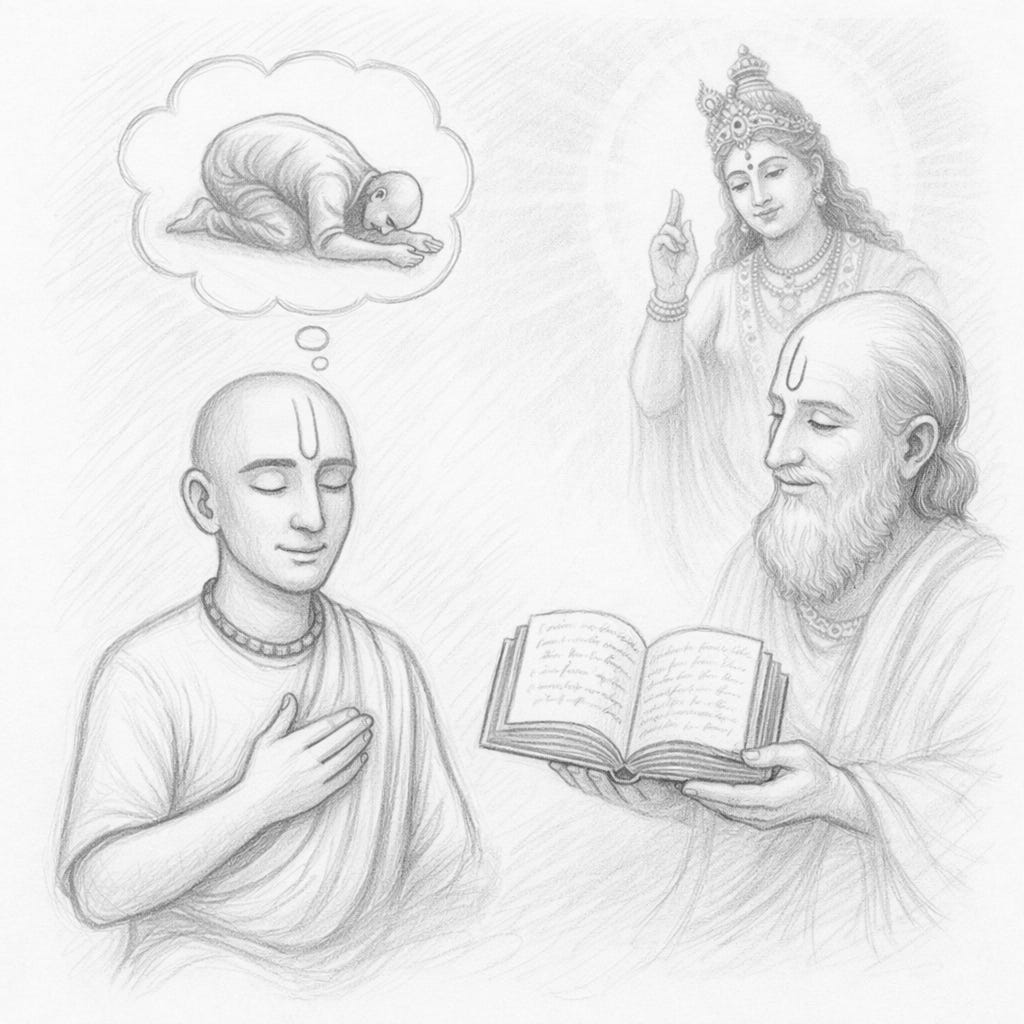
One point that is very central to Vedic culture, and very essential in order to understand it, is the principle of authority. This same principle is the basis of the spiritual culture and the principles enunciated in the Vedas in all eras: from Satya-yuga to Kali-yuga.
Other factors change from one era to another, starting with the process of self-realization. For Satya-yuga, aṣtānga-yoga is recommended, for Treta-yuga, fire sacrifices are recommended, for Dvāpara-yuga, temple worship is recommended, and for Kali-yuga, congregational chanting is recommended. Even the philosophical understanding changes, with people in Satya-yuga interpreting the Vedas as mentioning the Supreme in every verse, while people from Treta-yuga onward see multiple demigods being mentioned. However, this single factor, the principle of authority, never changes; it is a constant in all ages. We can say that this is the very principle of the Vedas. Without it, the scriptures lose their relevance.
How does it work? In Vedic culture, everyone is trained to follow someone else. Everyone has his or her acts regulated by a superior authority. The children are trained to follow the parents, the wife to follow the husband, the subjects to follow the king, the brahmacārīs in the gurukula to follow the guru, and so on. Everybody learns to follow someone who is above, and to help others who are under.
A wife is supposed to follow her husband; however, the husband is supposed to follow his spiritual master and the precepts of the scriptures. The spiritual master, in turn, is supposed to follow his spiritual master, who in turn was a follower of his own spiritual master, in an unbroken chain that goes all the way back to the Lord Himself.
A king rules over all the subjects, but he acts under the brāhmanas, who in turn act under the precepts of the scriptures. There are even cases of brāhmanas using their power to remove kings who would abuse their power, thus protecting the citizens, like in the case of Vena. Such brāhmanas, however, don’t aim to take power. They remove a sinful king with the goal of installing a proper king, like in the case of King Pṛthu. Sometimes, demigods may also intervene, and the final authority is the Lord himself, who also personally intervenes when there is dire need, exterminating the demons, protecting the devotees, and reestablishing the principles of religion.
In this way, Vedic Culture means that everyone follows the precepts enunciated by the Supreme Lord, directly or indirectly, and thus everyone progresses on the path. We may not like the idea of being restricted, but the alternative of remaining eternally in this material world is certainly much more uncomfortable.
The principle of authority is present in every society, since without it, there is just anarchy. In every society, one has to follow the laws, pay taxes to the government, respect the police, etc. The difference is that in the Vedic system, we follow authorities that are connected with the Supreme Lord in the name of spiritual progress, while in a mundane society, we are forced to follow materialistic rulers governing according to their own interests.
This principle of authority is essential not only for regulating action but also in the transmission of spiritual knowledge, which is the very essence of human life. Because we are all imperfect, we can’t obtain perfect knowledge by ourselves: we always need to receive it from perfect sources. When this system is broken, spiritual knowledge is lost, and we cut ourselves off from the very means of salvation from material life.
The difficulty in maintaining this Vedic principle of authority is that three factors need to be fulfilled simultaneously:
a) We need to find qualified authorities to follow.
b) We need to become good followers of such authorities.
c) We need to become kind instructors for those who come after us.
The difficulty is that modern culture pushes us in the direction of individualism and independent action. This combines with negative propensities we may be bringing from past lives, and the result is that we often, plainly speaking, have a hatred for authority. Just as people criticize politicians, artists, and others in a position of power or privilege, it’s common for devotees to criticize and find faults in any sort of spiritual leaders, be it based on facts or fiction.
The problem with this approach is that it destroys this principle of authority that is so essential in spiritual life. One can’t really advance in the spiritual path without having spiritual teachers and role models. While on the one hand, we must learn to protect ourselves from leaders acting out of self-interest, we need to be attentive not to reject the principle of authority in itself, which is so essential for our spiritual progress. We should always have spiritual authorities, but we should find the right ones.
Another problem is that if we can’t follow, we will also not be able to guide others. We then risk becoming bad authorities ourselves and misleading others. This also shows another possible shortcoming, which is not being able to recognize good qualities in others. As mentioned by Bhīṣmadeva in his discourse to King Yudhiṣṭhira before abandoning his body, one who sees good qualities in others gradually develops their good qualities, while one who criticizes others gradually absorbs their sins and vices.
« Things I Wish Someone Had Taught Me When I Started Krishna Consciousness
You can also donate using Buy Me a Coffee, PayPal, Wise, Revolut, or bank transfers. There is a separate page with all the links. This helps me enormously to have time to write instead of doing other things to make a living. Thanks!