


You can receive new articles directly in your inbox. Subscription is free; donations are welcome.
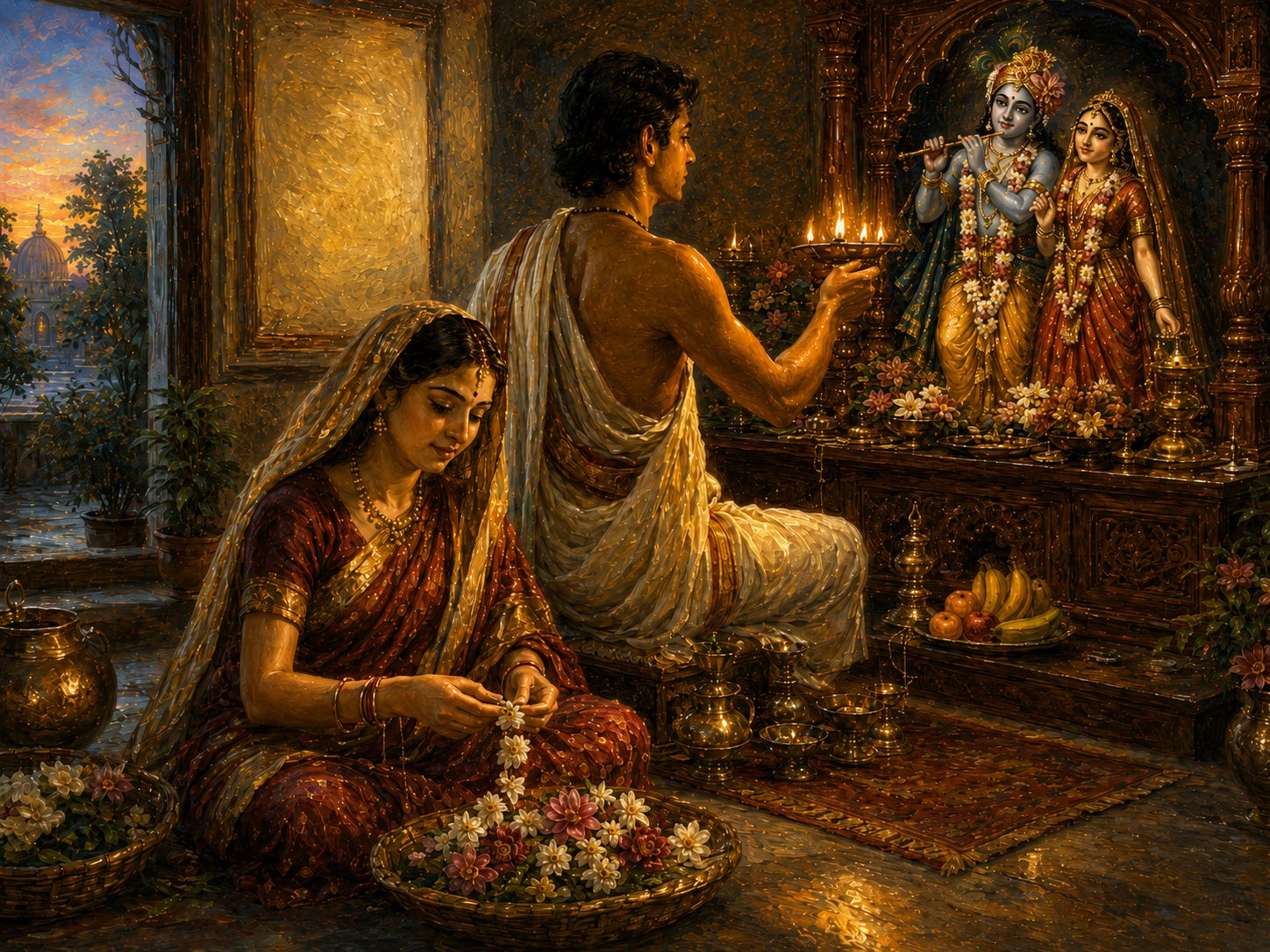
Śrila Bhaktivinoda Thākura once wrote that in an ideal marriage, the wife should be very devoted to her husband, and the husband should be a perfect devotee of the Lord. Prabhupāda also mentions the same point in his books. We may fail to notice how deep it is.
We study that in Vedic culture, wives would be extremely dedicated. Draupadī followed her husbands in the exile, facing all kinds of hardships. Sītā remained faithful to Rāma even after being separated from him and faced with all forms of danger. Gāndhārī even covered her eyes when she heard that her future husband was blind, as a way to better understand and follow him. All these examples go much beyond ordinary dedication.
The qualities of a good wife are described in the Śrīmad-Bhāgavatam (7.11.28) as:
santuṣṭā — She is satisfied in all circumstances.
alolupā — She is not greedy
dakṣā — She is expert in household affairs, running the house while the husband works outside.
dharma-jñā — She understands and practices religious principles.
priya-satya-vāk — She speaks truthfully and pleasingly.
apramattā — She is careful, attentive, not negligent.
śuciḥ — She is clean and pure.
snigdhā — She is affectionate towards the husband, children, and in-laws.
This combination of qualities may sound unrealistic today, but the text describes that just as in the past, there were highly-qualified men like Pṛthu and Yudhiṣṭhira, there were also women who would uphold such elevated qualities.
A good example is Arci, the wife of Pṛthu Maharaja. When the king retired to the forest, she followed him and accepted the same austerities, eating fruits and leaves, lying on the ground, etc. She did not have to do it; she could have stayed in the palace and spent her final days in comfort. Still, she decided to follow her husband to the end. It was also not just a matter of fanatical austerity. Even though she became thin and frail, Śrīmad-Bhāgavatam describes that she did not feel difficulty because she felt pleasure in serving her husband. We will be pressed to find a better example of selfless love than this.
This explains that the Vedic ideal of a selfless wife is not based on repression, but on love, honor, and shared spiritual purpose. In this passage, Prabhupāda explains that both husband and wife are trained for a life dedicated to a higher purpose. The man is trained to execute his duties in Kṛṣṇa consciousness, and the wife is trained to support him in that higher mission.
We can also see that all the qualities described in SB 7.11.28 are balanced by the last two words in the same verse: apatitaṁ bhajet.
Bhajet means to worship, follow, or serve in a selfless way, and apatitam refers to a husband who is not fallen. As Prabhupāda mentions, it is not that a chaste wife should follow a narādhama, the worst of men. A perfect wife can only be paired with a perfect husband. We can see that when Rukmini came to know that she was going to be married to Śiśupāla, she pleaded Kṛṣṇa to prevent it, and decided that if Kṛṣṇa would not appear to save her, and she would be effectively married to him, she would fast until death.
What are the qualities of a qualified man? SB 7.11.21 gives a preliminary list:
śamaḥ — control of the mind
damaḥ — control of the senses
tapaḥ — austerity
śaucam — cleanliness
santoṣaḥ — satisfaction
kṣāntiḥ — forgiveness
ārjavam — simplicity, straightforwardness
jñānam — knowledge
dayā — mercy
acyutātmatvam — complete surrender to the Supreme Personality of Godhead
satyam — truthfulness
This list is preliminary because these are the qualities of a Brāhmana. A Vaiṣnava is supposed to supersede these qualities, being devoted to Kṛṣṇa and serving Him with his body, words, and thoughts.
A qualified husband should be self-controlled. He should protect, not exploit, be spiritually serious, grateful for his wife’s service, and use scriptures to bring people to Kṛṣṇa, instead of a tool for domination.
This brings us back to the point made by Bhaktivinoda Thākura. The problem in Kali-yuga is not just the women nor just the men. We all lack the ideal qualifications of people from other eras, and this makes all kinds of relationships difficult. Just making the women perfect wives would not solve the problem, for perfect wives can’t be paired with drunkards. Making the man perfect also does not solve the problem, for pure devotees can’t be paired with materialistic women. A selfless wife paired with an exploitative husband, or a selfless man paired with a selfish woman, results in an exploitative relationship. The only solution is when a perfect wife is combined with a perfect husband, just as illustrated in all these historical examples.
Both Śrila Bhaktivinoda Thākura and Śrīla Prabhupāda also show us the solution for this problem: Kṛṣṇa consciousness.
It is not possible to truly elevate people through repression alone, or even by merely training in the ordinary sense. Even speaking about the duties and qualities of men and women can backfire, because as soon as we start speaking about “men” and “women,” we reinforce people’s material conditioning. The women become defensive, questioning why they need to serve abusive men, and the men become defensive, asking why they should sacrifice for a woman who is not submissive. The problem then often grows instead of being solved.
Only when we come in contact with Kṛṣṇa and become purified by His association can we break with our conditioned natures and change in a meaningful way. This gives us a higher sense of identity, as eternal servants of Kṛṣṇa, meant to serve Kṛṣṇa and one another, and not just men and women trying to enjoy life to the maximum extent. Thus, before speaking about material duties, we have to establish the common spiritual identity.
Materially speaking, no couple is truly compatible, because men and women are always different. People come togueter thinking that the spouse will satisfy all their material ambitions, but we see practically that it often ends tragically. Even between Lord Śiva and Pārvatī, the highest and most compatible couple in the universe, there are sometimes disagreements and misunderstandings, as shown in the pastime of Citraketu and other events.
A man and a woman can only be about 75% compatible astrologically, and even this is extremely rare. As long as husband and wife remain selfish, there will always be problems, and even if somehow the marriage works without serious trouble, a materialistic couple will always walk in the wrong direction. Being astrologically compatible just means a man and a woman are under a similar form of illusion, and can thus cooperate in their material pursuits. Without a higher goal, it just increases material conditioning.
This brings another point made by Prabhupāda: ideal compatibility is when both the husband and the wife are pure devotees.
It can sound fanatical at first, but when we calmly examine it, we see it is true. All astrological tendencies are governed by karma. This is what makes people incompatible. A pure devotee comes in contact with Kṛṣṇa, who destroys all karma, just as the sun destroys fog in the morning. More than that, contact with Kṛṣṇa makes one develop all sorts of good qualities that predominate over material faults. When two persons are in contact with Kṛṣṇa and are determined to serve Him, that’s the best form of compatibility.
Husband and wife in this case become like two points at the base of a triangle, which has Kṛṣṇa at the top. As both move closer to Kṛṣṇa, they naturally come closer to each other. Conversely, when we move away from him, we become further apart. Real compatibility is not two conditioned natures perfectly satisfying each other, but two devotees willing to be purified by serving the same center.
In this way, different forms of education and organization may help, but the decisive factor is that both become Kṛṣṇa conscious. Without this, it is not really possible to have peaceful and spiritually progressive marriages.
This is a publication for thoughtful readers who want to go deeper into Kṛṣṇa consciousness. I publish daily, trying to offer high-quality spiritual content, and all posts are available to free subscribers. If you wish, you can also choose a paid subscription to support this work.
You can also receive the updates on WhatsApp or Telegram.
If you would like to contribute further, you can find the donation links here.