

Subscribe to receive new articles by e-mail. It’s free, but if you like, you can pledge a donation:
Join the Telegram group if you would like to join the live lessons. This course is maintained with your donations. Click here to donate.
💬 Text of the lesson
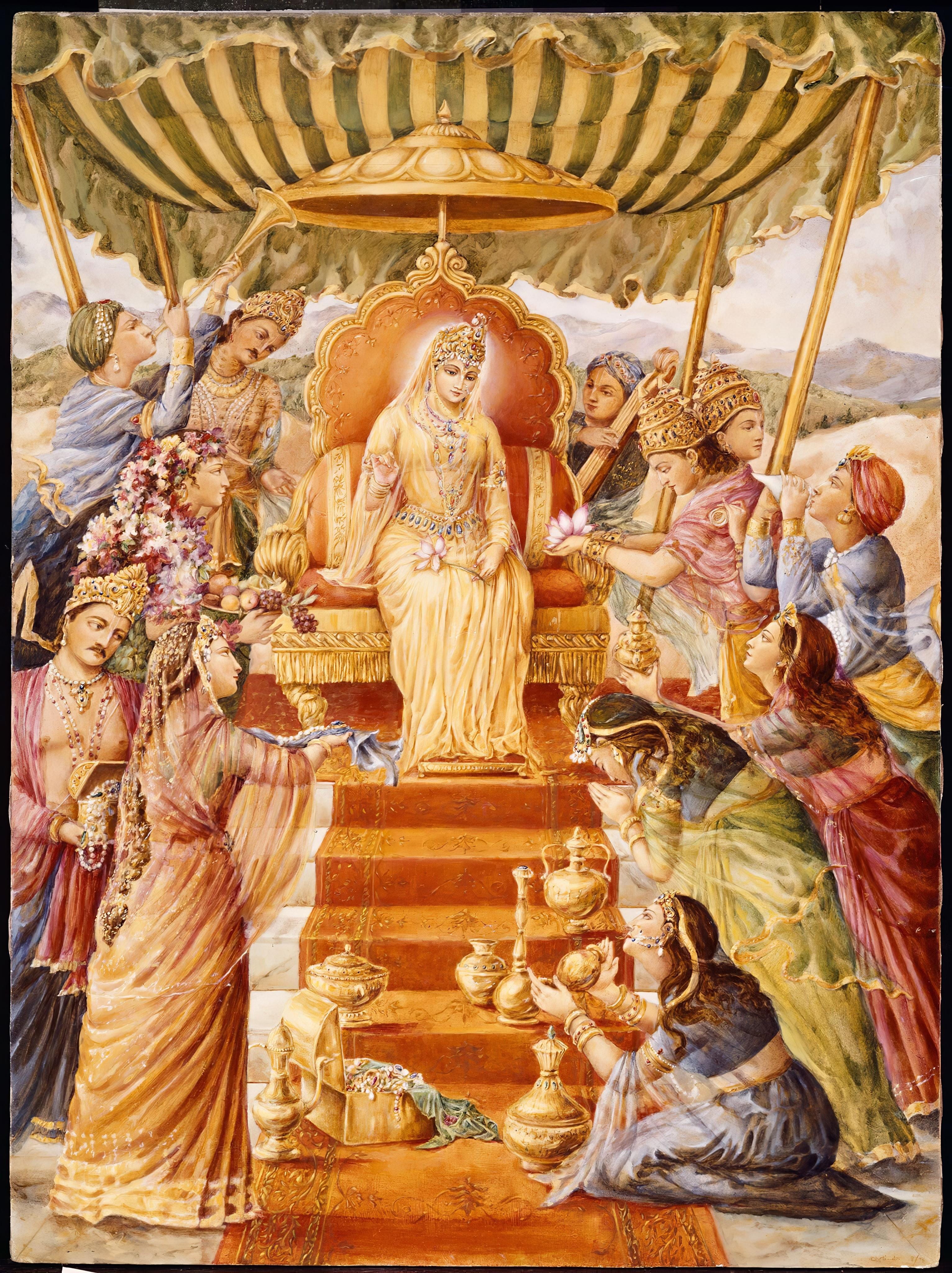
The real shelter for all women: Ramādevī worships Kāmadeva in Ketumāla-varṣa
“Śukadeva Gosvāmī continued: In the tract of land called Ketumāla-varṣa, Lord Viṣṇu lives in the form of Kāmadeva, only for the satisfaction of His devotees. These include Lakṣmījī [the goddess of fortune], the Prajāpati Saṁvatsara and all of Saṁvatsara’s sons and daughters. The daughters of Prajāpati are considered the controlling deities of the nights, and his sons are considered the controllers of the days. The Prajāpati’s offspring number 36,000, one for each day and each night in the lifetime of a human being. At the end of each year, the Prajāpati’s daughters become very agitated upon seeing the extremely effulgent disc of the Supreme Personality of Godhead, and thus they all suffer miscarriages.In Ketumāla-varṣa, Lord Kāmadeva [Pradyumna] moves very graciously. His mild smile is very beautiful, and when He increases the beauty of His face by slightly raising His eyebrows and glancing playfully, He pleases the goddess of fortune. Thus He enjoys His transcendental senses.
Accompanied during the daytime by the sons of the Prajāpati [the predominating deities of the days] and accompanied at night by his daughters [the deities of the nights], Lakṣmīdevī worships the Lord during the period known as the Saṁvatsara in His most merciful form as Kāmadeva. Fully absorbed in devotional service, she chants the following mantras.” (SB 5.18.15-17)
Different from the other varṣas of Jambūdvīpa, where the Lord is present in His deity form, in Ketumāla-varṣa, He is personally present. How can it be? Prabhupāda explains in his purport to text 15:
“This Kāmadeva, who appears as Kṛṣṇa’s son named Pradyumna, is viṣṇu-tattva. How this is so is explained by Madhvācārya, who quotes from the Brahmāṇḍa Purāṇa: kāmadeva-sthitaṁ viṣṇum upāste. Although this Kāmadeva is viṣṇu-tattva, His body is not spiritual but material. Lord Viṣṇu as Pradyumna or Kāmadeva accepts a material body, but He still acts spiritually. It does not make any difference whether He accepts a spiritual or a material body; He can act spiritually in any condition of existence. Māyāvādī philosophers regard even Lord Kṛṣṇa’s body as material, but their opinions cannot impede the spiritual activity of the Lord.”
The Kāmadeva who lives in Ketumāla-varṣa is different from the demigod who acts as the predominating deity of erotic desire. He is an incarnation of the Lord, as accepted by Madhvācārya. Just as a deity has a body composed of metal, stone, or other material elements but acts spiritually, as Kāmadeva, the Lord accepts a body composed of material elements but acts transcendentally. Although material, it should be understood that His body is free from ignorance or contamination from the three material modes. He accepts a body out of His own desire, to assume a form visible to His devotees living in the material world, and not being forced by the laws of karma like us. He remains the controller and is worshiped by Ramādevī (the form of Lakṣmīdevī who appeared from the churning of the milk ocean), accompanied by Prajāpati Saṁvatsara and his descendants, the predominating deities of the days and nights, who fear the Sudarśana cakra of the Lord. As explained by Prabhupāda on SB 8.8.17, the Laksmi who appeared from the churning of the milk ocean is the same eternal Laksmi who resides eternally with Lord Viṣnu. The pastime simply serves as a pretext for her manifestation in this particular universe.
The prayers of Ramādevī, described in this section, address the position of women and show the path of pure devotion to the Lord as beyond the ordinary recommendations of the varnāśrama system. Ideally, a lady should practice both, externally following the recommendations of the scriptures, but internally cultivating this internal mood of unalloyed devotion to the Lord. Between the two, however, devotion to the Lord is primary, because it is connected with the eternal nature of the soul, while social norms are connected with the temporary body. This point is nicely explained by Śrīla Bhaktivinoda Thākura in his Jaiva Dharma, in the discussions about nitya-dharma (the eternal nature of the soul), and naimittika-dharma (temporary dharma, arising from our current material position). Although material duties should not be neglected, there is a clear hierarchy of priority.
“Let me offer my respectful obeisances unto the Supreme Personality of Godhead, Lord Hṛṣīkeśa, the controller of all my senses and the origin of everything. As the supreme master of all bodily, mental and intellectual activities, He is the only enjoyer of their results. The five sense objects and eleven senses, including the mind, are His partial manifestations. He supplies all the necessities of life, which are His energy and thus nondifferent from Him, and He is the cause of everyone’s bodily and mental prowess, which is also nondifferent from Him. Indeed, He is the husband and provider of necessities for all living entities. The purpose of all the Vedas is to worship Him. Therefore let us all offer Him our respectful obeisances. May He always be favorable toward us in this life and the next.
My dear Lord, You are certainly the fully independent master of all the senses. Therefore all women who worship You by strictly observing vows because they wish to acquire a husband to satisfy their senses are surely under illusion. They do not know that such a husband cannot actually give protection to them or their children. Nor can he protect their wealth or duration of life, for he himself is dependent on time, fruitive results and the modes of nature, which are all subordinate to You.” (SB 5.18.18-19)
In conditioned life, one who receives a male body claims to be a male, but in reality, all souls are ultimately female, part of the energy of the Supreme Lord, and meant to serve Him. In this world, every woman desires material comfort and other facilities, but there is no need to worship the Lord for this, because all these are supplied by the goodness of fortune, who constantly serves Him and is very attentive to the needs of His devotees. Instead, a woman should directly worship the Lord, seeing Him as the only true husband and protector.
Material life is based on sense enjoyment, but the senses are given by the Lord who is Hṛṣīkeśa, the master and controller of the senses. Even a materialist is completely dependent on the Lord, since the power to enjoy using one’s senses comes from Him. Since in any case we are dependent on the Lord, why not accept that, and try to cultivate this transcendental relationship? A lady accepts a husband seeking maintenance, nourishment, and protection, but in any case, these come from the Lord. A man may act as a representative and appear to give these resources, but ultimately, it all comes from the Lord. Just as rain appears to come from Indra, but ultimately is bestowed by Lord Viṣnu alone, wealth, love, children, and other facilities a husband may appear to provide are in reality given by the Supreme Lord. Without His sanction, no man has the power to provide anything, being slacked to his own karma.
Therefore, developing this forgotten relationship with Kṛṣṇa, the Supreme Lord, is the true purpose of life, behind all material relationships and social conventions. Lakṣmīdevī thus guides all of us in this direction.
In his purports to texts 17 and 18, Prabhupāda emphasizes the meaning of the word māyāmaya, emphasizing the compassionate nature of the Lord. In certain religious traditions, the Lord is seen simply as a deliverer of punishment, someone to be feared, but this is a material conception. One who acts sinfully is, indeed, punished by the laws of karma, but this is simply the result of the mechanical material laws. Although ultimately everything is under the supervision of the Lord, He is not personally involved in these affairs. These are just mechanical results of our own activities. For example, fire is a potency of the Lord, and it is well understood that if I put my hand inside the fire, it will burn. However, if I do it, I can’t blame Kṛṣṇa for burning my hand. This is just the result of my own choice. Similarly, the scriptures explain the workings of this material world and the results of different sorts of activities. If we still decide to do it, we can’t complain when we receive the automatic result.
However, regarding the Lord’s personal dealings, He is always affectionate and merciful toward His devotees, in whatever form the devotee may choose to worship. Every time the Lord personally intervenes, it is for our ultimate benefit. Even when the Lord appears to chastise and kill a demon, in reality He is simply destroying one’s contamination and sending him back to Godhead. Therefore, instead of dealing with the material energy, trying to obtain favors from a husband or demigod, one should pray to the Lord and try to satisfy Him.
As Prabhupāda explains:
“Māyā means affection as well as illusion. When a mother deals with her child affectionately, she is called māyāmaya. In whatever form the Supreme Lord Viṣṇu appears, He is always affectionate toward His devotees. Thus the word māyāmayam is used here to mean “very affectionate toward the devotees.” Śrīla Jīva Gosvāmī writes in this regard that māyāmayam can also mean kṛpā-pracuram, deeply merciful. Similarly, Śrīla Vīrarāghava says, māyā-pracuranātmīya-saṅkalpena parigṛhītam ity arthaḥ jñāna-paryāyo ’tra māyā-śabdaḥ: when one is very affectionate due to an intimate relationship, one is described as māyāmaya. Śrīla Viśvanātha Cakravartī Ṭhākura explains māyāmayam by dividing it into the words māyā and āmayam. He explains these words to indicate that because the living entity is covered by the disease of illusion, the Lord is always eager to deliver His devotee from the clutches of māyā and cure him of the disease caused by the illusory energy.”
These prayers of Ramādevī do not necessarily mean a woman should not get a husband, but emphasize that the Lord should be seen as the ultimate cause. No man has any potency to act independently of Him, as Prabhupāda explains:
“In this verse, Lakṣmīdevī (Ramā) shows compassion toward women who worship the Lord for the benediction of possessing a good husband. Although such women desire to be happy with children, wealth, a long duration of life and everything dear to them, they cannot possibly do so. In the material world, a so-called husband is dependent on the control of the Supreme Personality of Godhead. There are many examples of a woman whose husband, being dependent on the result of his own fruitive actions, cannot maintain his wife, her children, her wealth or her duration of life. Therefore, factually the only real husband of all women is Kṛṣṇa, the supreme husband. Because the gopīs were liberated souls, they understood this fact. Therefore they rejected their material husbands and accepted Kṛṣṇa as their real husband. Kṛṣṇa is the real husband not only of the gopīs, but of every living entity. Everyone should perfectly understand that Kṛṣṇa is the real husband of all living entities, who are described in the Bhagavad-gītā as prakṛti (female), not puruṣa (male).”
As he further explains, “Kṛṣṇa is the original master or husband of everyone, and all other living entities, having taken the form of so-called husbands, or wives, are dancing according to His desire. A so-called husband may unite with his wife for sense gratification, but his senses are conducted by Hṛṣīkeśa, the master of the senses, who is therefore the actual husband.”
Marriage, therefore, should be conducted in a spirit of service to the Lord, instead of mere material satisfaction. A wife should see the husband as a servant of the Lord, meant to be respected and served, and similarly, the husband should see his wife as the dear servant of the Lord, who should be protected and nourished. When we support each other in this understanding, we can peacefully cooperate in the service of the Lord. With Kṛṣṇa in the center, our marriage becomes instrumental in our spiritual progress, instead of an obstacle to it.
Conversely, if we prefer to insist on the model of the husband being seen as a provider of material resources and the wife as a source of enjoyment, then the relationship will remain mundane and illusory, and will simply distract us from the ultimate goal. In this case, the scriptures recommend abandoning it after the age of fifty to dedicate the remaining years of our lives to the service of Kṛṣṇa.
“He alone who is never afraid but who, on the contrary, gives complete shelter to all fearful persons can actually become a husband and protector. Therefore, my Lord, You are the only husband, and no one else can claim this position. If You were not the only husband, You would be afraid of others. Therefore persons learned in all Vedic literature accept only Your Lordship as everyone’s master, and they think no one else a better husband and protector than You.
My dear Lord, You automatically fulfill all the desires of a woman who worships Your lotus feet in pure love. However, if a woman worships Your lotus feet for a particular purpose, You also quickly fulfill her desires, but in the end she becomes broken-hearted and laments. Therefore one need not worship Your lotus feet for some material benefit.” (SB 5.18.20-21)
Even though the Lord is the only true husband and protector, people often prefer to accept other ordinary persons for this function. The Lord has no objection, and he in fact sanctions these arrangements. Kṛṣṇa is providing husbands for everyone, and if a devotee lady prays to him with this goal in mind, the Lord can very easily give her a husband. However, this will be a fallible and temporary arrangement, since no ordinary man has the power to protect anyone or make anyone happy. The lady will thus inevitably become broken-hearted and lament. Again, this is not the Lord’s fault, but just the inevitable result of such a material arrangement. If we want to touch the fire, the Lord can arrange for us the possibility of doing so, but He is not responsible for our hand being burned; this is the result of our own choice.
As Prabhupāda explains in his purport to text 20:
“Here the meaning of husband or guardian is clearly explained. People want to become a husband, a guardian, a governor or a political leader without knowing the actual meaning of such a superior position. There are many people all over the world — indeed, throughout the universe — who claim for some time that they are husbands, political leaders or guardians, but in due course of time the Supreme Lord desires their removal from their posts, and their careers are immediately finished. Therefore those who are actually learned and advanced in spiritual life do not accept any leader, husband or maintainer other than the Supreme Personality of Godhead.”
What is the solution then? Later, Prabhupāda clarifies:
“Na te viduḥ svārtha-gatiṁ hi viṣṇum: people do not know that real advancement in life consists of accepting the Supreme Personality of Godhead as one’s master. Instead of deceiving themselves and others by pretending to be all-powerful, all political leaders, husbands and guardians should spread the Kṛṣṇa consciousness movement so that everyone can learn how to surrender to Kṛṣṇa, the supreme husband.”
There is no problem in one becoming a husband, father, or even a spiritual master or demigod. However, one who does so should understand the spirit of the instructions of Ṛṣabhadeva, and see himself as a servant of the Lord, meant to elevate one’s dependents to the platform of Kṛṣṇa consciousness, directing them to the only real husband, father, and protector. Anyone who thinks they can give shelter to someone is under illusion. Only the Lord can fulfill this function.
In his purport to text 21, Prabhupāda emphasizes the path of unalloyed devotional service. We should serve the Lord out of love, trying to satisfy Him, and not out of desire for the fulfillment of material goals, such as a house, husband, children, etc. Apart from that, as Prabhupāda puts it:
“The Supreme Lord personally takes care of anyone who is completely engaged in His devotional service. Whatever he has, the Lord protects, and whatever he needs, the Lord supplies. Therefore why should one bother the Lord for something material? Such prayers are unnecessary.”
However, if one has material desires and is going to ask someone, it is much better to ask the Lord: akāmaḥ sarva-kāmo vā, mokṣa-kāma udāra-dhīḥ, tīvreṇa bhakti-yogena, yajeta puruṣaṁ param, “A person who has broader intelligence, whether he is full of all material desire, is free from material desire, or has a desire for liberation, must by all means worship the supreme whole, the Personality of Godhead.” (SB 2.3.10)
Prabhupāda thus concludes:
“Lakṣmīdevī advises all devotees who approach the Lord with material desires that according to her practical experience, the Lord is Kāmadeva, and thus there is no need to ask Him for anything material. She says that everyone should simply serve the Lord without any motive. Since the Supreme Personality of Godhead is sitting in everyone’s heart, He knows everyone’s thoughts, and in due course of time, He will fulfill all desires. Therefore, let us completely depend on the service of the Lord without bothering Him with our material requests.”
The best platform is to practice unalloyed devotional service and just serve the Lord out of love. This is the natural result of a platform of true knowledge, when we understand that the Lord is omniscient and the protector of His devotees. If the Lord is already seeing everything and is eager to give us protection, it means that all situations are simply the best for us, the fastest path for us to become purified and find our way back to Godhead.
However, if one has pressing material desires, then the second-best alternative is to just pray to the Lord for that. Kṛṣṇa is very intelligent, and He is capable of supplying it in a context that will not hamper our spiritual progress. Once it is understood that no one can act without the sanction of the Lord, only a person bereft of all good sense will approach a demigod or other powerful material personality for that.
“O supreme unconquerable Lord, when they become absorbed in thoughts of material enjoyment, Lord Brahmā and Lord Śiva, as well as other demigods and demons, undergo severe penances and austerities to receive my benedictions. But I do not favor anyone, however great he may be, unless he is always engaged in the service of Your lotus feet. Because I always keep You within my heart, I cannot favor anyone but a devotee.
O infallible one, Your lotus palm is the source of all benediction. Therefore Your pure devotees worship it, and You very mercifully place Your hand on their heads. I wish that You may also place Your hand on My head, for although You already bear my insignia of golden streaks on Your chest, I regard this honor as merely a kind of false prestige for me. You show Your real mercy to Your devotees, not to me. Of course, You are the supreme absolute controller, and no one can understand Your motives.” (SB 5.18.22-23)
Materialistic persons who are a little pious often worship demigods for material benedictions, but the demigods themselves seek the favor of Lakṣmīdevī. She, however, is fixed in the service of the Lord and does not like to favor anyone who is not a devotee.
As Prabhupāda mentions:
“Although sometimes a materialist becomes very opulent in the eyes of another materialist, such opulence is bestowed upon him by the goddess Durgādevī, a material expansion of the goddess of fortune, not by Lakṣmīdevī herself.”
The material blessings bestowed by Durgā, however, are illusory and can give only illusory happiness (māyā-sukha). They are quickly lost, leaving only bewilderment and frustration. One practical example of this is Rāvana. He tried to capture Sītādevī, but instead got just an expansion of Durgā, who ultimately led to his downfall.
On the other hand, when a devotee obtains some extraordinary opulences, they are given by the real Lakṣmīdevī, just like Sudhāmā (the brāhmana) obtaining a towering celestial palace and other opulences after visiting Kṛṣṇa and giving Him a morsel of broken rice. These opulences tend to stick and don’t become an obstacle in their devotional service.
Kṛṣṇa’s general policy is to never give a blessing that leads a devotee to ask for the same thing again. In other words, when the Lord gives something, it solves the problem once and for all. Dhruva Maharaja desired to be a king more exalted even than Brahma, and the Lord made him the eternal king of a Vaikuṇṭha planet, where He personally resides.
Often, Indians are reluctant to worship Viṣnu because they think they will lose their material opulences (since many Vaiṣnavas are quite poor). This verse shows, however, that Vaiṣnavas have no scarcity of resources available to them, since the goddess of fortune herself is eager to bless them unlimitedly. However, Vaiṣnavas aim for something much more valuable, and are generally not very interested in material blessings, and the Lord Himself, understanding what is really valuable, does not impose them. Instead, He helps a devotee to gradually ascend to a platform of devotional service.
What is the proof that pure devotional service is the real blessing of the Lord? We can see that in the last verse of her prayers, Lakṣmīdevī mentions that the Lord shows His real mercy to His devotees, not to her.
Of course, Lakṣmīdevī receives great benedictions from the Lord, including the possibility of remaining always on His chest in the form of the śrīvatsa mark. However, she can’t attain the same benedictions as a special class of pure devotees. Who are they? Na tathā me priyatama, ātma-yonir na śaṅkaraḥ, na ca saṅkarṣaṇo na śrīr, naivātmā ca yathā bhavān (My dear Uddhava, neither Lord Brahmā, Lord Śiva, Lord Saṅkarṣaṇa, the goddess of fortune nor indeed My own self are as dear to Me as you are.)
Here, the Lord speaks about the helpless devotee who depends completely on His mercy. This special class of pure devotees, led by the gopīs of Vṛndāvana, is the ultimate recipient of the mercy of the Lord, which even the goddess of fortune herself, the recipient of all opulence, can’t achieve.
Even though Lakṣmīdevī resides always in the chest of Lord Viṣnu, she desired to join the conjugal pastimes of Kṛṣṇa in Vṛndāvana. For this, she practiced austerities for a very long time, but was still unsuccessful. In this mood, she prays that “although You already bear my insignia of golden streaks on Your chest, I regard this honor as merely a kind of false prestige for me. You show Your real mercy to Your devotees, not to me.”
This closes the cycle, bringing us to the highest stage of devotional service, the true benediction of the Lord, the most valuable benediction of all. Even great demigods desire the favor of the Goddess of fortune, but Lakṣmīdevī herself, the possessor and bestower of all material opulences, hankers for something else, something she can’t achieve. This very thing is available for devotees who reject all material benedictions as insignificant and fully surrender to the Lord, following the footsteps of the inhabitants of Vṛndāvana.
This point is explained in detail by Śrīla Prabhupāda in his purport to text 23, quoting from the Caitanya Caritāmṛta:
“Lord Caitanya replied, ‘Lord Kṛṣṇa has a specific characteristic. He attracts everyone’s heart by the mellow of His personal conjugal love. By following in the footsteps of the inhabitants of the planet known as Vrajaloka or Goloka Vṛndāvana, one can attain the shelter of the lotus feet of Śrī Kṛṣṇa. However, the inhabitants of that planet do not know that Lord Kṛṣṇa is the Supreme Personality of Godhead. Unaware that Kṛṣṇa is the Supreme Lord, the residents of Vṛndāvana like Nanda Mahārāja, Yaśodādevī and the gopīs treat Kṛṣṇa as their beloved son or lover. Mother Yaśodā accepts Him as her son and sometimes binds Him to a grinding mortar. Kṛṣṇa’s cowherd boyfriends think He is an ordinary boy and get up on His shoulders. In Goloka Vṛndāvana no one has any desire other than to love Kṛṣṇa.’”
This is a publication for thoughtful readers who want to go deeper into Kṛṣṇa consciousness. I publish daily, and all posts are available to free subscribers. If you wish, you can also choose a paid subscription to support this work. By subscribing, you also gain access to the manuscripts of the books I’m currently working on.
If you would like to contribute further, you can find the donation links here.