

« Things I Wish Someone Had Taught Me When I Started Krishna Consciousness
The ritvik philosophy is a dead end
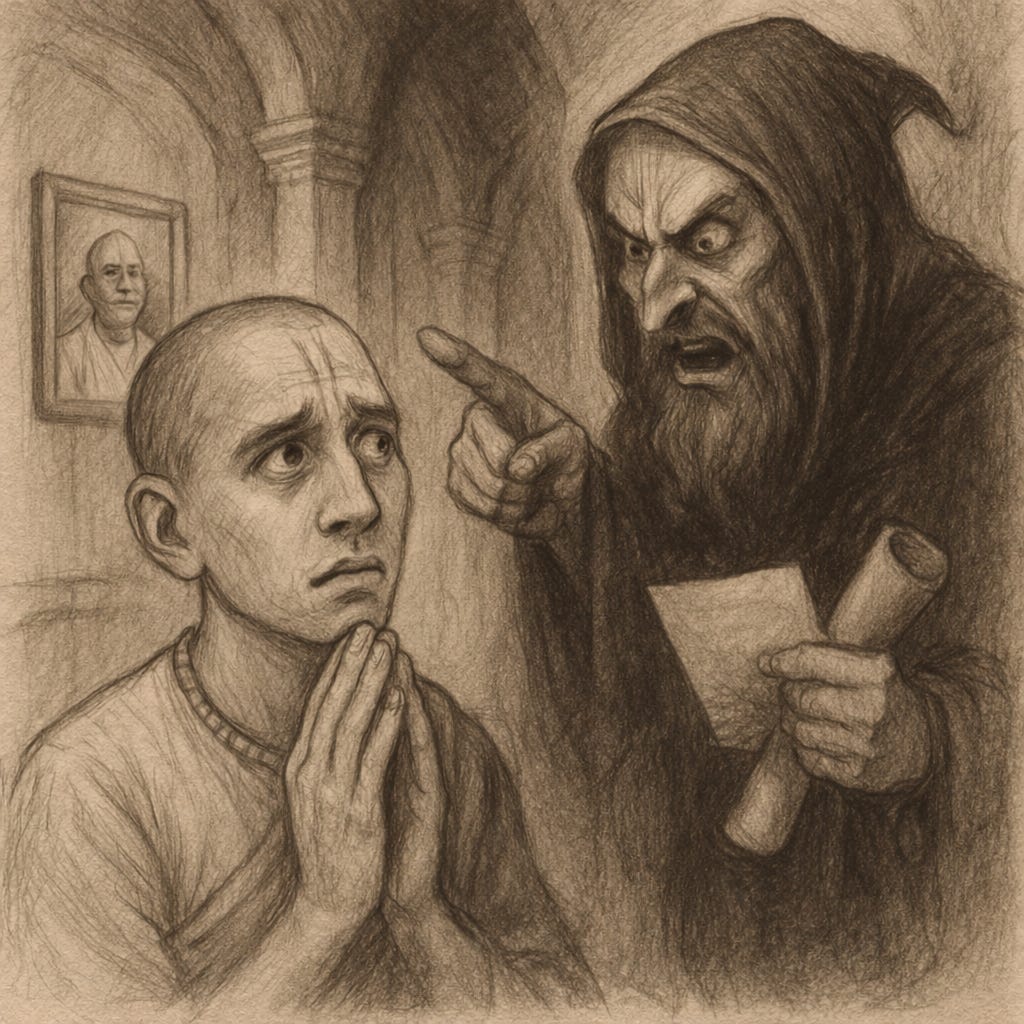
One of the challenges for any new devotee is the ritvik propaganda, which can appear ubiquitous, offering a parallel view of reality. Because of the internet and other facilities, we now have more opportunities to hear from liberated souls than in any other period of human history. One who somehow gets the taste can just hear the whole day. On the other hand, there is also much disinformation that can take us off the path.
There are different versions of the ritvik philosophy, but they are all centered around interpretations of two tapes recorded in the last days of Śrila Prabhupāda. According to them, the last instruction of Śrila Prabhupāda was that he should remain the only initiating spiritual master, and anyone can take a posthumous initiation from him, through a priest, who chants on his beads and does the other rites in front of a picture. From this, they create a whole parallel version of reality, based on layers of misinterpretation combined with conspiracy theories.
After hearing their arguments, many may have doubts about it in the back of their minds. The fear of maybe not doing the right thing in accepting a spiritual master or the fear of being cheated may hamper one in his spiritual progress.
The ritvik movement appeared in the 1980s, during the zonal acarya period, a time of confusion when there were excesses on the part of many. Seeing that some of the gurus were acting in questionable ways, a few devotees went to the opposite extreme, concluding that there would be no bona fide spiritual masters after Śrila Prabhupāda. This was the fruit of a polarization phenomenon, where some go to one extreme, and others end up going to the other.
Since that time, many points have been corrected, and our collective understanding of the role of the spiritual master has matured inside our movement. The ritvik philosophy was not based on the scriptures, but merely on supposition and interpretation of a few of Śrila Prabhupāda’s last statements. It was discussed for some time among the leaders of our society, but the lack of philosophical consistency led it to be quickly discarded. Most of the devotees who were initially promoting it abandoned it over the years. What happened is that unscrupulous individuals took it and started using it to amass followers, or at times just to attack our society. Many of them are individuals who don’t follow principles or chant. Frequently, their sadhana is simply to post criticism over the Internet.
The importance of accepting a spiritual master is one of the most central aspects of the Vaiṣnava philosophy. One who can’t accept a spiritual master out of pride, assuming that nobody is higher than him, or that no one is perfect, is actually doing so out of ignorance. In fact, in his purport to CC Adi 1.35, Śrila Prabhupāda directly states that: “If one thinks that he is above consulting anyone else, including a spiritual master, he is at once an offender at the lotus feet of the Lord. Such an offender can never go back to Godhead. It is imperative that a serious person accept a bona fide spiritual master in terms of the śāstric injunctions.”
In the whole story of Vaiṣnavism, there is not a single acarya who has not accepted a spiritual master. Even Lord Caitanya accepted Isvara Puri. To say nothing of Sri Caitanya Mahaprabhu, even Kṛṣṇa Himself accepted Sandipani Muni. Naturally, Kṛṣṇa is the original composer of the Vedic literature, and He knows it better than anyone else, but He still accepts a spiritual master just to give the proper example.
The main point is that it is practically impossible for a conditioned soul to free himself from material conditioning, and it’s impossible to attain a relationship with Kṛṣṇa without being connected with one of Kṛṣṇa’s associates. Because our consciousness is entrapped in the material energy, we can’t, at the present moment, associate with Kṛṣṇa or with His eternal associates. For all practical purposes, they are there, and we are here. Even though Kṛṣṇa is in our hearts, we can’t perceive or hear Him. For any conditioned soul, the only real opportunity to re-establish his relationship with Kṛṣṇa is by associating with a liberated soul who is here in this world, walking amongst us. Devotional service is not just theoretical; it must be learned by hearing, serving, and associating with a liberated soul. Not only that, but we need someone who can act as our lawyer, presenting our case to Kṛṣṇa and standing in our favor. We have been guilty of indescribable acts since time immemorial, and only by surrendering to Kṛṣṇa’s representative can we realistically be rectified.
One could then argue: what is the necessity of associating with a pure devotee if we can just hear Śrila Prabhupāda’s classes and read his books? Naturally, to associate with Śrila Prabhupāda’s vani is an essential aspect of our spiritual life, and even someone who doesn’t have contact with other devotees can make great advancement by just doing that. However, we are going to benefit only to the extent we follow what we read or hear. Without someone observing and correcting us, it is very difficult to properly follow the instructions given by Prabhupāda. We will always follow some instructions and forgive others; our minds will play tricks on us, and we will try to justify whatever we want to do based on something he said. Apart from that, Prabhupāda consistently tells us we must accept a spiritual master, someone who can act as his bona fide representative in our lives. How can we consider ourselves his followers if we refuse this instruction?
As he wrote in the same purport to CC Adi 1.35 mentioned earlier: “One should always remember that a person who is reluctant to accept a spiritual master and be initiated is sure to be baffled in his endeavor to go back to Godhead. One who is not properly initiated may present himself as a great devotee, but in fact he is sure to encounter many stumbling blocks on his path of progress toward spiritual realization, with the result that he must continue his term of material existence without relief. Such a helpless person is compared to a ship without a rudder, for such a ship can never reach its destination. It is imperative, therefore, that one accept a spiritual master if he at all desires to gain the favor of the Lord. The service of the spiritual master is essential.”
The initiating and instructing spiritual masters have the mission of not only teaching but also of specifically observing and correcting their disciples, allowing them to grow. To humbly accept corrections and to acknowledge one’s faults is a difficult process to follow, but anyone sincere in the spiritual path must accept it. This is a process that was ultimately created by Kṛṣṇa to correct the conditioned souls.
Ritviks don’t want to accept this instruction and thus concoct a conspiracy theory, based on the idea that Śrila Prabhupāda taught something during his whole life and then contradicted himself at the last moment. They then try to cover the incongruences and contradictions in their theory with further speculation, arguing that no disciples of Śrila Prabhupāda are qualified, that his books were changed, and so on.
The ritvik theory is an example of an idea that, in the name of maintaining Śrila Prabhupāda’s legacy, propagates a conclusion that is opposite to his teachings and is thus offensive to him. Anyone who studies Śrila Prabhupāda’s books will understand the concept of parampara and the importance of learning the spiritual science from a living spiritual master who can observe and correct the disciple. Just like Śrila Prabhupāda connected his disciples with Śrila Bhaktisiddhanta Sarasvati Thakura and the other members of the parampara, one needs to be connected to Śrila Prabhupāda through one of his qualified disciples or grand-disciples. The allegation that there are no pure and bona fide gurus after Śrila Prabhupāda is, in reality, an offense to him. It implies that Śrila Prabhupāda was incompetent and thus not able to train any of his disciples to become pure devotees. It also implies that the process given by him doesn’t work and that he wasn’t successful in his mission.
Apart from ritviks, these same baseless suppositions have been used by other unscrupulous personalities to create further damage. By claiming that all disciples of Prabhupāda are neophytes, that Prabhupāda taught only the ABCD, etc., they promote themselves as pure devotees who came to offer something higher, and in this way, try to accumulate disciples by sowing chaos. A truly advanced spiritual master is not anxious to increase the number of disciples and does not need to diminish other devotees, or encourage his disciples in doing so.
Even if one believes that there is not even a single pure devotee on the planet at the current moment, the necessity of accepting a spiritual master remains. There is a story that illustrates this point:
Once, Dronacarya asked both Duryodhana and Yudhisthira to fulfill a mission. Duryodhana’s mission was to find someone higher than him and bring him to his teacher by the end of the day, while the mission of Yudhisthira was to find someone lower than him. By the end of the day, both came back empty-handed. Being puffed-up, Duryodhana couldn’t find anyone he could accept as superior to himself, while wise Yudisthira could see that even the poorest persons could do things that he couldn’t, or would possess qualities he would lack. Therefore, in the end, he also came back empty-handed.
Unless one is like Duryodana, incapable of finding anyone higher than himself, he should choose someone connected to a bona fide line, whom one sees as more elevated than himself and from whom he can learn, and accept him or her as a spiritual master. One who is attracted to Śrila Prabhupāda should connect himself with him through one of his bona fide disciples or grand disciples.
Another good example in this connection is the story of Ekalavia, narrated in the Mahabharata. The deeper meaning was explained by Śrila Bhaktisiddhanta Saraswati Thakura in his article “Upakhyane Upadesa” (translated by H.H. Bhakti Caru Swami) and also explained in the book “Spiritual Connection” by HH Bhakti Dhira Damodhara Swami.
“One day, on the order of Dronacarya, the Kauravas and Pandavas ventured out from their capital to the forest to hunt. They soon came across a dog, directly on their path and were extremely astonished to find that seven arrows had been shot into the dog’s mouth simultaneously when he had opened it to bark. They could see that the archer who had let loose those arrows was even more skilled than any of the Pandavas, and set out to find him.
After searching for some time, they discovered that the boy who had performed this feat was Ekalavya, the son of Hiranyadhanura, and that he had developed his extraordinary skill by making and worshipping an idol of Dronacarya.
The Pandavas returned to their capital and informed Dronacarya of this amazing incident. In a humble mood, Arjuna informed Dronacarya of the fact that the acarya had one disciple more skilled in the art of archery than he. The acarya listened to these words in shock. At once, he returned to the forest with Arjuna and came upon Ekalavya, who was fully absorbed in practising archery as he let loose dense volleys of arrows, one after the other.
When Dronacarya approached, Ekalavya suddenly saw the acarya standing directly before him. The young archer immediately worshipped his feet, introduced himself as one of his disciples, and stood submissively with folded hands. Dronacarya addressed Ekalavya, “You must offer me guru-daksina.” Ekalavya replied, “Whatever you order, I am prepared to give.” Dronacarya next told Ekalavya to sever his right thumb and give it as daksina, and he followed the order of his gurudeva with a bright face, without any objection.”
At first, it looks like Ekalavia was the perfect disciple, and Arjuna was envious of him, but the real meaning is the opposite. Ekalavia was a member of the Nishada tribe. Not only did he lack the proper moral qualifications, but he was also envious of the Pandavas, being a member of a tribe that was a sworn enemy of the Kuru dynasty. When he approached Dronacarya, wanting to learn military science, Drona could understand his mentality, and thus he flatly rejected, seeing that whatever he would teach him would just increase his pride and would ultimately be used against his other disciples.
Ekalavia then concocted a method of worship with the goal of stealing the military knowledge from him. His worship was thus not based on love and submission but on pride. When Arjuna saw the situation, he was alarmed that the good name of his guru could be dishonored by this so-called disciple. He thus called Dronacarya, and he solved the situation by taking the thumb of Ekalavia. At the time, archers would hold the arrow using the thumb and the index finger; thus, by losing his thumb, Ekalavia’s talent became useless. In this way, Dronacarya nullified what Ekalavia had stolen from him.
Still, one could argue that Ekalavia should be given credit for his incredible sacrifice in offering his thumb to Dronacarya, but even this was not done with the proper consciousness. On the contrary, he acted out of pride, out of the fear of losing his reputation by breaking his word. He did that out of mundane considerations, just as other kṣatriyas did so many things out of pride throughout history. He taught that instead of admitting that he was not an actual disciple of Dronacarya, it would be better to cut off his finger and save face. Understanding his mentality, Dronacarya went ahead and asked his thumb as a daksina to quickly solve the problem.
Ekalavia can thus be considered the first ritvik of history. A ritvik may claim to be a disciple of Śrila Prabhupāda, while in reality concocting a process of worship that will not lead to any good result. One who is sincere will eventually be guided by the Supersoul to meet a bona fide spiritual master and surrender to him, understanding him to be Kṛṣṇa’s representative. The envious, however, will just fall into further darkness.
When confronted with arguments against their philosophy, many ritviks ask for “scriptural evidence”. Naturally, much evidence can be provided, starting with Bg. 4.2 and 4.34, but this is largely useless. Whatever evidence can be offered, a ritvik will always reject, using word jugglery and twisted logic.
The fact is that the scriptures repeatedly emphasize the importance of accepting a spiritual master and hearing the spiritual science from him (“Just try to learn the truth by approaching a spiritual master. Inquire from him submissively and render service unto him. The self-realized souls can impart knowledge unto you because they have seen the truth“). However, the ritvik philosophy is not based on the scriptures, and therefore, these arguments are not accepted. It’s not based on Śrila Prabhupāda either, since this is a point Śrila Prabhupāda repeatedly states, reinforces, and repeats in his purports. Ritviks ignore all these statements and instead base their philosophy on creative interpretations of a couple of recorded tapes. They use word jugglery and passages taken out of context to create a conspiracy theory, sustaining that Prabhupāda contradicted himself, teaching all his life that we should accept a spiritual master and then changing his mind in the last moment, creating a process that deviates both from the scriptures and from predecessor acaryas.
« Things I Wish Someone Had Taught Me When I Started Krishna Consciousness
You can also donate using Buy Me a Coffee, PayPal, Wise, Revolut, or bank transfers. There is a separate page with all the links. This helps me enormously to have time to write instead of doing other things to make a living. Thanks!