

Subscribe to receive new articles by e-mail. It’s free, but if you like, you can pledge a donation:
In the very early days of our movement, when Śrīla Prabhupāda started the first temple in the Matchless Gifts store, there was not much discussion about clothes. Śrīla Prabhupāda was dressing like a sannyāsi, and his first disciples were dressing in their regular street clothes. At that point, Śrīla Prabhupāda was just teaching in the mood of “You don’t have to change anything, just add Krsna”. He was just making them chant Hare Krsna, hear from the Bhagavad-gītā, and take prasāda. He was even washing their plates afterward!
However, as time went on, Prabhupāda started to gradually implement more aspects. It happens that the practice of devotional service goes along two parallel lines: bhāgavata-vidhi and pañcarātrika-vidhi. Bhāgavata-vidhi includes chanting, hearing the scriptures, taking prasāda, and spreading Krsna Consciousness to others, while pañcarātrika-vidhi includes deity worship as well as different standards and rules. The aspects of bhāgavata-vidhi are easier to follow, but without the rules and regulations of pañcarātrika-vidhi, there is a risk one may gradually get off course and end up becoming a sahajiyā instead of attaining pure devotion to Krsna. Therefore, although in the beginning, Śrīla Prabhupāda focused on the essential aspects of bhāgavata-vidhi, gradually he started teaching also the principles of pañcarātrika-vidhi, which balance it.
Apart from cleaning standards, aspects of behavior, etiquette in dealing with other devotees, and so on, he also introduced standards of clothing for the temple devotees, with the men using dothi, kurta, and chadar, and the ladies dressing in saris.
Some argue that the dress is an integral part of our culture and practices, while others label it as something superficial. Some say that in the spiritual world, people dress the way Prabhupāda taught, while others argue that this style of dress is actually not traditional, since kurtas, for example, were not used until relatively recently. Some confuse the Vedic period, in which this standard of dressing was supposedly inspired, with the medieval period, where people would dress in different ways across the Indian subcontinent, sometimes even bare-chested. However, most of these discussions miss the main point, which is that the vision of a pure devotee is more significant than mere historical considerations based on different periods inside Kali-yuga. Prabhupāda established certain standards of dress that he envisioned as being more conducive to the practice of Krsna Consciousness, and this is more important than what people were wearing or not in previous centuries.
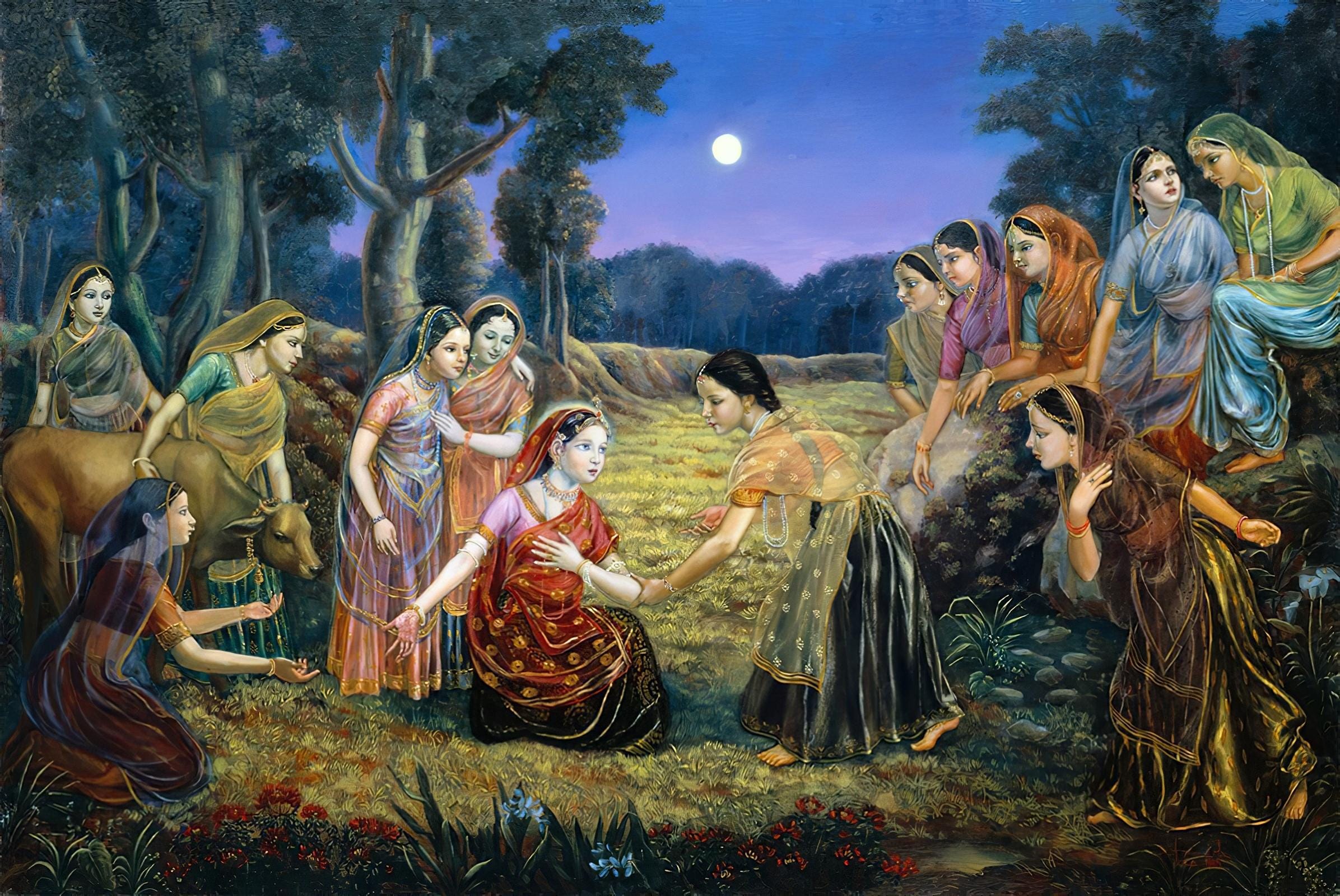
Just like the food we eat, the environment where we live or work, the friends we have, and so on, the clothes we wear affect our consciousness in different ways. A man dressed in a suit will feel and behave differently than when he is wearing swim trunks, for example. Different types of clothes affect our minds in different ways. They pull us in different ways, according to the three modes of nature. If one has the goal of following the spiritual path, it helps to keep the mind calm and disciplined. Dhotis and saris (when properly used) are good examples of clothes that inspire the mind in the direction of the mode of goodness. Since they are associated with spiritual practice, they also help to bring favorable impressions to the mind. If one has the habit of using devotional clothes when performing devotional activities, the mental association will help him or her to enter into the proper mood just by dressing.
We can see that different groups naturally develop certain codes of dress according to their activities: businessmen dress in a certain way, policemen dress in a certain way, hippies dress in a certain way, etc. Dressing in uniform helps a policeman to see himself as a policeman, and in the same way, long hair and dirty clothes help a hippie to connect with his hippie activities.
We can easily see this in old photos from Prabhupāda’s times. Devotees would see themselves as Vaiṣnavas, and the clothes would reinforce this self-image. Śrīla Prabhupāda mentioned on occasion that these are the clothes people wear in the spiritual world. If our goal is to get there, it surely does no harm to dress like them.
The problem with devotional clothes is that they can be misused. It’s not uncommon to see men putting dhotis in a clumsy way, or ladies using their saris in fashionable ways, that fail to protect their modesty. It’s also common to see devotees mixing Indian and Western articles, dressing in ways that look strange or not elegant. If one has the image of devotees dressing like hippies, he may very easily conclude that the problem is the “devotional clothes”, failing to consider that the problem may not be the dress, but just their improper use.
Devotees who appreciate devotional clothes can contribute by using them in a sāttvic and elegant way, looking like people coming directly from the spiritual world, as Śrīla Prabhupāda once put it. Devotees who prefer other styles of dress can also help by dressing in a sāttvic way, “like ladies and gentlemen,” as Prabhupāda once put it.
It’s also important to have common sense. Devotional clothes are useful when we are in the temple or doing different devotional activities, but one doesn’t necessarily have to use them all the time. In the early days of our movement, most devotees would live in the temple, and thus there was no need to use other types of clothes. As devotees started working and living outside, they started to wear plain clothes most of the time, according to their activities, and dress in dhotis and saris when worshiping their deities or going to the temple. Prabhupāda was also teaching devotees to have common sense when dressing, using pants instead of dhotis when working close to the printing press, for example (since the loose ending of a dhoti can cause an accident).
Devotional clothes have a purpose and, when properly used, can support our spiritual practice by helping us to enter into the proper mood. However, one doesn’t have to use them all the time unless he or she is living in the temple and being fully engaged in deity worship or preaching activities. A policeman doesn’t have to wear his uniform all the time when not on duty, for example.
There are different aspects to this question, and different types of clothes may have a role in our lives in different circumstances, as long as we keep the principle of dressing in a sāttvic way. The problem is when we have poorly dressed devotees on both sides discussing who is worse. This is just plain tama-guna.
You can also donate using Buy Me a Coffee, PayPal, Wise, Revolut, or bank transfers. There is a separate page with all the links. This helps me enormously to have time to write instead of doing other things to make a living. Thanks!
Respectfully Prabhu, Tilak and Tulsi beads make me feel more spiritual; a sari makes me self-conscious and uncomfortable, (in the west) and impractical with children (they always pull on them loosening them and the extra cloth falls into everything).
In Australia, saris & dhotis aren't identified as 'Hare Krishna' clothing or uniform. We have many Indian immigrants, so it just looks like we are wearing Indian clothing - nothing wrong with that, just that it doesn't represent a uniform).
It also seems quite bipolar for many devotees, I've seen bikinis at the beach and saris at the temple.
Whereas if we emphasise clean, appropriate and modest (appropriate for the temple and to the culture we belong) in our lives in general and of course at the temple, it is much more consistent for mode of goodness life. 🙏🙏