

Subscribe to receive new articles by e-mail. It’s free, but if you like, you can pledge a donation:
Join the Telegram group if you would like to join the live lessons. This course is maintained with your donations. Click here to donate.
💬 Text of the lesson
Śukadeva Gosvāmī starts the description of the history of Ajāmila in text 6.1.21:
In the city known as Kānyakubja, there was a brāhmaṇa named Ajāmila who married a prostitute maidservant and lost all his brahminical qualities because of the association with that low-class woman. (SB 6.1.21)
The Purānas describe many histories of bygone ages. The main purpose of these descriptions is to evoke self-realization, not to give a detailed historical account. In many cases, the chronology of the pastimes can be assessed based on the genealogical trees described. Most of the pastimes described in the first five cantos, for example, can be traced to the first manvantara, based on the connections with the descendants of Svāyambhuva Manu, with a few traced to the sixth manvantara, due to the connection with later incidents. The saga of Hiranyākṣa and Hiraṇyakaśipu can be traced to the 6th manvantara, due to their connection with Kaśyapa-muni, and so on.
From the details, the history of Ajāmila can be traced to the end of a previous Dvāpara-yuga, when people were already living close to 100 years. Śukadeva Gosvāmī describes the history as “itihāsaṁ purātanam,” a very old historical incident that has been transmitted by sages due to its philosophical significance. When exactly it happened, it is not possible to trace.
What was the problem with Ajāmila? He was a brāhmana who fell from all regulative principles because of an affair with an unqualified woman, a prostitute. As we studied in the Fifth Canto, many of the most severe punishments in hell are reserved for brāhmanas who perform abominable activities, such as drinking and illicit sex. Ajāmila did it all; therefore, the Yamadūtas already had a long list of punishments awaiting him.
He was, however, saved by simply chanting the holy names in a hopeless condition. Not only was he saved from the Yamadūtas, but he had a change of heart, abandoning his sinful life, dedicating his remaining days to serve the Lord in a sacred place, and at the end going back home, back to Godhead. This history is thus used to confirm the points made in the previous verses: devotional service is the only real process of purification, capable of not only destroying the karmic reactions of previous sins, but cutting the problem from the root by eliminating the material contamination that creates the urge for sinning in the first place.
At the core of the process of devotional service is the chanting of the holy names, which puts us in direct contact with the Lord. Because He is unlimitedly pure and potent, as soon as we come close to Him, no sinful reactions can persist. In fact, just by chanting the name of Lord Narāyana once, Ajāmila attracted the attention of the Viṣṇudutas, who appeared on the spot, armed with their transcendental weapons to protect him at the crucial moment.
As Prabhupāda explains:
“Parīkṣit Mahārāja’s original question was how to be freed from falling down into hell or into the hands of the Yamadūtas. In reply, Śukadeva Gosvāmī is citing this old historical example to convince Parīkṣit Mahārāja of the potency of bhakti-yoga, which begins simply with the chanting of the Lord’s name. All the great authorities of bhakti-yoga recommend the devotional process beginning with the chanting of the holy name of Kṛṣṇa (tan-nāma-grahaṇādibhiḥ).”
The maidservant
Who was the woman Ajāmila got involved with?
Ajāmila is described as dāsī-patiḥ, the husband of a low-class woman, a prostitute. There are different words used for prostitute in the Śrīmad-Bhāgavatam and other Puranas, depending on what exactly is referred to. For example, Piṅgalā (in the Eleventh Canto) is described as a “veśyā,” which is the direct word for a woman who sells her body. Another word is puṁścalī, a promiscuous woman. The woman Ajāmila got involved with is described as a dāsī, a śūdrāṇī.
Different from men and women of the higher classes, who would rigidly follow religious and moral principles, śūdras would often be looser in character. As Prabhupāda mentions, “Sometimes people who are very lusty establish relationships with such maidservants and sweeping women, since in the higher statuses of society they cannot indulge in the habit of woman hunting, which is strictly prohibited by social convention.”
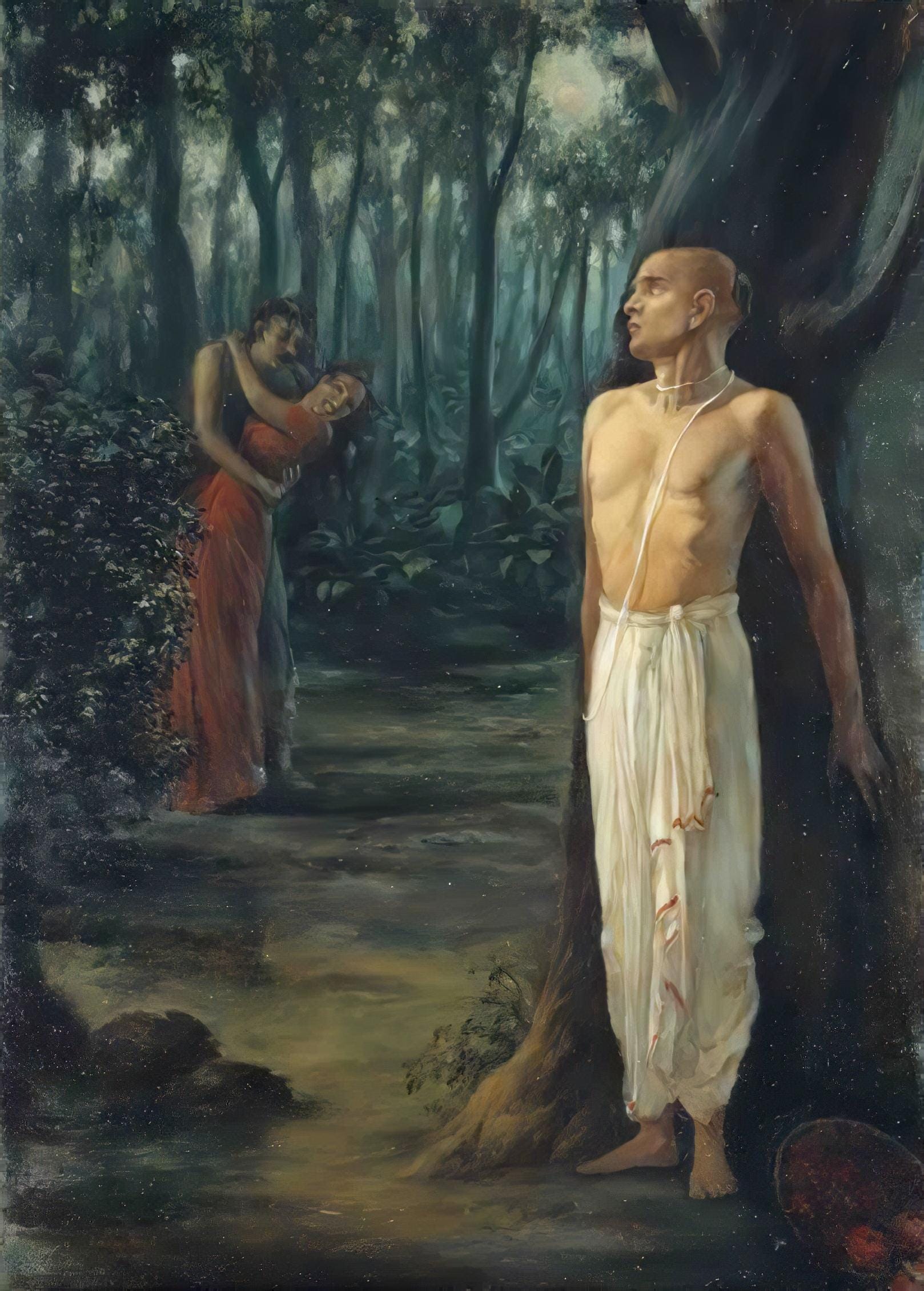
Ajāmila originally saw this woman having an affair with a drunk śūdra man at night, and from this vision he got an uncontrollable desire to associate with her. He was a high-class man, young and attractive, and therefore it was not very difficult for him to do so. He employed her as a servant in his house and, from there, became involved with her.
Due to this association, he gradually adopted her habits, starting to drink and so on. The Vedic idea of marriage is for a woman to voluntarily agree to follow a spiritually advanced man and, due to association, gradually progress to a similar standard. Ajāmila did the opposite, getting involved with a woman of loose character, and then following her in her bad habits.
Another problem with this relationship is that it was not based on genuine commitment. In a true marriage, the couple makes vows of continuing together no matter what the situation may become. King Nala lost everything and had to live wandering in the forest, but still, his wife Damayantī never left him, even when the situation became so dire that they didn’t even have enough clothes. This commitment is essential, because a man is not in control of his destiny, being under the results of his past karma. Difficulties come for everyone, and a man who enters married life needs the support of his wife to surpass them while maintaining religious principles.
This is another factor that was not present in the case of Ajāmila. The woman went to Ajāmila because he offered her material facilities. To keep her, he had to continue providing her with the material standards she demanded, eventually making him gamble, cheat, steal, kidnap, and even kill. In fact, in a class (August 17, 1968, Montreal) Prabhupāda mentions that, “At the last moment, when he was old enough, when he could not earn, he could not cheat to bring money, the man Ajāmila was thrown in the street by that woman.”
This gives an extra dimension to the situation of Ajāmila in his final moments. After spoiling his whole life to maintain this woman and breaking every religious principle in the process, when he became too old to work, he was thrown in the street.
In his purport to text 6.1.22, Prabhupāda mentions:
“Therefore we first advise all the disciples in our Kṛṣṇa consciousness movement to avoid illicit sex, which is the beginning of all abominable life and which is followed by meat-eating, gambling and intoxication, one after another. Of course, restraint is very difficult, but it is quite possible if one fully surrenders to Kṛṣṇa, since all these abominable habits gradually become distasteful for a Kṛṣṇa conscious person. If illicit sex is allowed to increase in a society, however, the entire society will be condemned, for it will be full of rogues, thieves, cheaters and so forth.”
Apart from being sinful, illicit sex brings us to relationships centered on sense gratification, just as in the case of Ajāmila. Attached, we end up developing bad habits and performing immoral activities, and end up spoiling our lives, just like Ajāmila. When two sincere devotees come together to constitute a family, both can benefit, for they can support each other in developing their spiritual practice. This is not a fall down, but an upgrade. Getting involved with a materialistic person just for sense gratification, on the other hand, puts us on the same path taken by Ajāmila, potentially with similar consequences.
A devotee who continues to follow up to the end of his or her life, is sure to not be taken by the Yamadūtas. As revealed later in the passage, Yamarāja specifically instructed his servants to never approach such devotees. However, if one stops practicing at some point and forgets Kṛṣṇa, there is no guarantee that he or she may not go to hell, just as an ordinary person.
Narāyana
Ajāmila met the servant lady when he was a young man. At that time, he was already married to a chaste brāhmana lady and was taking care of his elderly parents. However, the attraction to the prostitute led him to abandon them. He then lived with the prostitute until he was 88 years old. By that time, he had a small son called Narāyana, to whom he was very attached.
In his purport, Prabhupāda mentions:
“According to Vedic culture, one should leave home as soon as he has reached fifty years of age; one should not live at home and go on producing children. Sex life is allowed for twenty-five years, between the ages of twenty-five and forty-five or, at the most, fifty. After that one should give up the habit of sex life and leave home as a vānaprastha and then properly take sannyāsa. Ajāmila, however, because of his association with a prostitute, lost all brahminical culture and became most sinful, even in his so-called household life.”
When sex life is performed in the proper context, inside a marriage centered around spiritual practice, the tendency is that over time one loses his interest in sex life, for, over time, our taste for spiritual practice increases, as we become purified. Simultaneously, our attraction to sense gratification, culminating in sex life, decreases. As the children grow up, one is encouraged to entrust them with the family’s business and properties, and adopt a renounced life, first as a vānaprastha and eventually as a sannyāsī, using his older age to cultivate self-realization.
This arrangement is best for everyone, for the grown-up children, just entering married life, have the chance of developing their activities, while the father becomes free to develop self-realization. The mother can then choose between staying with the grown-up children or following her husband into retired life.
When there is no such higher purpose, however, one tends to just remain attached until old age, growing more and more attached to sense gratification and thus missing the opportunity of human life, just as in the case of Ajāmila.
He had, however, an important advantage over an ordinary materialistic man: In his young age, he had been trained as a brāhmana and had worshiped Lord Viṣnu. Later, he completely forgot his devotional service, but the Lord didn’t forget him. Even though he became so degraded, the Lord in the heart inspired him to name his youngest son Narāyana:
“Since Nārāyaṇa was the youngest of all the sons, he was naturally very dear to both his father and his mother. Because of the child’s broken language and awkward movements, old Ajāmila was very much attached to him. He always took care of the child and enjoyed the child’s activities.”
The child was so young that he could not even walk properly, and therefore Ajāmila was very much attached to him. He was always calling his name, and thus accumulating ajñāta-sukṛti, unknown spiritual merit, leading him to chant at the decisive moment. In his purport to text 6.1.27, Prabhupāda goes further, concluding that while calling his son, Ajāmila would effectively remember his previous devotional service:
“It may also be concluded that Ajāmila, who was the son of a brāhmaṇa, was accustomed to worshiping Nārāyaṇa in his youth because in every brāhmaṇa’s house there is worship of the nārāyaṇa-śilā. This system is still present in India; in a rigid brāhmaṇa’s house, there is nārāyaṇa-sevā, worship of Nārāyaṇa. Therefore, although the contaminated Ajāmila was calling for his son, by concentrating his mind on the holy name of Nārāyaṇa he remembered the Nārāyaṇa he had very faithfully worshiped in his youth.”
Meeting with the Yamadūtas
“Ajāmila then saw three awkward persons with deformed bodily features, fierce, twisted faces, and hair standing erect on their bodies. With ropes in their hands, they had come to take him away to the abode of Yamarāja. When he saw them he was extremely bewildered, and because of attachment to his child, who was playing a short distance away, Ajāmila began to call him loudly by his name. Thus with tears in his eyes he somehow or other chanted the holy name of Nārāyaṇa.” (SB 6.1.29)
Until the moment of death, Ajāmila was still connected with his life of sin. He was thus still eligible to be taken by the Yamadūtas. They were, therefore, waiting for him. Prabhupāda mentions that a person performs sinful activities with his body, mind, and words; therefore, three Yamadūtas came to take him. They were prepared to take him to hell to pay for all his sins. Ajāmila could see them in his final moments, before leaving his body. This experience is consistent with what is studied in modern medicine as terminal restlessness or terminal delirium. A large percentage of terminal patients describe seeing terrifying figures in their final days, becoming extremely agitated, and often requiring sedation.
Normally, a person is helpless at this stage. When the Yamadūtas come, it means his fate is already decided. In the case of Ajāmila, however, this terrifying vision led him to remember his son and desperately call his name, Narāyana! This imperceptibly changed the whole situation. By simply calling the name of the Lord in the last moment in full concentration, even if intending to call his son, Ajāmila became immediately freed from all sinful reactions. This immediately attracted the attention of the Viṣṇudutas:
“My dear King, the order carriers of Viṣṇu, the Viṣṇudutas, immediately arrived when they heard the holy name of their master from the mouth of the dying Ajāmila, who had certainly chanted without offense because he had chanted in complete anxiety.” (SB 6.1.30)
Despite his situation, Ajāmila somehow chanted the holy name without offense. He did not blaspheme devotees or consider the holy name to be on the same level as the names of the demigods. He also did not chant to counteract sinful activities, and so on. On top of that, he chanted with full attention. This qualified his chanting as nāmābhāsa, which has the power of immediately destroying all sinful reactions.
Normally, a sinful man cannot suddenly chant the holy name desperately like this at the time of death. This became possible in the case of Ajāmila because of his previous devotional service. The history of Ajāmila is thus not just a testament to the potency of the chanting of the holy names, but also to the protection of the Lord, which is the main topic of the Sixth Canto. Ajāmila performed devotional service in his young age, and the Lord made arrangements to save him in the critical moment.
“The order carriers of Yamarāja were snatching the soul from the core of the heart of Ajāmila, the husband of the prostitute, but with resounding voices the messengers of Lord Viṣṇu, the Viṣṇudūtas, forbade them to do so.
When the order carriers of Yamarāja, the son of the sun-god, were thus forbidden, they replied: Who are you, sirs, that have the audacity to challenge the jurisdiction of Yamarāja?” (SB 6.1.31-32)
The Viṣṇudutas have the same bodily features and opulences as Lord Narāyana Himself. They came thus armed with different types of transcendental weapons, like maces and sudarśana-cakras. They were prepared to fight the Yamadūtas if necessary.
In the Ramayana, it is described that once Rāvaṇa invaded the hellish planets with the intention of fighting Yamarāja. Reaching there, he saw the Yamadūtas punishing the sinful, and had the idea of attracting the attention of Yamarāja by attacking his servants. Rāvana was, however, surprised by their ferocity. Suddenly, he saw himself surrounded by hordes of Yamadūtas attacking him with spears, maces, arrows, and other types of weapons. He took a beating and was saved only by invoking the Pāśupatāstra he had received from Lord Śiva. This shows that the Yamadūtas are capable of fighting and punishing even great demigods and demons. Practically speaking, no conditioned soul can challenge their authority, since they are empowered and protected by Yamarāja. Never before had anyone had the audacity to oppose them in such a way. They thus enquired: Who are you, sirs? Are you devās? upadevās, or siddha-sattamās (pure devotees)?
All of this happened in the view of Ajāmila, who could see both groups, although still in his body. As Prabhupāda mentions:
“It should also be noted that Ajāmila was not yet dead, for the Yamadūtas were trying to snatch the soul from his heart. They could not take the soul, however, and therefore Ajāmila was not yet dead. This will be revealed in later verses. Ajāmila was simply in an unconscious state when the argument was in progress between the Yamadūtas and the Viṣṇudūtas. The conclusion of the argument was to be a decision regarding who would claim the soul of Ajāmila.”
The Yamadūtas had never seen such effulgent and beautiful beings. They could immediately understand that they were exalted persons, and therefore inquired why they were challenging the jurisdiction of Yamarāja in such a way. At this point, the proportion of power was already established. The Yamadūtas understood that they were completely outclassed by the Viṣṇudutas, and thus simply voiced their protest.
Just as the Yamadūtas were surprised in being obstructed, the Viṣṇudutas were equally surprised in seeing the Yamadūtas so completely clueless about the reason for their presence. Prabhupāda describes their mood:
“The Yamadūtas were surprised to see that the Viṣṇudūtas, although polite, were hindering the rule of Yamarāja. Similarly, the Viṣṇudūtas were also surprised that the Yamadūtas, although claiming to be servants of Yamarāja, the supreme judge of religious principles, were unaware of the principles of religious action. Thus the Viṣṇudūtas smiled, thinking, “What is this nonsense they are speaking? If they are actually servants of Yamarāja, they should know that Ajāmila is not a suitable candidate for them to carry off.”
They thus challenged them:
“The blessed messengers of Lord Viṣṇu, the Viṣṇudūtas, said: If you are actually servants of Yamarāja, you must explain to us the meaning of religious principles and the symptoms of irreligion. What is the process of punishing others? Who are the actual candidates for punishment? Are all karmīs engaged in fruitive activities punishable, or only some of them?” (SB 6.1.38-39)
Prabhupāda connects this question with our reality:
“The question posed by the Viṣṇudūtas was very suitable. One who represents someone else must fully know that person’s mission. The devotees in the Kṛṣṇa consciousness movement must therefore be fully aware of the mission of Kṛṣṇa and Lord Caitanya; otherwise they will be considered foolish. All devotees, especially preachers, must know the philosophy of Kṛṣṇa consciousness so as not to be embarrassed and insulted when they preach.”
Once he mentioned that devotees should know all scriptures thoroughly, just as a lawyer knows the law books, and thus be capable of establishing the correct conclusions of the scriptures when faced with any type of opponent.
The answer of the Yamadūtas is also significant:
“The Yamadūtas replied: That which is prescribed in the Vedas constitutes dharma, the religious principles, and the opposite of that is irreligion. The Vedas are directly the Supreme Personality of Godhead, Nārāyaṇa, and are self-born. This we have heard from Yamarāja.”
As Prabhupāda mentions, they answered properly, based on what they had heard from Yamarāja. They could also point out Nārāyaṇa as the cause of the material manifestation and the three modes as the covering that prevents the living entities from knowing Him. Under this covering, the living entity assumes different material identities and receives different material duties accordingly.
The sun, fire, sky, air, demigods, moon, evening, day, night, directions, water, land, and Supersoul Himself all witness the activities of the living entity, and when one deviates from his prescribed duties, one becomes eligible to be punished by the cosmic department of justice led by Yamarāja. All human beings who are involved in material activities are under his jurisdiction and can be punished by his servants according to the degree of their sins. The Yamadūtas had observed the previous activities of Ajāmila, and they were thus certain that he was supposed to be punished.
They thus pleaded:
“O inhabitants of Vaikuṇṭha, you are sinless, but those within this material world are all karmīs, whether acting piously or impiously. Both kinds of action are possible for them because they are contaminated by the three modes of nature and must act accordingly. One who has accepted a material body cannot be inactive, and sinful action is inevitable for one acting under the modes of material nature. Therefore all the living entities within this material world are punishable.
In proportion to the extent of one’s religious or irreligious actions in this life, one must enjoy or suffer the corresponding reactions of his karma in the next.” (SB 6.1.44-45)
Persons who are influenced by the mode of goodness act religiously and are promoted to the higher planetary systems. Those who are in the mode of passion act in ordinary ways. If they are not excessively sinful, they take another birth as human beings in the intermediate planetary system, and those who are influenced by ignorance become sinful and fall into hellish life.
Each life is a continuation of the previous, and thus we take birth influenced by the combination of modes we ended our previous life. Ordinarily, living entities have very little free will, and can change only very slowly, through a sequence of many lives.
“O best of the demigods, we can see three different varieties of life, which are due to the contamination of the three modes of nature. The living entities are thus known as peaceful, restless and foolish; as happy, unhappy or in-between; or as religious, irreligious and semireligious. We can deduce that in the next life these three kinds of material nature will similarly act. O best of the demigods, we can see three different varieties of life, which are due to the contamination of the three modes of nature. The living entities are thus known as peaceful, restless and foolish; as happy, unhappy or in-between; or as religious, irreligious and semireligious. We can deduce that in the next life these three kinds of material nature will similarly act.” (SB 6.1.46-47)
In the Third Canto of Śrīmad-Bhāgavatam, Lord Kapila mentions that after falling into hell, being punished, and then going through millions of births in the evolutionary cycle, a living entity eventually assumes again a human body in a similar situation to his last birth. Under a similar influence of the three modes, one tends then to again act in a similar way.
How can then one be saved? Practically speaking, only by devotional service:
māṁ ca yo ’vyabhicāreṇa, bhakti-yogena sevate
sa guṇān samatītyaitān, brahma-bhūyāya kalpate“One who engages in full devotional service, who does not fall down under any circumstance, at once transcends the modes of material nature and thus comes to the spiritual platform.”
When one finally comes to the platform of devotional service, progress can be very fast. One can quickly advance to the liberated stage, and from there gradually come to a platform of the platform of pure devotional service. Without starting on the devotional process, however, one tends to continue indefinitely in the process of birth and death, as indicated by the Yamadūtas.
Who controls this process?
“The omnipotent Yamarāja is as good as Lord Brahmā, for while situated in his own abode or in everyone’s heart like the Paramātmā, he mentally observes the past activities of a living entity and thus understands how the living entity will act in future lives.” (SB 6.1.48)
Yamarāja is not Lord Viṣnu, but he is empowered by Him to see all the activities of human beings and understand their mentality to adequately reward or punish them. Lord Viṣnu is in the heart of everyone as Paramātmā, and He can thus see everything. Because He empowers Yamarāja, he can also see. As Prabhupāda explains, “The word anumīmāṁsate means that he can decide in consultation with the Supersoul. Anu means “following.” The actual decisions concerning the next lives of the living entities are made by the Supersoul, and they are carried out by Yamarāja.”
Paramātmā thus sees everything and decides the destination of each living entity. This knowledge is revealed to Yamarāja, who acts in consultation with the Lord, and acts as His order carrier.
Life after life
Although the soul is eternal and goes through a sequence of material bodies, due to the influence of ignorance, we can’t see this sequence. Every time we accept a material body, we accept it as all in all, and can’t understand that this body is the result of past activities and that the activities we perform now will conduct us to the next body.
“As a sleeping person acts according to the body manifested in his dreams and accepts it to be himself, so one identifies with his present body, which he acquired because of his past religious or irreligious actions, and is unable to know his past or future lives.” (SB 6.1.49)
The material body is like a machine which we use to interact with this material world. Inside the gross material body is the subtle body. On top of this whole apparatus is the soul, which tries to enjoy the material world in cooperation with the mind and senses. When one acquires the body of a demigod, one feels happy; when one acquires a human body, one frequently laments; and when one assumes an animal body, one remains always afraid. All of this, however, is illusory. All forms of material existence are actually miserable, as Kṛṣṇa explains in the Gītā.
However, as the Yamadūtas explain, conveying the teachings they received from Yamarāja, we create our own material entanglement through our material desires and actions. As long as we don’t abandon this attitude of material enjoyment and come to the platform of service to Kṛṣṇa, there is no end to our material conditioning.
“The foolish embodied living entity, inept at controlling his senses and mind, is forced to act according to the influence of the modes of material nature, against his desires. He is like a silkworm that uses its own saliva to create a cocoon and then becomes trapped in it, with no possibility of getting out. The living entity traps himself in a network of his own fruitive activities and then can find no way to release himself. Thus he is always bewildered, and repeatedly he dies.” (SB 6.1.52)
We should thus use the human form of life to escape this material conditioning, instead of simply trying to improve our material condition. As Prabhupāda explains:
“Although he tries to create society, friendship and love, no one will be able to help him but Kṛṣṇa, the Supreme Lord. Therefore his only concern should be how to satisfy Kṛṣṇa. That is also what Kṛṣṇa wants (sarva-dharmān parityajya mām ekaṁ śaraṇaṁ vraja). People bewildered by material conditions try to be united, but although they strive for unity among men and nations, all their attempts are futile. Everyone must struggle alone for existence with the many elements of nature. Therefore one’s only hope, as Kṛṣṇa advises, is to surrender to Him, for He can help one become free from the ocean of nescience.”
The soul is active by nature; therefore, we must always do something. If we don’t want to act in the spiritual platform, we are forced to act materially. On top of that, our original constitutional position is that of servants; therefore, if we don’t want to serve Kṛṣṇa, we are forced to serve our senses. In this case, the original attitude of the service of the soul is manifested in a perverted way, appearing in the form of many “isms”. This ends only when we abandon all these material tendencies and agree to serve Kṛṣṇa.
As the Yamadūtas conclude:
“Since the living entity is associated with material nature, he is in an awkward position, but if in the human form of life he is taught how to associate with the Supreme Personality of Godhead or His devotee, this position can be overcome.”
From text 56 onward, the Yamadūtas give more detail on the life of Ajāmila.
In his youth, he had studied all Vedic literature and had all good qualities. However, one day, while returning from the forest, he saw the woman embracing a śūdra man, and became affected by it. He tried to remember the instructions of the śāstras and control his lustful desires, but he ultimately failed to control his mind. He eventually took the prostitute as a servant in his house and started an affair with her.
He used up all the money he got as an inheritance from his father to keep the woman satisfied, and when it ended, he got money by gambling, stealing, kidnapping, and killing. He gave up his legitimate wife and abandoned his elderly parents to live with her, sustaining an extravagant lifestyle with his immoral activities.
As Prabhupāda summarizes:
“By speaking this verse, Śukadeva Gosvāmī wants to impress upon the mind of the reader that Ajāmila’s exalted position as a brāhmaṇa was vanquished by his association with the prostitute, so much so that he forgot all his brahminical activities. Nevertheless, at the end of his life, by chanting the four syllables of the name Nārāyaṇa, he was saved from the gravest danger of falling down. Svalpam apy asya dharmasya trāyate mahato bhayāt: even a little devotional service can save one from the greatest danger. Devotional service, which begins with chanting of the holy name of the Lord, is so powerful that even if one falls down from the exalted position of a brāhmaṇa through sexual indulgence, he can be saved from all calamities if he somehow or other chants the holy name of the Lord. This is the extraordinary power of the Lord’s holy name. Therefore in Bhagavad-gītā it is advised that one not forget the chanting of the holy name even for a moment (satataṁ kīrtayanto māṁ yatantaś ca dṛḍha-vratāḥ). There are so many dangers in this material world that one may fall down from an exalted position at any time. Yet if one keeps himself always pure and steady by chanting the Hare Kṛṣṇa mahā-mantra, he will be safe without a doubt.”
This is a publication for thoughtful readers who want to go deeper into Kṛṣṇa consciousness. I publish daily, trying to offer high-quality spiritual content, and all posts are available to free subscribers. If you wish, you can support this work with a monthly contribution. When you subscribe, you can choose between a free subscription and a monthly contribution, and you can switch from a free subscriber to a supporter at any time.
If you would like to contribute further, you can find the donation links here.