

You can receive new articles directly in your inbox. Subscription is free; donations are welcome.
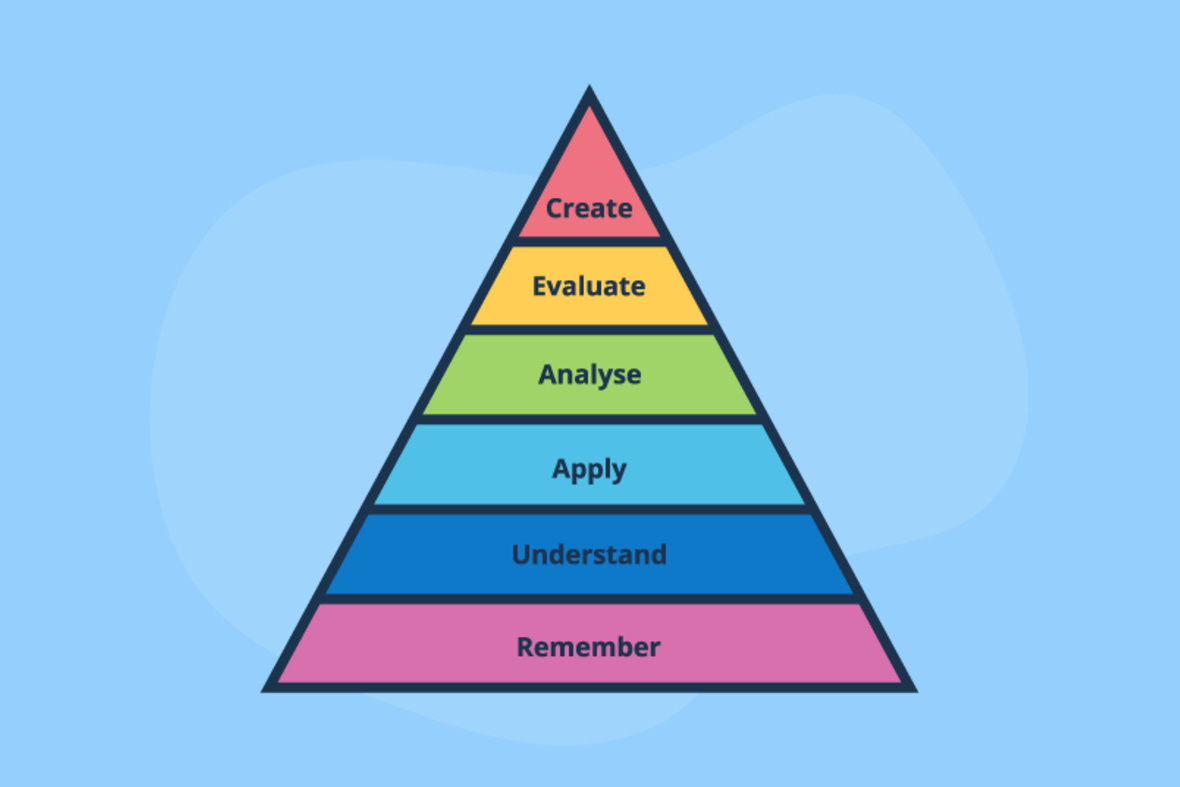
An idea that is prevalent in modern educational psychology to promote higher levels of education and thinking is Bloom’s Taxonomy, an educational framework based on six stages of thinking.
Learning objectives are classified from the very basic, just memorizing information, all the way to creating new ideas and concepts based on information previously studied. The goal is to help students to progress to higher levels of thinking and understanding.
For this, it offers a framework for analyzing and evaluating concepts, processes, procedures, and principles, rather than just remembering information. In other words, it teaches students how to go deeper in their studies and understand and apply what they are learning. This is a technology that can be very useful when we study the sastras, bringing us from the level of just reading information to the level of being able to understand and apply it.
Reaching the higher stages can help us a lot in better understanding and finding practical applications for the spiritual knowledge we are studying. Still better is that the advanced levels of thinking are more efficient methods of study. In other words, they help us to learn things faster than in the lower levels. It thus helps to make our progression exponential instead of linear.
As we gradually understand and progress through the six levels, we can improve our ability to understand the sastras and apply their knowledge to solve the practical struggles we find in our day-to-day lives and on our path back to Godhead. We can see that most successful people are the ones able to somehow figure out and apply the higher levels in this scale of thinking. This scale, therefore, is nothing new; it just describes a natural process. This same scale can be applied to all areas of knowledge, but here I’m applying it to a specific field, the philosophical study of the scriptures.
Let’s try to understand what the six levels are:
1) Remembering
The first level is remembering, or memorizing pieces of information. This is what children do in primary school when they have to memorize the arithmetic table or verbal tables and give the correct answers in exams. This level may be necessary when we need to memorize small bits of information that we will have to frequently use later. We read, repeat, answer questions, and so on. We get down to this level when we try to memorize using flashcards, for example. However, this level is not very efficient, because it is very tedious (giving one little impetus to study), and it restricts one to just little bits of information, doing little in terms of understanding the information we memorize or developing critical thinking.
Much of the educational system, including in our movement, is based on this level: memorizing verses and other pieces of information and answering a test. This is, however, not very efficient. To learn anything, we need to get out of this level as early as possible.
2) Understanding
The second level (understanding) is based on trying to comprehend some text, lecture, or other piece of information we are studying. When we operate on the first level, we will just see it as a pile of information we may try to memorize. The soul is eternal, Kṛṣṇa is God, the three modes of nature are goodness, passion, and ignorance, and so on. On the second level, however, we try to understand it, see the logic behind it, and see how these different pieces of information fit together. As we understand, we also become able to explain it. One example of an exercise that helps us to develop this stage of thinking is explaining something we read using our own words. This ability is essential when we speak about transmitting Kṛṣṇa Consciousness because we need to be able to explain the concepts of the scriptures in simple ways, according to people’s language and understanding.
Two persons may be reading the same book, but they will have completely different results when doing it at the first or second level. At the first level, one will just remember bits of information from the text but will not be able to understand or remember it, while someone reading at the second level will be able to remember the basic logic of the text and explain it. Explaining to other people, writing articles, writing lists of points, etc., are all techniques that help us to develop this second level of thinking. To be able to explain something is proof that we learned it.
It may sound advanced enough, but this is actually just the beginning. There are four levels above this.
3) Applying
The third level is about using the knowledge we are studying in practical life (applying) to solve problems. One may read the Bhagavad-gītā and get information about the three modes of material nature, but how can this knowledge be used to solve practical problems? We may see someone suffering from addiction, for example, identify the source of the problem as associated with the mode of ignorance, and try to help this person by helping him or her to develop habits connected with the mode of goodness, such as waking up early, cultivating cleanliness, finding some occupation, studying, cultivating friendships, taking care of one’s health, and so on, and by gradually helping this friend to improve his or her spiritual practice. By increasing the influence of the mode of goodness and one’s proximity to Kṛṣṇa, one can get the tools to fight one’s addiction. We can see that at this level, the philosophy of Kṛṣṇa Consciousness stops being just some theoretical knowledge and becomes a tool to solve practical problems. That’s the minimum level any mentor or spiritual teacher has to master. Some methods that can help us to develop this level of thinking are discussing problems and their possible solutions, studying practical instructions of previous ācāryas that may reveal their process of the practical application of the philosophy, observing seniors who are competent as mentors and spiritual masters, and so on.
4) Analyzing
Level four of thinking is about comparing and analyzing. It is about taking different philosophical concepts or different practices and philosophies and being able to identify similarities and differences between them, not just on a superficial cultural level (like dress, food, and habits) but on a deep philosophical level. What are the similarities between the teachings of Christ and Vaiṣṇavism? What are the main similarities with Islam, and what are the differences? What are the common points between the philosophy of Śaṅkarācārya and the teachings of Prabhupāda, for example? What is the difference between Prabhupāda and the philosophy of the caste Goswamis?
This level of thinking has huge applications because it allows us to identify similarities between philosophies and cultures and thus be able to present the philosophy of Kṛṣṇa Consciousness in inclusive and non-sectarian ways, and at the same time be able to notice differences and thus be able to spot mistaken concepts or traces of other philosophies mixed with it. At this level, we may be able to notice someone mixing traces of philosophy from the caste goswamis or sahajiyās, or even Māyāvāda philosophy in the teachings of Prabhupāda, for example.
Studying very deeply the concepts and logic present in our teachings, as well as other philosophies, constructively debating with other devotees on various points, making summaries, tables, and mind maps, writing articles and books explaining similarities and differences, and so on, are all exercises that can help us to develop this level of thinking.
This level of thinking is essential for devotees engaged in creating study methods, writing books, doing philosophical research, and so on. It’s also essential for translation work, especially from Sanskrit, since one has to understand well different philosophical concepts to maintain the spirit of the text.
When we come to this level, our capacity for understanding and memorizing information becomes much greater, because our brain is forced to spend a great mental effort comparing different sets of concepts and information, and this creates very strong memories of the concepts we are analyzing.
Most people are not able to reach this level of thinking, but this doesn’t have so much to do with capacity. It has to do with something that is defined as the misinterpreted effort hypothesis. The problem is that each level of thinking requires more effort than the previous, although the results are also exponentially better. It requires time and discipline to develop each successive stage. It’s more or less like learning a new language; the brain has to be rewired in a new way, so to speak.
The difficulty is that it comes to a point when one judges that he or she will never learn and decides to just stop at a certain stage. When one convinces himself that it is too difficult, he will never make it; it is hopeless, etc., it becomes impossible to progress.
Developing a level of excellence demands studying and applying the philosophy of Kṛṣṇa Consciousness for decades. In the beginning, we may struggle to understand and apply even basic concepts, but as we practice them, accumulate realization, and then exercise it by teaching other people and carefully consider different philosophical points, their application, compare them with other points of view, etc., we “rewire” our brains around it and can gradually attain higher levels. All of this, however, takes time and effort. If we convince ourselves that it is impossible, we may get permanently stuck at the lower levels, just as many stay their whole lives without ever being able to learn a second language, not due to a lack of capacity, but just because they convince themselves that they can’t.
5) Evaluating
Next, we have level five, which is about evaluating and judging what is primary and secondary, what is more important or less important, what is applicable to a certain situation, and what is not, and so on. This level is necessary to properly apply what we call “time, place, and circumstance,” or, in other words, to be able to properly adjust the philosophy to different practical situations without making mistakes. Not everything is ideal, and thus we frequently have to make compromises, but what is acceptable and what is not acceptable is not always easy to determine.
At this level, one starts to see the philosophy as not just a set of points and ideas that are interconnected, but also as a hierarchy of principles. They are all important, but some are more important than others. In normal circumstances, it’s better to consult one’s spiritual master when deciding about this type of issue, but one may come to the point that he or she becomes responsible for guiding others in such a type of situation. When it comes, it’s better to be prepared.
We may all think that we know things and we are capable of making decisions, but the unfortunate reality is that we often make mistakes. To reach a level where we can understand the philosophy well enough to not just explain and practically apply it, or even compare and harmonize different ideas and philosophical systems, but also know where to cut corners when necessary, requires a very profound understanding of it.
6) Creating
Finally, there is level six, which is creating hypotheses or finding answers for problems when not all information is available. This level of thinking is necessary when we are involved in advanced philosophical studies, like when we are dealing with branches of knowledge for which there is simply not enough information available. One good example is the cosmology of the Śrīmad-Bhāgavatam, a discipline that is very difficult to understand and for which details are often missing.
In this case, just studying the available material may not be sufficient, because not all details are available or clearly explained. One has thus to study what is available and then compare it to other sets of information, use logic, and so on to create a hypothesis of what it means, go back to the initial knowledge to look for contradictions, test it against other ideas, verify the practical application, and so on. One can then see how strong the hypothesis is and, based on that, determine if it is true, possibly true, or just a dead end. The trap in this process is that it requires great faith and fidelity to the teachings of the scriptures and previous ācāryas; otherwise, it can quickly degenerate into what we call mental speculation.
This sixth level of thinking is necessary for advanced philosophical research when we are dealing with the unknown, new books from the scriptures that were not commented on by our previous ācāryas, clarification of details that are not well known, and so on. A person who becomes proficient in this process is what we generally call a genius.
However, this can be more ordinarily used as a process of learning. In this case, it can be the most effective process of all. We can create a set of hypotheses quite early in our studies of a new subject and from there treat our study as research to prove or disprove them. In this way, we not only force ourselves to deeply examine the subject we are studying in all detail but also keep our study interesting and dynamic. It is based on identifying gaps in the knowledge we have and then filling them.
Often, we think that we can learn the philosophy of Kṛṣṇa Consciousness by just hearing or reading a lot. This is certainly a good start, but it is by itself insufficient. Hearing a lot of classes, or even reading a lot of books, is a good way to keep our minds engaged in remembering Kṛṣṇa, but it is not a good method for learning anything. To effectively learn, we need to actively engage with this knowledge by making lists of points, summaries, finding points that are not clear or not sufficiently explained, formulating questions, doing further research on ideas that are just mentioned in the lecture or text, and then writing about them, and so on. We can see that the Vedic process of obtaining knowledge is based on the disciple hearing from the spiritual knowledge and engaging with the knowledge received by asking questions, and so on. Just hearing is only part of this process.
In this way, the advanced levels may appear intimidating at first, but it comes with time if we get out of our comfort zone and learn to engage with the knowledge we are receiving instead of remaining just passive spectators. That’s something I learned from my spiritual master: to not just read, but to engage with the knowledge, effectively study it, apply it, and eventually master it.
The idea is that we should at least be able to master the first three levels, being able to not just understand the scriptures and the books of Śrīla Prabhupāda but also be able to apply this knowledge in our practical lives. Anything that comes beyond that we may consider a bonus.
This is a publication for thoughtful readers who want to go deeper into Kṛṣṇa consciousness. I publish daily, and all posts are available to free subscribers. If you wish, you can also choose a paid subscription to support this work. By subscribing, you also gain access to the PDFs of all my books and drafts of books I’m working on.
If you would like to contribute further, you can find the donation links here.