

Subscribe to receive new articles by e-mail. It’s free, but if you like, you can pledge a donation:
It may not be very well known, but Yamarāja has a son called Bhadraśravā, who is the ruler of Bhadrāśva-varṣa, the tract of land east of Ilāvṛta-varṣa in the cosmology of Śrīmad Bhāgavatam.
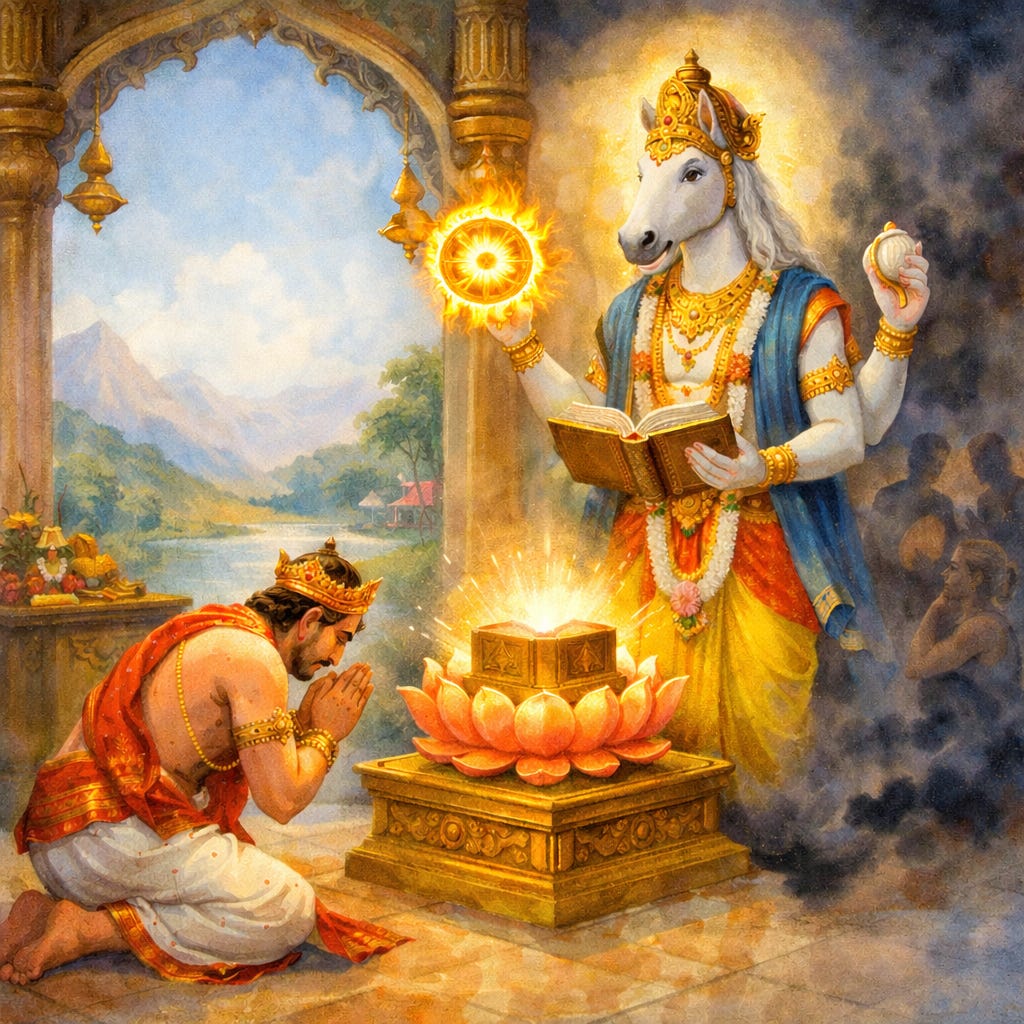
This is described as a tract of land that is part of Jambūdvīpa, the central island of Bhū-mandala, a tract of land where human beings live for 10,000 years in semi-celestial conditions. The Lord is present there in His deity form as Hayaśīrṣa (or Hayagrīva), the director of all religious principles and protector of the Vedas, and is worshipped by Bhadraśravā, followed by the other inhabitants.
First of all, who is Hayagrīva?
At the end of each day of Brahmā, the Vedas are stolen by ignorance personified, who hides them in the lower planetary systems. Normally, the Lord, who is present as Matsya sustaining the whole structure of Bhū-mandala, fights with the demon and saves the Vedas, transmitting them again to Brahmā at the beginning of his next day.
At the end of the previous day, however, the Lord appeared as Hayagrīva (the horse-headed incarnation) to fight with the demon and save the Vedas. This appears to be connected with the universal destruction at the end of the first half of the life of Brahma, which is a special event, different from the end of the other days of Brahmā.
How is it that the Vedas can be stolen by a demon? In his purport, Prabhupāda connects it with the Vedas being forgotten and then transmitted again at the beginning of the next cycle of creation: “Although Vedic knowledge is imperishable, within this material world it is sometimes manifest and sometimes not. When the people of this material world become too absorbed in ignorance, the Vedic knowledge disappears. Lord Hayagrīva or Lord Matsya, however, always protects the Vedic knowledge, and in due course of time it is again distributed through the medium of Lord Brahmā. Brahmā is the trustworthy representative of the Supreme Lord. Therefore when he again asked for the treasure of Vedic knowledge, the Lord fulfilled his desire.”
A demon doesn’t necessarily have to assume a form with two hands and legs to cause harm. Just as Tṛṇāvarta had the form of a whirlwind, Tamasā (the demon of ignorance personified) made everyone forget the knowledge of the Vedas.
This same Lord Hayagrīva, who preserved the Vedas during the whole period of the night of Brahmā, is present in His deity form in Bhadrāśva-varṣa, where He is worshiped by His devotees, who offer Him respectful obeisances and offer Him prayers in devotional trance. You can read his prayers on SB 5.18.2-6.
In his purport to text two, Prabhupāda reinforces the point that the purpose of human life is to purify our existence, which is achieved by worshiping the Supreme Lord and performing penances and austerities. Human life is not meant for blind indulgence in sense gratification.
As students of the Śrīmad Bhāgavatam, we are already familiar with this conclusion, but it is missed by 99% of the population. Bewildered by the illusory energy, they continue their materialistic life day after day, without considering the impending danger of death. People simply get absorbed in momentary sense gratification, without considering the future. If my father dies, this is a very clear warning that I’m the next. A materialist, however, simply takes the inheritance and continues his process of enjoyment without a second thought. Often, people lack even basic decency; a father who loses his son may sometimes take away his possessions and start an affair with the widow. From this, we can see how the fixation on sense gratification makes one gradually lose all good qualities.
What materialists don’t realize, however, is that even to enjoy their senses, they need the cooperation of the Lord. If Paramātmā doesn’t give them sanction and empower them to perform their actions, materialists can’t act at all, as it happens sometimes at the end of life, when one becomes paralyzed or falls into a coma. In this way, both devotees and materialists depend on the mercy of the Lord. The difference is that a devotee is guided and empowered by the Lord to attain success in human life and go back home, back to Godhead, while a materialist is allowed to act sinfully for some time, as he desires, but later has to deal with the karmic consequences.
As Prabhupāda explains in his purport to text three: “In other words, materialistic persons want to commit all kinds of sinful activities, but without the sanction of the Supreme Personality of Godhead, no one can do anything. Why does the Supreme Personality of Godhead permit sinful activities? The Supreme Lord does not want any living being to act sinfully, and He begs him through his good conscience to refrain from sin. But when someone insists upon acting sinfully, the Supreme Lord gives him the sanction to act at his own risk (mattaḥ smṛtir jñānam apohanaṁ ca). No one can do anything without the sanction of the Lord, but He is so kind that when the conditioned soul persists in doing something, the Lord permits the individual soul to act at his own risk.”
Different from the materialists, who are simply deep into ignorance, others study the Vedas and understand the temporality of this material world. By practicing this knowledge, they become detached from the bodily concept of life. In other words, they become liberated souls.
However, the illusory energy is so powerful that even such great scholars can fall back into illusion. How is that possible? Prabhupāda explains that, “A liberated soul is a person who has sufficient knowledge of this material world and is therefore unattached to the bodily conception of life. But because of association with the modes of material nature for a very long time, even liberated souls sometimes become captivated by the illusory energy due to inattentiveness in the transcendental position. Therefore, Lord Kṛṣṇa says in Bhagavad-gītā (7.14), mām eva ye prapadyante māyām etāṁ taranti te: “Only those who surrender unto Me can overcome the influence of the material energy.”
Because we are in contact with the material energy for a very long time, there is still a tendency to become illusioned, even in advanced stages of knowledge. Being a Vedic scholar is thus not sufficient; one has to become a devotee of the Lord.
Even when we come to the devotional platform, however, we need to remain vigilant. The pastime of Bharata Maharaja shows that even in the devotional path, inattention can create havoc. As Prabhupāda explains:
“Everyone should very cautiously execute devotional service by rigidly following regulative principles. Thus he will remain fixed at the lotus feet of the Lord. Otherwise, a little inattention will create havoc. We have already seen an example of this in the case of Mahārāja Bharata. Mahārāja Bharata was undoubtedly a great devotee, but because he turned his attention slightly toward a small deer, he had to suffer two more births, one as a deer and another as the brāhmaṇa Jaḍa Bharata. Afterward he was liberated and went back home, back to Godhead.”
As soon as we surrender to Kṛṣṇa, He protects us and is ready to forgive our mistakes. However, if we insist on the same mistake over and over, He may allow us to fall into illusion again for some time so we can again get a taste of the suffering of the material world and become serious again in our practice.
In summary, the prayers of the inhabitants of Bhadrāśva-varṣa teach us that:
a) The goal of life is purification, not just blind sense gratification.
b) Despite the mercy of the Lord being available to everyone, most of the population remains under the spell of Māyā.
c) How to escape? Ultimately, one has to become a devotee. Even being a Vedic scholar is not sufficient.
d) Because the material energy is the divine potency of the Lord, it can be overcome only when we come back to our original position of service, sheltered at His lotus feet.
e) The Lord is the cause of everything, but still He remains separate from everything. Because He remains transcendental, He is the one who can save us from the material ocean. No one can become free by his own power.
You can also donate using Buy Me a Coffee, PayPal, Wise, Revolut, or bank transfers. There is a separate page with all the links. This helps me enormously to have time to write instead of doing other things to make a living. Thanks! You can also receive the updates on Telegram.