

Subscribe to receive new articles by e-mail. It’s free, but if you like, you can pledge a donation:
Ordinarily, when one falls into an animal body, one has to go through the whole evolutionary process before a new human birth, but this didn’t apply to Bharata Maharaja. It was true that he had to take birth as a deer because of his attachment to an animal, but this animal birth was a one-time event, and after leaving that body, he immediately took his next birth from pure brāhmana parents. How can it be so? Even though Bharata took birth as an animal, because of the mercy of the Lord, he remained Krsna-conscious and could remember the events of his previous life. He was thus able to practice Krsna Consciousness even in the body of a deer, and leave this body pitifully crying for the mercy of the Lord.
Just as in the body of a deer, Bharata could remember all the incidents of his previous lives: how he was the great King Bharata, who had fallen because of the association with a deer, and now had been given a new opportunity in a human body. This time, however, he was extremely careful to avoid all bad association and dedicate himself exclusively to the service of the Lord. He was not interested even in performing brāhminical duties, considering these material and also a form of entanglement.
Brāhminical duties are under the material mode of goodness. They are superior to other material duties, and are useful to elevate conditioned souls, but they are in themselves not transcendental. Remembering his past lives, Bharata was a paramahaṃsa from birth. He was thus already beyond the brāhminical level. He could very well have performed brāhminical duties externally while remaining internally fixed in transcendental meditation, but after his experience in his first birth as a king, when he fell due to the association of a deer, he was afraid. A brāhmana can easily become proud of his position, or become attracted to fruitive performances. Apart from that, a brāhmana is forced to associate with many materialists in the course of his duties, performing ceremonies for them, instructing them in their Varnāśrama duties, and so on. The duties of a brāhmana are purer than fighting like a kṣatriya or dealing with money like a vaiśya, but it is still far from perfect.
Afraid of again falling victim to bad association, Bharata decided to not take any chances this time, and behaved externally as dull, deaf, dumb, and blind. He is thus known in this third birth as Jaḍa Bharata (the dull Bharata). He was perfectly alert within, always fixed in meditation on the Supreme Lord, but externally, he was behaving in this way.
Bharata’s father was very attached to him and therefore continued to instruct him despite his unwillingness, believing a father should instruct his son. He continued doing so until the end of his life, hoping in his heart that one day his son could become a learned scholar, but all his attempts were unsuccessful.
This brāhmana had two wives. The first had nine sons, and the second was the mother of Jaḍa Bharata and his sister. When the father finally met death, the second wife chose to enter the funeral pyre and follow him to his next birth, entrusting Bharata and his sister to the care of the first wife.
The nine step-brothers of Jaḍa Bharata were ritualistic brāhmanas. They were versed in the Ṛg Veda, Sāma and Yajur Veda, but had not transcended the level of fruitive activity, and could not understand the transcendental position of their brother. As proud materialists, they were propense to envy and anger, and would call Jaḍa Bharata ill names and mistreat him, but he would not protest and would act according to their desires, working in the fields and guarding the plantations at night. For this work, he would receive inedible food, like burned rice from the bottom of the pot, solid residues from oil production, worm-eaten grains, or even rice husk. Jaḍa Bharata was beyond material duality and would eat just to maintain his body, without considering food palatable or unpalatable, and would thus gladly accept anything he was given and would not protest or hold any grudges.
Jaḍa Bharata used to lie on the ground and would not bother covering his body, ignoring different climatic conditions. He was not taking baths or accepting any comforts. He just wore a dirt loincloth and a brāhmana thread that was put in his body by his father and became blackish over time. Seeing that he was the son of a brāhmana, people used to call him brahma-bandhu and other names, but Bharata did not care about it.
For a transcendentalist, being neglected by materialistic people is not a curse, but a blessing. Such neglect allows one to remain aloof, not getting involved with the entanglements of mundane society. Jaḍa Bharata took advantage of that to remain incognito, wandering here and there as he pleased.
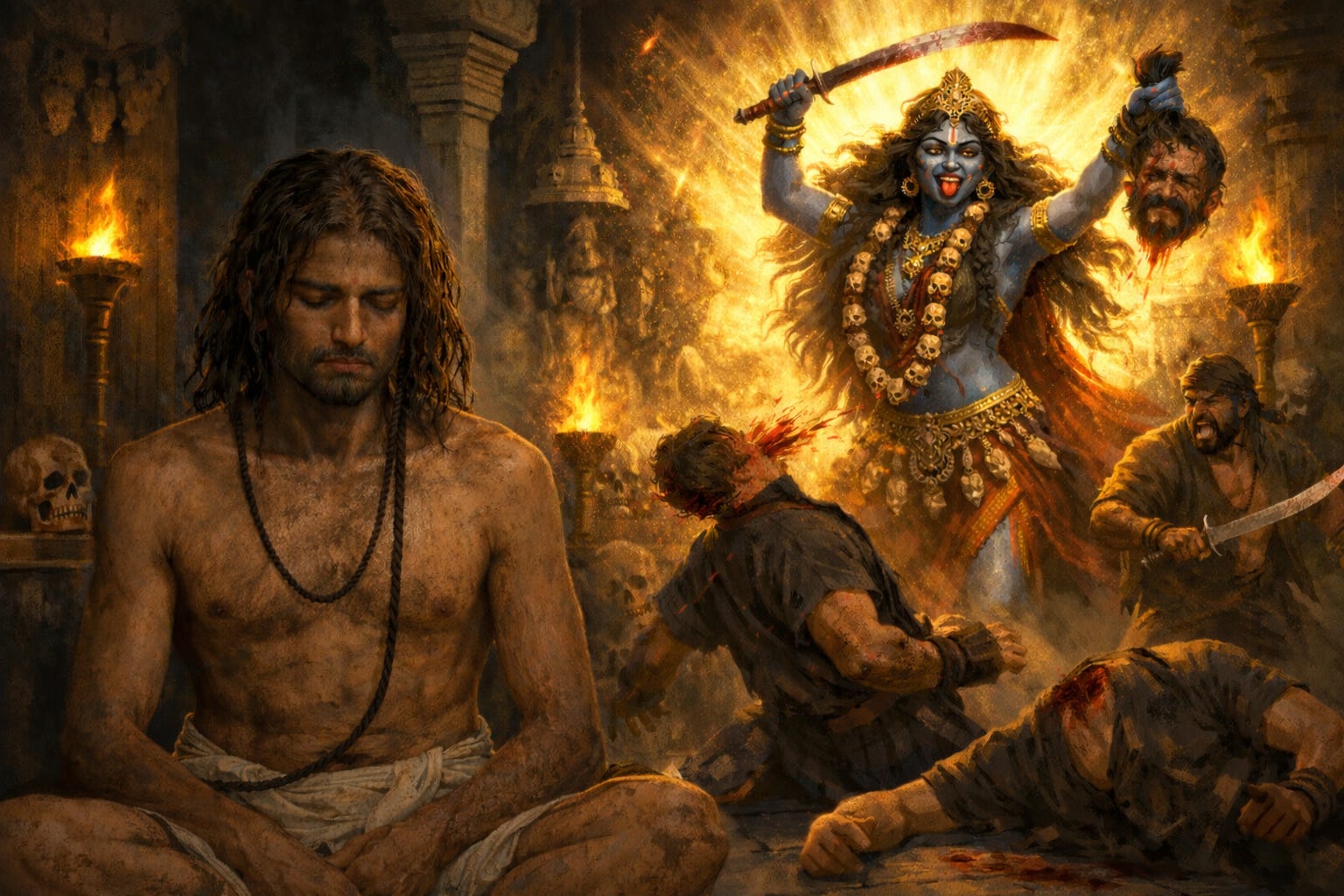
One night, while he was watching the plantation, he was spotted by a group of dacoits who were worshipers of Bhadra Kālī. The leader desired a son and thus had the desire to do a human sacrifice to the goddess. They had captured some dumb man that they considered a suitable man-animal to be sacrificed in this way, but he somehow escaped. Seeing Jaḍa Bharata, they considered him a fitting replacement, and thus captured him and brought him to the temple to be sacrificed.
Jaḍa Bharata’s body is described as being as strong as a bull. With such strength, he could have resisted or escaped, but situated in self-realization, he chose to not do so.
In the portions of the Vedas destined to people in the mode of ignorance, there is the description of rituals of animal sacrifice to Kālī or Durgā as a concession for meat eaters, but nowhere is there a prescription in the scriptures for a human sacrifice. The dacoits were simply speculating a process. Still, the thief who was acting as the chief priest was ready to kill Jaḍa Bharata and offer his blood to Kālī to be drunk as a liquor. He took a sharp sword and chanted the mantra of Bhadra Kālī to consecrate it. Goddess Kālī, however, could not tolerate the offense of having a pure devotee being killed. The body of the deity burst, and Kālī personally emerged from it in a body that was intolerably effulgent. Leaping violently from the altar, she immediately decapitated all the rogues and thieves with the very sword with which they had intended to kill Jaḍa Bharata.
This is yet another instance of the protection of the Lord. Ordinary men protect themselves with weapons and other material arrangements, but pure devotees like Jaḍa Bharata simply depend on the protection of the Lord, who sometimes protects them personally, like in the case of Nṛsiṁhadeva emerging from the pillar, and sometimes through His different potencies or representatives. A pure devotee fully understands that the soul is different from the body and is thus fearless.
“Śukadeva Gosvāmī then said to Mahārāja Parīkṣit: O Viṣṇudatta, those who already know that the soul is separate from the body, who are liberated from the invincible knot in the heart, who are always engaged in welfare activities for all living entities and who never contemplate harming anyone are always protected by the Supreme Personality of Godhead, who carries His disc [the Sudarśana cakra] and acts as supreme time to kill the demons and protect His devotees. The devotees always take shelter at the lotus feet of the Lord. Therefore at all times, even if threatened by decapitation, they remain unagitated. For them, this is not at all wonderful.” (SB 5.9.20)
Parīkṣit Maharaja could have questioned how Jaḍa Bharata could have remained tolerant even in such a situation, and this verse conveys the preemptive answer of Śukadeva Gosvāmī. It is indeed very difficult to remain composed when faced with impending death, but this is possible for a devotee who is detached from the body and fully surrendered to the Lord.
To understand the significance of this answer, it is important to keep in mind that Parīkṣit Maharaja faced a similar situation, being about to be killed by the winged serpent. In fact, we all live in this material world with a sword on our neck, with death potentially coming at any moment. Śukadeva Gosvāmī thus instructs the king – and all of us – on how to face such imminent danger.
You can also donate using Buy Me a Coffee, PayPal, Wise, Revolut, or bank transfers. There is a separate page with all the links. This helps me enormously to have time to write instead of doing other things to make a living. Thanks!