

You can receive new articles directly in your inbox. Subscription is free; donations are welcome.
The story of the dayitās, the ones who received the mercy of Jagannātha
The dayitās are the intimate servants of Lord Jagannātha. Their service is very confidential: they bathe, carry, nurse, protect, and serve the Lord during His most intimate pastimes.
In the Caitanya Caritamrta, Madhya, 13.8-13, it is mentioned:
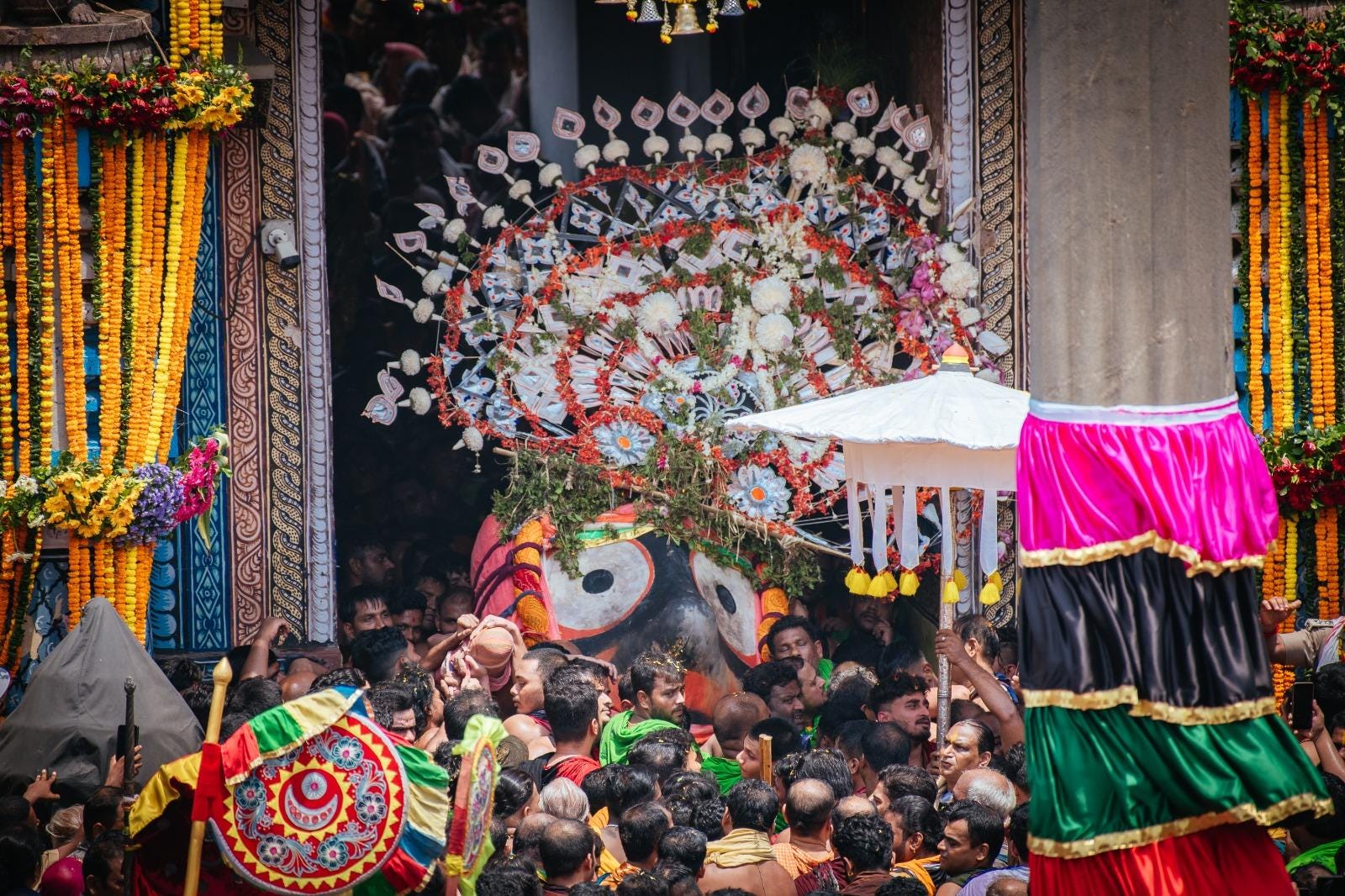
“The very strongly built dayitās [carriers of the Jagannātha Deity] were as powerful as drunken elephants. They manually carried Lord Jagannātha from the throne to the car. While carrying the Deity of Lord Jagannātha, some of the dayitās took hold of the shoulders of the Lord, and some caught His lotus feet. The Lord Jagannātha Deity was bound at the waist by a strong, thick rope made of silk. From two sides the dayitās caught hold of this rope and raised the Deity. Strong, puffed-up cotton pads called tulīs were spread out from the throne to the car, and the heavy Deity of Lord Jagannātha was carried from one pillowlike pad to the next by the dayitās. While the dayitās carried the heavy Jagannātha Deity from one pad to the next, some of the pads broke, and the cotton contents floated into the air. When they broke, they made a heavy cracking sound. Lord Jagannātha is the maintainer of the whole universe. Who can carry Him from one place to another? The Lord moves by His personal will just to perform His pastimes.”
Who are these dayitās, and how can they become so fortunate that they can touch and carry Lord Jagannātha? In reality, it’s not just about carrying. They perform many different types of personal services and are accepted as family members. Prabhupāda explains more about them in his purport to the same verse:
“The word dayitā refers to one who has received the mercy of the Lord. Lord Jagannātha has a number of stalwart servants known as dayitās. These servants do not come from very high-caste families (brāhmaṇas, kṣatriyas or vaiśyas), but because they are engaged in the service of the Lord, they have been elevated to a respected position. Thus they are known as dayitās. These servants of Lord Jagannātha take care of the Lord from the day of the Snāna-yātrā up to the time the Lord is carried from the throne to the Ratha car. In the Kṣetra-māhātmya these dayitās are said to come from the śabaras, a caste that keeps and sells pigs. However, among the dayitās there are also many who come from the brāhmaṇa caste. Those dayitās coming from the brāhmaṇa families are called dayitā-patis, or leaders of the dayitās. The dayitā-patis offer food such as sweetmeats to Lord Jagannātha during the anavasara, the resting period after Snāna-yātrā. They also make the early-morning offering of sweetmeats daily. It is said that during the anavasara Lord Jagannātha suffers from fever and that the dayitā-patis offer Him an infusion of drugs represented by fruit juice. It is said that in the beginning Lord Jagannātha was worshiped by the śabaras and was known as the Deity Nīla Mādhava. Later, when the Deity was established in the temple, the Lord became known as Jagannātha. Because the Deities were taken from the śabaras, all the śabara devotees were elevated to the position of dayitās.”
Everything starts in the chandan-yātrā period, when the construction of the three chariots for the Ratha-yātrā begins. In Purī, new chariots are constructed every year and dismantled after the festival. Jayananda Prabhu was following the same tradition in the West during his time, which was even captured in film.
Two weeks before the Ratha-yātrā, there is another great festival, the snāna-yātrā, when Lord Jagannātha is bathed in a grand ceremony. After this bathing, the Lord plays His pastime of becoming sick, and is hidden from public view. During this time, the dayitā-patis offer Him special food and medicinal preparations, including fruit juice that plays the part of a special medicine. This is one of the most intimate parts of Jagannātha’s worship, when the Lord is not approached as a distant king, but as a beloved family member who must be cared for.
During this time, they also make restorations on His transcendental form, preparing Him for the nava-yauvana darśana, when Jagannātha, together with Baladeva and Subhadrā, give darśana again after the period of seclusion
The most visible function of the dayitās is to carry Lord Jaganatha during the Ratha-yatra. This carrying of the Lord is known as Pāṇḍu-vijaya or Pahandi. This pastime shows the Lord's desire to come out of the temple and meet the devotees outside. The body of the Lord contains the whole universe, and no one can carry Him, but the dayitās are empowered to become the instruments of that movement, carrying Him step by step from the throne to the chariot.
While the brāhmaṇa priests serve the Lord through mantras, offerings, worship, and rituals, the dayitās serve Him through intimate bodily service. They touch Him, carry Him, nurse Him when He is ill, and perform the hidden rites connected with the navakalevara, when the forms of Jagannātha, Baladeva, and Subhadrā are replaced by fresh-carved forms.
This is another extraordinarily important function performed by the dayitās. The point is that the form of a deity has always been maintained in pristine condition. When a deity is installed, we ask the Lord to come to that form, and it is offensive to ask the Lord to remain in a damaged body. A deity has thus to be repainted when necessary, and the form may also be repaired. In the case of Lord Jagannātha, because the deity is made of wood, the whole form is changed every 12 or 19 years, according to astronomical calculations. When this happens, the Lord is asked to move from the old form to the new form, just like He is asked to assume a new form when a deity is installed.
The navakalevara is an extensive and detailed ritual. A central detail of it is the brahma-padārtha, a mysterious object that is transferred from one form to another as part of the ceremony. Brahma means “divine principle”, padārtha means “substance”. brahma-padārtha means the Supreme Brahman appearing in a visible form. No one knows what it is, but it is probably some object that was used or is related to Kṛṣṇa when He was personally present, some form of mahā-prasāda that is worshiped as non-different from Him, or maybe a śālagrāma-śila.
After the brahma-padārtha is removed from the form and transferred to the new one, the old form is considered “dead”. The dayitās carry it to the Koili Baikuṇṭha and bury it, togueter with the beds and pillows used by the Lord. They then observe mourning just as after the death of a family member.
This reveals one of the most striking details about the dayitās that set them apart from the priests. The priests worship Him like a king, while the dayitās take care of Him like a family member. This shows the combination of familiarity and ritual worship that is the defining characteristic of the worship of Lord Jagannātha in Purī.
The dayitās are mainly a hereditary community, but in their case, it makes sense, since by definition, a family is hereditary, different from other positions that can be filled as necessary. They are believed to be descendants of the first worshipers of Jagannātha, before He was installed in the temple.
Originally, the dayitās come from the lower social classes, but over time they were joined by brāhmanas who desired to join this intimate service. This created a semi-separate class, the dayitā-patis ( leaders of the dayitās), who perform specific functions, such as making the offerings of food to the Lord during the anavasara.
This is a publication for thoughtful readers who want to go deeper into Kṛṣṇa consciousness. I publish daily, trying to offer high-quality spiritual content, and all posts are available to free subscribers. If you wish, you can also choose a paid subscription to support this work.
You can also receive the updates on WhatsApp or Telegram.
If you would like to contribute further, you can find the donation links here.