

Subscribe to receive new articles by e-mail. It’s free, but if you like, you can pledge a donation:
Vena was the son of a saintly king, but he didn’t inherit the qualities of his father. On the opposite, he was so cruel that while playing with young boys of his age, he would kill them, apart from mercilessly killing all sorts of animals. It was not even Kali-yuga, as we could imagine. He took birth in a distant past, in some distant Treta-yuga.
Seeing the cruel and merciless behavior of his son, Aṅga punished him in different ways to try to reform him, as it was expected from a responsible father, but when everything failed, he became greatly aggrieved. He, however, concluded that obtaining such a bad son was in reality a blessing in disguise, and instead of lamenting, he decided to take the path of renunciation and abandon all illusory attachment to this world.
However, with the disappearance of Aṅga, there was no qualified ruler to look after the citizens. Although qualified in terms of knowledge of the sastras, brāhmaṇas don’t have the nature to rule and do not aspire for it. Only kṣatriyas have the right nature for ruling the kingdom, punishing criminals, and fighting enemies. A qualified kṣatriya is thus installed on the throne, and the brāhmaṇas assist him by giving good advice. As long as a kṣatriya follows this system, he can act as a saintly king, even if not fully qualified.
Without a king, the citizens became unruly and slacked in the performance of their duties. A king was necessary, and without a better option, the brāhmaṇas decided to install Vena on the throne (despite the protest of the ministers), hoping that they would be able to control him with good advice.
Vena was easily able to control the criminals and offer security to the citizens, but on the other hand, he became proud and started considering himself higher than anyone, including the Brāhmaṇas. He thus started misusing his power and insulting great personalities. He prohibited the brāhmaṇas from performing sacrifices or giving charity, stopping all types of religious sacrifices.
Without a king, there would be no one to protect the citizens from rogues, but on the other hand, the king himself was irresponsible. The situation was thus extremely dangerous. What to do?
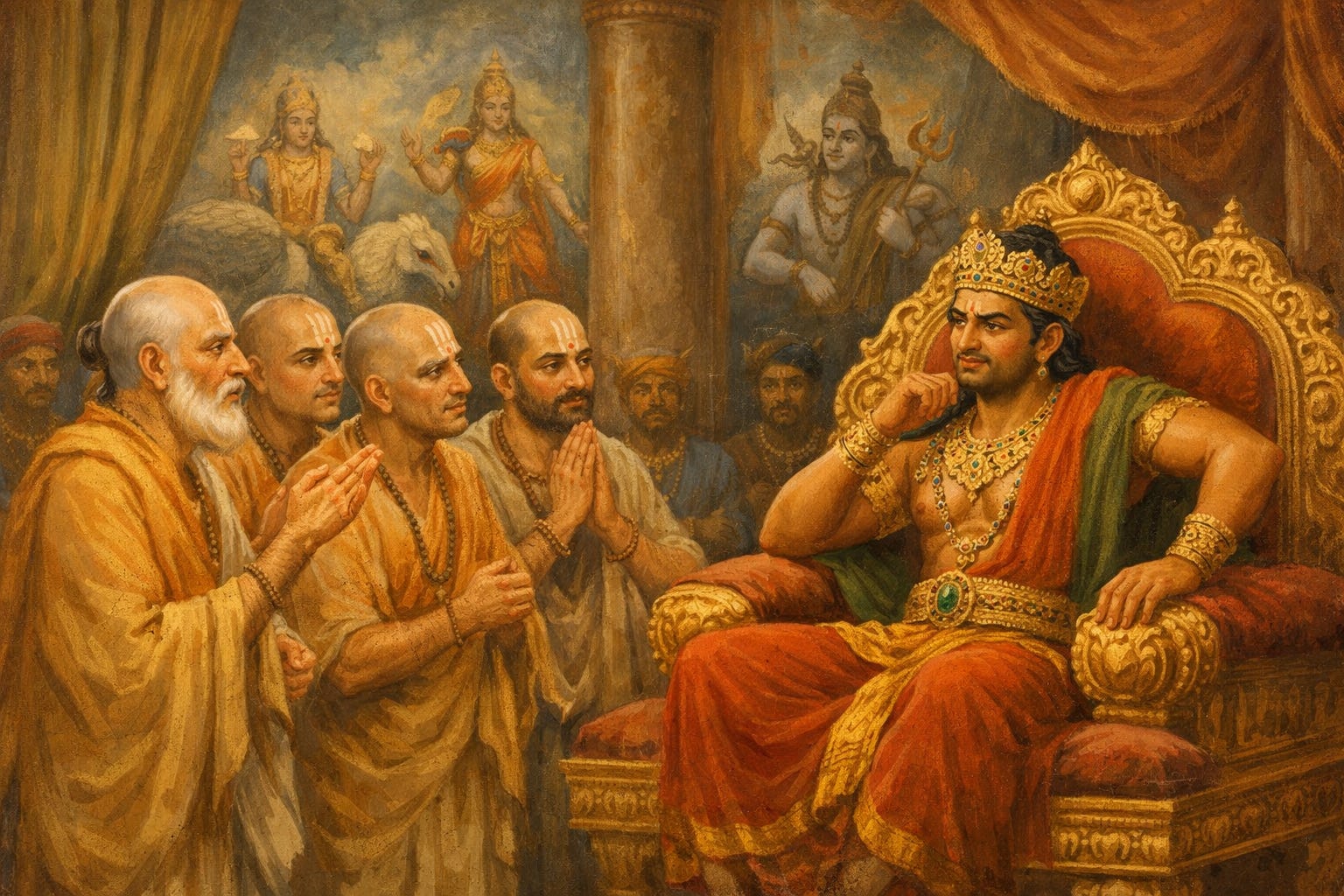
A state can’t survive without a king, but a sinful king like Vena is no better. The brāhmaṇas thus decided to try a last-ditch attempt to give good advice to Vena, performing their duty as teachers. If he did not accept it, they planned to kill him with a curse. Internally, they were very angry with Vena’s sinful activities, but externally, they tried to cover it, speaking to him using sweet words, in a way that he could be touched and accept their advice.
What did they tell him? In summary, they advised him as follows:
a) By following the advice of saintly persons, a king acts virtuously and thus increases his prosperity and duration of life. By being impious, a king becomes liable not only to the reactions to his own sins but to the sins of the misguided inhabitants of the kingdom.
b) Rulers who strictly follow religious principles are elevated to lokān viśokān, the planets without misery. In other words, they can be elevated either to the celestial planets or the spiritual planets, according to their devotion. By their example, they also elevate the citizens, and thus everyone benefits by becoming rid of the material influence and achieving happiness in life.
c) By acting otherwise and following the principles of irreligion, a ruler spoils the spiritual progress of the whole populace, and he himself fails from his position. Vena was on this path, and thus the brāhmaṇas indirectly alerted he would be very soon deposed if he did not agree to change.
d) The duty of a king is to protect the citizens both against criminals and corrupt ministers who may try to plunder them. When a king properly performs this duty, he becomes eligible to collect taxes from them. In this way, a king enjoys both in this life, enjoying vast riches, and after death, enjoying the results of his virtuous activities. By failing to protect the population, however, a king becomes a criminal in just extorting taxes and fines out of them.
e) The ultimate goal of a pious king is to elevate the population to the platform of devotional service to the Lord. By doing so, he can satisfy the Lord. Not everyone may be able to immediately attain a position of pure devotional service; therefore, the king should engage them according to their natural tendencies in following the Varṇāśrama system, so they may be gradually elevated by satisfying the Lord with their activities.
f) When the Lord becomes satisfied, nothing is impossible to achieve (like in the case of Dhruva Maharaja); therefore, even great demigods worship Him. The Lord is the enjoyer of all sacrifices, the owner of everything, and the ultimate goal of all processes of austerity. He is worshipable by everyone, and Vena should thus not consider himself above this process of worship.
g) All good results come from the performance of sacrifices, granted by different demigods, who are plenary expansions of the Lord. By stopping the sacrificial performances, Vena was disrespecting the demigods, which would do no good.
The advice of the Brāhmaṇas was solid and at the same time compassionate. Vena, however, was too blinded by his false prestige to follow it. Instead of following the good advice of the brāhmaṇas, Vena turned against them, accusing them of betraying their king, who was maintaining them, and acting like prostitutes, by worshiping someone else (the Lord). In this way, he completely inverted the situation, failing to understand that he himself was being maintained by the Lord. This shows the position of every materialist, who sees himself as all-powerful and the maintainer of others, putting himself in the position of the Lord. Just as Vena was killed by the brāhmaṇas a result of this mentality, every materialist has to similarly face death eventually.
It is said in the scriptures that the king is the embodiment of all demigods and the incarnation of the Lord because he acts as His representative. Vena, however, due to his false pride, twisted this point by declaring himself the supreme and considering the demigods and the Lord himself as parts of his body. Therefore, he concluded, the brāhmaṇas should worship him, instead of worshiping the Lord.
Vena said:
“Lord Viṣṇu; Lord Brahmā; Lord Śiva; Lord Indra; Vāyu, the master of air; Yama, the superintendent of death; the sun-god; the director of rainfall; Kuvera, the treasurer; the moon-god; the predominating deity of the earth; Agni, the fire-god; Varuṇa, the lord of waters; and all others who are great and competent to bestow benedictions or to curse — all abide in the body of the king. For this reason the king is known as the reservoir of all demigods, who are simply parts and parcels of the king’s body. For this reason, O brāhmaṇas, you should abandon your envy of me, and by your ritualistic activities you should worship me and offer me all paraphernalia. If you are intelligent, you should know that there is no personality superior to me who can accept the first oblations of all sacrifices.” (SB 4.14.27-28)
In hearing this, the brāhmaṇas understood it would not be possible to correct the king. There was no limit to his arrogance, and if allowed to continue ruling, he would destroy the whole world. As Prabhupāda mentions in his purport: “Saintly persons are generally very kind to all kinds of living entities, but they are not unhappy when a serpent or a scorpion is killed. It is not good for saintly persons to kill, but they are encouraged to kill demons, who are exactly like serpents and scorpions. Therefore all the saintly sages decided to kill King Vena, who was so dreadful and dangerous to all human society.”
The brāhmaṇas then killed the king for his blasphemy, not by using weapons, but by cursing him. Brāhmaṇas in our age don’t rigidly follow brahminical principles and thus have no such powers, but at that time, brāhmaṇas were so powerful that just by words they could bring down a powerful king like Vena. After the king was dead, the sages returned to their hermitages.
This story, however, has a happy ending, leading to the appearance of Pṛthu Maharaja, an incarnation of the Lord who played the role of the perfect king, reversing all the damage done by Vena.
You can also donate using Buy Me a Coffee, PayPal, Wise, Revolut, or bank transfers. There is a separate page with all the links. This helps me enormously to have time to write instead of doing other things to make a living. Thanks!