


You can receive new articles directly in your inbox. Subscription is free; donations are welcome.
Nowadays, more and more products and services are offered as subscriptions. Instead of just paying upfront once, like before, companies try to sell everything as indefinite monthly payments. The idea is simple: a company can earn much more long-term with a subscription than by just selling a product once.
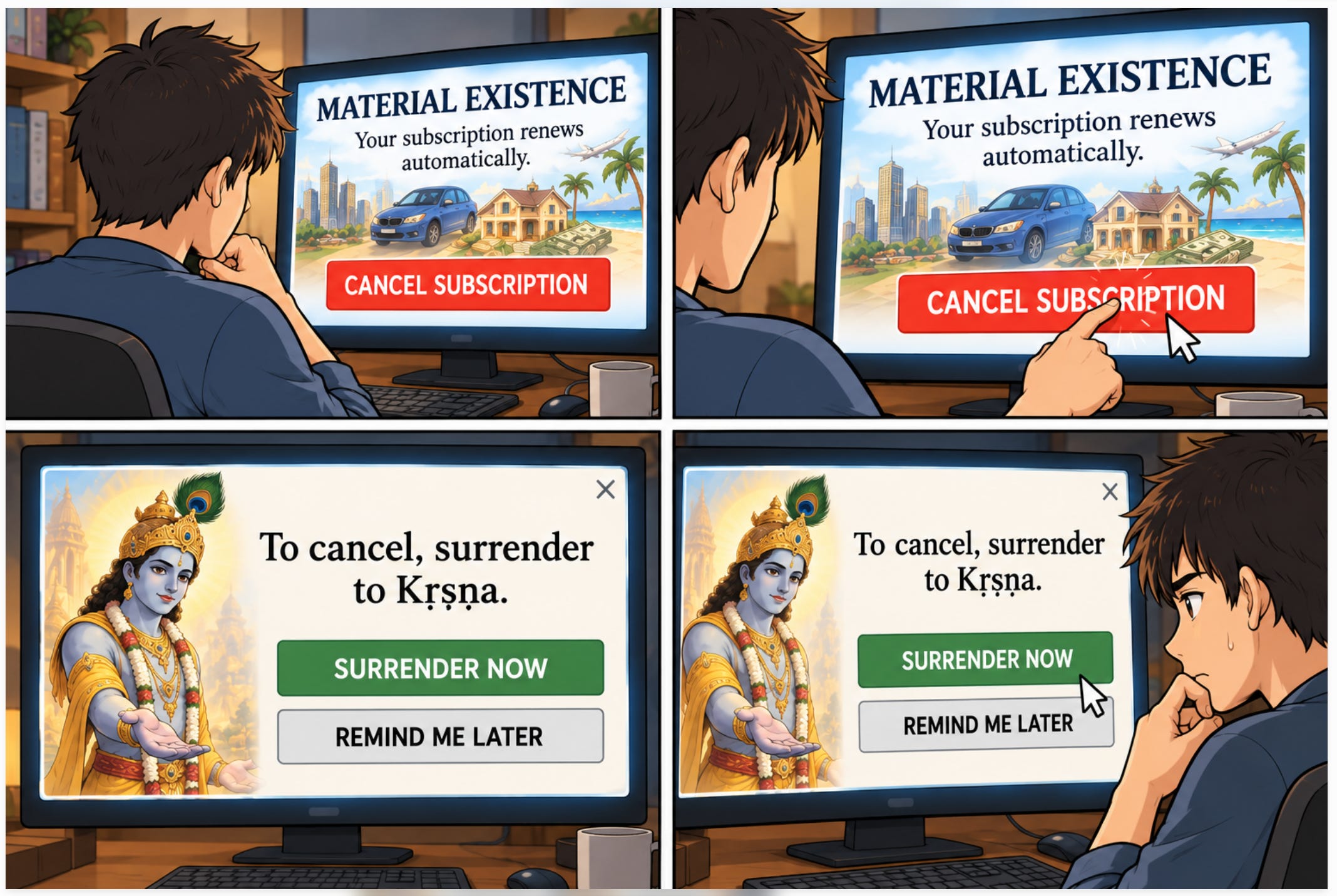
The basic technique is well known: make subscribing very easy, renewing automatic, and unsubscribing incredibly difficult, so once one gets in, in a moment of weakness, one can’t easily get out. That’s a perfect description of life in this material world.
Here we go from one body to the other, going through different cycles in our material experience. In each life we are offered different illusory goals to pursue: house, car, family, social prestige, personal gratification, fame, etc. These different goals and images create impressions in our consciousness that nourish different material desires that keep expanding. In each life we find many difficulties and frustrations, but we also find some material pleasure and new material goals we keep pursuing. All these images are stored in the mind and nourish a material consciousness that keeps carrying us from one body to the other. As long as our material consciousness continues, our material subscription is automatically renewed. Death is thus simply the end of a cycle that leads to the start of a new one, called birth.
Why does the subscription keep renewing? Because we remain attached to material life. Try to turn off the phone or computer for five minutes. Close your eyes. What images come to your mind? These are the thoughts that, at the time of death, can carry us to the next body. This is what makes the subscription automatically renew.
Kṛṣṇa explains this in the Gītā (13.22):
“The living entity in material nature thus follows the ways of life, enjoying the three modes of nature. This is due to his association with that material nature. Thus he meets with good and evil among various species.”
How to end it? That’s the tricky part. Renewing is easy; we just continue as usual. Canceling, however, demands active effort. We need to make a decision, call the office, resist all the offers of discounts and extra services, resist all the reminders of the features and functions we will lose access to, and keep insisting that we don’t want a different plan; we want to get out.
Material life is extraordinarily difficult to cancel by our own strength. Even intelligence, austerity, wealth, or philosophical knowledge can’t independently free the conditioned soul from the grasp of material nature. Just as the operators on the other side of the line are trained to keep insisting until we decide to keep the service, Māyā has the function of testing our determination. What is the solution then? We call the CEO:
“This divine energy of Mine, consisting of the three modes of material nature, is difficult to overcome. But those who have surrendered unto Me can easily cross beyond it.” (Bg 7.14)
Kṛṣṇa is the controller of Māyā. The way to become free is connecting directly with Him. When He sees that we are sincere in getting out and gets in our case, Māyā immediately gives up. His order is supreme. Māyā is His energy, not His rival. Kṛṣṇa also explains this in the Gītā (9.10):
“This material nature, which is one of My energies, is working under My direction, O son of Kuntī, producing all moving and nonmoving beings. Under its rule this manifestation is created and annihilated again and again.”
What does it mean to surrender to Kṛṣṇa? We need to understand his teachings in the Bhagavad-gītā and Śrīmad-Bhāgavatam and apply them to our lives. We should keep a clean life, chant the mahā-mantra regularly, and work for Kṛṣṇa. By following this regulated spiritual practice, we can come to Him, as He promises in the Gītā:
“Engage your mind always in thinking of Me, become My devotee, offer obeisances to Me and worship Me. Being completely absorbed in Me, surely you will come to Me.”
One does not have to be an important person to speak with the CEO. He explicitly remembers us that all classes of subscribers can call Him:
“O son of Pṛthā, those who take shelter in Me, though they be of lower birth – women, vaiśyas [merchants] and śūdras [workers] – can attain the supreme destination.” (Bg 9.32)
In Kali-yuga, everyone is a śūdra, which includes all the men. Vaiśyas are rare people who have slightly higher qualifications. Women are mentioned separately so no one could argue that they are excluded. So, no matter if one is a woman or a śūdra, it does not matter; if we are dissatisfied with our material subscription, we can call the CEO, and He can order Māyā to release us. It’s our choice.
What is the difficulty then? The problem is that we keep choosing “Remind me later.”
See what Kṛṣṇa explains in 2.62-63:
“While contemplating the objects of the senses, a person develops attachment for them, and from such attachment lust develops, and from lust anger arises. From anger, complete delusion arises, and from delusion bewilderment of memory. When memory is bewildered, intelligence is lost, and when intelligence is lost one falls down again into the material pool.”
Our material bondage is perpetuated because of desire and attachment; it is not because of the lack of an escape route. Kṛṣṇa is in the heart of everyone; as soon as someone shows a sincere desire, He can put him or her in contact with someone who can offer guidance. The problem is for us to develop this sincere desire to get out. We are like a person watching one more reel before getting up from bed, and then another, and another...
This process is also explained in the Gītā. That’s 3.39:
“The wise living entity’s pure consciousness becomes covered by his eternal enemy in the form of lust, which is never satisfied and which burns like fire.”
As long as we keep putting fuel into the fire of material lust, it will keep burning. The way to stop is by gradually suffocating it by a combination of material regulation and the acquisition of a higher taste in the spiritual practice.
One interesting detail to understand is that our desires can be quite contradictory. We may desire to become free from suffering, while simultaneously desiring the very causes of suffering. It may sound illogical, but it is incredibly common. An alcoholic may desire to become free of hangouts and all the difficulties that his habits cause. This part is easy. The problem is that he continues to desire to drink! As long as he doesn’t come to the conclusion that drinking is the source of his problems, there is no point in disliking the hangouts. One has to pass through the stage of knowledge, understanding the consequences of drinking, and then realization. When he finally decides to stop, it comes the hardest part: resisting the impulse to relapse.
Similarly, canceling our material subscription passes through acquiring transcendental knowledge, starting our spiritual practice, realizing it, making a firm decision to avoid the causes of material life, renouncing our ego, ambitions, etc., and then keeping our decision firm until the current subscription ends (at death), resisting the “remind me later” button that keeps blinking on the screen.
Before we go, Māyā may offer a final deal. What about a free upgrade in our subscription? We may get some unexpected inheritance, a better job, or even the possibility of becoming a great scholar, a guru, or a respected religious leader. There is no problem in using these things for Kṛṣṇa, but if it awakens our ego and desires, we can lapse back into the automatic renewal. As Kṛṣṇa explains in the Gītā, all places in this material world share the same basic problems. A better subscription does not solve anything.
Do you remember what the verse is? Exactly! 8.16:
“From the highest planet in the material world down to the lowest, all are places of misery wherein repeated birth and death take place. But one who attains to My abode, O son of Kuntī, never takes birth again.”
The process of devotional service is not about obtaining a more comfortable material life but about stopping the cycle entirely. We may finish our current cycle in whatever subscription plan we are currently in; that’s just temporary anyway. The main point is to be fixed on where we will go next.
As Arjuna notes on Bg 6.34–35, the mind is difficult to control, but Kṛṣṇa explains that it can be controlled through practice and detachment. The entire Bhagavad-gītā teaches us this process, and at the end Kṛṣṇa points us to the unsubscribe button: “Surrender Now.”
He, however, does not force us to click on it. At the end of the Gītā, after instructing us, He allows us to choose:
“Thus I have explained to you knowledge still more confidential. Deliberate on this fully, and then do what you wish to do.”
There are two options on the screen; we can choose which to click.
Read more:


This is a publication for thoughtful readers who want to go deeper into Kṛṣṇa consciousness. I publish daily, trying to offer high-quality spiritual content, and all posts are available to free subscribers. If you wish, you can support this work with a monthly contribution. When you subscribe, you can choose between a free subscription and a monthly contribution, and you can switch from a free subscriber to a supporter at any time.
You can also receive updates on WhatsApp or Telegram.
If you would like to contribute further, you can find the donation links here.