

Subscribe to receive new articles by e-mail. It’s free, but if you like, you can pledge a donation:
In modern cosmology, the movements of the planets are explained from a heliocentric perspective, where the sun is orbited by the planets of our solar system while simultaneously wobbling in an almost circular orbit around the center of the galaxy. Vedic cosmology also gives us a valid model for explaining days and nights, as well as the passages of the seasons and the movements of the stars. It is, however, based on a geocentric model that puts our planet at the center, as part of Bhū-mandala, with the sun, all the stars, and other cosmic structures, as well as the other planets of the solar system orbiting this structure.
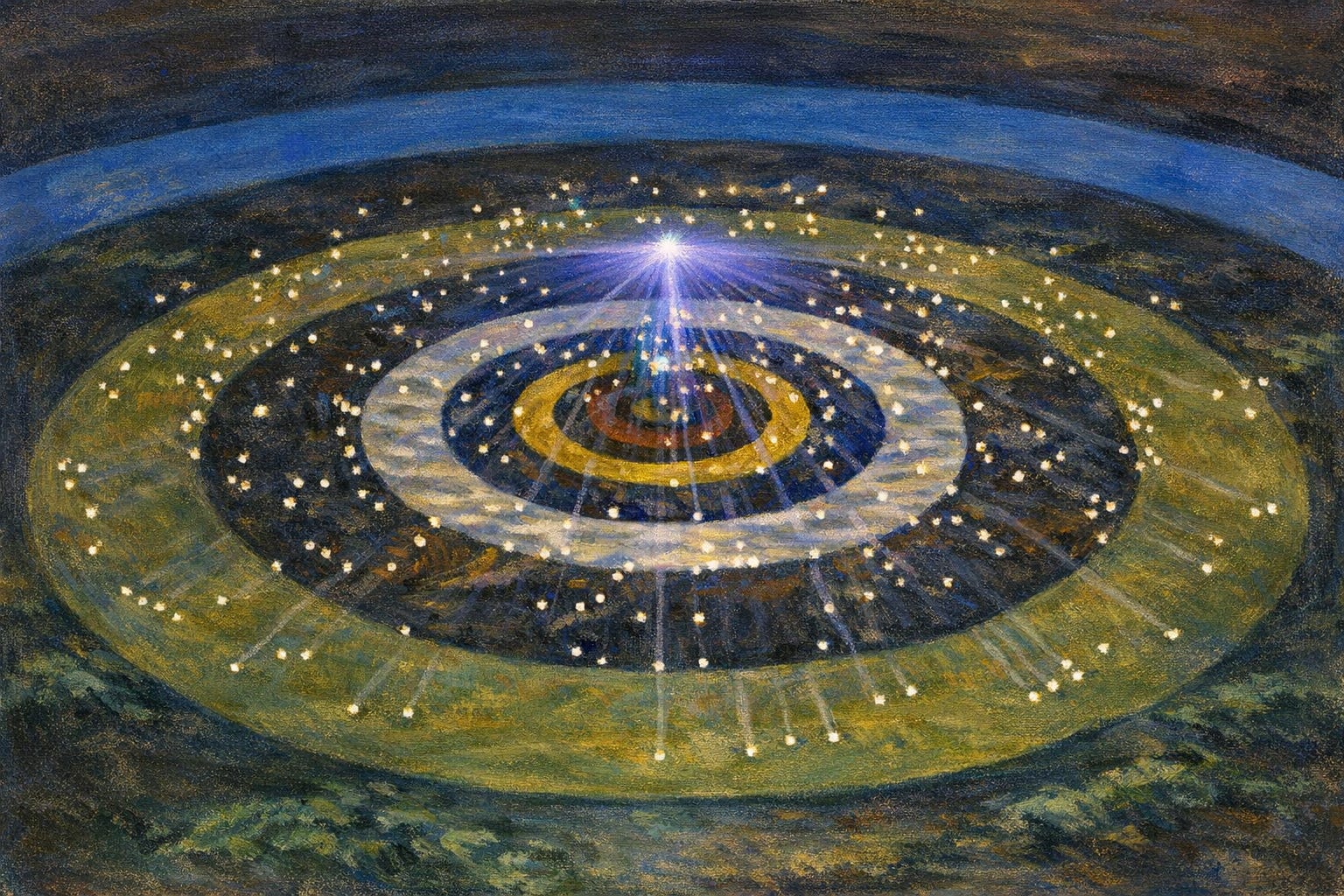
How does it work? In the cosmological model described in the Śrīmad Bhāgavatam (and all the other Puranas), the earth is described as stationary (as part of the structure of Bhū-mandala), while the whole sky, including the sun, orbits around it once a day. This daily movement of the whole sky around Dhruvaloka is complemented by the individual orbits of the sun, moon, and planets, resulting in the movements of the luminaries we see in the sky.
This movement of the sun is described by Lord Brahmā himself in his prayers in the Śrī Brahma-saṁhitā: yasyājñayā bhramati sambhṛta-kāla-cakro. The sun performs its journey, mounting the wheel of time. This movement of the sun around Mount Sumeru is thus a key element in Vedic cosmology, because it is connected with the very passage of time due to the influence of kāla (time), the divine potency of the Lord.
This may sound illogical at first. Why believe that the whole universe orbits around our planet? Doesn’t it make more sense to believe the opposite, as in modern cosmology?
Here is a point one may consider: when we look to the sky, we see only the relative motions of the sun, moon, stars, and planets, but practically speaking, we can’t tell experimentally what is orbiting around what. This is a point noted by a few important astronomers and physicists. As stated:
“Let it be understood at the outset that it makes no difference, from the point of view of describing planetary motion, whether we take the Earth or the Sun as the center of the solar system. Since the issue is one of relative motion only.” “We know now that the difference between a heliocentric and a geocentric theory is one of motions only, and that such a difference has no physical significance.” (Astronomer, Fred Hoyle)
“I can construct for you a spherically symmetrical universe with Earth at its center, and you cannot disprove it based on observations. You can only exclude it on philosophical grounds. In my view there is absolutely nothing wrong in that.” (Physicist, George F. R. Ellis)
Modern cosmology concludes that the earth orbits the sun based on the study of gravity. The Vedas also accept the influence of gravity, defining it as the potency of Lord Ananta, which maintains all the planets in their particular orbits. However, the Vedas make the point that the universe operates under the will of the Lord, not under mechanical forces. Our planet has a central role in the cosmos because it is the place where the souls create a new set of karma that will define their destiny. It is also the place chosen by the Lord when He personally descends to play His pastimes and the place where His divine abodes of Vṛndāvana, Jagannātha Pūri, Navadvīpa, etc., manifest. If He decides that the intermediate planetary system will have the form of a cosmic lotus and not only the sun but all the stars should orbit around it, who can prevent it?
Prabhupāda makes the point that the descriptions given in the Vedas should be given precedence over empirical observations, since, even though empirical observation is also a valid method for obtaining knowledge, it is imperfect, and it often results in errors, while the statements of the Vedas come from perfect sources, starting from God himself.
A few points that can be mentioned to support this point:
a) During medieval times, many believed the earth was flat, while the Vedas explained it as a sphere since the beginning, giving formulas to calculate its circumference and the distance to the moon and other astral bodies.
b) In 1929, Hubble calculated the age of our universe at about 2 billion years. Later, in 1958, Sandage put it around between 4 and 18 billion years. In 2003, a study conducted by Spergel brought it to 13.7 billion years, a number that was raised to 13.75 billion in 2011 (Komatsu), 13.772 in 2013 (Bennet et al.), 13.799 in 2015 (Lawrence), and finally 13.801 in 2018 (Aghanim et al.). The value given in the Vedas, however, remains constant since the beginning: 13.819 billion years (this is calculated from the destruction at the end of the first half of the life of Brahma, including Sridhara’s factor of two).
As we can see, the number given in different studies has gradually increased over time as the methodology and data of the studies have improved. The difference is already less than 0.15% from the value given in the Vedas. It may be that in the future, new studies put the numbers even closer, or even give exactly the same number.
c) The idea of multiple universes has existed for a long time in the field of science fiction, but it started gaining serious traction in scientific circles only in the 1980s, with the development of inflationary cosmology. Guth introduced the idea of cosmic inflation in 1981, and later developments by Linde showed that inflation can naturally produce multiple bubble universes. The multiverse theory gained further traction in the 1990s and 2000s, as the string theory evolved. The Vedas, however, have been stating since the beginning that, vast as it may be, our universe is just one among millions of other bubble-like universes floating in the causal ocean.
Just as the idea of our universe existing for billions of years and being just one amongst millions of other universes would sound utterly absurd to a medieval mind, other ideas proposed in the Vedas may sound incoherent to us. However, as our understand increases, not only in terms of experimental knowledge, but in terms of spiritual insight, the explanations given in the Vedas start to make more sense to us.
One central idea of the model of the Vedic universe that is different from what is believed in modern science is the concept of different dimensions, from gross to subtle, which explains the existence of the different structures and planetary systems described in the Vedas, such as Bhū-mandala, and their connection with our gross reality.
For example, in the Third Canto, Lord Kapila describes matter based on the five elements, earth, water, fire, air, and ether. The reason is that this is the only model that allows us to describe matter in all levels, not only in our gross reality.
According to the Vedas, reality exists on several different levels, going from gross (where matter is composed of atoms) to subtle (where matter assume more refined forms). We live in a gross material level, and the demigods live in different gradations of material subtle level. Just as we can’t see demigods such as Indra and Surya, unless they assume forms visible to us, they can’t see higher beings such as Nārada or the four Kumāras, unless they assume forms visible to them. The subtlest material level exist in Brahmaloka, where reality is so subtle that there is practically no matter at all. Outside the universe, there is the spiritual level, which is still higher and subtler, inaccessible even to the inhabitants of Brahmaloka.
In material science, the chemical elements are counted according to their atomic composition. Hydrogen is composed of atoms with one proton and one electron, lithium is composed of atoms with two of each, iron is made of atoms with twenty-six, and so on. There are also variations, like tritium, which is a hydrogen isotope, with one proton and two neutrons, for example. The Vedas, however, classify the elements according to their characteristics, and not according to their atomic structure. The reason is that material reality is composed of different levels of existence, which go from gross to subtle. In the gross level we live, matter is composed of atoms, but in the subtle realms of the inhabitants of Bhū-Mandala, of the demigods, great sages, etc. matter has different compositions. The classification of modern science, based on types of atoms is valid only for our plane, while the classification of the Vedas in terms of fire, ether, water, smell, taste, sight, hearing, etc. describes reality in all planes, because everywhere people see, taste, hear, and matter has properties of having taste, form, odor and so on. This classification of elements given by Lord Kapila is thus much more scientific than it may seem at first.
In the Vedas, the moon is described as a celestial planet, higher than the sun in the subtle scale. However, when we go there, we see only rocks and dust, because the matter that compose that level of reality is too subtle for us to experience.
This concept is indirectly supported in modern cosmology in the concept of dark matter. According to recent studies, about 95% of our universe is composed of dark matter and dark energy, different types of matter, not composed of atoms or detectable forms of energy. The Vedas explain it in terms of the subtle forms of matter that compose the abodes of the demigods and structures like Bhū-mandala, while modern science is still trying to figure out what it may be.
The idea of multiple dimensions (as different levels of reality in the same space) is currently discussed only in science fiction, but it may be the next Vedic concept to be acknowledged in scientific circles, just as the concept of multiple universes.
You can also donate using Buy Me a Coffee, PayPal, Wise, Revolut, or bank transfers. There is a separate page with all the links. This helps me enormously to have time to write instead of doing other things to make a living. Thanks! You can also receive the updates on Telegram.