

« The ‘Fall’ of the Jīva, as Explained by Śrīla Prabhupāda
Chapter 4: The teachings of Sanat-kumāra
The teachings of Lord Kapila give us the philosophical basis to understand our original transcendental position, our conditioning in the material world, and the process to become free from it, instructions that Śrīla Prabhupāda elaborates in his purports. This philosophical foundation is further developed in two other passages of Śrīmad-Bhāgavatam: the instructions of Sanat-kumāra to Pṛthu Maharaja, and the song of Lord Śiva, revealed to the Pracetas. The final conclusion is later given in the allegory of King Purañjana, where Prabhupāda gives some of his most memorable purports, giving his conclusions on the topic.
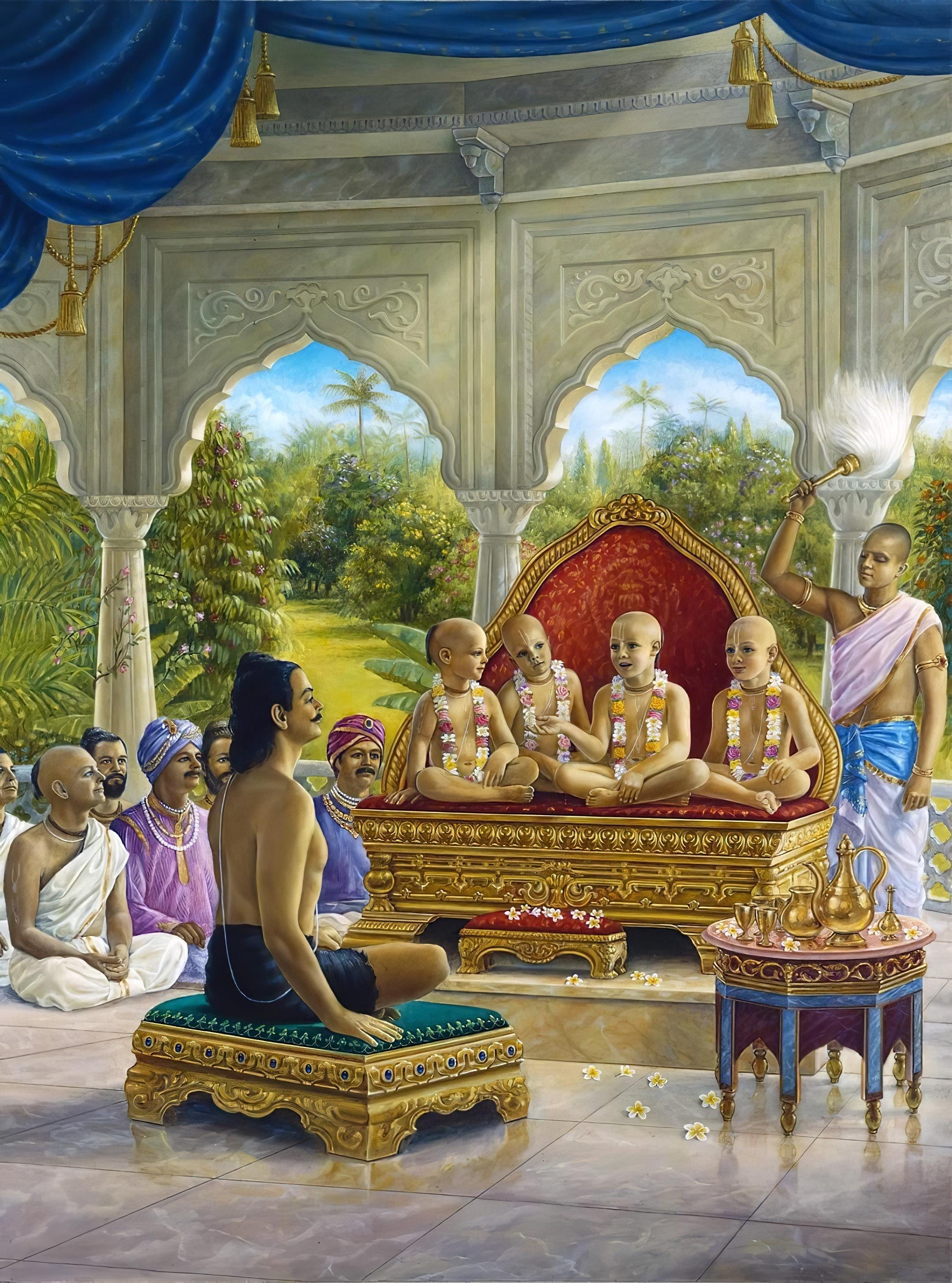
The topic with the instructions of Sanat-kumāra starts with the four brothers appearing during the sacrifice of Maharaja Pṛthu to give him spiritual instructions on the process of devotional service in answer to the inquiries of the king. Even though a small passage, with just 23 verses, this is a central passage of the Śrīmad-Bhāgavatam, which includes knowledge on sambandha, abhidheya, and prayojana, and thus also explains the original position of the soul, and how we fall into material conditioning, building on the conclusions enunciated by Lord Kapila at the end of the Third Canto.
From where does it start? By declaring that Kṛṣṇa Consciousness is the ultimate good, and that the best way to learn about it is in the association of devotees. As Sanat-kumāra mentions:
“When there is a congregation of devotees, their discussions, questions and answers become conclusive to both the speaker and the audience. Thus, such a meeting is beneficial for everyone’s real happiness.” (SB 4.22.19)
The main point is not even the scriptures themselves, but the devotees discussing them. As Prabhupāda points out in the purport, the Bhagavad-gītā was well-known for many centuries in the West before he came, with many discussions held and many commentaries written, but not even a single person became Kṛṣṇa conscious as a result of such discussions. When he published the Bhagavad-gītā As It Is, however, the effect was immediately noticed.
Such discussions amongst devotees benefit all involved, because when we speak about Kṛṣṇa, we directly associate with Kṛṣṇa. The speaker thus benefits as much as the audience. Even if one is not a devotee, just by hearing, one becomes purified and, with time, may also come to the platform of devotional service.
“Sanat-kumāra continued: My dear King, you already have an inclination to glorify the lotus feet of the Supreme Personality of Godhead. Such attachment is very difficult to achieve, but when one has attained such unflinching faith in the Lord, it automatically cleanses lusty desires from the core of the heart.” (SB 4.22.20)
The propensity to enjoy matter, manifested in the form of material lust, is the root cause of the conditioning of the soul. This lust can be cleansed only by the association of devotees, because only by this association can we ascend to the platform of devotional service. Other processes, such as karma and jñana, are ineffective without the presence of bhakti. As Prabhupāda mentions in his purport, the living being has no factual connection with material enjoyment or with lust. We simply imagine we are in this material condition, just as someone dreaming after falling asleep. By the association of pure devotees, we are awakened, and we become situated in our constitutional position as eternal servants of the Lord. Pṛthu Maharaja was already situated in this platform of strong faith and devotion, and he inquired from the Kumāras so others could be elevated to the same platform.
Since lust is the cause of conditioning, what is the process to become free from it? This is answered by Sanat-kumāra in the next verse:
“It has been conclusively decided in the scriptures, after due consideration, that the ultimate goal for the welfare of human society is detachment from the bodily concept of life and increased and steadfast attachment for the Supreme Lord, who is transcendental, beyond the modes of material nature.” (SB 4.22.21)
Progress in spiritual life has two components: detachment from the bodily conception of life and attachment to the Lord, and the highest welfare is that which achieves these two things. This is the conclusion from the scriptures, and the main focus of the instructions of Sanat-kumāra. This same topic will be further discussed in the allegory of King Purañjana, described later in the Fourth Canto, which describes in detail the situation of the conditioned soul in this material world to invoke in us a powerful sense of detachment. This allegory is followed by the story of Queen Vaidarbhī and her meeting with the Supersoul, who reveals to her their eternal relationship, which was forgotten when she decided to enjoy this material world.
Why is it not possible to become attached to the Lord while at the same time remaining attached to the material world? The Lord is transcendental and beyond the modes of material nature, and therefore, He cannot be attained as long as one is tied to this material world, just as one can’t remain on the ground and touch the clouds at the same time. A person in the bodily concept of life can’t even understand the ultimate goal, what to speak of attaining it. The process of giving up the attachment to this material world starts with transcendental inquiry (athāto brahma-jijñāsā). After one’s attachment slackens as a result of such inquiry, one gradually comes to the platform of devotional service. Without devotional service, however, mere philosophical inquiry stops in impersonalism, from which one may fall back to the material platform.
What about the second component, attachment to the Lord?
“Attachment for the Supreme can be increased by practicing devotional service, inquiring about the Supreme Personality of Godhead, applying bhakti-yoga in life, worshiping the Yogeśvara, the Supreme Personality of Godhead, and by hearing and chanting about the glories of the Supreme Personality of Godhead. These actions are pious in themselves.” (SB 4.22.22)
The words yogeśva uropāsanayā are translated in the verse as “worshiping the Yogeśvara, the Supreme Personality of Godhead”, but in the purport, Prabhupāda calls our attention to another meaning: yogeśvara-upāsanā also means to render service to a pure devotee. Without serving a pure devotee, one cannot advance in spiritual life. We serve Kṛṣṇa by serving His devotees. And how can these pure devotees be served? “To serve the topmost devotee means to hear from him about the glories of the Supreme Personality of Godhead.”
Kṛṣṇa mentions in the Gītā (7.28) that devotional service comes after attaining a platform of piety. This explains why it is so rare for common people to come to this platform. However, by simply hearing from pure devotees, we become situated in this platform of piety, giving us the opportunity. To further advance, becoming fully cleansed, one should accept a bona fide spiritual master and learn from him how to serve Kṛṣṇa.
The process of developing attachment to Kṛṣṇa includes many positives, such as hearing from saintly persons, accepting a spiritual master and learning from him, following in the footsteps of great ācāryas, and so on. It also includes many negatives, or things to avoid in order to quickly progress, as described by Sanat-kumāra:
“One has to make progress in spiritual life by not associating with persons who are simply interested in sense gratification and making money. Not only such persons, but one who associates with such persons should be avoided. One should mold his life in such a way that he cannot live in peace without drinking the nectar of the glorification of the Supreme Personality of Godhead, Hari. One can be thus elevated by being disgusted with the taste for sense enjoyment.” (SB 4.22.23)
To be able to advance quickly, we should do both simultaneously. As Prabhupāda explains in his purport, just abandoning the association of materialistic persons is not sufficient: one has to also find positive engagement in the company of devotees. Therefore, although both are necessary, association of devotees should be the priority, because by associating with devotees, we gradually lose the taste for material association, but by just abandoning material association and going to meditate in the forest, one doesn’t automatically develop taste for devotional service, and without this taste, one cannot remain fixed on the transcendental platform.
In this way, it is understood that we need association, but where to find it? To offer this devotee association, our ācāryas have been engaged in creating and expanding spiritual institutions. Śrīla Bhaktivinoda Thākura created the World Vaiṣnava Association, Śrīla Bhaktisiddhānta Sarasvatī Thākura created the Gauḍīya Maṭha, and Śrīla Prabhupāda created ISKCON. In one sense, these institutions are perfect because they are dedicated to the cause of the Lord and are thus connected to the spiritual platform, but on the material side, there may be many deficiencies introduced by imperfect individuals joining, such as ourselves. The idea, however, is that by associating with devotees, hearing about Kṛṣṇa, and being engaged in practical devotional service, we can gradually grow. We should thus try to focus on the spiritual side, valuing the possibility of associating with devotees instead of paying too much attention to the material imperfections.
The process of bhakti is described in more detail
After describing the foundations of the process of bhakti in verses 4.22.18 to 23, Sanat-kumāra goes deeper into the details of the devotional practice in verses 24 to 31. It is already accepted that hearing about Kṛṣṇa from devotees is the foundation of the process of bhakti and that accepting a spiritual master and learning from him is the next step. What other directives should we follow to make the mind more fixed on the Lord?
In text 24, six additional principles are offered for one desiring to advance on the spiritual path:
“A candidate for spiritual advancement must be nonviolent, must follow in the footsteps of great ācāryas, must always remember the nectar of the pastimes of the Supreme Personality of Godhead, must follow the regulative principles without material desire and, while following the regulative principles, should not blaspheme others. A devotee should lead a very simple life and not be disturbed by the duality of opposing elements. He should learn to tolerate them.” (SB 4.22.24)
We can break this very significant verse into several points:
a) Nonviolence (ahimsā) means not only refraining from committing violence against others, but also to stop violence from being committed against animals and other innocent creatures by spreading spiritual principles. If a devotee suffers personal injury, he should tolerate it, but if he sees someone else being harmed, he should be compassionate and do what he can to prevent it. Materialistic philanthropists usually promote the protection of a certain group or species, but a devotee understands the principle of universal brotherhood and is thus a friend to all and does his best to teach others this transcendental science. This is true ahimsā.
b) Following in the footsteps of great ācāryas means to join the disciplic succession by accepting a spiritual master and learning the transcendental science from him. All previous ācāryas showed the perfect example by following this same path.
c) What about smṛtyā, remembering the nectar of the pastimes of the Supreme Personality of Godhead? Prabhupāda explains that “Life should be molded in such a way that one cannot remain alone without thinking of Kṛṣṇa. We should live in Kṛṣṇa so that while eating, sleeping, walking, and working, we remain only in Kṛṣṇa.” How to achieve that? “This remembrance of the Lord can be continued if we hear about Him constantly.” Nowadays, we have the facility for hearing from sādhus not only personally and through books, but also through recordings, broadcasts, online meetings, and all sorts of electronic and virtual tools. We should, as far as possible, fill up our time with Kṛṣṇa-kathā. Prabhupāda gives the example of devotees hearing lectures while working, making incense in the Spiritual Sky company that devotees were running in the 1970s.
d) The fourth instruction, yamaiḥ, means to control our senses. This may sound very difficult in the beginning, but Prabhupāda explains that “This is possible when one does not desire any material sense gratification.” This can be achieved by observing the regulative principles and abandoning the idea of enjoying our senses separately from Kṛṣṇa. By serving Kṛṣṇa, we obtain a higher taste.
e) The problem in rigidly following regulative principles is that this can make us envious or intolerant of others who are not following the same standard. Prabhupāda explains that there are different religious systems meant for different grades of people, according to the influence of the three modes of material nature over them. Criticizing just creates enmity and agitates the mind, making people even more resistant. Instead, a devotee should encourage followers of other systems to stick to their principles, so that they may gradually progress. Doing so has two advantages: a devotee may encourage them to come closer to the standard of bhakti by encouraging them to follow positive principles present in their systems, and by this pleasant and soft approach, they may accept the devotee as a guide, which will open the door for them to become gradually attracted to the path of devotional service.
f) Finally, a devotee should be nirīhayā: simple, meek, and gentle. As Prabhupāda defines, “A devotee should not live very gorgeously and imitate a materialistic person. Plain living and high thinking are recommended for a devotee. He should accept only so much as he needs to keep the material body fit for the execution of devotional service.“ Life in the material world is always uncomfortable, and the more we try to make arrangements to reduce these discomforts, the less we have time to practice devotional service. We should thus learn to tolerate a certain level of bodily discomfort, so we can remain fixed in our spiritual practice.
How can we become fixed in these six principles? Sanat-kumāra concludes that this can be achieved by constantly hearing about Kṛṣṇa.
Ordinary people are attracted to hearing about politics and other mundane topics, but a devotee should acquire a taste for hearing about Kṛṣṇa. How to acquire this taste? This brings us back to the principle of hearing from realized souls. Prabhupāda describes this process very didactically in his purport to text 25:
“We can increase our propensity for devotional service by hearing Bhagavad-gītā and Śrīmad-Bhāgavatam from realized souls. The more we hear from realized souls, the more we make advancement in our devotional life. The more we advance in devotional life, the more we become detached from the material world. The more we become detached from the material world, as advised by Lord Caitanya Mahāprabhu, the more we increase in attachment for the Supreme Personality of Godhead.”
What is the result of following this process? After accepting a spiritual master and, by his guidance, attaining love for Kṛṣṇa and detachment from the world, the soul becomes free. Just as a fire appearing from wood destroys the wood itself, the soul practicing Kṛṣṇa Consciousness using the material body and senses gradually burns his material surroundings.
“Upon becoming fixed in his attachment to the Supreme Personality of Godhead by the grace of the spiritual master and by awakening knowledge and detachment, the living entity, situated within the heart of the body and covered by the five elements, burns up his material surroundings exactly as fire, arising from wood, burns the wood itself.” (SB 4.22.26)
Prabhupāda explains that apart from the five elements that constitute the material manifestation, the soul is tied to this world by five kinds of material attachments: ignorance, false egoism, attachment to the material world, envy, and absorption in material consciousness. Due to the spell of these attachments, we remain forgetful of our true nature, shackled to this world. When they are destroyed by knowledge and detachment, our original nature emerges, and we become firmly fixed in loving service to Kṛṣṇa. However, these coverings can’t be removed without accepting a spiritual master and following his instructions, just as when we are tied, we need the help of someone who is free.
When one becomes advanced in spiritual practice, one becomes liberated even while still living in the material body. This situation is compared to a dry coconut detached from the coconut husk, even though still within the husk. The body of a pure devotee is called cin-maya-śarīra, or a spiritualized body, because he doesn’t perform material activities, even though engaged in all kinds of undertakings for Kṛṣṇa. This art of action in Kṛṣṇa Consciousness is described in the Gītā. By this process of devotional service, not only the performer, but the activity itself, the paraphernalia used to perform it, the offering, and even the place where a devotee performs his service merge into transcendence (Bg 4.19-24). Once our original Kṛṣṇa Consciousness is covered by Māyā, the only way to revive it is by engaging the material body, material consciousness, and anything else we have now in the service of the Lord.
You can also donate using Buy Me a Coffee, PayPal, Wise, Revolut, or bank transfers. There is a separate page with all the links. This helps me enormously to have time to write instead of doing other things to make a living. Thanks!