

« Things I Wish Someone Had Taught Me When I Started Krishna Consciousness
The temporary harm and the eternal good
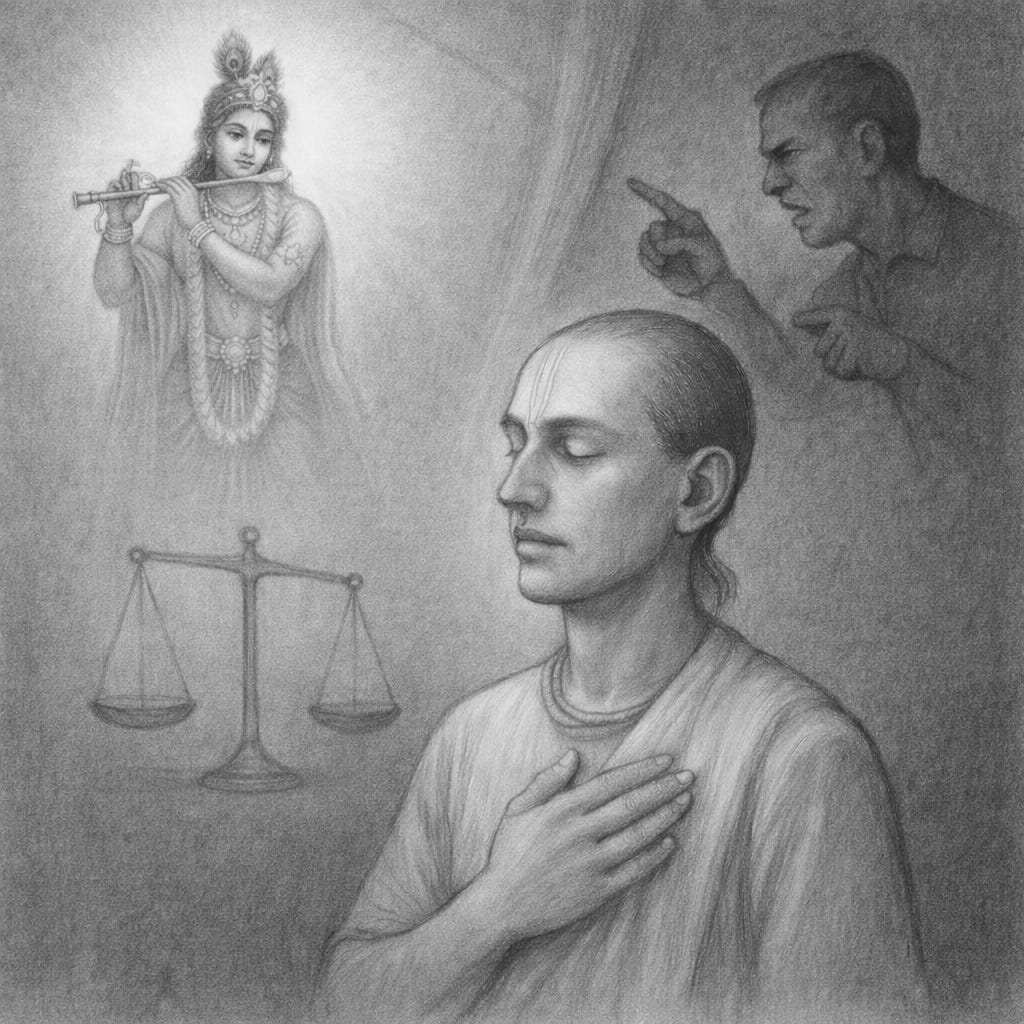
It’s said that devotees on the highest platform see everyone as a servant of Kṛṣṇa, and thus they consider everyone as superior to themselves. This may sound difficult to understand since most people are not really serving Kṛṣṇa at the present moment, but this is due to the material covering of the pure soul. In our current state, when we look at a person, we don’t see the soul at all, but just the material covering; but for a devotee in the highest platform, it’s the opposite: he sees the soul instead of the temporary nature covering it.
For us, it may be very difficult to understand how this works, but the nature of the soul transcends space and time. Although now conditioned, the soul is in truth an eternal servant of Kṛṣṇa, and it is this eternal nature that a perfect devotee can see. Currently, this eternal nature exists simultaneously with a temporary, material nature, but a devotee who is exclusively concentrated on the transcendental platform doesn’t consider it. Instead, he focuses on the transcendental reality beyond space and time.
This point of a spiritual and a material identity existing simultaneously is something that can be very relevant when we speak about relationships with other devotees, which are frequently strained by human imperfections such as anger, envy, negligence, or even dishonesty.
Śrila Prabhupāda explains that everything we do in terms of service to Kṛṣṇa is eternal, because it is connected with the eternal spiritual platform. On the other hand, the material activities we do, be it good or bad, are connected with the temporary material identity and are thus temporary.
This means that whatever service we do, especially in terms of helping people become Kṛṣṇa conscious, is eternal, while the sinful activities we perform, together with whatever imperfections we may show, are temporary, being connected with the material world. This doesn’t mean we will not have to pay for the harm we do, but the negative effects will always be temporary, and thus comparatively less important than the eternal effects of devotional service.
This is something to keep in mind when we are dealing with the imperfections of other devotees (and ultimately of people in general). Each person has an eternal nature, through which they serve Kṛṣṇa, and there is a separate, temporary nature, in which they act materially under the three modes and often perform questionable activities. As if relating to two different persons, we may thus sometimes deal with one and sometimes with the other, or even with a mixture of both, just like dealing with someone just out of bed, not yet fully awake.
While this often demands us to be careful, it can allow us to appreciate whatever good they do, despite the imperfections they may show, and thus “hate the sin, but not the sinner”, understanding that the contaminations will be eventually washed away, be later in this life or the next, but the devotional service they perform is eternal.
This understanding is also instrumental to understanding persons who did important service, but at the same time created harm. When we can understand this dual nature, we can see how both things can come together, without necessarily contradicting each other. A perfect devotee will never commit sinful activities or harm others, but a less advanced devotee may show a combination of some grade of devotional service and questionable actions, and thus do good and harm simultaneously. Anyone who performs some important service should be respected, since this service exists in the eternal platform, but if one doesn’t show proper behavior, he or she may not be trusted, or kept close.
On the one hand, there is hope: because one is serving, the tendency is that, over time, the devotional service will prevail and the contamination will be cleansed. On the other hand, such individuals may often cause harm to others until this cleansing happens, so it is important to exert caution. Both sides can be simultaneously present.
Unfortunately, many leaders in spiritual institutions fit into this description; therefore, one needs to always be mindful not to get into harm’s way. As Śrila Prabhupāda once said, we should surrender to Kṛṣṇa using our intelligence and not surrender our intelligence. In other words, we should use our discernment to find ways to surrender to Kṛṣṇa, while avoiding dangers and obstacles on the path, and not just blindly surrender to persons who may not be free from personal interest, even though we may still appreciate whatever service they are doing at a distance.
« Things I Wish Someone Had Taught Me When I Started Krishna Consciousness
You can also donate using Buy Me a Coffee, PayPal, Wise, Revolut, or bank transfers. There is a separate page with all the links. This helps me enormously to have time to write instead of doing other things to make a living. Thanks!