

Subscribe to receive new articles by e-mail. It’s free, but if you like, you can pledge a donation:
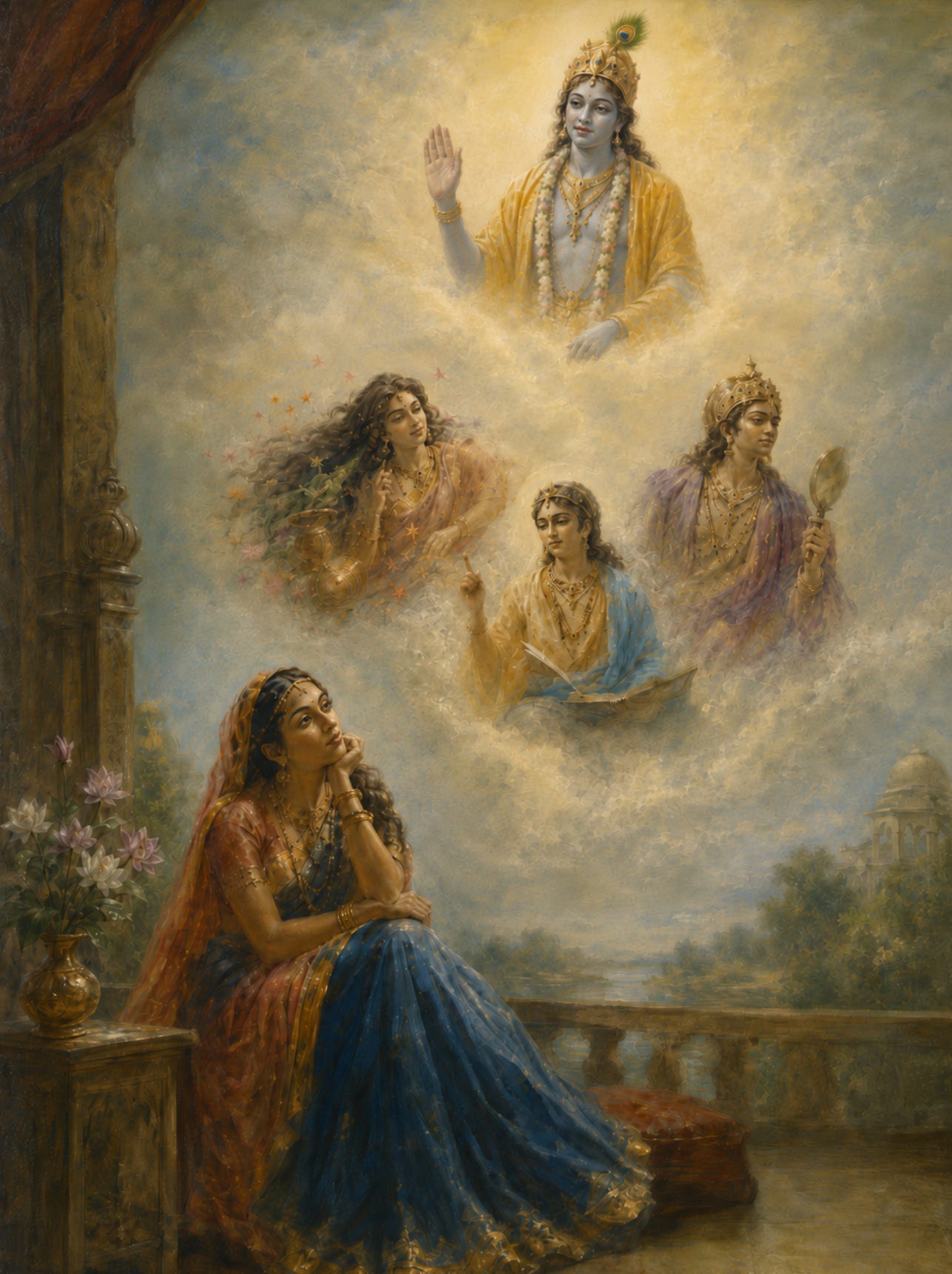
We frequently speak about the voice inside our head, but if we pay attention, we will notice that it is not just one voice. Different impulses, arguments, and identities appear, often contradicting each other.
The alarm rings early in the morning. One voice may say: “I’m tired, I will sleep more.” But then, another voice may answer, “No, get up, you have to chant, you already skipped yesterday.” Then a third voice may protest, “What kind of devotee are you?” and so on.
Some voices may speak in the first person, others in the second person, or even in the third person. Some may sound highly emotional, like a child screaming; others rational, others moderated. Who are all these voices? Which one is the real me?
To answer this question, I need to first of all determine who I am. There are many voices inside the head because my current self has many layers.
In one study (Russell, 1993), patients under general anesthesia undergoing surgery were left capable of moving one hand. This was done by placing a tourniquet on the corresponding arm, reducing the blood flow, and thus preventing one of the components of the anesthesia, the muscle-paralyzing drug, from reaching it. During the surgery, Russell asked the patients to squeeze his hand if they could hear him and again if they were experiencing pain. Seventy-two percent responded during surgery, and many indicated that they experienced pain at some point. Although they appeared unconscious and almost none remembered the experience afterward, some awareness remained. Part of their consciousness was still awake and capable of feeling pain and responding to simple commands.
Another example. In a case report (Alang and Kelly, 2015), a woman with a serious intestinal infection received a fecal transplant from her overweight daughter to restore her gut flora. Before the transplant, her weight had been stable around 61 kg, but after receiving the new set of gut bacteria, her eating habits changed, and she started gaining weight. After 16 months, she was already obese at 77.1 kg, and after 36 months she was already 80.3 kg, which she was unable to reduce even with a supervised program. The new bacteria somehow altered her appetite, making her eat more without recognizing that part of this desire was being generated by the microorganisms in her gut.
With this, we can understand that our current self is composed of layers, and not all layers may be awakened at the same time. That’s exactly what we experience when we wake up. Our consciousness comes back in stages, and part of it may not wake up until later in the day. Many people describe that their intelligence doesn’t work well in the morning, for example, while for others it may be the opposite. Hunger comes and goes; memory also comes and goes, just as other forms of desire and bodily needs.
One passage that can help us understand how it works is the allegory of King Purañjana described in the Fourth Canto of Śrīmad-Bhāgavatam. After traveling for a long time (transmigrating through the 8.4 million forms of life), the king (the soul) finds an attractive city (the human body) and is allowed to rule it for 100 years. He meets an attractive woman (the intelligence), who becomes his queen; there is a minister (the mind) and many servants (the senses), each one with many wives (the objects of the senses). The city has many gates (the sensory organs) and a huge population (all the different cells and microbes who live there, each one with a separate soul).
Each of us is an individual soul who controls a body composed of innumerable other living entities. Each living cell is a separate being, and they coexist with many microbes and bacteria, who also have their functions and may have a say in the decisions of the king. In this context, it is not difficult to understand how the gut bacteria can have a say. They can produce chemicals that are interpreted by the body as hunger, making one eat more, just like a group of citizens may influence the decisions of the king by convincing a minister to support their views.
From the Bhagavad-gītā, we learn that our real self is the soul, who is independent of the body and, in fact, transmigrates from one body to another at death. The soul is transcendental, but covered by the false ego, we accept a material identity. The concept of “I” in terms of a material identity starts from the material ego. We are then covered by the material intelligence (our rational side) and the mind (the emotional side), which, in turn, is influenced by the input of the senses, which are, in turn, activated by the objects of the senses. We may see a cake, for example, which activates the appetite, which awakens desire in the mind. We have then a voice inside our heads telling us to eat. The intelligence then may reply that we are not hungry, or that it is not time to eat, or that we may gain weight; the mind may insist, and so on.
We, as the soul, are not another voice; we are the witness that is observing all these different voices interacting with each other and identifying with them. We then desire, choose, suffer, and enjoy even though, factually, we have nothing to do with the material body.
The mind expresses attraction and rejection: “I want this,” “I hate that,” “I am tired,” “I want to stay in bed.” These different desires of the mind can conflict with each other and appear as separate voices, while the intelligence considers consequences, makes plans, remembers duties and commitments, and argues based on that. Just as the mind, the intelligence also often goes in different directions simultaneously, reacting to the different desires of the mind, and also may appear as different voices. The ego then follows this cacophony and attaches the word “I” to them.
This “I,” however, is not me; it is just a temporary material identity created by the material ego. I may identify myself as a materialist, or as a yogī, as a householder, or as a renunciant, an illiterate, or a scholar, and this sense of identity may also pull me in different directions, serving as fuel for the arguments of the intelligence. This intelligence, however, is also not “I”; it is simply another artificial layer that works based on previous information, experiences, and bias, not very different from modern AI systems (which are just a synthetic imitation of intelligence). Just as an AI, the intelligence is not alive; it acts mechanically, as part of the material potency of the Lord. Just as the computational power of a datacenter is allocated to different AI sessions, we get a small fragment of the total cosmic intelligence to help us find our way in the material creation (Lord Kapila explains these points in the Third Canto of Śrīmad-Bhāgavatam).
In this way, even if one of the voices opposes the mind, telling us to control ourselves, it doesn’t necessarily mean it is spiritual. I may identify myself as a fakir, for example, and control my eating as part of this material identity. If I had some bad experience eating pineapples, the intelligence may protest when the mind says it wants to eat one, and so on.
Where does the soul appear in this maze? The soul is not another voice; the soul is the witness. The soul is the conscious person who hears the arguments and identifies with some of them. This is how bacteria can also introduce a voice into our internal discussion. They don’t directly speak, of course, but they can produce chemicals and other signals that are interpreted by the mind as hunger, discomfort, etc., triggering latent desires, just as the senses do. The mind then speaks, “I feel like eating,” and the false ego accepts this appetite as our own.
Beyond these three material voices is the guidance of Kṛṣṇa Himself as Paramātmā. Just as the soul, He is also a witness, but there are two crucial differences. The first is that the soul is the witness of a single body, while Paramātmā is the witness of all bodies. The second is that the soul falls under the spell of the false ego and thus starts to identify with the voices of the mind and intelligence, while the Supersoul always remains transcendental, always observing from a neutral position. The two are compared to two birds seated on the same tree. The soul is the bird who becomes attracted to the fruits of the tree and thus sometimes experiences sweetness and sometimes bitterness, while the Supersoul is the bird who simply observes.
The purpose of spiritual life is therefore not to make the kingdom silent. The senses have their function. The point is that a pure devotee does not identify with them. He sees hunger and cold as one seeing lights turning on in the instrument panel of a car. They are information, not identity. The pure devotee simply observes these inputs and decides what to do based on his priorities.
The problem is not even having a material body. Pure devotees also accept material bodies when they come to fulfill some mission in this world. The problem begins when the king forgets his identity and becomes controlled by his ministers, servants, citizens, and visitors.
In the Bhagavad-gītā, Kṛṣṇa explains that “The working senses are superior to dull matter; mind is higher than the senses; intelligence is still higher than the mind; and he [the soul] is even higher than the intelligence.” (Bg 3.42)
This gives us the hierarchy. The urges of the senses are very strong, but the mind is higher than the senses and can direct their actions. Similarly, the wanderings of the mind can be disciplined by the intelligence. Through the process of Kṛṣṇa consciousness, the hierarchy is gradually restored, and we come to understand that our current self is not our real self. Our real self exists outside the material experience, as an eternal servant of Kṛṣṇa. When the soul is not connected with Kṛṣṇa, one can be easily swayed by the movements of the mind and material intelligence, but when one is again connected with Kṛṣṇa, the hierarchy culminates in Him, who is greater than all. When the soul is connected with Kṛṣṇa, the functions of all the subordinates, the intelligence, mind, and senses, will also be automatically engaged in the context of our real, eternal identity. That’s what Prabhupāda calls Kṛṣṇa consciousness.
If you would like to better understand your real identity, check out the book. Free for everyone:

You can also donate using Buy Me a Coffee, PayPal, Wise, Revolut, or bank transfers. There is a separate page with all the links. This helps me enormously to have time to write instead of doing other things to make a living. Thanks!