

Subscribe to receive new articles by e-mail. It’s free, but if you like, you can pledge a donation:
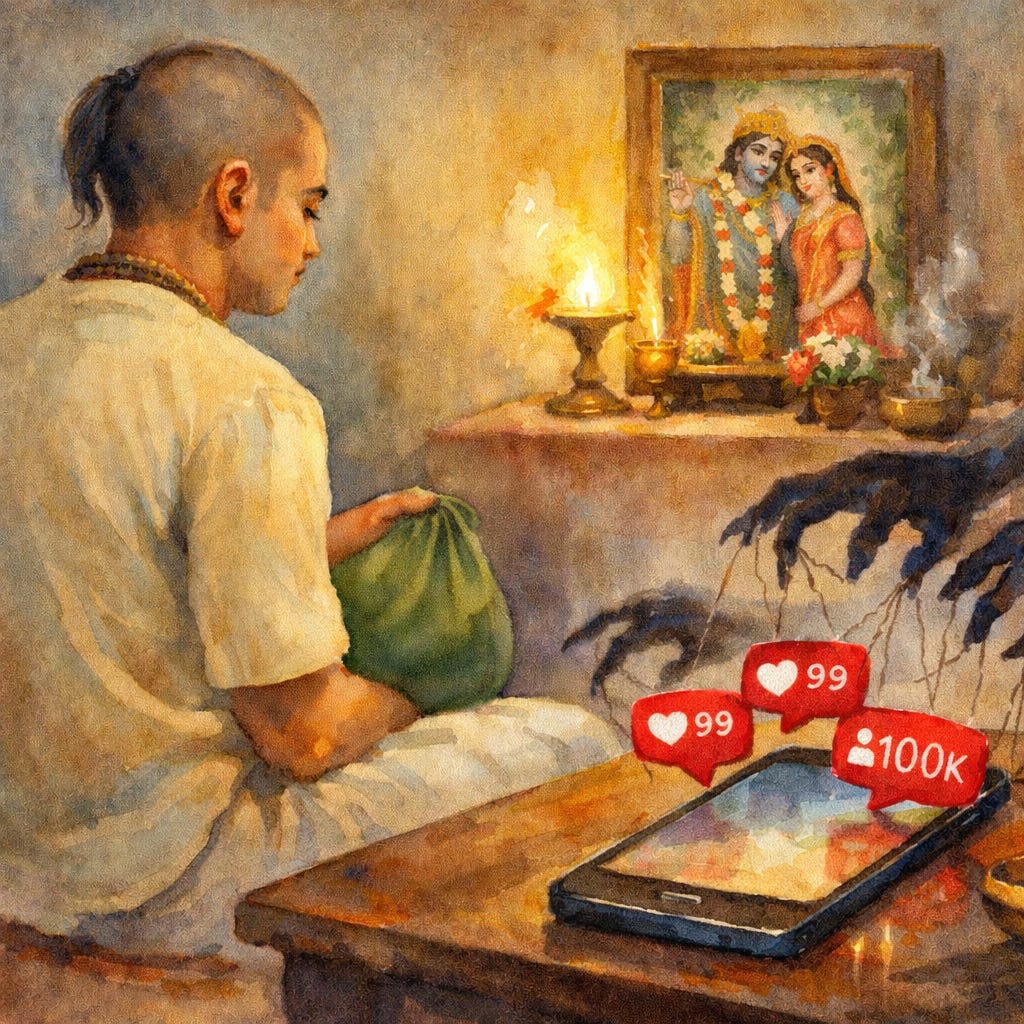
Nowadays, many of us are getting sucked under the influence of these weapons of mass distraction we call social media, where we are not just stimulated to see the content created by others but also enticed to create our own content in the form of photos, reels, articles, videos, and so on. In this way, we are conditioned by our overlords to contribute to their efforts to increase the audience of their services, and in doing so, are rewarded with likes, shares, or even a few comments.
The ones who are successful in this game can amass a huge number of followers and become celebrities. Followers are nowadays a symbol of status, just like personal beauty or money, and many work really hard to increase the magical number, even at the expense of other areas of their lives.
Just like in other trends of modern life, devotees are not immune to this. Just like regular people tend to worship influencers, a devotee who has a lot of followers on Instagram or subscribers on YouTube is often more respected. Just like there are people who judge us based on physical beauty, money, or mundane education, there are also devotees who judge us based on our number of followers. To some, we have indeed more or less value as individuals according to the number of followers we have.
Although we understand philosophically that material fame and status are ephemeral, we may be tempted to enter into the game and try to also increase our number of followers and subscribers. That’s when we have to take a very long and deep breath.
First of all, social media is not a replacement for real sadhu sanga, or association with pure devotees. There are a few pure devotees here and there in social networks, but most of the content we follow is not produced by them. It ends serving then more like an extension of Māyā’s subtle net than anything else, increasing our association with conditioned consciousness. There is a difference between hearing from pure devotees, who effectively see the spiritual reality and can convey it to us, and just getting in contact with the regurgitations of other conditioned souls.
Apart from that, there is the point of what I’m achieving with my effort. Krsna explains in the Gītā that there are three types of work: karma (pious work that produces auspicious material results), akarma (transcendental activities that destroy our previous karma and gradually elevate us to the transcendental position), and vikarma (impious activities that result in negative reactions).
Everyone has to work, but one can choose between working in an area that benefits people (be it spiritually or materially) or opening a beer factory, for example. One who works doing activities that gradually bring people to Krsna consciousness practices akarma, one who works in activities that contribute to the gradual improvement of society practices karma, and one who works in activities that contribute to the degradation of society practices vikarma. In any of the three scenarios, we will, in the short term, receive the fruits we are entitled to according to our past karma, but the long-term consequences of the three types of work will be very different. Karma makes us materially prosperous, akarma makes us advance in spiritual life, while vikarma results in future misery.
This concept is so important because it can be applied to all kinds of activities we do, including social media.
One thing I learned about social media is that we need to produce some content that will be beneficial for society, and then however comes, comes. One may have ten million followers or just a few dozen, but the important part is that the people who are seeing our posts get something positive out of it. Maybe one can get millions of followers by showing his buttocks, but how will this benefit people? If we can reach a number of people by doing something that may attract them to Krsna consciousness, or help them in their spiritual life, that’s wonderful. This will certainly help us also. However, there is no point in attracting a number of followers by just posting things that will distract them and increase their material fever. This will not bring any good results for them or for us.
This mentality of posting content that brings others to Kṛṣṇa consciousness helps us to avoid the first trap of social networks, which is the base search for fame and recognition, or pratiṣṭhā, of trying to attract attention to ourselves, instead of Kṛṣṇa. In this sense, social networks can be even more dangerous than other forms of material fame, because in social networks, fame is quantified in our direct number of followers, likes, etc., making us hooked on continuously checking the stats of each post, in a roller coaster of expectations about the next post going viral. Thinking in terms of what is beneficial to people instead of what gets more likes helps us to develop a detached mentality and work for Kṛṣṇa, as He explains in the Gītā.
Even doing that, there is still a subtle trap, however: am I trying to serve Kṛṣṇa, or am I trying to be seen serving Kṛṣṇa? It’s very easy to confuse the idea of sharing devotional moments so they can inspire other people, and playing the role of a devoted person, just to attract others. If I do that, then the identity of a devotee I project becomes just another mask I wear. When I just wash pots in the temple, it is very easy to develop humility and effectively do it for Kṛṣṇa. When, however, my service is scripted and broadcasted, it is easy to transform it into a mask and play the role of a devotee instead of being one. If we fall into this mistake, we become no different from ordinary actors.
If we can also avoid this mistake, there is another one: social media fragments attention, reducing the quality of our hearing, chanting, and meditating on Kṛṣṇa. All these things demand deep attention, which is easily destroyed when we become habituated to constantly checking likes and comments. Even if our mentality in creating content is that of helping others to come close to Kṛṣṇa, it may still be, in the long run, negative for my spiritual practice. This brings us to another point: we can help others come close to Kṛṣṇa only to the extent we can help ourselves. When we become deep in our spiritual practice, we get the potency to inspire others to do the same. Otherwise, we become just another voice that dilutes and dumbs down things.
A question to ask ourselves: Would I continue if no one read or reacted to my posts? The answer can give us some deep insights in of we are doing it for Kṛṣṇa or if the focus has been to simply increase our ego. Śrila Bhaktisiddhānta Sarasvatī Thākura used to say that if no one comes, we should preach to the four walls. This evokes the proper mentality of broadcasting Kṛṣṇa consciousness not only as a service to Kṛṣṇa, but as a process of self-purification. A proper Vaiṣnava does not think he is benefiting people with his discourse; instead, he is grateful for the opportunity of purifying himself by remembering Kṛṣṇa and glorifying him. This is what makes the discourses of a pure devotee spiritually powerful. When we cultivate this mentality, the number of followers and likes becomes unimportant, since the goal becomes the activity of posting about Kṛṣṇa in itself. In this case, even when we have to work for promoting the content we are creating, this effort can remain pure, because the idea can be of simply connecting people with something that may benefit them. My ego then goes into the background, and Kṛṣṇa becomes the main focus.
You can also donate using Buy Me a Coffee, PayPal, Wise, Revolut, or bank transfers. There is a separate page with all the links. This helps me enormously to have time to write instead of doing other things to make a living. Thanks!
Hare krishna
Thank you prabhu. Please keep up with your social media posts they are definitely helpful for increasing our love for Krishna and endeavoring in our sadhana