

Subscribe to receive all new articles directly by e-mail. It’s free, but if you like, you can pledge a monthly or annual donation to support my work. There is also Telegram.
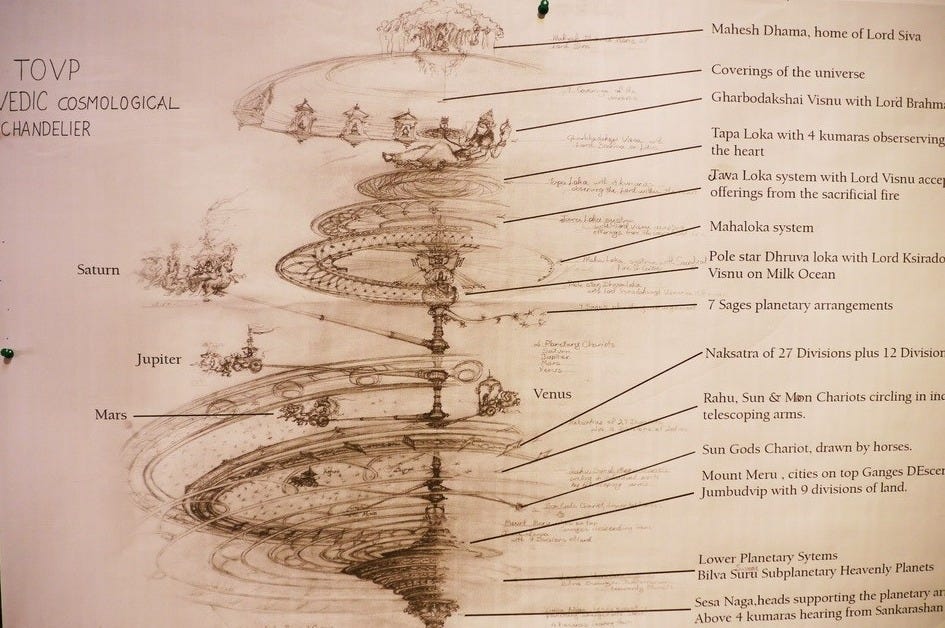
In the 5th canto of Śrīmad Bhāgavatam, Śukadeva Gosvāmi explains the Vedic model of the universe, describing the structure of the different planetary systems and so on. This model is not very easy to understand (we will try to explain it in more detail in an upcoming book), but it has an important purpose.
The description of the universe in the Fifth Canto is similar to the description of the virāṭ-rūpa offered in the 2nd and 3rd cantos that has the purpose of helping the yogī to see the universe as a form of the Lord and thus meditate on Him. If a yogī can directly meditate on the transcendental form of the Lord, this is much better, but the question is that it is not so easy in the beginning. A yogī is thus instructed to start with what he can see, the expansive universe we see when we look to the sky, and imagine it as a form of the Lord, connecting the different planetary systems and natural features of our planet with parts of His body. By doing that, a yogī learns to focus his mind and grows in spiritual realization and gradually comes to realize the transcendental form of the Lord.
Similarly, if we come to the stage of being interested only in the transcendental form of the Lord—His qualities, pastimes, and so on—and completely lose interest in this material creation, that’s perfect. As long as we are not on this platform, however, we can advance by studying the composition of the material universe and learning to see all of its features as manifestations of Kṛṣṇa’s potency. Just as a yogī meditating in the universal form, by doing that, we grow in spiritual realization. As Śukadeva Gosvāmi explains, “If one reads the description of this external form of the Lord with great faith, or if one hears about it or explains it to others to propagate bhāgavata-dharma, or Kṛṣṇa consciousness, his faith and devotion in spiritual consciousness, Kṛṣṇa consciousness, will gradually increase.”
People normally have curiosity in understanding the world around them. Modern educators hijack this natural propensity, using it to teach people an atheistic model of the universe that pushes them away from God consciousness. Śukadeva Gosvāmi, however, offers an alternative: the theistic view of the universe described in the Śrīmad Bhāgavatam. Prabhupāda had the view that, if correctly understood, the model of the Vedic universe could form a coherent response to modern scientific theories, offering people an option. He envisioned the temple of the Vedic planetarium as a vehicle to spread this alternative version, with a giant chandelier showing a working model of the Vedic universe and different exhibitions explaining the different concepts that are part of the model. By studying this model and learning to see the universe in connection with Kṛṣṇa, understanding how our acts in this life affect our consciousness and how our consciousness determines where we stay in this gigantic universal creation, people can automatically advance in Kṛṣṇa Consciousness.
See what Śukadeva Gosvāmi mentions in SB 5.26.39:
One who is interested in liberation, who accepts the path of liberation and is not attracted to the path of conditional life, is called yati, or a devotee. Such a person should first control his mind by thinking of the virāṭ-rūpa, the gigantic universal form of the Lord, and then gradually think of the spiritual form of Kṛṣṇa [sac-cid-ānanda-vigraha] after hearing of both forms. Thus one’s mind is fixed in samādhi. By devotional service one can then realize the spiritual form of the Lord, which is the destination of devotees. Thus his life becomes successful.
Here, the process to help common people reach spiritual consciousness is further explained. First, we should study the Vedic universe, learning to see the Lord behind the cosmic manifestation. After acquiring a little faith, one should hear about the spiritual form of the Lord and gradually move his’s meditation from the material manifestation to the spiritual form of the Lord, gradually reaching samādhi. However, he warns that the spiritual form of the Lord can’t be understood by academic study alone: to realize the spiritual form of the Lord, we need to practice devotional service. Practical devotional service is thus an integral part of the process.
Prabhupāda saw the spiritual society he created as a vehicle for both education and practical engagement of the public in the process of devotional service. Here is one instructive example of how these two go along together:
Once, Madan Mohan Malaviya, the vice-chancellor of the Benares Hindu University, came to the Gaudiya Math to ask some intricate philosophical questions to Śrila Bhaktisiddhānta Sarasvatī Thākura. Asked the questions, however, Śrila Bhaktisiddhānta answered that he should go to the next room and ask the devotees who were polishing the ārati paraphernalia of the deities.
The scholar was skeptical that these devotees could answer such difficult questions on Vedanta philosophy, but as Śrila Bhaktisiddhānta insisted, he decided to go and ask them. When he approached them, they immediately engaged him in helping to polish the different items, a task that took some time.
Even though he was a famous scholar, Madan Mohan was humble in heart and agreed to help them in their service. As he did that, however, something changed in his heart. Suddenly, he could understand the intricate questions that were previously troubling him. By the time he finished polishing the brass items, everything was clear in his mind.
When he went back to the first room, Śrila Bhaktisiddhānta Sarasvatī asked if he got the answer to his questions, and he confirmed that as he helped polish the paraphernalia, the answers automatically came to his mind. Bhaktisiddhānta then explained that the philosophy of Kṛṣṇa Consciousness can be understood only through a service attitude (sevonmukhe hi jihvado); it can’t be understood just by reading books. He then described the example of his own Guru Maharaja, Śrila Gaura Kiśora Dās Babaji, who, although illiterate, had the highest level of spiritual realization and could explain all kinds of intricate philosophical concepts, because he was sevonmukha, inclined to serve Krsna.
Before meeting Śrila Bhaktisiddhānta Sarasvatī Thākura, the scholar was trying to find the answers by mere intellectual exercises. Bhaktisiddhānta understood that his problem was not a lack of intellectual arguments, but the simple fact that he never started the process of practical devotional service. When this gap was finally filled, he could finally understand everything.
You can also donate using Buy Me a Coffee, PayPal, Wise, Revolut, or bank transfers. There is a separate page with all the links.