

« Things I Wish Someone Had Taught Me When I Started Krishna Consciousness
The worst betrayal
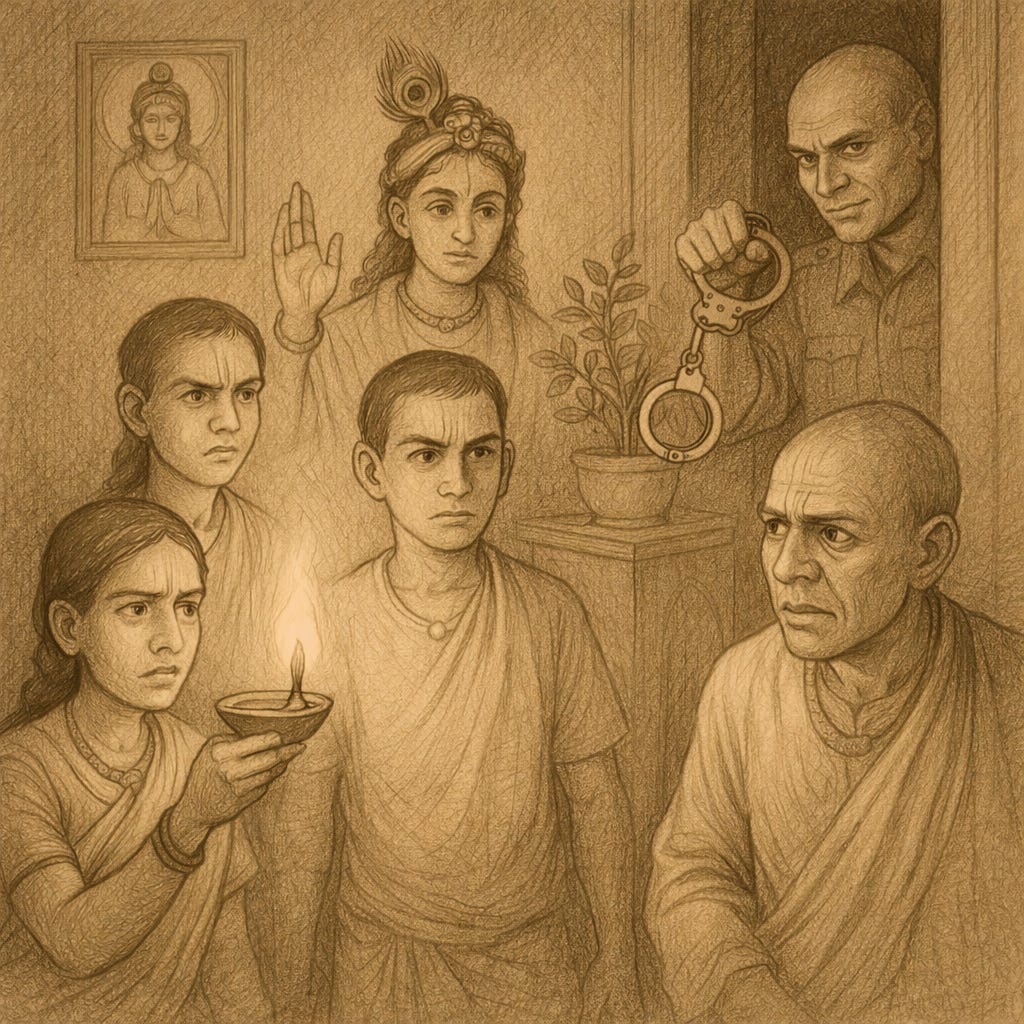
Cases of misbehavior and bad examples are one thing. What to do in serious cases, where a leader is caught doing immoral or even criminal activities, when one abuses his position to exploit and manipulate, while using his influence to cover such acts?
The first point is to try to assess the real extent of what happened. Many situations are described online in exaggerated ways, making them appear much worse than they actually are. A case of consensual sex can be described almost like rape, and the words “child abuse” can mean many other things apart from the first meaning that comes to mind.
It’s also important to make the distinction between fall-downs and cases of abuse and exploitation. A fall fits into the definition of human weakness. One may have an extra-marital affair, a sannyāsī may become involved with a lady, and so on. Cases like these are usually not premeditated, and although they prove that one is not fully transcendental, it does not necessarily imply that a devotee is not seriously trying.
However, other cases can be characterized as crimes or serious abuses, and even worse, there are cases where the same individual commits the same type of abuse repeatedly, using different artifices to maintain their position and followers, despite that. Such cases are deeply revolting and can be extraordinarily destructive, but it is essential to distinguish between the group and the individual who abuses the trust of the members of the group. Positions are filled based on trust, but trust can be abused. Often, people who look honest and trustworthy can ascend to positions of leadership, just to later use the same positions to perpetrate and hide crimes.
Unfortunately, criminals and dishonest people have an advantage when it comes to attaining positions of leadership in any kind of group or organization, because they can use any means to achieve such a goal, while honest persons are limited by their ethics. We can observe this pattern in ordinary politics. This allows predators to often abuse the system, especially in spiritual societies, using charisma to create a group of followers and obtain a higher position, and then using different stratagems to maintain such a position, even while repeatedly harming others. It may be shocking, but often the mind can play tricks that can lead one to go a long way in the spiritual path without true reformation. One’s ego can lead one to practice spiritual life in unhealthy ways, focusing on goals instead of real qualities, and the same ego can lead one to create a following, emulating qualities that others find attractive. This, in turn, can be used to ascend into higher positions, which in turn feed one’s ego even more, leading one to relax in the control of one’s senses, and eventually fall into abominable acts.
Cases like that can be very destructive for everyone involved, because they involve not only the breach of trust and damage to the victims, but also the infighting created by the clash of those who take the side of the victims, and the ones who, because of sentimentality or ignorance of the true facts, take the side of the perpetrator. When everything comes into light, it becomes clear who was wrong, but when things are happening, it is much harder to have a clear view, because people who commit crimes like these are often psychopaths, who are efficient in covering their tracks and manipulating others.
Another problem is that in many cases, what happens is not sufficient for the case to be treated like a criminal case. Many times, the actions committed do not qualify as such because there is not enough evidence to start a criminal case, or because the victims choose not to report the case. As a result, it ends up being dealt internally as a disciplinary case. This has two limitations: the first is that a group of devotees elected to deal with a case like this doesn’t have power of police. They can remove people from their positions, or maybe ban them from the community, but anything beyond that is frequently beyond their powers. Another problem is that devotees have a soft heart and often are too lenient even within this framework, which infuriates the victims and others.
It should, however, be understood that there is a universal system of justice from which no one can escape. Religious movements and communities often have little defense against psychopaths and predators infiltrating, because members tend to trust each other and follow leaders out of sentiment. This often allows perpetrators to not only abuse the system to attain positions of leadership but also to cover their tracks, manipulate others, and make it harder to face punishment. This, however, does not mean they will go unpunished. In any case, the punishment one could face in a civil or criminal court is very mild compared to what a predator may face in hell for what he did.
The greatest danger in such cases, however, goes beyond the harm directly caused, amplifying itself in the form of collateral damage to the faith of others, which can affect thousands of people. A predator being able to climb into a leadership role and cover his tracks may lead many to conclude that the whole group or institution must be equally corrupt, or that the process itself doesn’t work.
Here, it is important to distinguish between these three components: the process itself, which is eternal, the group or institution, which is composed of human beings, and thus inherently imperfect, and the individual criminal, who abused the system. Part of the problem comes from considering the group or institution as perfect, something that it was never meant to be. Although a spiritual society is generally safer than it would be otherwise, it doesn’t mean it is completely safe, nor that it is impervious to the actions of bad elements. We thus need to be always attentive, especially when vulnerable persons are involved, and not just trust that leaders will provide us with safety. Not only are they also human, but they are often already distracted with other duties, and thus frequently fail to notice the bad elements.
« Things I Wish Someone Had Taught Me When I Started Krishna Consciousness
You can also donate using Buy Me a Coffee, PayPal, Wise, Revolut, or bank transfers. There is a separate page with all the links. This helps me enormously to have time to write instead of doing other things to make a living. Thanks!
Many sincere beginner devotees left institution due to such irresponsible leaders' activities and assumes that material life is much better than such scandals. This is great sin to betray someone's trust and such persons must be rotten into the hail...