


You can receive new articles directly in your inbox. Subscription is free; donations are welcome.
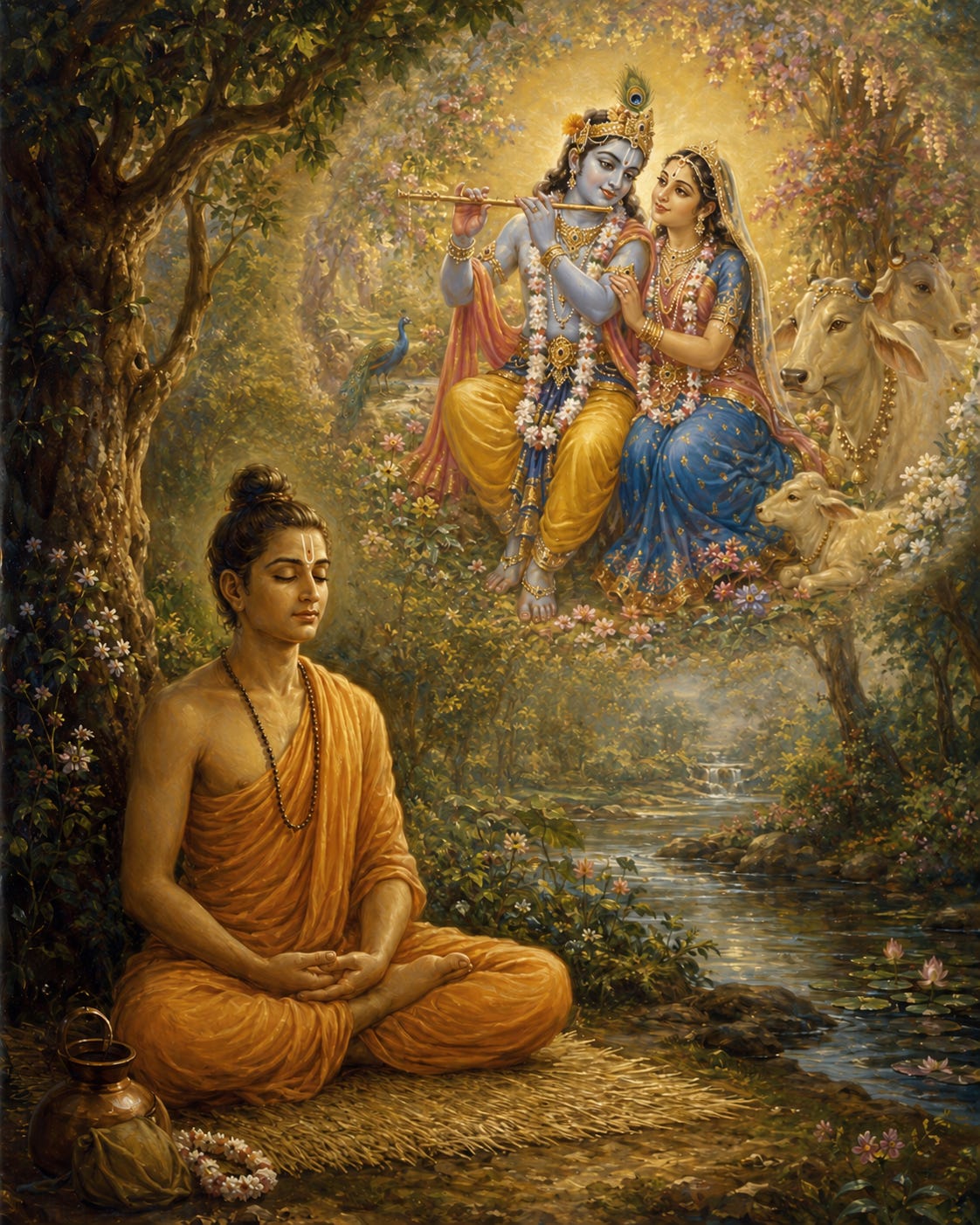
In the sixth chapter of the Bhagavad-gītā, Kṛṣṇa describes the process of mystic yoga, culminating with samādhi, the state of complete spiritual absorption that brings freedom from all material suffering:
“In the stage of perfection called trance, or samādhi, one’s mind is completely restrained from material mental activities by practice of yoga. This perfection is characterized by one’s ability to see the Self by the pure mind and to relish and rejoice in the Self. In that joyous state, one is situated in boundless transcendental happiness, realized through transcendental senses. Established thus, one never departs from the truth, and upon gaining this he thinks there is no greater gain. Being situated in such a position, one is never shaken, even in the midst of greatest difficulty. This indeed is actual freedom from all miseries arising from material contact.”
Impersonalists also attain a form of trance, absorbed in the concept of being one with Brahman, but Prabhupāda calls our attention to the fact that real samādhi means to become aware of our constitutional position in relation to Kṛṣṇa. This begins from Paramātmā realization and fully blossoms in Bhagavam realization, full Kṛṣṇa consciousness. As he explains, “By practice of yoga one becomes gradually detached from material concepts. This is the primary characteristic of the yoga principle. And after this, one becomes situated in trance, or samādhi, which means that the yogī realizes the Supersoul through transcendental mind and intelligence, without any of the misgivings of identifying the self with the Superself.”
The whole message of the Gītā is based on this principle of yoga as the process that connects us with Kṛṣṇa, not as an impersonal force, but as the Supreme Personality of Godhead, Bhagavan. Some, however, may refer to Patañjali and argue that the ultimate goal of yoga is to merge into the Supersoul. Prabhupāda counters this argument in his purport, explaining that even in the Patañjali system, the goal is to realize the Supersoul, not to merge with Him. The idea of merging is an interpretation that was introduced later by modern commentators.
The Yoga-sūtras of Patañjali explain the existence of transcendental pleasure. This is also emphasized in the Vedanta-sūtras (ānanda-mayo ’bhyāsāt). If there is transcendental pleasure, then there is spiritual experience, and spiritual experience means that the self is not annihilated after liberation. The soul continues to exist as an individual, and in this individual position, experiences spiritual bliss. This bliss is present in all three levels of realization: Brahman, Paramātma, and Bhagavan; therefore, there is no merging at any stage. Even if one attains the impersonal Brahmajyoti, one remains an individual, and this explains how Mayāvādīs can fall back into the material world.
This is supported by the text itself. The Yoga-sūtras (4.33) mention:
puruṣārtha-śūnyānāṁ guṇānāṁ pratiprasavaḥ kaivalyaṁ
svarūpa-pratiṣṭhā vā citi-śaktir iti
This verse is generally translated by scholars as meaning that kaivalya (liberation) appears when the three modes of nature become latent, or the power of consciousness becomes established in its own nature.
Trevor Leggett translates it as:
“Transcendental Aloneness is withdrawal of the guṇa-s, now without any purposes of Puruṣa; or it is the establishment of the power-of-consciousness in its own nature.”
Swami Sivananda translates it as:
“Kaivalya (perfect independence) comes when the Gunas (qualities), devoid of motive, become latent. Or the power of consciousness gets established in its own nature.”
As in other examples, they capture a few of the details mentioned in the text, but miss others, giving an incomplete meaning. The main problem, however, is that the conclusion is incorrect, for they imply that the soul merges into the Absolute Truth after liberation.
Prabhupāda gives us a more comprehensive study of the verse in his purport:
Puruṣārtha-śūnyānām indicates a person who abandons all selfish pursuits, including dharma, artha, kāma, and even impersonal liberation.
Kaivalyam doesn’t mean impersonal liberation, but the state in which the soul becomes free from all coverings and realize his true spiritual identity.
Svarūpa is the eternal nature of the soul, jīvera ‘svarūpa’ haya — kṛṣṇera ‘nitya-dāsa’ (It is the living entity’s constitutional position to be an eternal servant of Kṛṣṇa).
Pratiṣṭhā means established or abiding. Svarūpa-pratiṣṭhā thus means that the soul becomes again established in one’s original position as an eternal servant of Kṛṣṇa.
This meaning is confirmed by the last word, citi-śakti, the internal potency of Kṛṣṇa, under whose care all spiritual activities are manifested.
Following the conclusions given by Śrīla Prabhupāda, the verse can thus be translated as:
puruṣārtha-śūnyānāṁ guṇānāṁ pratiprasavaḥ kaivalyaṁ
svarūpa-pratiṣṭhā vā citi-śaktir itiWhen one abandons all selfish pursuits, including the desire for material development, sensual enjoyment, and impersonal liberation, one becomes free from the influence of the three material modes. In this state, one becomes free from all coverings and realizes his true spiritual identity as a pure soul, an eternal servant of Kṛṣṇa. One comes thus under the care of the internal potency of the Lord and serves Him in full Kṛṣṇa consciousness.
As Prabhupāda explains, unauthorized commentators do not understand the real purpose of the Patañjali system of yoga. Because such commentators are influenced by the monist concept, they become biased in their translations and commentaries, distorting the meaning of the verses. Just as unauthorized commentators cannot enter into the real meaning of the Bhagavad-gītā, they cannot also properly understand other books from Vedic literature. They thus do a great disservice by misrepresenting their meaning, interpreting them according to Māyāvādi conclusions. To properly understand these texts, we have to receive the conclusions from a self-realized soul. Just being a Sanskrit scholar is not sufficient.
Prabhupāda also connects this verse from the Yoga-sūtras with the teachings of Śrī Caitanya Mahāprabhu: ceto-darpaṇa-mārjanaḿ bhava-mahā-dāvāgni-nirvāpaṇaḿ (Siksatakam 1).
What Patañjali calls Kaivalya (liberation) is mentioned by Mahāprabhu as bhava-mahā-dāvāgni-nirvāpaṇaḿ, the extinguishment of the fire of conditional life, which is achieved by the process of ceto-darpaṇa-mārjanaḿ, the process of clearing the mirror of the mind, that leads one to see oneself in one’s orriginal identity as an eternal servant of Kṛṣṇa. As He mentions, “O son of Maharaja Nanda (Krsna), I am Your eternal servitor, yet somehow or other I have fallen into the ocean of birth and death. Please pick me up from this ocean of death and place me as one of the atoms at Your lotus feet.”
Prabhupāda also mentions two types of samādhi: Samprajñāta-samādhi, and Asamprajñāta-samādhi. The first is the transcendental understanding that one is not the body, but the transcendental soul, while the second is the deeper, factual realization. When a yogī becomes firmly situated on the second level, he becomes firm in the transcendental platform. This is real success in the practice of the yoga system. Compared to that, modern yogīs perform quite poorly. Pseudo yogis, practicing in the cities while involved in sex and other sensual habits, are a mockery to the process, and even real yogīs, who may attain mystical perfections, are not properly situated.
Kṛṣṇa consciousness is thus the best process of yoga for the age we live. As Prabhupāda concludes in his commentary:
“As long as the material body exists, one has to meet the demands of the body, namely eating, sleeping, defending and mating. But a person who is in pure bhakti-yoga, or in Kṛṣṇa consciousness, does not arouse the senses while meeting the demands of the body. Rather, he accepts the bare necessities of life, making the best use of a bad bargain, and enjoys transcendental happiness in Kṛṣṇa consciousness. He is callous toward incidental occurrences – such as accidents, disease, scarcity and even the death of a most dear relative – but he is always alert to execute his duties in Kṛṣṇa consciousness, or bhakti-yoga. Accidents never deviate him from his duty. As stated in the Bhagavad-gītā (2.14), āgamāpāyino ’nityās tāṁs titikṣasva bhārata. He endures all such incidental occurrences because he knows that they come and go and do not affect his duties. In this way he achieves the highest perfection in yoga practice.”
This is a publication for thoughtful readers who want to go deeper into Kṛṣṇa consciousness. I publish daily, trying to offer high-quality spiritual content, and all posts are available to free subscribers. If you wish, you can also choose a paid subscription to support this work.
You can also receive the updates on WhatsApp or Telegram.
If you would like to contribute further, you can find the donation links here.
🤍🕉️🤍