

Subscribe to receive new articles by e-mail. It’s free, but if you like, you can pledge a donation:
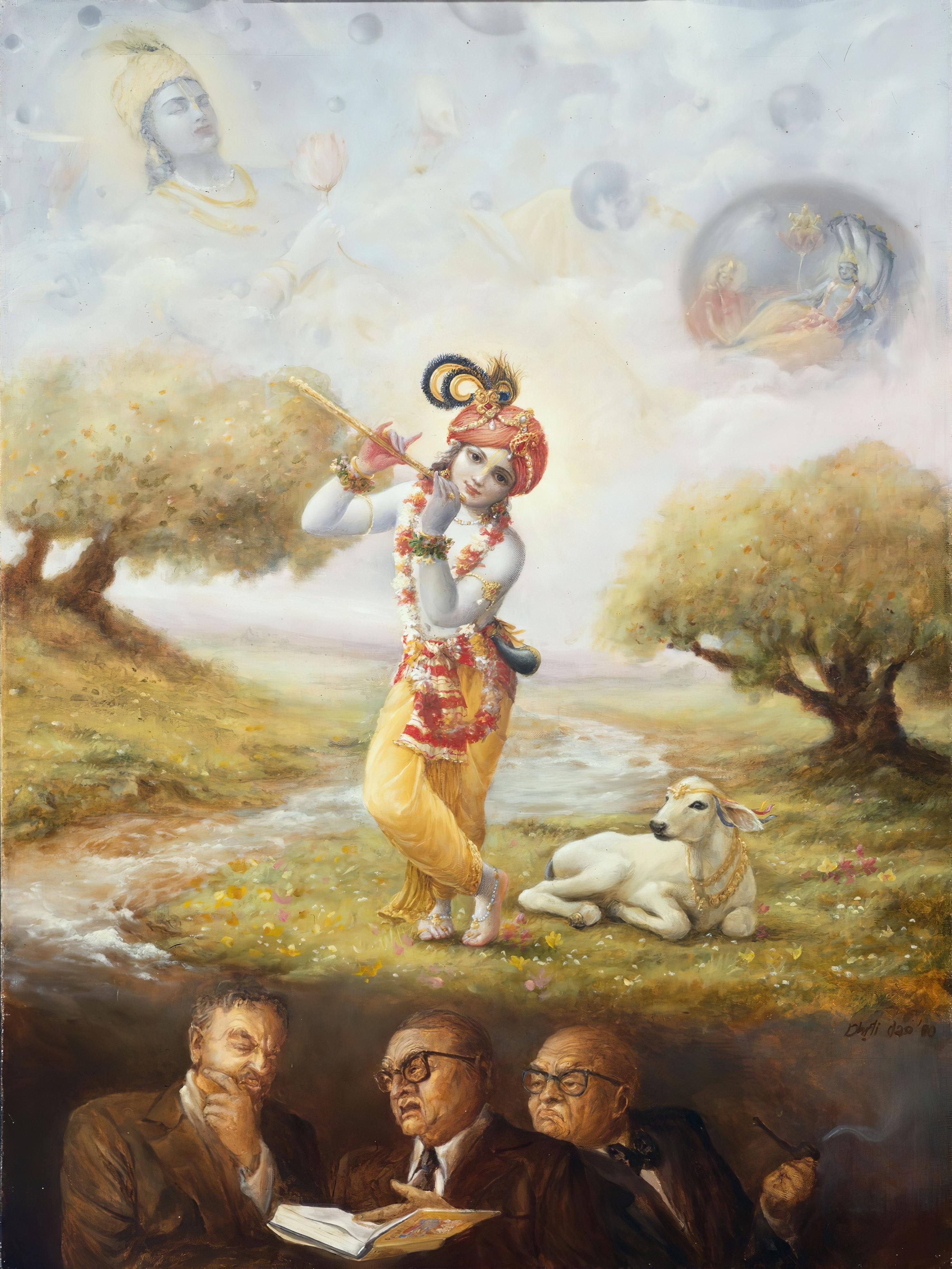
When I was young, I was an atheist for some time. Really. That was when I was about nine years old. Before that I didn’t remember questioning the goal of life or any higher purpose. I was happy just eating, playing, and studying like most children. At this point, however, I started reading some scientific magazines and accepted the theory that the universe comes from the Big Bang. If it is written in the magazine, it must be correct, right? An inadvertent consequence of that, however, is that I start thinking about killing myself. If after death there is just nothing, then what’s the point of going through the struggles of life? If I came from nothing and I will return to nothing, then what’s the point of living? Better to just accept the inevitable.
Interestingly enough, that’s something Krsna explains in the Bhagavad-gītā (although in a different context) on 2.26, where He describes the Lokāyatika and Vaibhāṣika philosophies. As He mentions,
“If, however, you think that the soul [or the symptoms of life] will always be born and die forever, you still have no reason to lament, O mighty-armed.”
In his purport to this verse, Śrila Prabhupāda mentions that no one cares too much about the loss of a bulk of chemicals. It makes sense: If life is the result of simple interaction of chemicals, without a higher purpose, then life has very little value. One may thus kill himself or kill others or do anything he or she wants, since all these things will be inconsequential, since life itself is purposeless.
There is something deeper, however. The real reason many promote this idea of life coming from matter and death being the end is usually just a cynical attitude of enjoying the world without having to fear the consequences. It’s very convenient for someone who is causing suffering to others to believe that everything ends with death, since in this case he will not have to fear some kind of punishment, justice, or retribution. However, if someone really comes to believe death is the end and seriously considers it from a philosophical perspective, one will lose the will to live. A logical progression will then be to commit suicide. Life is hard, and without some sense of purpose, a person with some philosophical sense will not be interested in struggling through it.
Apart from that, there is another point. It’s not really possible for us to imagine a state of non-existence. Can you imagine stopping existing? It’s not something we can conceive, because we don’t have this experience. Since in reality we are immortal souls, there was never a time when we did not exist. We can only relate to situations we experienced at a certain point in the past. Even dreams are combinations of our previous experiences. One sees mountains, and one sees gold, and therefore, in a dream, one may see a mountain of gold. However, we can’t imagine non-existence because we don’t have this experience. We have periods of unconsciousness, like when we are in deep sleep, but even in such states we are never fully unconscious, and after some time we are awakened again.
After some time going through these mental motions, I came to the conclusion that maybe the magazine was not right after all. Perhaps there was a better explanation. At the time there was no Internet (actually there was, but it was a military thing, not open for general people), so I went to a bookshop and started looking for books that would explain the afterlife. I found something that explained vaguely about how the soul continues existing after the death of the body. It was a great relief. From there I started reading books from different authors and philosophies until I came into contact with the books from Śrila Prabhupāda.
Considering atheism is a philosophy I rejected when I was 9 years old, you can imagine what is my level of appreciation for it. There are different philosophies that have different degrees of truth, but atheism is the complete opposite of truth. As Krsna explains (Bg 18.32): “That understanding which considers irreligion to be religion and religion to be irreligion, under the spell of illusion and darkness, and strives always in the wrong direction, O Pārtha, is in the mode of ignorance.”
That’s why I also, in general, don’t have much respect for atheists. For me, these are immature people with intelligence on the level of a nine-year-old child. Some of them may become proficient in different technical areas, but from my point of view, this is more like the mechanical processing of information of ChatGPT and other computer tools and not real, human intelligence.
In the Vedanta-sūtra, it is mentioned that athāto brahma-jijñāsā: Having come to the human form of life, it is time to inquire about Brahman, the Absolute Truth.
This sūtra has many meanings (seriously, one could write a series of books on it), but one of them is that philosophical inquiry about the absolute truth is the threshold of human life. Before that, one is not considered a properly human being. The Sanskrit term for that is “dvipadaḥ paśuḥ” (two-legged animal). There are four-legged animals, and there are two-legged animals. One type is more refined than the other, but neither of the two is considered truly intelligent. It may sound harsh, but that’s the conclusion the ancient sages came to after deliberating carefully on this topic.
You can also donate using Buy Me a Coffee, PayPal, Wise, Revolut, or bank transfers. There is a separate page with all the links. This helps me enormously to have time to write instead of doing other things to make a living. Thanks! You can also receive the updates on Telegram.