

« Things I Wish Someone Had Taught Me When I Started Krishna Consciousness
There are lessons to be learned in family life
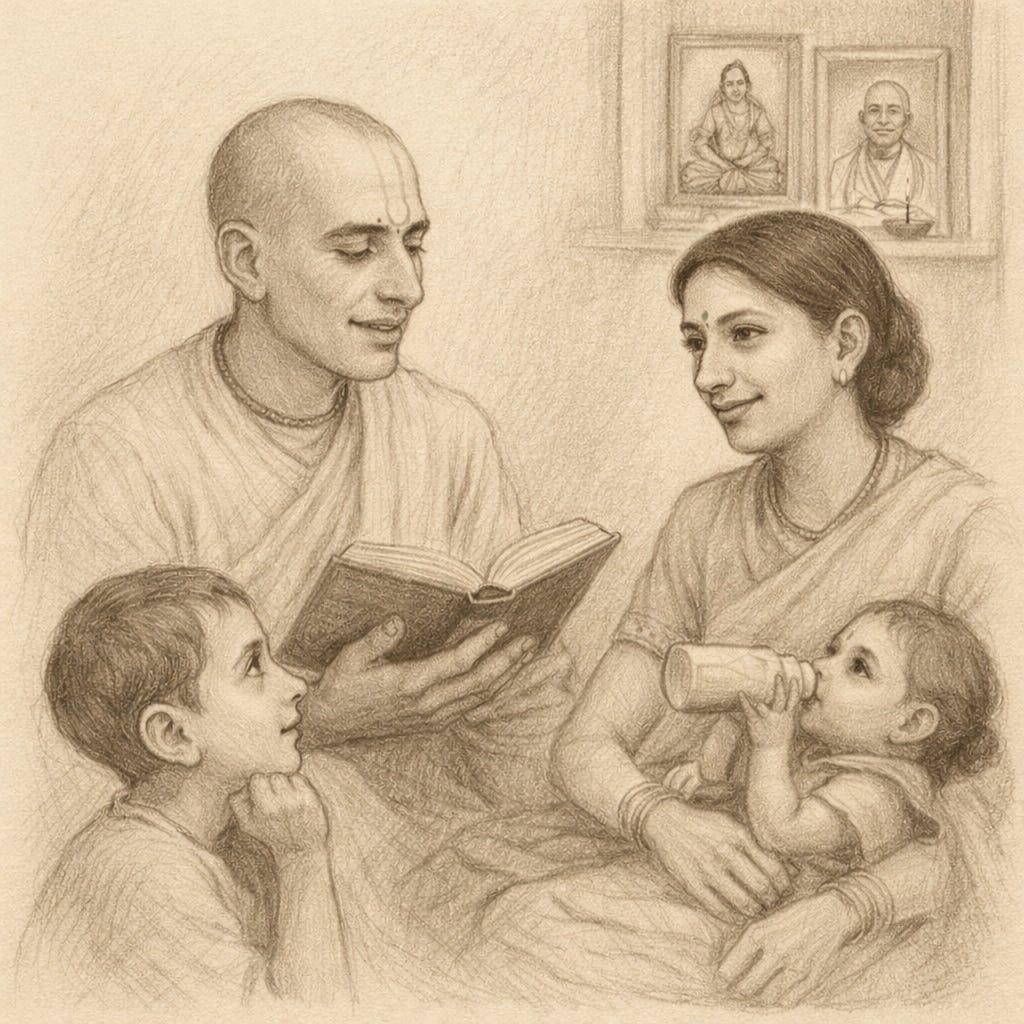
Often, passages of the scriptures that speak about renunciation are taken out of context, and married life is presented as a fall. However, it is not exactly like this. If one is pure and has no necessity for mundane relationships, there is indeed no need to get married or to get involved with material life beyond bare physical necessities. However, most of us are not in this stage. Most of us are still in a sinful platform, battling to control our minds and not fall into promiscuity. In this case, married life is offered in the scriptures as a progression, a path for gradually controlling our senses and progressing into a pure life. It may not be free from risks, and it may not be easy, but for most of us, that’s the best opportunity we have.
We may bring many arguments to the table, but in the end, the question is quite simple: people have a need for loving and feeling loved. This is the eternal characteristic of the soul. When one is sufficiently advanced on the spiritual path, one can apply this loving propensity to Kṛṣṇa, which brings full satisfaction. At this stage, there is no need to exert it on the material platform. These are the ones who become disinterested in the material world and are perfectly happy in serving and advancing further in spiritual life. These are sadhus who must be respected.
However, this platform is not viable for most, at least for now. It requires that we have already being practicing Kṛṣṇa Consciousness in our previous lives, coming to the path already with a good baggage, finding a good spiritual environment to live on, with senior devotees who can properly guide us, like-minded devotees with whom to can have deep friendship and services that are according to our nature, where we can apply our propensity for action in a positive way. Many of us don’t have even a single one of these factors.
For ladies, the situation is much more difficult, because not only do women have a very deep need for family life and motherhood, but also because opportunities for ladies living in temples and being properly maintained are rare in our society. On top of that, there is great social pressure. Ladies who decide not to enter into family life usually face a lot of difficulties in our society. We can see that practically all lady disciples of Śrila Prabhupāda got married at some point, and there are good reasons for that. There are a few ascetic ladies in our tradition, but they are the exception, not the rule.
As long as we are not liberated souls, the place for exerting this loving propensity is in family life. That’s the place where this loving propensity can be used in a positive way to serve one’s partner and children. Just as we have this necessity, other people also have the same need, and by being a good wife or husband, we can not only solve our own problem but also help another person. Children also have the same need for love, and family life is also an opportunity to serve in this direction. To raise and properly educate a few children to be devotees of Kṛṣṇa is probably the best service most of us can possibly do.
Many of course have fear. Men fear the responsibility, and women fear being restricted or mistreated, and everyone fears the long-term commitment to children. There is also fear of failure, fear of not being able to find a good partner, fear of ridicule, of being judged, and so on. However, fear is not a very good reason to avoid doing necessary things. In the Bhagavad-gītā, Kṛṣṇa explains that “one who gives up prescribed duties as troublesome or out of fear of bodily discomfort is said to have renounced in the mode of passion. Such action never leads to the elevation of renunciation.”
We can practically see that devotees who are not sufficiently qualified for a life of renunciation, but at the same time avoid family life out of fear or frustration, rarely attain any good results from it, exactly as Kṛṣṇa describes in the Gītā.
Two verses later, Kṛṣṇa explains how true renunciation is based on accepting our natural position and executing our duties without fear and without attachment to the result. This is actually true renunciation and not the simple avoidance of duty: “O Arjuna, when one performs his prescribed duty only because it ought to be done, and renounces all material association and all attachment to the fruit, his renunciation is said to be in the mode of goodness.”
Most of the time, the real renunciation for both men and women is to renounce the idea of being “free” and avoiding responsibility, and instead settle down and accept the long-term responsibility of taking care of a family. This is often the best position in terms of offering a platform where we can continue advancing in spiritual life. Proper gṛhasthas have the conditions for advancing faster in spiritual life than devotees who try to renounce for the wrong reasons.
At the same time, however, it is important to be cautious. Family life is not very easy to balance in the times we live in. In previous ages, people would learn how to conduct their families by observing their parents during childhood and following the same patterns later on. Most of us, however, lack good examples in this direction. As a result, we have to, in most cases, learn on duty, making mistakes and fixing them. It helps, however, when we have proper guidance from senior devotees, who can help us to avoid the most serious blunders.
For one who is starting in spiritual life, I would recommend practicing seriously or even living in the ashram for some time, getting some training, strengthening one’s spiritual practice, and considering going to family life a little later, when some concrete possibility appears. We may need some time to understand our nature, and, on top of that, finding a suitable partner can take time. Therefore, the best is to find a position where one is happy and engaged in spiritual life and can be cool about it for some time, and move into family life when a suitable spouse appears. On the other hand, if one waits too long, he or she may come to a point where the need becomes too urgent, and one can’t choose a suitable partner with a cool mind. It’s important to avoid these two extremes.
In short, family life is not just “māyā”; there are important services to be performed there, and many lessons to be learned.
« Things I Wish Someone Had Taught Me When I Started Krishna Consciousness
You can also donate using Buy Me a Coffee, PayPal, Wise, Revolut, or bank transfers. There is a separate page with all the links. This helps me enormously to have time to write instead of doing other things to make a living. Thanks!