

« Things I Wish Someone Had Taught Me When I Started Krishna Consciousness
Tulasi Devi speaks about family life
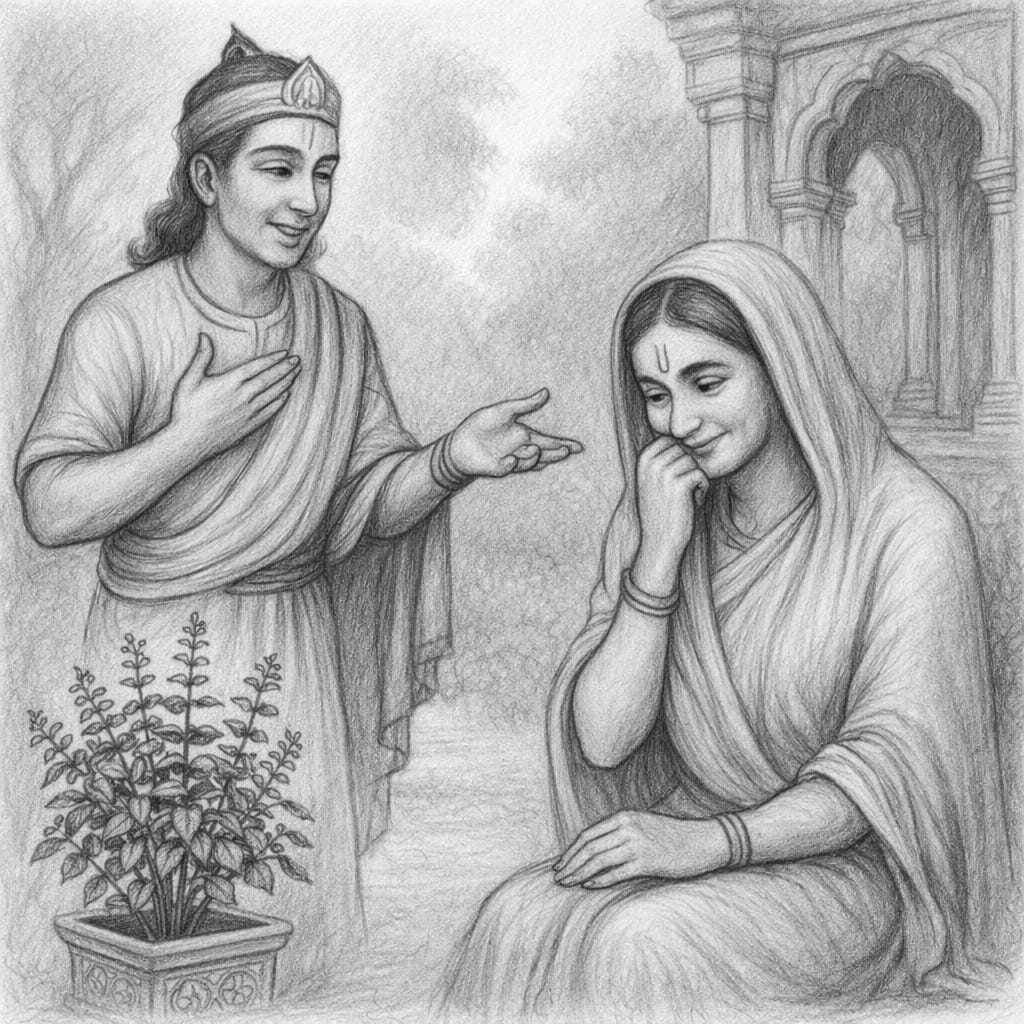
Many know about the famous dialogue between Tulasi Devi and Śankhacūḍa, where she firmly rejects him. In this part of the dialogue, many negative feminine qualities are stated, and therefore, this part is sometimes popular amongst brahmacārīs. However, not everyone knows how the dialogue ends.
The story is that Śankhacūḍa approached Tulasi, intending to marry her. Tulasi was actually waiting for Śankhacūḍa, and she had already decided to marry him. It’s described that Tulasi blushed and hid her face with her veil, secretly smiling at him.
The advances of Śankhacūḍa were thus not undesired, as it may seem when one reads just the first part of the dialog. However, as an intelligent lady, she first wanted to test her future husband. The story goes like this:
“Tulasi was adorned with lovely jingling ornaments, and the knot of hair at the back of her head was decorated with a jasmine wreath. Shark-shaped earrings adorned her cheeks while a diamond necklace beautified her breast. She wore gorgeous bangles of conch on her arms and wrists, as well as precious jewels on her fingers.
Śankhacūḍa sat down and said to her, “O beautiful girl, whose daughter are you? And how have you come to this forest? You look most fortunate and blessed. Indeed, you are the personification of heavenly joy—the best of women! You are a model of loveliness and can certainly bewilder even the saints!”
When Tulasi gave no reply, he asked, “O gracious one, why don’t you speak? I am your servant, so please greet me with the melody of your speech.”
Her head lowered, her face smiling, beautiful Tulasi said, “I am the daughter of King Dharmadhvaja and have been practicing asceticism here. But who are you? And why are you talking to me? If a noble man sees a virtuous woman alone, he does not talk to her. So go away—wherever you please.”
Here we come to the punchline:
“Tulasi continued. “The śāstras say that only a degraded man desires a woman. At first, a woman is sweet to a man, but later proves fatal. Though her mouth rains honey, her heart is like a jar of poison. She uses sweet words, but her heart is sharp like a razor. To achieve her own selfish ends, she is submissive to her husband; otherwise, she is insubmissive. While her face looks cheerful, her heart is dirty. Even the Vedas and the Puranas cannot fathom her character. A wise man never trusts a base woman. She has no friend or enemy; for all she wants are new lovers. When a woman sees a well-dressed man, she inwardly desires him, but outwardly she appears chaste and modest. She is naturally passionate, attracts men’s minds, and eagerly engages in sex. Though outwardly she hides her lust and appears modest, when she meets her lover in secret, she is ready to swallow him up. When she does not have sex with him, she feels offended, her body burns with anger, and she begins to quarrel. When her passions are fully satisfied, she becomes cheerful; when unsatisfied, morose.”
“A woman likes a good lover more than sweet foods or refreshing drinks; she likes him even more than her own son; he is dearer to her than her life. But if the lover becomes impotent or aged, she regards him as an enemy. Quarrels and anger ensue. Then she devours him as a snake eats a rat. She is rashness personified and a mine of vices. A woman is hypocritical, obstinate, and unfaithful. Even Lord Brahma and other gods are deluded by her. She is a hindrance on the path of austerity, an obstacle to liberation, an impediment to developing faith in Lord Hari, a refuge of all delusion, and a living chain that binds men to the world. She is like a magician and is as false as dreams. She appears to be very beautiful, but she is a bucket of stool, urine, gas, and blood. When God created her, he arranged that she should become the spirit of delusion to the deluded and poison to those who desire liberation. Thus, on no account should a woman be desired, and by all means she should be avoided.”
This is the famous part. Cleverly, Tulasi tests the intelligence of her future husband by questioning why he was interested in her and describing many negative qualities. This description is indeed not wrong; women can really show all these bad qualities, but it is, of course, intentionally one-sided.
Men become easily attracted to women, but most of the time, this attraction is just superficial, based on appearance. A man just becomes attracted to the beauty of a lady and loses his intelligence. He then approaches her without any clear idea of what a serious relationship entails. This is thus an important instruction to all intelligent ladies, who should first test the intelligence of the prospective husband before accepting him.
Posed with this challenge, Śankhacūḍa answered, in an also very significant way:
“Śankhacūḍa smiled and then answered, “O goddess, what you have said is not completely false. It is partly true and partly false. From the Creator have come chaste and unchaste women. One is praiseworthy, the other isn’t. Examples of chaste women are Laksmi, Sarasvatī, Durgā, Sāvitrī and Rādhā. Women who are expansions of them are auspicious, glorious and very commendable, such as Satarupa, Devahūti, Svadha, Savaha, Daksina, Anasuya, Ganga, Diti, Aditi, Vedavati, etc. In every yuga cycle these women are excellent. The heavenly apsaras are also expansions and partial expansions of the above women, but they are not praiseworthy because they are unchaste.
Women who are in the mode of goodness are virtuous and pure. The sages declare them to be excellent. But those who are in the modes of passion and ignorance are not so praiseworthy. The passionate ones are fond of sense pleasures, indulge in them, and always want to fulfill their selfish goals. Such women are usually insincere, deluded, and irreligious. Generally, they are unchaste. But women in the mode of ignorance are considered the worst. They are irresistible.”
Here, Śankhacūḍa reveals a piece of information that is important for every man to understand. Often, men discuss whether ladies are good or bad, but the fact is that there are different types of women, and one’s mileage will vary according to what type he gets involved with.
Ladies in the mode of goodness are capable of evoking the best in their husbands due to their good qualities. As wives, they are loving, caring, supportive, and at the same time shy and modest. These qualities nourish the mode of goodness in the man, which stimulates him to be sensitive, protective, calm, and self-situated. Shyness and modesty make a lady look very attractive, but this is the type of beauty that satisfies the mind without bringing forth an uncontrolled sex drive. In this way, the lady can serve as an inspiration for the man, encouraging him to perform both his material and spiritual duties, but at the same time help him to control his senses (this system is described by Śrila Prabhupāda on ŚB 3.23.2). This is a type of marriage that is considered beneficial for a man. Unfortunately, it is becoming rare nowadays, as both men and women fall in qualification due to the influence of Kali-Yuga. Nowadays, a man can get such a wife usually only through extraordinarily good fortune, or after practicing serious austerities.
Women in the mode of passion are more attracted to material enjoyment. They dress and behave in sensuous ways and are always hankering for material things. They see men more as objects for the satisfaction of their desires. This type of lady stimulates the mode of passion in the man, which makes him more inclined to sexual life and material enjoyment, creating a situation that is hardly favorable for spiritual advancement. Foolish men are, of course, very fond of this type of woman, but a man who is serious about spiritual life will have serious problems in this type of marriage since it will be very difficult to conduct his family life in a way that is not contrary to his spiritual practice. At the same time, if he fails to provide the level of material comfort the wife desires, she becomes prone to leave him, creating further problems. This is the type of marriage that is described in a negative way in the scriptures.
Finally, there are ladies in the mode of ignorance. They are harsh, intolerant, unclean, restless, and bad-behaved. These qualities stimulate the mode of ignorance in the man, leading to quarrels, destructive behavior, and aggression. This is, of course, the worst type of marriage.
We can notice, however, that Śankhacūḍa describes this type of woman as “irresistible”, although he also describes them as being “the worst”. The point is that a woman who is at the same time beautiful and emotionally unstable is the one who is capable of more seriously captivating a man, who becomes addicted to the ups and downs of such a relationship. The fact is that our minds are attracted to strong emotions, either positive or negative. This type of woman provides both extremes, and thus, they captivate men in ways that women in passion or goodness are not capable of. However, this is a negative type of attraction that makes a man lose his intelligence and become bewildered.
Tulasi Devi describes men who lose their intelligence due to involvement with the wrong type of women later in her dialogue:
“A man who is conquered by a woman is very impure and condemned by people in general. The forefathers and the demigods regard men who are conquered by women as low and contemptible. Even their fathers and mothers mentally despise them. The Vedas say that when a child is born or a relative dies, the brāhmanas are purified in ten days; the kṣatriyas in twelve days; the vaiśyas in fifteen days; and the śūdras, as well as other low classes, in twenty-one days. But a man conquered by a woman always remains impure. Only when his body is burned to ashes does he become purified. Neither the ancestors nor the demigods accept from him offerings of cakes, flowers, etc. Men whose hearts are totally conquered by women acquire no fruits from their knowledge, austerities, japa, fire sacrifices, worship, learning, or fame.”
She also gives practical advice to the ladies as to how a good husband should be selected:
“One should choose one’s husband by examining a man’s merits and defects. If one gives his daughter in marriage to a man devoid of all good qualifications, to an old man, to a man who is ignorant or poor, illiterate, diseased, ugly, wrathful, harsh, lame, limbless, deaf, dumb, inactive, or impotent—this sin is equivalent to the sin of murdering a brāhmana. But if one gives his daughter in marriage to a young Vaiṣnava who is learned, well-qualified, and peaceful, one acquires the fruits of performing ten horse sacrifices.”
Thus, according to the advice of Tulasi Devi, the husband should be a young Vaiṣnava who is learned, well-qualified, and peaceful. Men who are devoid of good qualifications, who are ignorant, poor, and illiterate, as well as men who are diseased, very ugly, wrathful, harsh, dumb, or inactive, should be avoided.
We can see that, more than just a bashing for brahmacārīs, this dialogue between Tulasi Devi and Śankhacūḍa offers practical advice for all intelligent boys and girls who are considering entering into family life.
« Things I Wish Someone Had Taught Me When I Started Krishna Consciousness
You can also donate using Buy Me a Coffee, PayPal, Wise, Revolut, or bank transfers. There is a separate page with all the links. This helps me enormously to have time to write instead of doing other things to make a living. Thanks!
Though it appears as an ageold appeal, which otherwise is correct upto this moment and must be used as a guide to the topsy turvied and misguided society