

« Things I Wish Someone Had Taught Me When I Started Krishna Consciousness
Two dangerous mistakes we often make in spiritual life
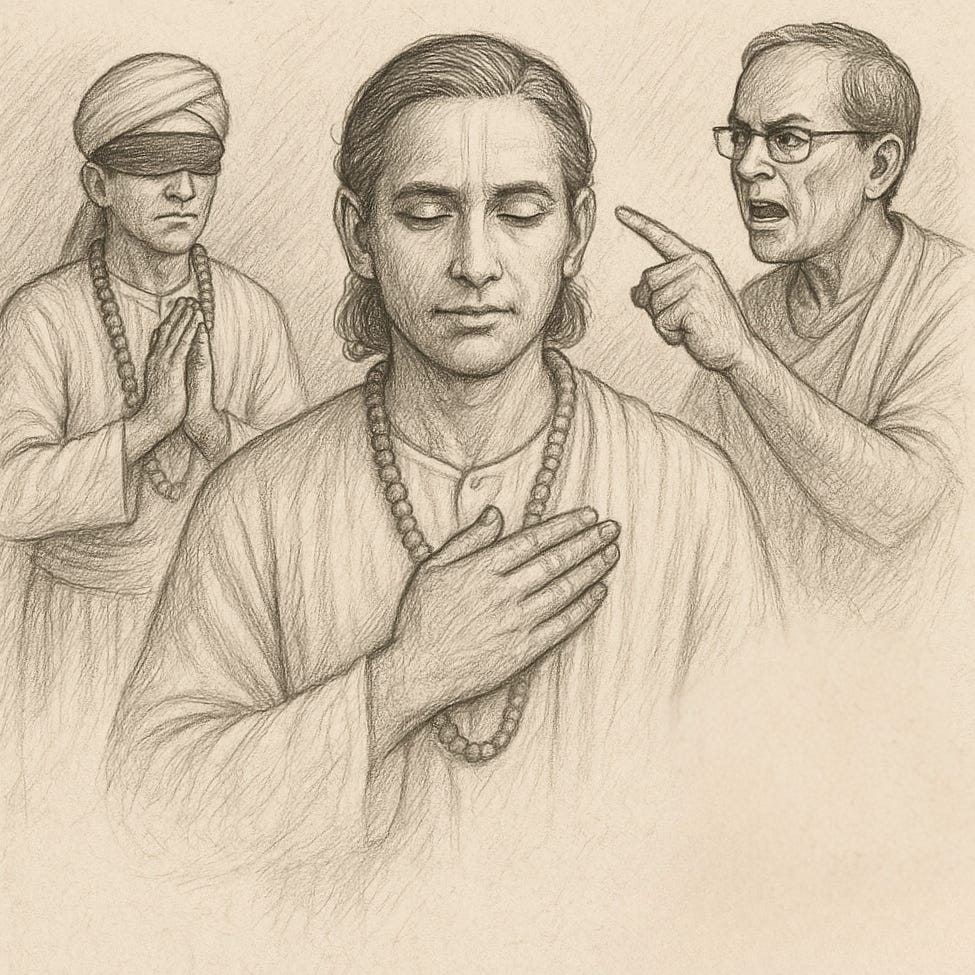
Two dangerous mistakes we may commit in spiritual life are to expect all devotees to be perfect and to demand that all devotees be perfect.
If we expect all devotees to be perfect, we may blindly follow and trust everyone without proper discrimination. This makes one vulnerable to being exploited by people of dubious character, as well as by devotees who may have good intentions but lack the common sense and experience necessary to engage others properly. We then become hurt or feel betrayed, and this makes it difficult to trust others in the future, creating a pendulum effect that brings us to the other extreme: thinking that devotees are all bad, that no one can be trusted, etc.
This can, in turn, easily lead one to stop or downgrade his or her spiritual practice. We can see that many don’t associate with devotees anymore because of bad experiences they had at some point in the past. Most of us will face some kind of let-down at some point, and our reaction to it will determine much of our success in our spiritual practice in this life.
Another mistake is to demand that all devotees are perfect. While the first problem comes from ingenuity or naivety, the second comes from pride. In this case, one thinks that he or she is very advanced and thus expects that others will fit into idealized roles. When one sees that devotees don’t fit into the stereotypes he or she created, one starts to criticize and eventually leaves.
We can see that both are problematic and lead to a similar result: loss of devotee association and spiritual stagnation.
It’s not possible to have a worldwide movement composed of only perfect people in this material world. Even during Satya-yuga, people had faults and would be propense to anger and other faults (like in the case of Suruci, the stepmother of Dhruva Maharaja), what then to say about the age we live in? Even if such a perfect society existed, it would not help us much, because we would not be accepted in it, since we are not perfect ourselves. One example is that there is, in fact, a society of perfect sages somewhere in the Himalayas, in Badarīkāśrama, where Śrī Nara-Nārāyaṇa, Vyāsadeva, and others live. However, this is a higher-dimensional space, to which regular mortals have no access. It is exactly because of that that it remains a society of perfect individuals.
Although perfection is always the goal, our Kṛṣṇa Conscious movement was never envisioned as a perfect society, nor will it ever be perfect, at least as long as we are in this material world. Śrila Prabhupāda explains that our movement is like a hospital, where, except for a few doctors, everyone is sick to a greater or lesser degree. In other words, it’s a place where sick people go to be treated in association with other sick people. There are sick people inside, and there are sick people outside; the difference is that the sick people inside are being treated and are gradually becoming better, although the process demands a lot of effort and may take longer than we initially expected. Doctors and nurses are also human, sometimes tired or imperfect, but the hospital is still the right place for healing. We don’t abandon treatment because other patients cough or misbehave.
The value of a spiritual society is not in being perfect or fitting into our stereotypes, but in the presence of a few dedicated devotees who can help us to progress.
The proper understanding is to accept that just as we have faults and are prone to commit mistakes, others also have faults and have the same propensity to commit mistakes. Just as we hope to be excused when we cause trouble to others, we should also be able to forgive others who, due to ignorance or negligence, cause problems for us.
Once, a very angry devotee came to Śrila Bhakti Thirta Swami to share her complaints about the behavior of other devotees and the problems they had caused her. After she finished her complaints, Bhakti Thirta Swami said: “Yes, I agree completely with you, this is terrible, I agree you should never forgive them for what they did, but with a condition: Only if you also never did anything bad to anyone else. If you ever did something bad to others, then you should forgive them, just like you expect others to forgive you.”
Although forgiveness is not easy, it is the only path to eventually becoming free from this material world. We can see that this topic is not only discussed in Vaiṣnava literature but was also taught by masters of other traditions, like Christ. Although Aśvatthāmā killed Draupadī’s sons, she chose to forgive him, instead of having him killed. Of course, Aśvatthāmā didn’t learn the lesson and used the opportunity to try to kill Parīkṣit in the womb, which in turn led him to be cursed by Kṛṣṇa to suffer for 3,000 years, but Draupadī didn’t have anything to do with it. Forgiving someone doesn’t necessarily free him or her from one’s karmic debits, but it makes us free from further connection. After being forgiven by Draupadī, Aśvatthāmā continued his path, suffering for the results of his actions, but Draupadī became disconnected from it. She didn’t have to be in contact with him, nor carry him in her heart. Without learning to forgive and being forgiven by others, it’s extremely hard to find our way back to Godhead.
« Things I Wish Someone Had Taught Me When I Started Krishna Consciousness
You can also donate using Buy Me a Coffee, PayPal, Wise, Revolut, or bank transfers. There is a separate page with all the links. This helps me enormously to have time to write instead of doing other things to make a living. Thanks!
Much needed
Very nice prabhu , the fact i like the most is that forgiving others, we dont carry them in the heart🙏