

Subscribe to receive new articles by e-mail. It’s free, but if you like, you can pledge a donation:
🔉 Audio of the lesson »
🎙Podcast (Search for “Mysteries of the Vedas” on Spotify, iTunes, etc. to hear all the lessons
Join the Telegram group if you would like to join the live lessons. This course is maintained with your donations. Click here to donate.
💬 Text of the lesson
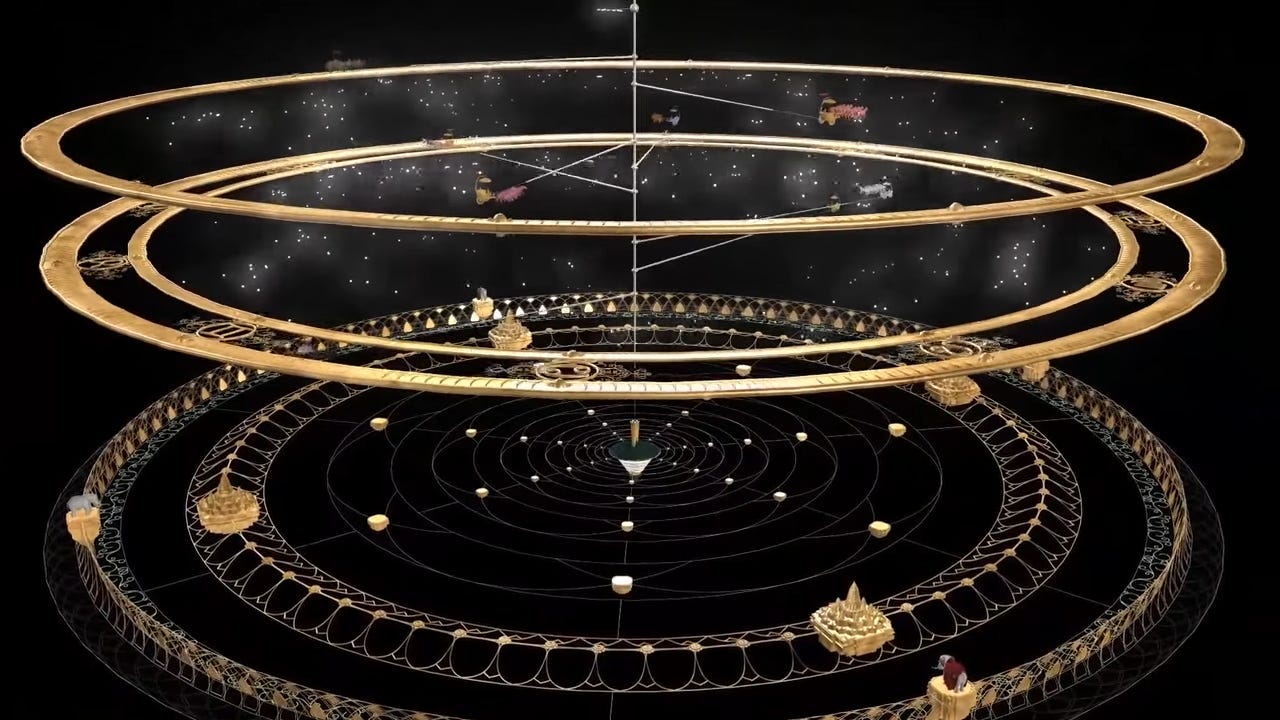
Understanding Jambūdvīpa, the central island of Bhū-mandala
“In Jambūdvīpa there are nine divisions of land, each with a length of 9,000 yojanas [72,000 miles]. There are eight mountains that mark the boundaries of these divisions and separate them nicely.” (SB 5.16.6)
All the measurements in the description of Śukadeva Goswami are given in yojanas, an ancient Vedic unit of distance used in Sanskrit texts. The length of the yojana can vary according to the context, but Prabhupāda concludes that the descriptions of the Śrīmad Bhāgavatam are based on a yojana of eight miles.
Jambūdvīpa is described as being circular in form (round like the leaf of a lotus flower), with a length and breadth of 100,000 yojanas (800,000 miles), as confirmed in SB 5.20.2. It’s difficult to conceive something this size, but just for comparison, the equatorial circumference of our planet is about 24,901 miles, which is about 3,113 yojanas. If we do the math, Jambūdvīpa is 2,547 times larger than the entire surface area of earth!
Jambūdvīpa is divided into nine varṣas, or tracts of land, separated by gigantic mountains, whose size is almost inconceivable for us. For example, there are four great mountains surrounding Mount Sumeru (Mandara, Merumandara, Supārśva, and Kumuda), which are 10,000 yojanas, or 80,000 miles high! For comparison, Mount Everest, the highest mountain on our planet, is about 5.5 miles (0.69 yojanas) high. Again, we are speaking about a difference of orders of magnitude.
Taking into consideration the earth’s gravity, the maximum theoretical height for a mountain on our planet (before the rock would start crumbling under its own mass) is about 6 miles, or, in other words, not much taller than the Everest. This shows that the structures of Jambūdvīpa don’t exist under the same physical constraints as mountains and landmasses of our planet. Because they are described in the scriptures, we can be sure that such mountains exist and are perceived by other inhabitants of Jambūdvīpa, but these are not structures found on our planet.
The verse I just quoted states that there are nine divisions of land in Jambūdvīpa, each with a length of 9,000 yojanas. The boundaries of these tracts of land are marked by eight mountains. This gives a simplified idea of the layout of Jambūdvīpa. The whole island has 100,000 yojanas of length and breadth, and the mountain ranges that divide the varṣas are 2,000 yojanas in length at the base. Most of the varṣas have a length of 9,000 yojanas, but there is an important exception.
In his purport, Prabhupāda gives a Sanskrit quote from the Vāyu Purāṇa, describing the locations of the various mountain ranges that are part of Jambūdvīpa and how they divide the whole island into nine separate tracts of land. This reference is mentioned by Śrīla Viśvanātha Cakravartī Ṭhākura in his commentary, clarifying the information omitted in the simplified model given in this verse:
dhanurvat saṁsthite jñeye dve varṣe dakṣiṇottare; dīrghāṇi tatra catvāri caturasram ilāvṛtam iti dakṣiṇottare bhāratottara-kuru-varṣe catvāri kiṁpuruṣa-harivarṣa-ramyaka-hiraṇmayāni varṣāṇi nīla-niṣadhayos tiraścinībhūya samudra-praviṣṭayoḥ saṁlagnatvam aṅgīkṛtya bhadrāśva-ketumālayor api dhanur-ākṛtitvam; atas tayor dairghyata eva madhye saṅkucitatvena nava-sahasrāyāmatvam; ilāvṛtasya tu meroḥ sakāśāt catur-dikṣu nava-sahasrāyāmatvaṁ saṁbhavet vastutas tv ilāvṛta-bhadrāśva-ketumālānāṁ catus-triṁśat-sahasrāyāmatvaṁ jñeyam.
It can be translated in the following way:
“Two varṣas of Jambūdvīpa, the southernmost and the northernmost, are bow-shaped. They are known as Bhārata-varṣa and Uttarakuru-varṣa.
The four varṣas adjacent to them are Kiṃpuruṣa-varṣa, Hari-varṣa, Ramyaka-varṣa, and Hiraṇmaya-varṣa. These four varṣas are elongated in form. Because they are long and narrow in the middle, their length is 9,000 yojanas.
Ilāvṛta-varṣa, however, [the central tract of land, with Mount Sumeru in the middle and surrounded by mountains on four sides], is quadrangular.
Considering that the Nīla and Niṣada mountain ranges run in parallel across the island all the way to the [salt] ocean, Bhadrāśva-varṣa and Ketumāla-varṣa [situated left and right of Ilāvṛta] also have a bow-like shape.
The breadth of Ilāvṛta-varṣa, Bhadrāśva-varṣa, and Ketumāla-varṣa [north to south] should be understood as 34,000 yojanas, but in the case of Ilāvṛta, an extent of 9,000 yojanas can be calculated from the vicinity of Mount Meru, in any of the four directions.”
This verse explains the basic division. Bhārata-varṣa and Uttarakuru-varṣa, as well as Kiṃpuruṣa-varṣa, Hari-varṣa, Ramyaka-varṣa, and Hiraṇmaya-varṣa, are narrow and long, like strips of land that run in parallel. Among them, Bhārata-varṣa and Uttarakuru-varṣa are bow-shaped, because they represent the two extremes of the circle. All these six varṣas are 9,000 yojanas in length, and the mountains adjacent to them are 2,000 yojanas in length at the base. Combined, these six varṣas and the six adjacent mountains are 66,000 yojanas in length.
The middle section, however, is divided into three perpendicular divisions: Ketumāla-varṣa (to the left), Ilāvṛta-varṣa (in the center), and Bhadrāśva-varṣa (to the right). Between them are the Gandhamādana and Mālyavān mountains.
From the three, Ketumāla and Bhadrāśva are like squares that are bow-shaped, or crescent-like in one of the sides (being on the two extremities of the island), while Ilāvṛta is a perfect square, being boxed by line-like mountains on all sides. The total breadth of these three varṣas (north to south) is the same: 34,000 yojanas.
Ketumāla and Bhadrāśva are plain. Ilāvṛta, however, is a special case, because it has Mount Sumeru at the middle. Sumeru’s width at the foot is 16,000 yojanas; therefore, we have 9,000 yojanas from Sumeru to the Nīla mountain (northward), plus the width of Sumeru’s base (16,000 yojanas), plus 9,000 from Sumeru to the Niṣadha mountain (southward), totaling 34,000 yojanas.
Combined with the 66,000 yojanas from the combination of the other varṣas, we have 100,000 in total.
Mount Sumeru: The golden mountain
“Amidst these divisions, or varṣas, is the varṣa named Ilāvṛta, which is situated in the middle of the whorl of the lotus. Within Ilāvṛta-varṣa is Sumeru Mountain, which is made of gold. Sumeru Mountain is like the pericarp of the lotuslike Bhū-mandala planetary system. The mountain’s height is the same as the width of Jambūdvīpa — or, in other words, 100,000 yojanas [800,000 miles]. Of that, 16,000 yojanas [128,000 miles] are within the earth, and therefore the mountain’s height above the earth is 84,000 yojanas [672,000 miles]. The mountain’s width is 32,000 yojanas [256,000 miles] at its summit and 16,000 yojanas at its base.” (SB 5.16.7)
Mount Sumeru is the defining feature of Jambūdvīpa, a gigantic mountain made of solid gold, that has a height of 100,000 yojanas (the same as the length and breadth of the island) and the form of an inverted cone. In other words, it is upside down. The last 16,000 yojanas of the narrow part of Sumeru are set into the ground, leaving 84,000 on the visible part above-ground. Taking the visible part, Sumeru is 16,000 yojanas in width at the base and 32,000 yojanas at the summit.
As already mentioned, Mount Sumeru is situated right at the middle of Ilāvṛta-varṣa, the central tract of land. In total, Ilāvṛta is 34,000 yojanas in length and breadth, which includes the 16,000 yojanas of Sumeru plus 9,000 yojanas on each side.
Mount Sumeru is what makes Jambūdvīpa look like a lotus. The appearance of the mountain, combined with the other mountain ranges around it, also makes the island look like an arena for the performance of yajñas, reminding all the inhabitants of the real purpose of life.
“Just north of Ilāvṛta-varṣa — and going further northward, one after another — are three mountains named Nīla, Śveta and Śṛṅgavān. These mark the borders of the three varṣas named Ramyaka, Hiraṇmaya and Kuru and separate them from one another. The width of these mountains is 2,000 yojanas [16,000 miles]. Lengthwise, they extend east and west to the beaches of the ocean of salt water. Going from south to north, the length of each mountain is one tenth that of the previous mountain, but the height of them all is the same.” (SB 5.16.8)
Nīla, Śveta, and Śṛṅgavān are the three long mountain ranges north of Ilāvṛta-varṣa that create the divisions between Ramyaka-varṣa, Hiraṇmaya-varṣa, and Uttarakuru-varṣa to the north. The width of all three mountain ranges is 2,000 yojanas, and each varṣa is 9,000.
Nīla is the longest, being situated closer to the center of the circular outline of Jambūdvīpa, while Śveta is shorter by one tenth (as indicated by the word daśāṁśādhikāṁśena). Śṛṅgavān is again one-tenth shorter than Śveta, being situated closer to the border of the circle. If taken literally, these proportions suggest that Jambūdvīpa is not a perfect geometrical circle, having a general circular outline, but locally irregular boundary patterns, analogous to the uneven coastlines of terrestrial continents.
In his purport to text 5.16.8, Prabhupāda mentions three verses from the Brahmāṇḍa Purāṇa that are quoted by Madhvācārya in his comment. These verses can be translated as:
yathā bhāgavate tūktaṁ, bhauvanaṁ kośa-lakṣaṇam
tasyāvirodhato yojyam, anya-granthāntare sthitam
maṇḍode puraṇaṁ caiva, vyatyāsaṁ kṣīra-sāgare
rāhu-soma-ravīṇāṁ ca, maṇḍalād dvi-guṇoktitām
vinaiva sarvam unneyaṁ, yojanābhedato ’tra tu“Just as the Bhāgavata Purāṇa sets forth the description of the cosmic structure of Bhū-mandala, other texts also describe different details that should be reconciled without contradiction. Thus, even if other purāṇas present different arrangements for the position of the milk ocean, or different statements about the orbital measures of Rāhu, the moon, and the sun, these variations can be understood as arising from differences in the measure of the yojana.”
This sets the general tone for studying Vedic cosmology. The words of the texts should not be taken rigidly, but rather reconciled with other scriptural references and taken as parts of a harmonious description. Above all, we should not be too attached to minor details, since in any case the structure of the universe is perceived differently by different species, according to their level of consciousness and their sensory capacities. There are also differences in the length of the yojana, which can vary in different descriptions, creating apparent contradictions.
Even in the translation of Śrīla Prabhupāda, there are some apparent inconsistencies that can be reconciled if we take the descriptions as a whole, instead of being attached to the meaning of each particular word. SB 5.16.5 mentions that the length of Jambūdvīpa is one million yojanas, while later verses clarify it is 100,000 yojanas. Text 5.16.6 appears to describe all varṣas as having exactly the same length, while other verses describe a more complex arrangement, and so on.
“Similarly, south of Ilāvṛta-varṣa and extending from east to west are three great mountains named (from north to south) Niṣadha, Hemakūṭa and Himālaya. Each of them is 10,000 yojanas [80,000 miles] high. They mark the boundaries of the three varṣas named Hari-varṣa, Kimpuruṣa-varṣa and Bhārata-varṣa [India].” (SB 5.16.9)
Just like there are three mountain ranges and three varṣas north of Ilāvṛta, the same arrangement repeats to the south, with three mountains (Niṣadha, Hemakūṭa, Himālaya) and three varṣas (Hari-varṣa, Kimpuruṣa-varṣa, Bhārata-varṣa).
Our planet is somehow part of Bhārata-varṣa, but how exactly is open to interpretation, since Bhārata-varṣa is described as being much larger than our planet. “Bhārata-varṣa” is also often translated as “India”, as Prabhupāda mentions in his translation.
How can these two interpretations be reconciled? How can Bhārata-varsa simultaneously mean the whole planet and India?
In his research work, Sadaputa Prabhu concludes that apart from a cosmological model of the universe, the description of Bhū-mandala in the Fifth Canto describes, simultaneously, three other secondary models. This is possible due to the nature of the Sanskrit language, where the same words can have more than one meaning, and thus an expert poet is capable of composing sentences that have multiple simultaneous meanings.
According to him, the first of these secondary explanations is Bhū-mandala as a stereographic projection (or a planisphere) of our planet, taking the north pole as the center. This is commonly used to represent the features of a sphere on a map intended for astronomical or navigational purposes. A planisphere is very convenient in such situations because it allows one to calculate the position of stars and planets in the sky, as well as land and maritime routes, without entering into all the complexities of calculating the curvature of the earth. That’s basically what we do every time we use a map.
The second explanation is of Bhū-mandala as a topographic map of south-central Asia, offering a basic description of the geography of our planet, with a focus on the area of the Himalayas, India, and adjacent countries. This model describes the different rivers that flowed there in antiquity. In this secondary meaning, Bhārata-varṣa can be taken literally to mean the Indian subcontinent, bordered by the Himalayas.
The third explanation is of it as a map of the solar system. In this explanation, the borders of the different islands of Bhū-mandala describe the orbits of the planets of our solar system from the geocentric point of view adopted by the Purāṇas. Sadaputa Prabhu’s research confirmed that the borders of the islands of Bhū-mandala roughly match the orbits of the planets of our solar system.
“In the same way, west and east of Ilāvṛta-varṣa are two great mountains named Mālyavān and Gandhamādana respectively. These two mountains, which are 2,000 yojanas [16,000 miles] high, extend as far as Nīla Mountain in the north and Niṣadha in the south. They indicate the borders of Ilāvṛta-varṣa and also the varṣas known as Ketumāla and Bhadrāśva.” (SB 5.16.10)
The Mālyavān and Gandhamādana mountains mark the east and west boundaries of Ilāvṛta, separating it from Ketumāla-varṣa and Bhadrāśva-varṣa.
The Niṣadha and Nīla mountains run in parallel, from east to west, while Mālyavān and Gandhamādana run perpendicular to them, from north to south. This creates the distinctive layout of Bhū-mandala with a central square (Ilāvṛta) and the other varṣas arranged around it, with Ketumāla to the west, Bhadrāśva to the east, Ramyaka, Hiraṇmaya, and Uttarakuru to the north, and Hari, Kimpuruṣa, and Bhārata to the south.
When we hear such descriptions, mentioning mountains that are 80,000 miles high and so on, our first reaction may be to try to reason how this can be possible, creating different mental arguments to prove or disprove it. In his purport, however, Prabhupāda sets the correct mentality: we can’t properly understand even the features of our own planet, what to say about other parts of the cosmos, we can’t even perceive. Most of us understand very little about our surroundings, even considering just mundane knowledge. The best we can do in this context is to begin with the descriptions from the scriptures and the explanations of self-realized ācāryas, and then interpret other information in that light, trying to see the universe as a manifestation of the wonderful potencies of Kṛṣṇa, instead of a dead wasteland as concluded by modern theories. The layout of Bhū-mandala, with a gigantic, cone-shaped mountain made of solid gold, planted into the soil upside-down in the exact middle of a set of concentric rings doesn’t appear to make much sense following the framework of the universe appearing by chance, but it makes perfect sense in the context of an all-powerful God with an artistic sense crafting the material world as an inverted reflection of the spiritual realm.
As Prabhupāda mentions, “If we can appreciate the extensive energy of the Supreme Personality of Godhead, that will benefit us.”
“On the four sides of the great mountain known as Sumeru are four mountains — Mandara, Merumandara, Supārśva and Kumuda — which are like its belts. The length and height of these mountains are calculated to be 10,000 yojanas [80,000 miles].” (SB 5.16.11)
Sumeru is a very tall mountain, widening upward, like an inverted cone. Part of it is planted within the ground, but it has four subsidiary mountains standing as supporting braces on the four sides. These four mountains, named Mandara (to the east), Merumandara (to the south), Supārśva (to the west), and Kumuda (to the north), are similarly shaped. They are 10,000 yojanas tall and 10,000 yojanas in length. They are, however, narrower in width (shaped like canine teeth), fitting inside the space of 9,000 yojanas on each side between Sumeru and the adjacent mountains.
“Standing like flagstaffs on the summits of these four mountains are a mango tree, a rose apple tree, a kadamba tree and a banyan tree. Those trees are calculated to have a width of 100 yojanas [800 miles] and a height of 1,100 yojanas [8,800 miles]. Their branches also spread to a radius of 1,100 yojanas.” (SB 5.16.12)
There are four huge trees on top of these four mountains, like flagstaffs. The size of these trees gives an idea about the colossal scale of Bhū-mandala. Each of these trees is 1,100 yojanas tall, and the branches spread on a radius of 1,100 yojanas. For comparison, the diameter of the Earth is 7,918 miles, or 989.75 yojanas. In other words, each of these cosmic trees is larger than our planet in diameter!
“O Mahārāja Parīkṣit, best of the Bharata dynasty, between these four mountains are four huge lakes. The water of the first tastes just like milk; the water of the second, like honey; and that of the third, like sugarcane juice. The fourth lake is filled with pure water. The celestial beings such as the Siddhas, Cāraṇas and Gandharvas, who are also known as demigods, enjoy the facilities of those four lakes. Consequently they have the natural perfections of mystic yoga, such as the power to become smaller than the smallest or greater than the greatest. There are also four celestial gardens named Nandana, Caitraratha, Vaibhrājaka and Sarvatobhadra.” (SB 5.16.13-14)
Between the four supporting mountains, there are four celestial lakes and four celestial gardens, creating a luxuriant celestial environment that serves as a place of enjoyment for different classes of lower demigods, such as the Siddhas, Cāraṇas, and Gandharvas, as well as the many servants of Bhavānī, the wife of Lord Śiva.
The waters of these lakes taste, respectively, like milk, honey, sugarcane juice, and pure water. It’s not just about taste, however: these waters grant the natural perfections of mystic yoga, such as the power to become smaller than the smallest or greater than the greatest.
There is a certain hierarchy in the division of Bhū-mandala. The closer to the center, the higher the standard of living. The external parts of the structure are inhabited by human beings who have a similar standard of living as the inhabitants of Treta-yuga, while the ones who live at the very center, in Ilāvṛta-varṣa, live practically like demigods.
Bhārata-varṣa, however, is a special case, a place where souls who have exhausted the results of their past activities come to perform activities and accumulate a new set of karma that will bring them either upwards or downwards. To accommodate souls in different stages of evolution, Bhārata-varṣa goes through the sequence of Satya-yuga, Tretā-yuga, Dvāpara-yuga, and Kali-yuga.
“The best of the demigods, along with their wives, who are like ornaments of heavenly beauty, meet together and enjoy within those gardens, while their glories are sung by lesser demigods known as Gandharvas.” (SB 5.16.15)
The central region of Ilāvṛta-varṣa is generally not accessible to human beings and to the other inhabitants of Bhū-mandala. Only the ones who have the necessary qualifications can enter there. It is described that Kardama Muni and Devahūti, for example, visited these regions during their honeymoon in their flying castle. Apart from upa-devas, like the Siddhas and Cāraṇas, as well as especially qualified yogīs, like Kardama Muni, this place also serves as a resort region for the higher demigods, who come to enjoy there accompanied by their wives. When they do so, they are served by the Gandharvas.
The celestial rivers of Ilāvṛta-varṣa
The next verses, from 5.16.16 to 24, describe how the four great trees on top of the four supporting mountains of Mount Sumeru produce four celestial rivers that increase the opulence of the inhabitants of Ilāvṛta-varṣa:
“On the lower slopes of Mandara Mountain is a mango tree named Devacūta. It is 1,100 yojanas high. Mangoes as big as mountain peaks and as sweet as nectar fall from the top of this tree for the enjoyment of the denizens of heaven.
When all those solid fruits fall from such a height, they break, and the sweet, fragrant juice within them flows out and becomes increasingly more fragrant as it mixes with other scents. That juice cascades from the mountain in waterfalls and becomes a river called Aruṇodā, which flows pleasantly through the eastern side of Ilāvṛta.
The pious wives of the Yakṣas act as personal maidservants to assist Bhavānī, the wife of Lord Śiva. Because they drink the water of the river Aruṇodā, their bodies become fragrant, and as the air carries away that fragrance, it perfumes the entire atmosphere for eighty miles around.” (SB 5.16.16-18)
Hearing about the four great trees on top of the supporting mountains of Sumeru, one could be inclined to take the description as merely symbolic. After all, how could a tree be the size of a planet? If we go in this direction, however, we will end up taking the whole description as symbolic, and eventually take the whole Bhāgavatam as symbolic.
To avoid that, Prabhupāda insisted that the descriptions of Bhū-mandala and other cosmic structures should be accepted literally rather than symbolically. Just because these places are not found on our planet, it doesn’t mean they don’t exist. Any sane person will be forced to admit that there are many things about the universe we don’t know.
The idea of a real place that exists despite operating under seemingly different physical laws, without the same restraints we find on our planet, is emphasized in these verses. How can it be so?
Even in material science, it is accepted that other planets are radically different from earth. Let’s consider Saturn, for example. According to modern theories, it is not just a larger version of earth, but a gas giant where what we call “surface” is really just the altitude where the atmosphere becomes opaque. There, we never reach land, we just pass through layers of clouds until the air becomes so dense that the pressure can crush any structure we can conceive. As we go deep, matter itself behaves in ways we can never see on earth.
If one were to describe a place where winds blow at 1,800 km/h and where storms are larger than our planet, one would probably doubt that such a place can exist, but this is all observable in Saturn through telescopes. Similarly, Mars has 26 km tall mountains, Titan has lakes made of hydrocarbons (petrol-like), Triton has nitrogen geysers, and so on. If we can find such exotic places even in our gross dimension, we can just consider what kind of wonderful structures could be found in higher dimensions, where physical laws as we know them don’t apply. That’s what the Śrīmad Bhāgavatam describes.
The whole premise of the Vedic universe is based on the idea of different gradations of living beings experiencing reality according to their level of consciousness. Demigods have a lifestyle that is better than ours in every regard: power, knowledge, bodily beauty, mystic perfections, and so on. It’s thus not surprising that their abodes are also beautiful and opulent in ways that we can’t fully comprehend.
As one becomes more and more elevated in terms of consciousness and pious activities, one gains access to progressively more opulent abodes. Kṛṣṇa’s abode in the spiritual world is unlimitedly opulent, and it is thus not difficult for Him to create opulent, mystical abodes in this material world.
Apart from the four great lakes in Ilāvṛta-varṣa, there are also a number of great rivers. The first flows on the eastern side of Ilāvṛta. This river, however, does not start from springs, but from the great mango tree (named Devacūta) on top of Mandara Mountain. This cosmic tree, which has a height and radius of 1,100 yojanas, gives fruits the size of mountain peaks, sweet as nectar. These giant fruits fall from the tree and break on impact, creating a river of celestial juice that cascades from the top of Mandara Mountain, flowing through the eastern side of Ilāvṛta-varṣa.
The personal assistants of Bhavānī, the wife of Lord Śiva, drink this fragrant juice, and as a result their bodies become fragrant and perfume the whole atmosphere for 10 yojanas around them. This shows that just as everything else, the food consumed by demigods is also of a superior quality, with mystical attributes that sound incomprehensible to us. Just as one can freshen one’s breath by consuming spices like cinnamon, the inhabitants of Ilāvṛta can make their entire bodies perfumed by consuming this celestial juice.
Prabhupāda quotes a verse from the Vāyu Purāṇa in his purport to 5.16.16 as an additional reference: aratnīnāṁ śatāny aṣṭāv, eka-ṣaṣṭy-adhikāni ca, phala-pramāṇam ākhyātam, ṛṣibhis tattva-darśibhiḥ. This verse can be translated as: “Sages who are seers of the truth declare the size of these fruits to be 861 aratnis (about 400 meters).”
“Similarly, the fruits of the jambū tree, which are full of pulp and have very small seeds, fall from a great height and break to pieces. Those fruits are the size of elephants, and the juice gliding from them becomes a river named Jambū-nadī. This river falls a distance of 10,000 yojanas, from the summit of Merumandara to the southern side of Ilāvṛta, and floods the entire land of Ilāvṛta with juice.
The mud on both banks of the river Jambū-nadī, being moistened by the flowing juice and then dried by the air and the sunshine, produces huge quantities of gold called Jāmbū-nada. The denizens of heaven use this gold for various kinds of ornaments. Therefore all the inhabitants of the heavenly planets and their youthful wives are fully decorated with golden helmets, bangles and belts, and thus they enjoy life.” (SB 5.16.19-21)
On top of the Merumandara Mountain, there is another great tree that gives jambū fruits the size of elephants. These fruits produce another celestial river, called Jambū-nadī, that flows from the south side of Ilāvṛta-varṣa. The special property of the juice that forms this river is that it produces great quantities of gold when dried by the sun, supplying the inhabitants with as much gold as they want.
A scientifically minded person could argue that this is impossible, since on our planet, gold can be produced only using a nuclear reactor, but again, we are not speaking about a level of reality conditioned by the same physical laws. Yogis can produce gold, as well as other desirable objects, using a mystic perfection called prākāmya-siddhi. This shows that there are subtle potencies that can do things that would ordinarily be impossible. These mystical potencies, in turn, emanate from the Lord, and it is thus not surprising that He may transfer a small fragment of this potency to a celestial river, so it can produce gold.
One of the goals of the description is to challenge our perception of reality, forcing us to reckon with the fact that there is indeed a God, who can produce many wonderful things in different parts of the cosmos. If one has the desire to see this wonderful places or even live there for some time, this is also possible by simply performing devotional service, as in the case of Kardama Muni.
In his purport to text 20-21, Prabhupāda connects this opulence of the inhabitants of Ilāvṛta-varṣa with our current situation:
“In modern times, girls and ladies have ornaments made of plastic instead of gold, and plastic utensils are used instead of golden ones, yet people are very proud of their material wealth. Therefore the people of this age are described as mandāḥ sumanda-matayo manda-bhāgyā hy upadrutāḥ (Bhāg. 1.1.10). In other words, they are extremely bad and slow to understand the opulence of the Supreme Personality of Godhead. They have been described as sumanda-matayaḥ because their conceptions are so crippled that they accept a bluffer who produces a little gold to be God. Because they have no gold in their possession, they are actually poverty-stricken, and therefore they are considered unfortunate.”
From the perspective of a devotee, however, gold doesn’t have much value. One may, of course, use unlimited quantities of gold for Kṛṣṇa, but for his personal gratification, a devotee will not be very attracted. Gold is compared to stool in the teachings of Jaḍa Bharata because of its property of making one more propense to sense enjoyment. Prabhupāda tries to elevate us to this higher understanding in his purport:
“Śrī Caitanya Mahāprabhu has instructed devotees not to be allured by golden ornaments and beautifully decorated women. Na dhanaṁ na janaṁ na sundarīm: a devotee should not be allured by gold, beautiful women, or the prestige of having many followers. Śrī Caitanya Mahāprabhu, therefore, confidentially prayed, mama janmani janmanīśvare bhavatād bhaktir ahaitukī tvayi: “My Lord, please bless Me with Your devotional service. I do not want anything else.” A devotee may pray to be delivered from this material world. That is his only aspiration.”
If, however, one desires to enjoy both gold and sensual enjoyment, there is a proper place for that, as described here. We just need to follow the guidance of the scriptures for one life, and then be promoted to Ilāvṛta-varṣa or another celestial abode to enjoy a long life of material opulence.
This is a publication for thoughtful readers who want to go deeper into Kṛṣṇa consciousness. I publish daily, and all posts are available to free subscribers. If you wish, you can also choose a paid subscription to support this work. By subscribing, you also gain access to the manuscripts of the books I’m currently working on.
If you would like to contribute further, you can find the donation links here.