


You can receive new articles directly in your inbox. Subscription is free; donations are welcome.
There is a verse in the Śrīmad-Bhāgavatam that is especially significant in the context of the philosophy of Śrī Caitanya Mahāprabhu. That’s the ātmārāma verse, ŚB 1.7.10:
ātmārāmāś ca munayo
nirgranthā apy urukrame
kurvanty ahaitukīṁ bhaktim
ittham-bhūta-guṇo hariḥ
The primary meaning of the verse is that Kṛṣṇa is full of transcendental qualities. He is not a material manifestation of an impersonal Absolute Truth as insinuated by Māyāvādīs. He is the original, Supreme Personality of Godhead, and this is proved by the fact that great sages like the four Kumāras and Śukadeva Gosvāmi, who were already in the transcendental stage, beyond attraction to anything material, became attracted to Kṛṣṇa.
Prabhupāda translates it as:
“All different varieties of ātmārāmas [those who take pleasure in the ātmā, or spirit self], especially those established on the path of self-realization, though freed from all kinds of material bondage, desire to render unalloyed devotional service unto the Personality of Godhead. This means that the Lord possesses transcendental qualities and therefore can attract everyone, including liberated souls.”
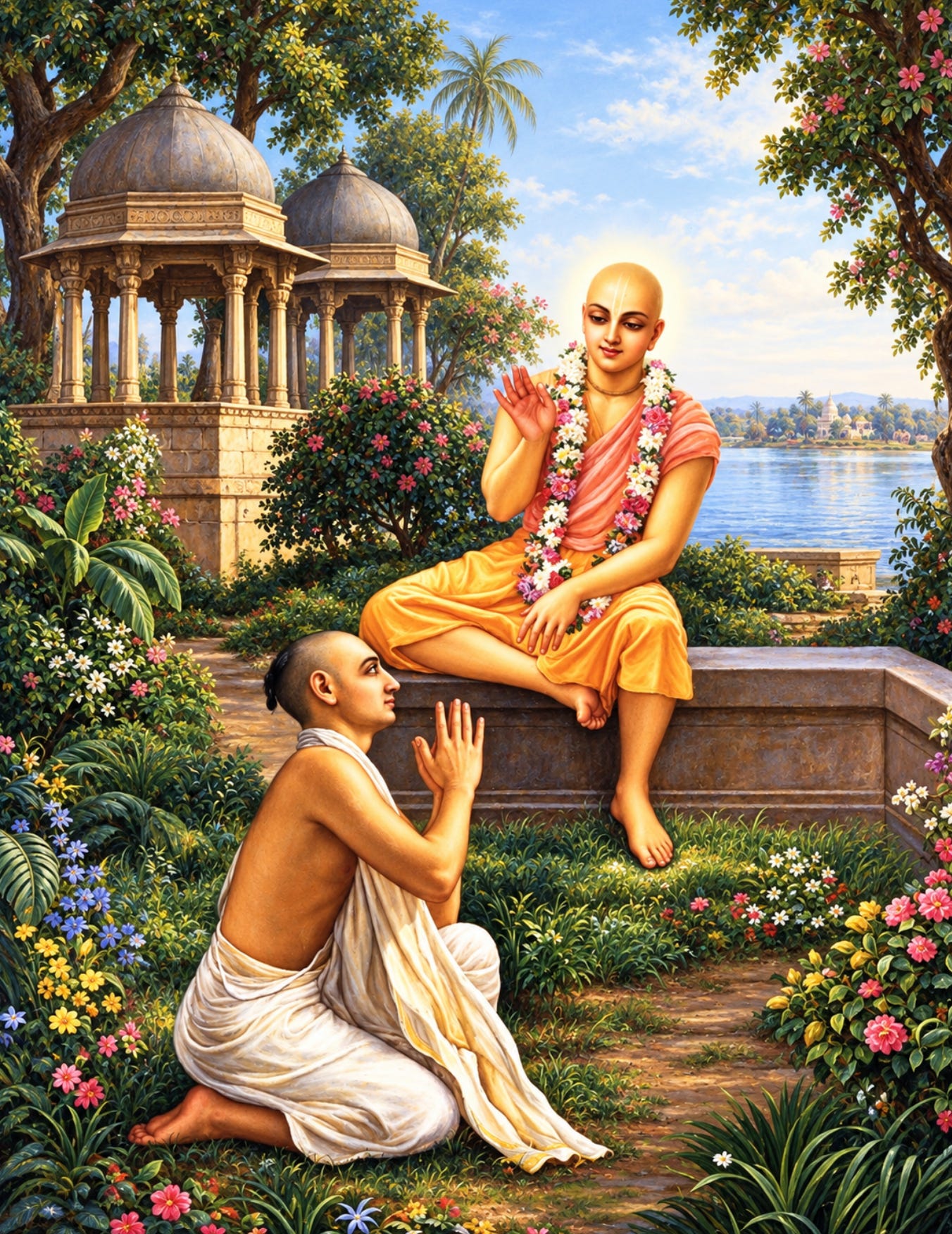
Śrī Caitanya Mahāprabhu greatly expanded this primary meaning into 18 explanations in His talks with Sarvabhauma Bhaṭṭācārya and further expanded it into unprecedented 61 explanations in his instructions to Sanātana Gosvāmī.
These explanations, however, were not just some empty intellectual exercise or a mere proof of divinity. Instead, these explanations encapsulate the conclusions of the whole philosophy of Śrī Caitanya Mahāprabhu, which Gaudiya Vaiṣnavas try to apply in their practical lives. Understanding this verse can thus be a great impetus for our spiritual practice, because it gives us a capsule that includes the whole philosophy of Kṛṣṇa consciousness inside.
These explanations are described in the Śrī Caitanya-caritāmṛta, Madhya-līlā, chapter 24. Here I’m just giving a summary, so you can get the main thread of the discussion.
The verse is composed of 11 words: (1) ātmārāmāḥ, (2) ca, (3) munayaḥ, (4) nirgranthāḥ, (5) api, (6) urukrame, (7) kurvanti, (8) ahaitukīm, (9) bhaktim, (10) ittham-bhūta-guṇaḥ, and (11) hariḥ.
What Mahāprabhu does is gradually reveal the meaning of the verse by exploring the individual meanings of each word.
He establishes three important principles:
a) Bhakti is superior to liberation. As Kṛṣṇa mentions in Bg 18.54, liberation is not the ultimate destination; it is just the beginning of a new stage. Even one who has achieved liberation will find greater happiness in loving devotional service to Kṛṣṇa.
b) Kṛṣṇa’s qualities and pastimes are transcendental. They attract even great liberated souls, who have completely lost their attraction to material enjoyment. Therefore, His qualities cannot be material.
c) Bhakti is universally accessible. Not only liberated sages, but philosophers, yogīs, ordinary people, and even ignorant people can become devotees through contact with Kṛṣṇa’s devotees.
What makes devotional service so accessible is that a person does not have to first become liberated before starting his practice of devotional service, because bhakti itself purifies one from material desires and awakens devotion to Kṛṣṇa, provided it is practiced sincerely and in proper association. Conversely, other schools have much tighter prerequisites. To follow the path of karma, one has to be a righteous follower of the Vedas; the path of jñāna requires one to be a renunciant, and yoga has even higher prerequisites. Only the process of bhakti is powerful to the point of purifying all classes of people and sublime enough to attract even great sages who have already exhausted the benefits of these other processes.
Thus, bhakti is both the means of spiritual perfection and the perfection itself. Liberation is not the ultimate purpose but just a by-product. The real result of bhakti is achieving loving service to Kṛṣṇa.
Mahāprabhu’s explanation
He starts with the basic meaning of the verse: Even great sages and self-realized persons become attracted to the devotional service of Kṛṣṇa because His transcendental qualities are extraordinarily attractive. In other words, Kṛṣṇa attracts even great, liberated sages.
From there, he expands the meaning by examining each individual word.
Let’s go one by one:
1) Ātmārāmāḥ (those who find pleasure in the self)
Initially, ātmārāma suggests someone satisfied in spiritual realization, without dependence on material enjoyment. They find pleasure in the ātmā, the Absolute Truth.
However, Mahāprabhu explains that apart from “the Absolute Truth,” the word ātmā has six other meanings: the body, the mind, endeavor, firmness, intelligence, and nature.
Therefore, the meaning of “ātmārāma” changes according to how we read the word “ātmā”. Therefore, the ātmārāmas who are attracted to Kṛṣṇa are not only great sages; it includes many other categories of people, ultimately, everyone:
Body: If we take ātmā as the body (deha), then ātmārāma is someone seeking satisfaction through the body and senses.
Mind: If atmā is taken as the mind (mana), then ātmārāma is someone absorbed in mental activity.
Endeavor (prayatne): Someone who seeks pleasure in work and activity.
Firmness (dhṛti): Someone whose satisfaction comes from steadiness and determination.
Intelligence (buddhi): Someone who searches for happiness in studies and intellectual activity.
Nature (svabhāva): Someone who acts according to his nature and finds happiness in this way.
In this way, the verse not only applies to great sages; it also applies to philosophers, yogīs, ordinary people, and even the sinful, like fruitive workers and hedonists. All of them become attracted to Kṛṣṇa.
2) Munayaḥ (the sages)
Initially, muni means a thoughtful sage, like the four Kumāras. These certainly become attracted to Kṛṣṇa. It is described that the four Kumāras were already completely absorbed in the impersonal aspect of the Absolute Truth, but still, they were immediately attracted to the worship of Kṛṣṇa simply by smelling the aroma of the tulasī leaves offered to Lord Nārāyaṇa. Similarly, Śukadeva Gosvāmi was attracted simply by hearing about Kṛṣṇa’s activities.
Mahāprabhu broadens the word to include those who are thoughtful, persons who are grave or silent, ascetics and others who undergo great vows, those in the renounced order and saints.
Later, He even applies the word “muni” to birds and bumblebees, supporting it with descriptions of creatures absorbed in Kṛṣṇa’s flute and the descriptions of His glories. This implies that not only human beings but even lower animals and plants become attracted to Kṛṣṇa, as can be noted in His pastimes in Vṛndāvana.
3. Nirgranthāḥ (those without knots or bindings)
Mahāprabhu gives different meanings to grantha and the prefix nir-:
a) Someone without the knots of ignorance (a liberated soul).
b) Someone without connection to scriptures (an illiterate or ignorant person).
c) Someone who does not follow the Vedic regulations (illiterate, lowborn, misbehaved, unregulated).
d) Someone without wealth, or, conversely, someone possessing a lot of wealth.
The word nirgranthāḥ, therefore, describes both the liberated transcendentalist and the helpless fool completely submerged in ignorance. Both can come to the platform of service to Kṛṣṇa. Later, Mahāprabhu illustrates this point by telling the story of the hunter Mṛgāri, who became a great devotee by the association of Nārada Muni. This makes the point that even the lowest person can become a devotee through the association of a pure Vaiṣnava.
4) Api (even, although, indeed)
In the primary meaning of the verse, “api” establishes a contrast: even though the sages are already liberated, they engage in devotional service.
Mahāprabhu, however, gives the word many other meanings: possibility, question, doubt, censure, aggregation, appropriate application of things, and extravagance.
This introduces many more meanings for the verse, opening interpretations such as:
a) Even liberated persons become devotees.
b) Even ignorant persons can become devotees.
c) Indeed, various categories of living beings engage in devotional service.
Basically, the previous words included all classes of living entities; all of them become attracted to the service of Kṛṣṇa, and now, api denotes different ways they become attracted. We can see that with each word, the inclusiveness of the verse is dramatically expanded.
5) Urukrame (the Lord who performs extraordinary activities)
Uru means great, and krama means steps. Originally this refers to Kṛṣṇa, as Vāmanadeva, who captured the whole universe with His steps.
Mahāprabhu adds several additional meanings: power, trembling, a systematic method, argument, and a forceful attack by stepping forward.
In this way, the word describes Kṛṣṇa’s inconceivable potencies, responsible for the creation, maintenance and annihilation of innumerable universes, as well as His spiritual activities.
This makes clear that the ultimate object of devotion is not some form of impersonal principle but the Supreme Lord, Kṛṣṇa, who possesses extraordinary personal qualities and potencies.
6) Kurvanti (they perform)
Up to here, we have many classes of people and living entities that become attracted to Kṛṣṇa. However, what is their engagement, or the process followed by them?
Here the word kurvanti indicates the process of bhakti itself. As He explains:
“The word ‘kurvanti’ means ‘they do something for others,’ since it is a form of the verb ‘to do’ indicating things done for others. It is used in connection with devotional service, which must be executed for the satisfaction of Kṛṣṇa. That is the purport of the word ‘kurvanti.’”
In other words, they do not simply contemplate Kṛṣṇa or cultivate knowledge about Him. They actively perform devotional service. This point becomes even more significant later, as the discussion progresses into superiority of pure devotion to mere self-satisfaction.
7) Ahaitukīm (without ulterior motive)
This word comes from the root “hetu” (motive, or cause).
Mahāprabhu connects it with three goals that are excluded from pure devotional service. In other words, because Kṛṣṇa is so attractive, different classes of people come to serve Him without becoming distracted by these three classes of things. This makes the point that the pleasure derived from these three is vastly inferior to the pleasure of loving service to Kṛṣṇa, or, alternatively, that their quality is inferior.
What are these three things?
a) Bhukti (material enjoyment).
b) Siddhi (mystic perfections).
c) Mukti (liberation).
One may initially approach Kṛṣṇa looking for these things (as Kṛṣṇa explains in chapter seven of the Gītā); as they progress, they lose attraction to them, because devotional service makes us develop a higher taste.
8) Bhaktim (devotional service)
Here we come to the main point, the practice itself. Mahāprabhu identifies ten divisions of bhakti: one is sādhana-bhakti, the other nine are stages of development of prema-bhakti.
He then explains how devotional love develops according to one’s relationship with Kṛṣṇa. There are five primary rasas (neutrality, servitorship, friendship, parental affection, and conjugal love), and each of them has unlimited details and variations. They are explained in detail in The Nectar of Devotion.
In other words, bhakti is not just a process of religion but a process that culminates in transcendental loving relationships with Kṛṣṇa, which are, in turn, the ultimate goal of life and the highest perfection.
9) Ittham-bhūta-guṇaḥ (possessing such extraordinary qualities)
In this way, different classes of people become attracted to Kṛṣṇa, who possesses transcendental qualities, and they express this attraction by practicing devotional service without attraction to material goals.
However, how exactly does this attraction manifest? This is explained by the word ittham-bhūta-guṇaḥ.
Kṛṣṇa possesses such transcendental sweetness that even the happiness of impersonal Brahman realization becomes insignificant compared to His transcendental qualities.
For example, the four Kumāras are attracted by the fragrance of the Tulasī leaves offered to Him, Śukadeva Gosvāmi was attracted by hearing His pastimes, the gopīs are attracted by His beauty and personal qualities, and other devotees are attracted by mercy, friendship, affection, and other qualities.
Devotional service is thus not just some form of religious duty devotees perform. They serve Kṛṣṇa because of genuine attraction to His transcendental qualities and derive a degree of transcendental pleasure from this service that has no parallel.
10) Hariḥ (He who removes and attracts)
Hari is another name of Kṛṣṇa. It has two meanings:
a) He who removes ignorance, material suffering, sinful reactions and obstacles to devotional service.
b) He who bestows transcendental love.
This word indicates the reciprocation of Kṛṣṇa. He is not an inert deity. He directly reciprocates the service of His devotees by taking away all obstacles and actively helping them to progress in the direction of the ultimate goal.
11) Ca (and, also, certainly)
Mahāprabhu explains that this last word includes meanings such as addition, aggregation, emphasis, connection, and certainty. As a result, “ca” allows combining different classes of ātmārāmas with other different meanings, creating unlimited meanings.
As He mentions:
“When the conjunctions ‘ca’ [‘and’] and ‘api’ [‘although’] are added to this verse, the verse can assume whatever meaning one wants to give it.”
The deeper progression
After explaining the meaning of the individual words, Mahāprabhu details and exemplifies numerous interpretations of the complete verse. These detailed explanations go through the rest of chapter 24 of the Madhya-līlā:
a) The jñānīs become devotees (107–153).
b) The yogīs also become devotees (154–164).
c) Scholars, foolish persons, birds, animals, and even trees become devotees (165–210).
d) Even the sinful and unregulated become devotees (221–283).
e) Everyone can become a devotee (295–311).
In this way, we can summarize his teachings in five points:
1) Even liberation is not comparable with bhakti. Those who are already free from material contamination find a superior happiness in serving Kṛṣṇa.
2) Even ignorance, material attachment, or bad habits are not a disqualification for one to start on the path of devotional service. One does not need to be liberated to start in the process.
3) The attraction to Kṛṣṇa is the eternal nature of the soul. It becomes covered by material association, but it can be awakened by association with pure devotees.
4) Kṛṣṇa is the ultimate object of satisfaction. In this way, the true ātmārāma is not simply someone who is self-satisfied but a pure devotee who finds complete satisfaction in the loving service of Kṛṣṇa.
5) All living entities, regardless of their current position or consciousness, have the tendency to become attracted to devotional service to Kṛṣṇa and have the potential to awaken love for Him to the highest degree. This is awakened through the association of devotees and the practice of devotional service.
These five points describe the essence of the philosophy taught by Mahāprabhu and the very essence of what we are trying to practice.
Read more:


This is a publication for thoughtful readers who want to go deeper into Kṛṣṇa consciousness. I publish daily, trying to offer high-quality spiritual content, and all posts are available to free subscribers. If you wish, you can support this work with a monthly contribution. When you subscribe, you can choose between a free subscription and a monthly contribution, and you can switch from a free subscriber to a supporter at any time.
You can also receive updates on WhatsApp or Telegram.
If you would like to contribute further, you can find the donation links here.