

« Things I Wish Someone Had Taught Me When I Started Krishna Consciousness
Using our natural talents for Kṛṣṇa
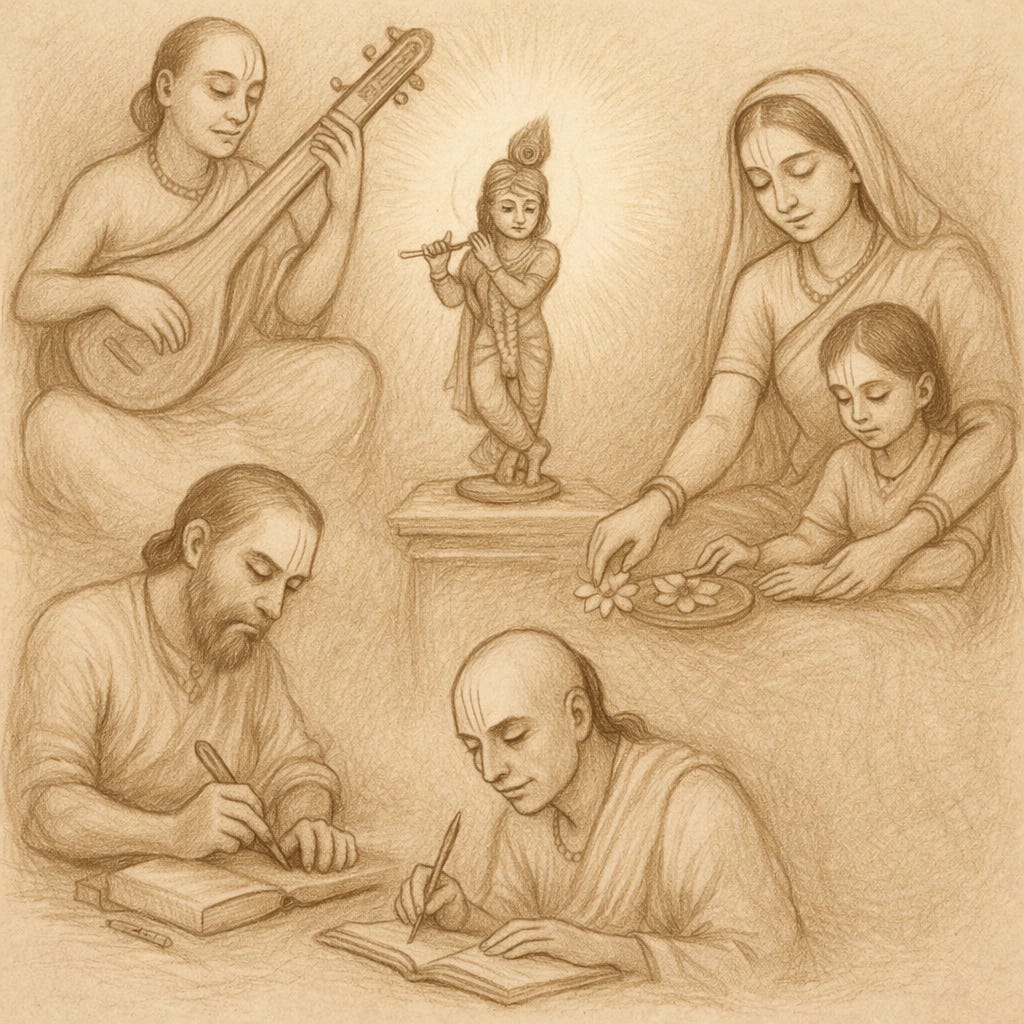
One of the greatest secrets for long-term success in spiritual life is to find a situation where we can use our natural talents and propensities in the service of Kṛṣṇa.
That’s a point that can’t be overlooked. Each of us receives a certain material nature that is not easy to give up. In fact, when we study the Bhagavad-gītā, we see that Kṛṣṇa does not advise us to abandon this nature, but instead recommends us to use it in His service. Why is it so? It is much more effective to use the tools we already have to serve Kṛṣṇa and thus advance than to battle our minds to try to become something else and only then try to serve Kṛṣṇa.
Such changes are not even possible because the only process that can allow us to change our nature is Kṛṣṇa Consciousness, and even then, only on a very high level. A pure devotee may be able to change his or her nature, but it is not possible for a neophyte. When we are starting, or even at an intermediate level, the process to advance is to work according to our nature, using our natural talents to serve Kṛṣṇa.
As Kṛṣṇa explains in the Bhagavad-gītā:
“Even a man of knowledge acts according to his own nature, for everyone follows the nature he has acquired from the three modes. What can repression accomplish?” (3.33)
“It is far better to discharge one’s prescribed duties, even though faultily, than another’s duties perfectly. Destruction in the course of performing one’s own duty is better than engaging in another’s duties, for to follow another’s path is dangerous.” (3.35)
We can see that some devotees of Śrī Caitanya Mahāprabhu, like Puṇḍarīka Vidyānidhi, were extremely rich, while others, like Kolaveca Śrīdhara, were extremely poor. However, they were all cooperating in the service of the Lord, serving according to their natural propensities and facilities. The main point is not to have a bigger or smaller collection of material objects or having this or that set of talents, but to be satisfied with whatever we have and maintain the peace of mind to use such assets to serve Kṛṣṇa.
When we are able to use our natural talents for Kṛṣṇa, we feel inspired, because we can work with enthusiasm, doing a service that is comfortable for us, that we can do effectively, and see the results. Because we are effective, other devotees also become pleased with our service, and thus everything works. When, however, we try to force ourselves to do something that is not natural for us, that we can’t do well, and we are uncomfortable doing, the opposite happens. We then feel unmotivated, insecure, and very quickly, feelings of low self-confidence, low self-esteem, etc., creep in.
Of course, emergencies often appear, and we should be prepared to do anything necessary in such cases. However, there is a difference between a temporary situation and a lifestyle.
The difficulty is that often leaders and seniors are not attentive enough to notice devotees’ talents or, in many cases, don’t have a use for them in their projects. Devotees then end up being engaged in general activities, which can be fine temporarily, as a process of training, but not in the long run.
Often devotees try to follow a strict spiritual program, dressing, eating, and acting in the way they are told, and being engaged in activities they have no talent or inclination for, and face difficulties after some time. After a period of crisis, they find a balance, where they give up some of the externals, going back to patterns that are more familiar to them, and from there find a foundation that allows them to continue practicing and being engaged in activities where they can shine by using their natural talents. Finding this balance, they can continue working on their internal qualities, practicing until the end of their lives. Whatever works, works, but if we can find this balance from the beginning, finding a spiritual teacher who can recognize our natural inclinations and help us to use them for Kṛṣṇa, we can avoid a lot of hurdles in our spiritual path.
Another point connected with using our talents for Kṛṣṇa is to avoid dry renunciation. Our philosophy is yukta-vairāgya, which means recognizing that everything belongs to Kṛṣṇa and should be used in His service. Real renunciation means to use everything we have for Kṛṣṇa, and not rejecting material facilities, thinking they are māyā. The same applies to our talents. Whatever talents we have should be properly cultivated and used in the service of Kṛṣṇa, instead of being rejected or neglected. We may temporarily focus on other activities if we join an āśrama or start on book distribution, for example, but we should understand that in the long run, the sustainable position for us is some service connected with our natural inclinations. We can see that most devotees who become fixed and successful in their services are devotees who find services connected with their natural inclinations and talents, or who learn to connect their talents with whatever service they are doing. Often, we think that we can’t be fixed or are not successful in devotional service due to some personal defect or moral deficiency, while in most cases, the problem is just that we are insisting on a path that is not appropriate for us. When we finally find a position or service that is according to our nature, we can flourish.
Another point is that a very small percentage of devotees have a natural tendency for celibate life. Most of us have a natural need for family life, and we thus do better when we plan for it, instead of trying to artificially insist on a platform that is not appropriate for us. Again, as Kṛṣṇa argues in the Gītā, what can repression accomplish?
Family life is an important step for most of us, since a great deal of our spiritual advancement depends on the quality of our marital relationship. We should thus plan in the long run. Everyone can be celibate for a few years, and for most, this can be hugely beneficial. We should, however, not burn bridges we will need later when we decide to enter married life. In the past, devotees would often drop out of university, break the connection with their families, sell their apartments, and sometimes even burn their documents, thinking that joining the āśrama would put them instantly on the transcendental platform. When the forces of nature would finally catch them, they would find themselves in a difficult situation, and often would blame their teachers for it.
These points can also be understood in the light of the teachings about karma, akarma, and vikarma Kṛṣṇa gives in the Gītā. On 4.18, He explains:
“One who sees inaction in action and action in inaction is intelligent among men, and he is in the transcendental position, although engaged in all sorts of activities.”
At first, this may appear to be one of these very complicated verses only scholars can understand, but it is actually quite simple. Here, Kṛṣṇa explains the difference between karma and akarma. Karma means fruitive activities that result in material reactions, while akarma means transcendental activities that purify us. In the verse, karma is translated as action, and akarma as inaction.
Inaction in action applies to a devotee who is apparently involved in all kinds of material activities according to his talents and inclination, but who is doing all of it for Kṛṣṇa. Although involved in so many seemingly materialistic activities, he is in a transcendental position. Action in inaction applies to a false renunciant, who is thinking himself transcendental for abandoning everything and sitting under a tree, but is actually becoming more and more involved in karmic reactions for neglecting his duties. Instead of becoming transcendental, he is becoming more materially entangled.
There is little point in discussing whether being a materialist is better or worse than being a false renunciant; both should be avoided. However, one can attain success in spiritual life by either being a true renunciant or by being a karma-yogi, executing seemingly material work for the satisfaction of Kṛṣṇa. In the yoga ladder, karma-yoga is subdivided into several levels, just as the renounced path is also subdivided into several levels. In this way, different classes and levels of devotees can be accommodated.
When devotees are properly guided, everyone can work according to their natural tendencies and thus be able to use their talents for Kṛṣṇa, resulting in devotees who are not only happier and more united but also more mature and more capable of helping others.
One who can attain internal renunciation can remain renounced even if he becomes a rich man, while someone who fails to do so may remain attached even after giving up all his possessions.
« Things I Wish Someone Had Taught Me When I Started Krishna Consciousness
You can also donate using Buy Me a Coffee, PayPal, Wise, Revolut, or bank transfers. There is a separate page with all the links. This helps me enormously to have time to write instead of doing other things to make a living. Thanks!