

Subscribe to receive new articles by e-mail. It’s free, but if you like, you can pledge a donation:
Join the Telegram group if you would like to join the live lessons. This course is maintained with your donations. Click here to donate.
💬 Text of the lesson
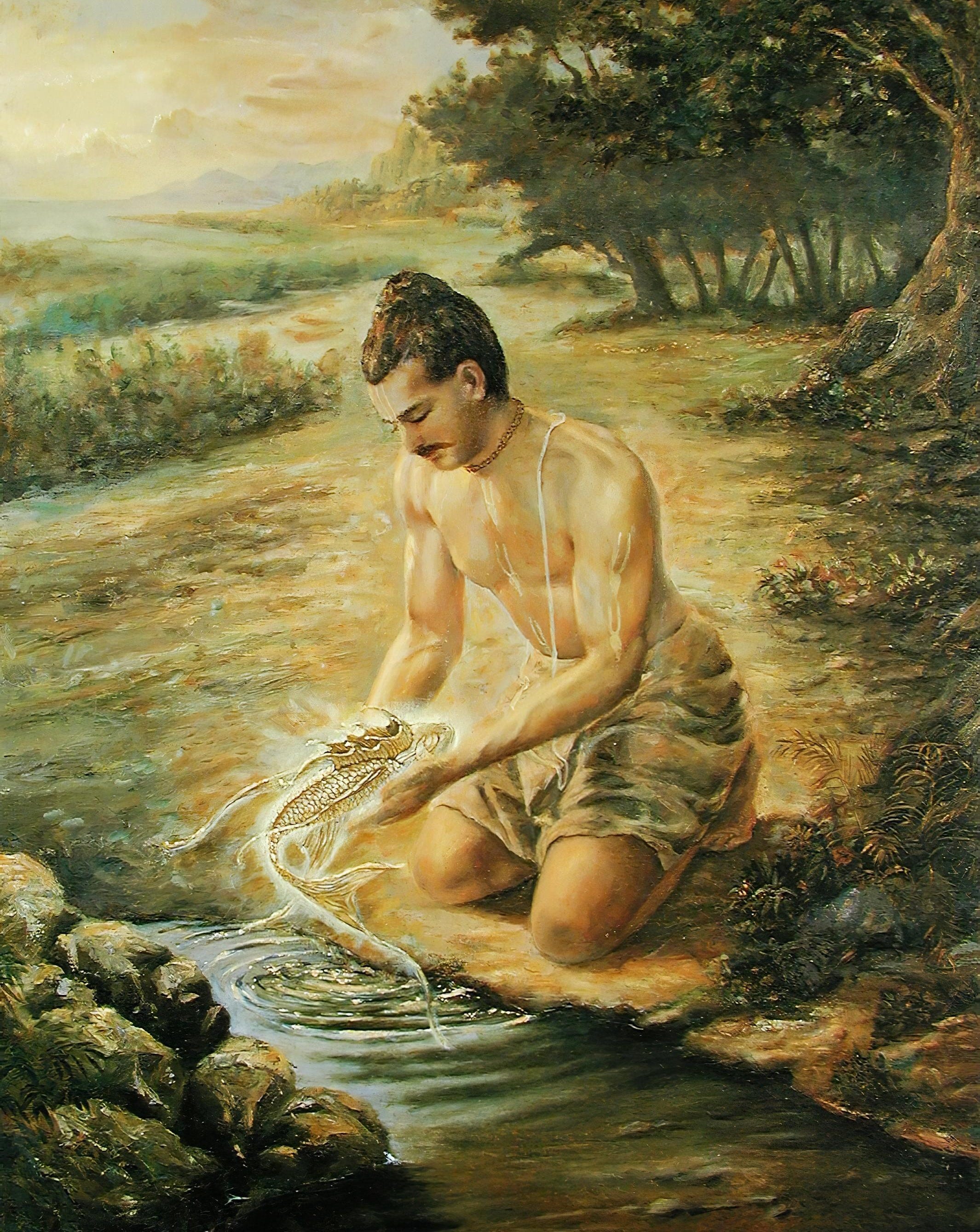
Vaivasvata Manu worships Matsya in Ramyaka-varṣa
Most of the third, fourth, and fifth cantos of Śrīmad Bhāgavatam describe pastimes that happened in the first Manvantara, narrating the activities of the descendants of Svāyambhuva Manu, from Uttānapāda and Priyavrata all the way to Bhārata Maharaja. The description of the worship in the different regions of Jambūdvīpa, however, describes the present, with devotees who are present there right now worshiping the Lord.
Vaivasvata is the current Manu, the 7th in the sequence. In his previous life, he was Mahārāja Satyavrata, a saintly king. To save him as well as other saintly persons from the devastation at the end of the Manvantara, the Lord appeared as Matsya, the fish incarnation, providing him with a great boat and personally guiding it through the waters of devastation. This historical event led to the appearance of many stories and legends which are part of other religious traditions, such as the Noah’s Ark.
Lord Matsya also instructed Satyavrata on devotional service, explaining to him the science of Sāṅkhya-yoga, as well as instructions from the Purāṇas and saṁhitās. Satyavrata came to the end of his life during the period of transition from the 6th to the 7th Manvantara, and was reborn as Śrāddhadeva, the son of Vivasvān (the current sun god), assuming the post of Vaivasvata Manu.
When Kṛṣṇa describes in the Gītā that “I instructed this imperishable science of yoga to the sun-god, Vivasvān, and Vivasvān instructed it to Manu, the father of mankind, and Manu in turn instructed it to Ikṣvāku”, the Manu He refers to is Śrāddhadeva.
Despite being reborn, Śrāddhadeva kept the remembrance of his relationship with Lord Matsya from his previous birth. He lives in Ramyaka-varṣa, the place where the Lord appeared, and continuously worships Him.
“Śukadeva Gosvāmī continued: In Ramyaka-varṣa, where Vaivasvata Manu rules, the Supreme Personality of Godhead appeared as Lord Matsya at the end of the last era [the Cākṣuṣa-manvantara]. Vaivasvata Manu now worships Lord Matsya in pure devotional service and chants the following mantra.
I offer my respectful obeisances unto the Supreme Personality of Godhead, who is pure transcendence. He is the origin of all life, bodily strength, mental power and sensory ability. Known as Matsyāvatāra, the gigantic fish incarnation, He appears first among all the incarnations. Again I offer my obeisances unto Him.” (SB 5.18.24-25)
Some say that God can’t come to this material world, while others say He may appear, but not in a human form. Others concede that He may appear in a human form, but certainly not in an animal form. In this way, people try to impose different limits on what God can or cannot do.
Kṛṣṇa, however, continues to challenge their understanding, not only reconciling all kinds of contradictory qualities in His personal form, but also assuming all kinds of forms in His incarnations, including animal forms, such as a boar, a turtle, and a fish. In all these forms, however, He appears in His transcendental body, free from any material contamination. He comes and goes out of His sweet will, just as a governor visiting a prison.
What makes animal forms, such as the form of a pig, so detestable is the influence of the material mode of ignorance, which covers the soul’s understanding and forces one to live in horrible conditions. When the soul is forced to accept an animal body, one is covered by ignorance and forgets one’s real nature. Even Indra forgot when he was cursed to become a pig. Becoming attached to his pig family and whatever enjoyment he could find in that form, he refused to become the king of heaven again when Brahma finally came to rescue him. The Lord, however, is never covered by illusion, nor is He forced to assume a material body like an ordinary conditioned soul. He can thus assume any form he desires, including the form of a hog or a fish, without coming under any sort of material influence. He remains always transcendental; appearing in different forms is merely a show.
Kuntīdevī explains in her prayers that Kṛṣṇa appears in this world “exactly like an actor dressed as a player.” Although appearing in different forms, He never gives up His transcendental body. Just his appearance changes. Still, He can’t fool His devotees. When Prahlāda Maharaja fought with Narāyana Ṛṣi in Naimiṣāraṇya, he could quickly understand that He was his worshipable Lord Nṛsiṁhadeva in a different form. Similarly, devotees of Śrī Caitanya Mahāprabhu could recognize Him as the Supreme Lord, even though He appeared as a devotee and tried to hide His divinity.
Vaivasvata Manu also describes Matsyāvatāra as the first incarnation, because He appears at the end of the day of Brahmā to save the Vedas, and returns them at the very beginning of his next day, before the appearance of other incarnations. Lord Hayagrīva appeared in this particular day, but in other days Lord Matsya appears.
“My dear Lord, just as a puppeteer controls his dancing dolls and a husband controls his wife, Your Lordship controls all the living entities in the universe, such as the brāhmaṇas, kṣatriyas, vaiśyas and śūdras. Although You are in everyone’s heart as the supreme witness and commander and are outside everyone as well, the so-called leaders of societies, communities and countries cannot realize You. Only those who hear the vibration of the Vedic mantras can appreciate You.
My Lord, from the great leaders of the universe, such as Lord Brahmā and other demigods, down to the political leaders of this world, all are envious of Your authority. Without Your help, however, they could neither separately nor concertedly maintain the innumerable living entities within the universe. You are actually the only maintainer of all human beings, of animals like cows and asses, and of plants, reptiles, birds, mountains and whatever else is visible within this material world.” (SB 5.18.26-27)
Everyone is under the control of the Lord. In the prayers of Lakṣmīdevī, it was already established that ultimately the Lord is the only male and the only protector. In this material world, we may pretend to be men and to protect wives and children, but all of this is illusory, since we depend on the Lord for everything. In this way, what is the point of claiming independence? On the contrary, when we declare our full dependency on the Lord, surrendering unto Him, we achieve happiness.
As Prabhupāda explains,
“Self-realization means to understand one’s subordinate position in relation to the Lord. When one is thus enlightened, he surrenders to the Supreme Personality of Godhead and is liberated from the clutches of the material energy. In other words, unless one surrenders to the lotus feet of the Lord, the material energy in its many varieties will continue to control him. No one in the material world can deny that he is under control. The Supreme Lord, Nārāyaṇa, who is beyond this material existence, controls everyone.”
Manu also declares that, apart from ordinary political leaders, great leaders of the universe, such as Brahmā and other demigods, are envious of the Lord’s authority. This can also be practically noted. When the Lord appeared in Vṛndāvana, He was challenged by both Brahmā and Indra. Brahmā doubted His divinity and decided to test Him by kidnapping His cowherd friends, while Indra was outraged because He stopped the traditional sacrifice to him and decided to level off Vṛndāvana using the saṁvartaka clouds. Later, when Kṛṣṇa visited the celestial planets and took the Parijāta tree, Indra, assisted by other demigods, again fought with Him.
How can it be? The point is that although the demigods are devotees of the Lord, they still have latent material desires and therefore have a tendency to identify with their positions of power, just as ordinary leaders. When one sees himself as a powerful monarch or demigod, the tendency is that he will fight when this position is challenged by a rival, even if this rival happens to be the Supreme Personality of Godhead. When this happens, the Lord has to curb their pride, defeating them in some effortless way, just as when he defeated Indra by just lifting His finger in Govardhana Lila.
This illustrates the danger of conditioned life: as soon as we have a little bit of material opulence or some intelligence, we tend to defy God. Scientists claim there is no God and that they will in the future be able to produce life; physicians try to achieve eternal life, while philanthropists often oppose missionary activities of devotees, claiming that worship of God is useless, and that the money and manpower would be better utilized to just feed the poor. However, all of them are ultimately defeated in their efforts.
“O almighty Lord, at the end of the millennium this planet earth, which is the source of all kinds of herbs, drugs and trees, was inundated by water and drowned beneath the devastating waves. At that time, You protected me along with the earth and roamed the sea with great speed. O unborn one, You are the actual maintainer of the entire universal creation, and therefore You are the cause of all living entities. I offer my respectful obeisances unto You.” (SB 5.18.28)
The word “millennium” is used by Prabhupāda in different senses, sometimes referring to a day of Brahmā, a set of four ages, or even a single age. In this particular verse, it is used in the sense of Manvantara.
There are always disturbances at the end of a Manvantara, but not a complete devastation like at the end of the day of Brahmā. However, at the end of the previous Manvantara, a special event happened: Brahmā felt sleepy and took a short nap, which triggered a devastation similar to what happens during his night, with the three words (Bhūḥ, Bhuvaḥ, Svaḥ, or in other words, the planetary systems up to Svargaloka) where inundated by the waters of devastation. In this context, the Lord appeared as Matsyāvatāra to save Satyavrata and the great sages and play another wonderful pastime.
There is a discussion on this topic in the Laghu-bhāgavatāmṛta, where different opinions are presented. Prabhupāda offers his conclusions on his purport to SB 8.24.37:
“This particular devastation actually took place not during the night of Lord Brahmā but during his day, for it was during the time of Cākṣuṣa Manu. Brahmā’s night takes place when Brahmā goes to sleep, but in the daytime there are fourteen Manus, one of whom is Cākṣuṣa Manu. Therefore, Śrīla Viśvanātha Cakravartī Ṭhākura comments that although it was daytime for Lord Brahmā, Brahmā felt sleepy for a short time by the supreme will of the Lord. This short period is regarded as Lord Brahmā’s night. This has been elaborately discussed by Śrīla Rūpa Gosvāmī in his Laghu-bhāgavatāmṛta. The following is a summary of his analysis. Because Agastya Muni cursed Svāyambhuva Manu, during the time of Svāyambhuva Manu a devastation took place. This devastation is mentioned in the Matsya Purāṇa. During the time of Cākṣuṣa Manu, by the supreme will of the Lord, there was suddenly another pralaya, or devastation. This is mentioned by Mārkaṇḍeya Ṛṣi in the Viṣṇu-dharmottara. At the end of Manu’s time there is not necessarily a devastation, but at the end of the Cākṣuṣa-manvantara, the Supreme Personality of Godhead, by His illusory energy, wanted to show Satyavrata the effects of devastation. Śrīla Śrīdhara Svāmī also agrees with this opinion.”
Aryamā worships Kūrma in Hiraṇmaya-varṣa
“Śukadeva Gosvāmī continued: In Hiraṇmaya-varṣa, the Supreme Lord, Viṣṇu, lives in the form of a tortoise [kūrma-śarīra]. This most dear and beautiful form is always worshiped there in devotional service by Aryamā, the chief resident of Hiraṇmaya-varṣa, along with the other inhabitants of that land. They chant the following hymns.” (SB 5.18.29)
Hiraṇmaya-varṣa is the penultimate tract of land to the north (on the opposite side of Bhārata-varsa), before Uttarakuru-varṣa. Aryamā is chief of the pitṛs, the departed ancestors. Kṛṣṇa mentions him in the Gītā when He says pitṝṇām aryamā cāsmi (of departed ancestors I am Aryamā).
The worship of the ancestors is very common amongst followers of the Vedas. Everyone who follows the path of fruitive activity has a duty to offer oblations to the ancestors annually, and one may also worship the ancestors seeking blessings, or the grace of joining them in Pitṛloka. However, just as all other material blessings, this is temporary. To make this point, we have the description that although many worship the pitṛs, the leader amongst them worships the Supreme Lord.
Why is that Aryamā worships Lord Kūrma? Is there any particular reason? Prabhupāda explains in his purport:
“The word priyatama (dearmost) is very significant in this verse. Each devotee regards a particular form of the Lord as most dear. Because of an atheistic mentality, some people think that the tortoise, boar and fish incarnations of the Lord are not very beautiful. They do not know that any form of the Lord is always the fully opulent Personality of Godhead. Since one of His opulences is infinite beauty, all the Lord’s incarnations are very beautiful and are appreciated as such by devotees. Nondevotees, however, think that Lord Kṛṣṇa’s incarnations are ordinary material creatures, and therefore they distinguish between the beautiful and the not beautiful. A certain form of the Lord is worshiped by a particular devotee because he loves to see that form of the Lord. As stated in Brahma-saṁhitā (5.33): advaitam acyutam anādim ananta-rūpam ādyaṁ purāṇa-puruṣaṁ nava-yauvanaṁ ca. The very beautiful form of the Lord is always youthful. Sincere servants of a particular form of the Lord always see that form as very beautiful, and thus they engage in constant devotional service to Him.”
Another objection mundane people may have to the idea of God assuming an animal form is that most animal forms are quite ugly. A pig or a turtle may not be the most attractive form. However, this again applies only to mundane animals. When the Lord comes as a hog or a turtle, these are the most beautiful forms. No form in the creation, including those of the demigods, can compare to the beauty of the Lord in any of His forms. Each devotee has a form of the Lord that is most dear, and this is an entirely personal matter. Since all forms of the Lord are equally transcendental, equally powerful, and so on, each devotee develops a special attraction to one of them. This is explained in the verse by the word “priyatama”, each devotee has a particular form that is most dear. This is a type of affection that comes directly from the soul; it is not subjected to mundane logic.
If we take any random group of new devotees and let them decide amongst themselves, it’s quite probable that all the men will decide they want to be cowherd boys, and all the ladies will decide they want to be gopis. This, however, usually doesn’t come from transcendental realization, but from a mere material calculation. If I identify with a male form, I will want to attain what I perceive as the most exalted male form, while one who sees oneself as a woman will want the most exalted feminine form. The soul, however, is neither a man nor a woman, and our perception of certain devotees of the Lord as “higher” and others as “lower” is mundane. One of the conclusions of the first part of the Bṛhad-bhāgavatāmṛta is that all pure devotees and associates of the Lord are perfect. As the Lord personally spoke to Nārada Muni:
“O sage, each of the devotees you saw and heard about in your wanderings here and there, from Prayāga-tīrtha to Dvārakā, is perfect in all respects. Each of them can deliver the entire world, and each has truly received My mercy. There exist between them only degrees of perfection.” (Bb 1.7.136)
In his commentary on this verse, Śrīla Sanātana Goswami mentions:
“In each of the places Nārada had visited, from Prayāga to Dvārakā, he had met with pure devotees who personified the transcendental virtues of bhakti, and he had heard about others, like the residents of Śrī Vaikuṇṭha and Śrī Nanda-vraja. By the strength of Kṛṣṇa’s mercy, each of these devotees was situated in perfection, and able to elevate others to perfection.
This does not mean, however, that their love for Kṛṣṇa lacked individual distinctions. Pure devotional service is by nature full of variety, so no two devotees are exactly alike. A formal ranking among Kṛṣṇa’s devotees does not exist, but still they show some differences in excellence. Ultimately, Śrīmatī Rādhārāṇī and Her companion gopīs are the most excellent devotees. The other pure Vaiṣṇavas acknowledge the supremacy of Śrīmatī Rādhārāṇī without envy, being satisfied with the unlimited happiness of serving Kṛṣṇa in their own individual ways. The second part of Bṛhad-bhāgavatāmṛta, “The Glories of Goloka,” will conclusively demonstrate that every pure devotee of Kṛṣṇa enjoys full satisfaction in his own loving exchanges with Kṛṣṇa.”
As Prabhupāda concludes in his purport:
“A certain form of the Lord is worshiped by a particular devotee because he loves to see that form of the Lord. As stated in Brahma-saṁhitā (5.33): advaitam acyutam anādim ananta-rūpam ādyaṁ purāṇa-puruṣaṁ nava-yauvanaṁ ca. The very beautiful form of the Lord is always youthful. Sincere servants of a particular form of the Lord always see that form as very beautiful, and thus they engage in constant devotional service to Him.”
Aryamā is personally devoted to Kūrmadeva, to whom he prays:
“O my Lord, I offer my respectful obeisances unto You, who have assumed the form of a tortoise. You are the reservoir of all transcendental qualities, and being entirely untinged by matter, You are perfectly situated in pure goodness. You move here and there in the water, but no one can discern Your position. Therefore I offer my respectful obeisances unto You. Because of Your transcendental position, You are not limited by past, present and future. You are present everywhere as the shelter of all things, and therefore I offer my respectful obeisances unto You again and again.” (SB 5.18.30)
The Lord is completely free from material contamination, and thus situated in viśuddha-sattva, the spiritual platform of pure goodness. The Lord is also the reservoir of all transcendental qualities, which often appear to be contradictory. As Prabhupāda explains in his purport:
“In the Brahma-saṁhitā it is said, goloka eva nivasaty akhilātma-bhūtaḥ: the Lord always remains in Goloka, the topmost planet in the spiritual world. At the same time, He is all-pervading. This paradox is only possible for the Supreme Personality of Godhead, who is full of all opulences. The Lord’s all-pervasiveness is confirmed in Bhagavad-gītā (18.61) where Kṛṣṇa states, īśvaraḥ sarva-bhūtānāṁ hṛd-deśe ’rjuna tiṣṭhati: “The Supreme Lord is seated in everyone’s heart, O Arjuna.” Elsewhere in Bhagavad-gītā (15.15) the Lord says, sarvasya cāhaṁ hṛdi sanniviṣṭo mattaḥ smṛtir jñānam apohanaṁ ca: “I am seated in everyone’s heart, and from Me come remembrance, knowledge and forgetfulness.” Therefore, although the Lord is present everywhere, He cannot be seen with ordinary eyes. As Aryamā says, the Lord is anupalakṣita-sthāna: no one can locate Him. This is the greatness of the Supreme Personality of Godhead.”
Māyāvādis conclude that the absolute is ultimately impersonal, devoid of qualities or activities, but as Vaiṣnavas, we believe in the exact opposite: Kṛṣṇa is the possessor of all qualities, and He performs all sorts of activities in His unlimited personal forms. How can a person possess all qualities, one can argue, since some qualities contradict others? If a man is big, he is automatically not small, and so on. This is true in the mundane platform, but as already declared, Kṛṣṇa is free from all material inebriety. He can thus be the biggest, as Mahā-Viṣnu, and at the same time the smallest, as Paramātmā. He has a personal form, present in one place, but at the same time is present everywhere, and so on. All kinds of contradictory qualities are reconciled in the transcendental form of the Lord.
The same inconceivable mystery applies to His activities. When the Lord appeared in Vṛndāvana, He exhibited a human form and played with His friends just like a human child. At the same time, however, He killed powerful demons and defeated Indra using just one finger by lifting up Govardhana. This perplexed even Brahmā, who decided to test Him by taking his friends and cows, which led to another wonderful pastime, when Kṛṣṇa exhibited thousands of Viṣnu forms, each one fully equipped with His own universe, complete with His own Brahmā and Śiva. Each of these Brahmās was present in his own universe, and as we study in the Śrīmad Bhāgavatam, each universe is covered by seven layers, each layer exponentially larger than the previous. This means the distance between different universes is inconceivably vast. Still, Kṛṣṇa was able to bring all these Brahmās together, right in front of the four-headed Brahmā of this universe. This can’t be understood unless we accept the fact that the Lord has inconceivable potencies and there is nothing impossible for Him.
Similarly, as Varāha, he found the earth inside the ocean by smell and then effortlessly lifted it. As Lord Kūrma, He swam in the water and supported the huge Mandara Mountain on His back, allowing the demigods and demons to use it as a pivot to churn the ocean. Just as His qualities, these activities are transcendental and inconceivable. The Lord is also not limited by past, present, and future, and, in fact, the Lord is controller of time itself, which is just one of His potencies. In each of His innumerable forms, the Lord is the shelter of everything.
“My dear Lord, this visible cosmic manifestation is a demonstration of Your own creative energy. Since the countless varieties of forms within this cosmic manifestation are simply a display of Your external energy, this virāṭ-rūpa [universal body] is not Your real form. Except for a devotee in transcendental consciousness, no one can perceive Your actual form. Therefore I offer my respectful obeisances unto You.” (SB 5.18.31)
In his purport, Prabhupāda mentions that “Māyāvādī philosophers think the universal form of the Lord to be real and His personal form illusory.” This may raise a few questions. The universal form is nothing more than the universe itself viewed as a form of the Lord, a concept used as an aid in meditation. In other purports of Śrīla Prabhupāda, we hear the idea that the Māyāvādis consider this material world false. In this context, the idea that Māyāvādīs think the universal form to be real may sound like a contradiction. How does it work?
One of the maxims of Māyāvāda philosophy is “brahma satyaṁ jagan mithyā” (Brahman is truth, and the world is false). Because they don’t accept that Brahman has multiple potencies, they conclude that the material creation is ultimately false, existing only under the purview of avidyā, or ignorance. Their conclusion is that all forms and activities also exist under the covering of avidyā, and thus, when Kṛṣṇa appears in this world and performs pastimes, they conclude that He assumes a material body and performs activities under the material mode of goodness. That’s why we call them Māyāvādis, because they believe Māyā is greater than God. At the same time, however, they accept the concept of the universal form, or virāṭ-rūpa, as a form of the Absolute Truth, in line with their concept that Brahman is everything. Since Brahman is everything, it sounds natural for a Māyāvādi to see the universe as Brahman. Thus, in an interesting philosophical twist, the universal form sounds more real to a Māyāvādi than the personal form of the Lord, as noted by Prabhupāda.
This Māyāvādi view is obviously incorrect. The central mistake is in not accepting the unlimited potencies of the Lord. Prabhupāda explains this point didactically in his purport:
“We can understand their mistake by a simple example. A fire consists of three elements: heat and light, which are the energy of the fire, and the fire itself. Anyone can understand that the original fire is the reality and that the heat and light are simply the fire’s energy. Heat and light are the formless energies of fire, and in that sense they are unreal. Only the fire has form, and therefore it is the real form of the heat and light. As Kṛṣṇa states in Bhagavad-gītā (9.4), mayā tatam idaṁ sarvaṁ jagad avyakta-mūrtinā: “By Me, in My unmanifested form. this entire universe is pervaded.” Thus the impersonal conception of the Lord is like the expansion of heat and light from a fire. In Bhagavad-gītā the Lord also says, mat-sthāni sarva-bhūtāni na cāhaṁ teṣv avasthitaḥ: the entire material creation is resting on Kṛṣṇa’s energy, either material, spiritual or marginal, but because His form is absent from the expansion of His energy, He is not personally present. This inconceivable expansion of the Supreme Lord’s energy is called acintya-śakti. Therefore no one can understand the real form of the Lord without becoming His devotee.”
The hand is part of the body, and therefore the body contains the hand. However, the inverse is not true. The body contains the hand, and the body is present in the hand in a sense, but the hand doesn’t include the body. Similarly, everything is part of Kṛṣṇa, and Kṛṣṇa is present in everything as Paramātmā. At the same time, however, the part can’t claim to include the whole. Kṛṣṇa is present in everything through the expansion of His energy, but not directly in His personal form. This inconceivable transcendental form, the source of everything, can be seen only by a devotee.
“My dear Lord, You manifest Your different energies in countless forms: as living entities born from wombs, from eggs and from perspiration; as plants and trees that grow out of the earth; as all living entities, both moving and standing, including the demigods, the learned sages and the pitās; as outer space, as the higher planetary system containing the heavenly planets, and as the planet earth with its hills, rivers, seas, oceans and islands. Indeed, all the stars and planets are simply manifestations of Your different energies, but originally You are one without a second. Therefore there is nothing beyond You. This entire cosmic manifestation is therefore not false but is simply a temporary manifestation of Your inconceivable energy.” (SB 5.18.32)
The material world is not false; nothing false comes from the Absolute Truth. Prabhupāda again gives a very didactic example:
“One thing may be permanent and another temporary, but both the permanent and the temporary are facts. For example, if someone becomes angry for a certain period, no one can say that his anger is false. It is simply temporary. Everything we experience in our daily lives is of this same character; it is temporary but real.”
Even the material bodies we use are real, coming also from Kṛṣṇa’s energy. They are certainly temporary and become a source of illusion when we identify the body with the self, but they are factual. The material manifestation is sometimes active and sometimes not, and it produces many temporary manifestations, but the energy is eternal, just as the Lord is eternal.
Māyāvādis conclude that this world is false, but this is contradicted in many passages, including this one. Instead, the correct conclusion is “sarvaṁ khalv idaṁ brahma” (everything is Brahman). In this way, Brahman is true, and everything that comes from Him is true, including this universe. There is nothing false. Kṛṣṇa is real, we are real, and His energy, arranged in the form of this material creation, is real. Everything, therefore, should be used in His service.
“O my Lord, Your name, form and bodily features are expanded in countless forms. No one can determine exactly how many forms exist, yet You Yourself, in Your incarnation as the learned scholar Kapiladeva, have analyzed the cosmic manifestation as containing twenty-four elements. Therefore if one is interested in Sāṅkhya philosophy, by which one can enumerate the different truths, he must hear it from You. Unfortunately, nondevotees simply count the different elements and remain ignorant of Your actual form. I offer my respectful obeisances unto You.” (SB 5.18.33)
Once it is established that the universe is not false and is manifested from the energy of the Lord, the automatic conclusion is that Kṛṣṇa is the knower of the material manifestation, as He Himself declares in the Gītā. Being Kṛṣṇa the knower and the ultimate authority, anyone who wishes to understand the material universe should get knowledge from Him.
Kṛṣṇa came personally as Lord Kapila to propagate the devotional Sāṅkhya system, explaining the material elements and the material creation in its proper context, and defining devotional service as the ultimate goal. Anyone who wants to properly understand the universe and its purpose should study this knowledge left by Him. Unfortunately, as Prabhupāda mentions in his purport, material scientists want to study natural laws without knowing the Supreme Personality of Godhead, who is the background of the material creation. Because of that, their knowledge remains incomplete, and they waste their time in broken theories, instead of investing it in the real goal of life.
This is a publication for thoughtful readers who want to go deeper into Kṛṣṇa consciousness. I publish daily, and all posts are available to free subscribers. If you wish, you can also choose a paid subscription to support this work. By subscribing, you also gain access to the manuscripts of the books I’m currently working on.
If you would like to contribute further, you can find the donation links here.