


You can receive new articles directly in your inbox. Subscription is free; donations are welcome.
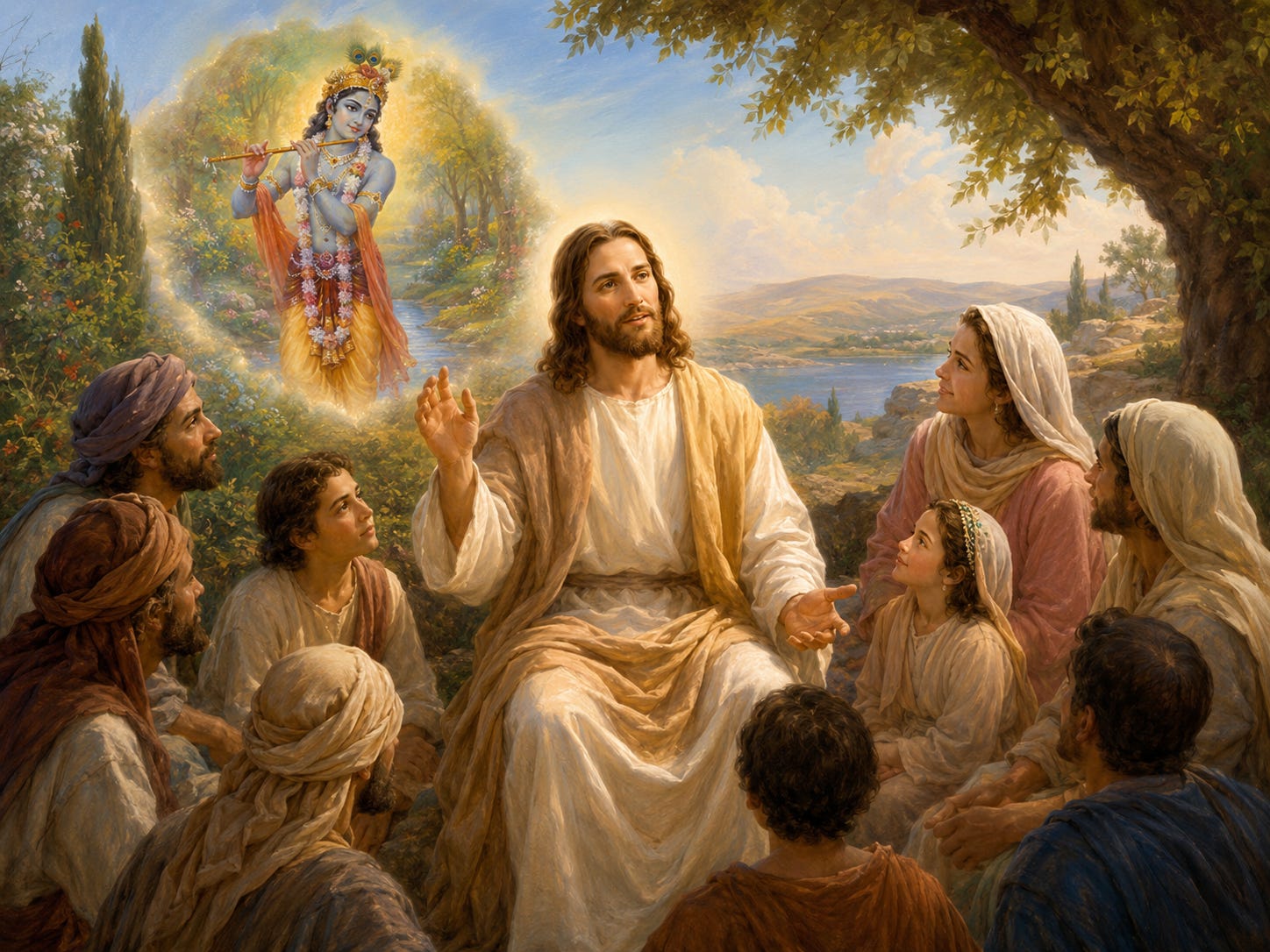
A common conception we have in the Hare Kṛṣṇa movement is that the father Christ spoke about is Kṛṣṇa. Christ spoke that he is the son; in the Gītā, Kṛṣṇa mentions that He is the father; therefore, when we accept it like that, there is no contradiction. This serves as a basis for cooperation. Christianity is a subsection of the same faith. We are on the same side. We can learn some things they do right, and they can also learn something from us, like better understanding the ideas of compassion and non-violence propagated by Christ, stopping the killing of animals, and so on.
In a garden conversation (June 25th, 1972, Los Angeles), Prabhupāda also mentions the relation between the two names:
“Prabhupāda: Kṛṣṇa’s time is five thousand years. So there is possibility of taking these stories from Kṛṣṇa’s life. The word Kristo is there in Greek dictionary. Kristo. And the meaning is “anointed face” or something like that. So Kṛṣṇa was known. And from Kristo the word Christ has come. That is explained in that Aquarian Gospel. So it appears that Kṛṣṇa was known. Formerly, all over the world the Vedic system was current. So Kṛṣṇa was known.”
“Prabhupāda: Christ has come from the word Kristo, and Kristo is a perverted word of Kṛṣṇa. So actually the word is coming from Kristo, and Kristo is Kṛṣṇa. Even in India still, Kṛṣṇa, one’s name is Kṛṣṇa, he is called Kristo.
My younger brother was named Kṛṣṇa. So we were calling him Kristo, Kristo. That is common. So from Kristo, Christ has come. Christo. From Kristo---Christo; from Christo---Christian.”
Many Christians, however, will disagree with this. Many will also denounce the Aquarian Gospel as a non-authentic book. Prabhupāda, however, appears to support it in a few conversations.
The book speaks about the missing years of Christ, the years of his life between his infancy and his return to preach the gospel, to which there are no references in the Bible. The book describes Christ traveling to India during this time, under the patronage of an Indian prince from Orissa. There, he is said to have studied the Vedas, quickly surpassing his Brahmana teachers in spiritual realization. The book describes him rejecting the concept of Brahmanas being superior by birth and teaching that all souls are equal, and so on. According to the book, Christ eventually started preaching his philosophy of universal love and equality to the lower classes, and eventually returned to teach it in his home region, the point where the description connects with what is described in the Bible.
Historically, the Aquarian Gospel was written by H. Dowling at the end of the 19th century. It, however, finds some sustenance in historical records from the Hemis Monastery in Ladakh and from the Roza Bal shrine in Kashmir. This evidence points to a historic Jesus passing through these places.
Prabhupāda, however, appeared more convinced by the conclusions themselves than by the historical context. He considered that Christ visiting India and learning from the Vedas was highly plausible based on spiritual insight. Therefore, even if the historic evidence is weak, the opinion of a pure devotee has weight because a pure devotee speaks based on spiritual insight. The history may have been forgotten, but Kṛṣṇa knows, and the pure devotee connected with Him can also know. For us, this has more weight than historic and archaeological evidence.
One important point to notice, however, is that although Prabhupāda supported the main theses of the book, of Christ studying in India, he disagreed with other portions of the book, like Christ considering the worship of Lord Jagannatha in Puri idolatry. The Aquarian Gospel is thus not scripture; it is just a book that got a few things right and others not so much.
The next point is about Kṛṣṇa being the father Christ referred to. This point is more obvious.
We can understand that Christ was not just an ordinary religious reformer but a self-realized person based on his teachings. The Gospel he transmitted can only be the result of spiritual insight. However, from where did Christ learn?
Even though pure devotees are eternally connected with Kṛṣṇa, when they come to this material world, they accept material bodies and have to learn the spiritual science from a self-realized soul. Even when Kṛṣṇa Himself comes, He accepts a guru to give example. It is improbable that Christ, as a self-realized soul, would break with this principle. From the Vaiṣnava perspective, it makes more sense that he learned from some bona fide school, and in this context, traveling to India makes sense. The years he disappears from the Bible are indirect proof of it. It suggests he traveled somewhere and learned from someone, and the fact that all records of these years disappeared from the Bible raises the possibility of this being an inconvenient truth the Church decided to cover.
If this is accepted, the idea that the story could have survived in unofficial records that were later studied by occultist societies in Europe and ended up being written into a book is not too far-fetched. We should remember that the Bible was heavily edited throughout the history of Christianity, and what we have access to is not exactly the words of Christ, but whatever fragments survived after centuries of scrutiny on the part of the Church.
In any case, whether Christ was in India or not, if we accept that Kṛṣṇa is God based on our studies of the Vedas and whatever spiritual realization we may have, and if we accept Christ as a self-realized soul, then it becomes clear that when he spoke about God as the father, he was speaking about Kṛṣṇa.
Even if one would argue that Christ was not consciously speaking about Kṛṣṇa, or that he never heard the name Kṛṣṇa, still the fact remains. If Kṛṣṇa is God, anyone who speaks about God speaks about Kṛṣṇa. Even if I don’t know the president’s name, from the moment I say “president,” I refer to the person, knowing or not.
We can thus offer an alternative explanation: that Christ knew about Kṛṣṇa, and that he adopted the name Kristo (or Kristus) to make people indirectly chant Kṛṣṇa’s name while referring to him, as well as to make the connection clear.
Another argument can be offered in terms of the similarity in concepts in the Jewish faith and in the teachings of Christ to concepts related to God in the Vedas. The names of God mentioned in the Bible come from Hebrew, Aramaic, or Greek, languages that are too distant from Sanskrit to preserve a direct linguistic connection, but the philosophical concepts are still similar.
Elohim, one of the main names for God in the Hebrew Bible, is connected to the root El, meaning “God” or “mighty one.” This connects in concept to names such as Viṣṇu, Nārāyaṇa, and Bhagavān.
Yahweh is commonly connected with the Hebrew verb “to be.” It has the meaning of God as the self-existent, eternal, omnipresent. It is thus connected to Vedic descriptions of the Supreme as sat (the eternal being), or sanātana (eternal).
Adonai means “lord” or “master” in Hebrew. This is conceptually close to titles such as īśvara, prabhu, nātha, and svāmī, used to describe God in the Vedas.
Theos is a name found in the Greek New Testament. The root is connected with shining or brightness. It is thus equivalent in concept to the Sanskrit deva.
Jesus comes from the Greek Iēsous and from the Aramaic Yeshua. It means “Yahweh saves” or “the Lord saves.” It is thus connected with Viṣnu names connected with protection and deliverance, like Hari (He who takes away material bondage), Mukunda (giver of liberation), and Nārāyaṇa (the shelter of all living beings).
Christ often refers to God as Father. The concept is the same as given by relational titles like pitā (father), jagat-pitā (father of the universe), and so on. Also, in the Gītā, Kṛṣṇa directly mentions: ahaṁ bīja-pradaḥ pitā, “I am the seed-giving father.”
This is the strongest theological parallel, noted by Prabhupāda in several conversations. The Bible presents God as father, and the Gītā presents Kṛṣṇa as the father. Therefore, both are in agreement.
This is a publication for thoughtful readers who want to go deeper into Kṛṣṇa consciousness. I publish daily, trying to offer high-quality spiritual content, and all posts are available to free subscribers. If you wish, you can also choose a paid subscription to support this work.
You can also receive the updates on WhatsApp or Telegram.
If you would like to contribute further, you can find the donation links here.
🕉️🤍🥹