

« Things I Wish Someone Had Taught Me When I Started Krishna Consciousness
We can progress on our own only up to a certain point
Often, we say that devotional service is eternal, and that even if someone does just a little bit in this life, he can be saved. Śrila Prabhupāda went as far as saying that if someone reads just one line of his books, his life can change. Kṛṣṇa Himself says in the Bhagavad-gītā that “In this endeavor, there is no loss or diminution, and a little advancement on this path can protect one from the most dangerous type of fear.”
Seeing from this optic, everything is very simple and easy. We just need to spread the mercy by chanting in public and distributing books, and people will automatically become Kṛṣṇa Conscious. One can thus question: “Why then bring all the institutional talk about accepting a guru? Why can’t people just practice on their own?”
On the one hand, the scriptures advertise the potency of the holy names, giving examples like the history of Ajāmila, who was saved by just chanting once the name of Narāyana when calling his son. On this line, there are statements like “there are no hard and fast rules” by Mahāprabhu. On the other hand, the same scriptures say that one can’t go back to Godhead without accepting a spiritual master and being trained under him. How can we reconcile the two sides?
The point is that these two categories of statements refer to people in different stages of spiritual development. Anyone can start and go to a certain point by just reading books and chanting; that’s why Śrila Prabhupāda asked us to distribute his books. There is no prerequisite for taking a book or for chanting. Everyone is welcome to join, regardless of having a pious or sinful life, being clean or not, being educated or not, etc.
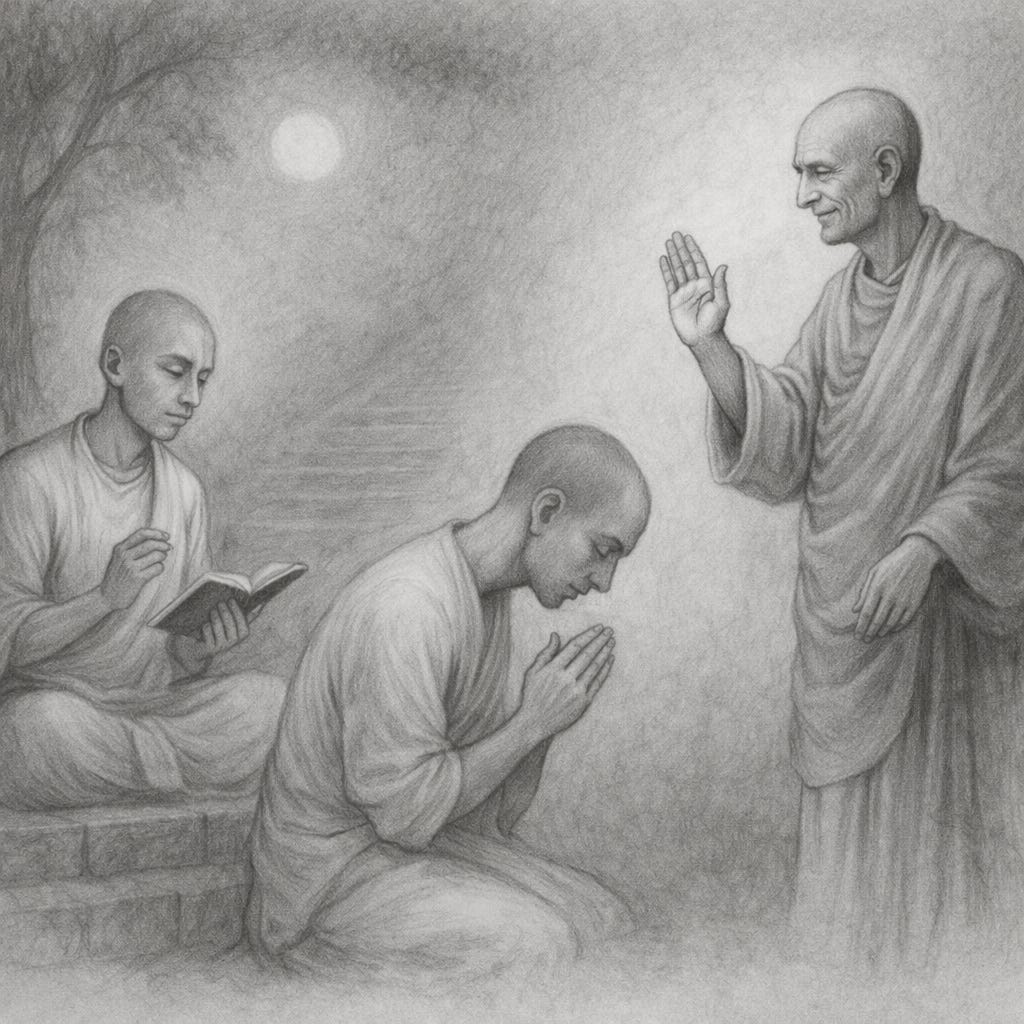
At a certain point, however, one should accept a spiritual master to move further. When one comes to this stage, different layers of discipline become necessary. One has to abandon previous sinful habits and lead a clean life. He needs to be submissive to the spiritual master (a student who is not submissive can’t properly learn) and so on. That’s what Kṛṣṇa says in the Bhagavad-gītā: “Just try to learn the truth by approaching a spiritual master. Inquire from him submissively and render service unto him. The self-realized souls can impart knowledge unto you because they have seen the truth.”
There are, therefore, two priorities: to convince people to start, and to convince devotees who have already come to a certain level to go further. When we talk to new people, we emphasize the flexibility of the process, the absence of hard and fast rules, and so on. This encourages them to start practicing and thus benefit from the chanting and association with devotees. This is not a “preaching strategy”; it is true at the level they are and the proper instruction at the moment.
There is, however, a limit on how much one can advance by practicing spiritual life on such an amateurish level. Theoretically, one can go up to the stage of liberation, as explained by Śrila Haridāsa Thākura, but it is improbable that one will achieve pure love of Godhead through this process. After graduating at this level, it’s time to accept a higher level of practice to advance further.
Of course, there is no loss or diminution; therefore, even one who is reluctant to become serious in spiritual life will have other chances in the future. It’s up to each of us to decide how eager we are to become free of this material world. The ones who are not in a hurry may stay a little longer and continue playing with the material energy for some more time. For the ones who are serious about getting out, however, there is a certain process to be followed. One can learn a lot by watching videos on YouTube, but to advance past a certain point, one must go to a university or find a private teacher.
When we speak about spiritual master, some may raise the issue of dīkṣā and śikṣā. Our paramparā, as envisioned by Śrila Bhaktisiddhānta Sarasvatī Thākura, is a śikṣā paramparā. Śrila Bhaktivinoda Thākura had a dīkṣā-guru, Śrila Bipin Bihari Goswami, but his relationship with his śikṣā-guru, Śrila Jagannātha Babaji Maharaja, is considered much more important. However, this doesn’t change much since the process of approaching the śikṣā-guru is the same as the process of approaching the dīkṣā-guru. Nor is the śikṣā-guru less important. The fact that one has a śikṣā-guru also doesn’t eliminate the need for a dikṣa-guru. Both of them represent thus two different manifestations of the mercy of the Lord, and one doesn’t nullify the other.
« Things I Wish Someone Had Taught Me When I Started Krishna Consciousness
You can also donate using Buy Me a Coffee, PayPal, Wise, Revolut, or bank transfers. There is a separate page with all the links. This helps me enormously to have time to write instead of doing other things to make a living. Thanks!