


You can receive new articles directly in your inbox. Subscription is free; donations are welcome.
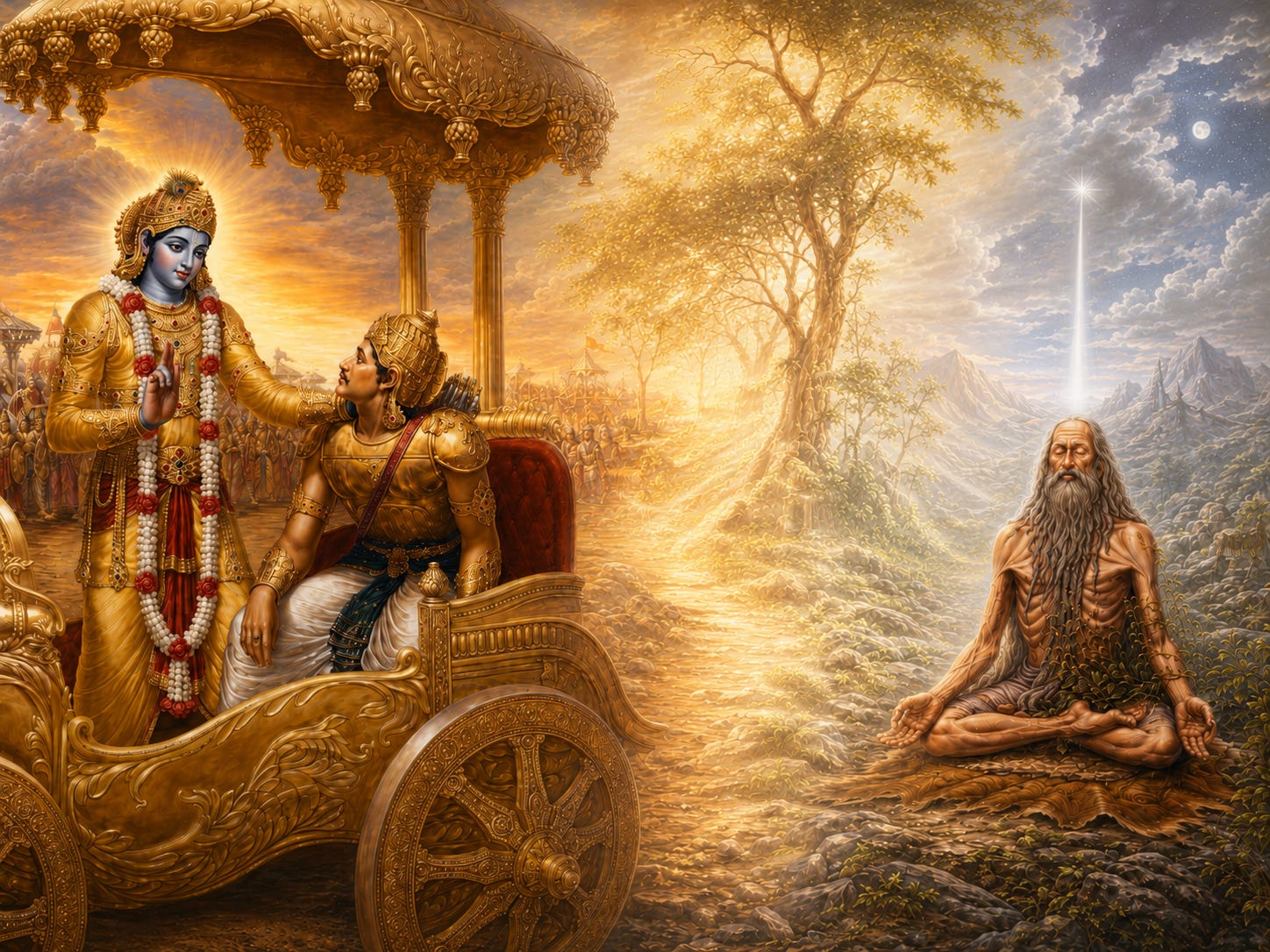
In the 6th chapter of the Bhagavad-gītā, Kṛṣṇa instructs Arjuna in the path of dhyana-yoga, or aṣtanga-yoga, the process of mystic yoga that involves sitting in an isolated place and meditating for long periods, keeping the mind perfectly peaceful. Arjuna, however, admits his incapacity in following this process:
“Arjuna said: O Madhusūdana, the system of yoga which You have summarized appears impractical and unendurable to me, for the mind is restless and unsteady.
The mind is restless, turbulent, obstinate and very strong, O Kṛṣṇa, and to subdue it, I think, is more difficult than controlling the wind.”
Prabhupada notes that Arjuna was much more qualified than anyone in our age. He was an advanced ksātriya, trained in discipline and religious principles, had a much longer life, and above all, he was a pure devotee and a personal associate of Kṛṣṇa. He was not a weak person. This makes his refusal especially significant. If even an advanced personality like Arjuna could not practice the process of mystic yoga described by Kṛṣṇa, what is the possibility that any of us may succeed? This prepares the ground for the next portion of the Bhagavad-gītā, from chapters 7 to 12, where the process of bhakti-yoga is described in detail. The process of mechanical meditation is extremely difficult in this age, whereas Kṛṣṇa consciousness is natural, because it gives the mind direct engagement in the service of Kṛṣṇa.
One point we can notice is that when Arjuna refuses the process of dhyāna-yoga in text 6.33, he does not criticize the process itself. Many great sages attained success practicing meditation in previous ages. It is an authorized discipline, and Kṛṣṇa Himself teaches it, both in the Gītā and in His advent as Lord Kapila (in the 3rd canto of Śrīmad-Bhāgavatam). The problem is not the process in itself; it is the agitated mind.
Arjuna elaborates in text 34, describing the qualities that make the mind so dificult to control. He mentions four qualities: Cañcalam: flickering, restless. The mind is unstable by nature, constantly moving from one object to another. Physical objects have limits on how fast they can move, but the mind can go from one side to the other of the universe instantly. This is what is referred to in different passages as the speed of the mind. Pramāthi: agitating, turbulent. Not only does the mind quickly move from one thought to another, but it also creates disturbance, which can be fatal for the yogī practicing meditation. Dṛḍham: obstinate. Even when we receive good instruction, and we decide to follow it, the mind resists. Bala-vat: strong. As we well know, once the mind decides to go in a certain direction, the pull can be very strong and dificult to resist. Even an intelligent person can easily fall under its control.
Arjuna compares the mind with the wind, which is subtle, flows everywhere, is powerful, and practically impossible to stop. Even if one can remain seated, there is no guarantee that the mind will remain still, and if the mind is not peaceful, then the yoga practice becomes mere imitation. Just as one cannot control the wind, Arjuna concludes that it is also not possible for him to control the mind through this method.
In his purport, Prabhupāda mentions a very important analogy for understanding our conditioned condition, which comes from the Upaniṣads. The body is like a chariot that moves around. We may think we are controlling this chariot, but we are actually just a passenger. The chariot is pulled by the senses, which are compared to horses. The horses are tied to the rein (the mind), and the rein is held by the intelligence. Since the intelligence is the main driver, it has to be purified by transcendental knowledge. Only then can it help us. The mind, however, is so strong that it can overpower the intelligence, and thus, even when we decide to follow the transcendental process, we still have to persistently fight the whims of the mind.
In this context, Kṛṣṇa’s answer in texts 6.35-36 is important. Kṛṣṇa does not lower the standard of the practice. The yoga process He described is what it is, and if one wants to achieve success in it, one has to follow it the way He described. This is more important and universal than it may sound at first.
Every process of self-realization brings certain difficulties, because they all involve controlling the mind. The process of Kṛṣṇa consciousness may be much easier than aṣṭāṅga-yoga, but it is not free of struggle. Just as Arjuna concluded that the process of meditation Kṛṣṇa describes is almost impossible to perform, we may have difficulties even following the basic process of Kṛṣṇa consciousness. The answer given by Kṛṣṇa is thus not just for Arjuna, but for every single transcendentalist who experiences difficulties in the path of self-realization.
The first point is not to lower or dilute the process, and risk making it ineffective. Instead, we should try to elevate ourselves by cultivating the two qualities Kṛṣṇa mentions: abhyāsa (repeated practice) and vairāgya (detachment).
Controlling the mind is similar to the process that siege armies would conduct in the Middle Ages. A castle may look impenetrable at first, but if supplies are cut and the walls are constantly bombarded with rocks and other projectiles, eventually the castle will fall. It may take a very long time, but even the most formidable forts can be taken by this process.
Similarly, we may not be able to chant purely, or even attentively, on the first day. In fact, it may take many years. However, as we insist on the practice, we gradually purify ourselves and undermine the obstinacy of the mind. At the same time, the process of mental renunciation explained by Kṛṣṇa in the previous chapter, while working for Him, combined with regulative principles, gradually starves the mind of new material attachments. If we keep the siege long enough, the mind eventually surrenders.
In his purport, Prabhupāda gives details on the execution of the process of devotional service. The main principle is to always hear about Kṛṣṇa. No matter which stage we are in, from beginner to advanced, this is the first priority. The more we hear about Kṛṣṇa from bona fide sources, the more we become attached to Him and detached from everything that distracts us from Him. This is the root of the repeated practice Kṛṣṇa mentions, that gradually brings us to vairāgya: detachment from matter and attachment to Kṛṣṇa.
This is a publication for thoughtful readers who want to go deeper into Kṛṣṇa consciousness. I publish daily, trying to offer high-quality spiritual content, and all posts are available to free subscribers. If you wish, you can also choose a paid subscription to support this work.
You can also receive the updates on WhatsApp or Telegram.
If you would like to contribute further, you can find the donation links here.