

You can receive new articles directly in your inbox. Subscription is free; donations are welcome.
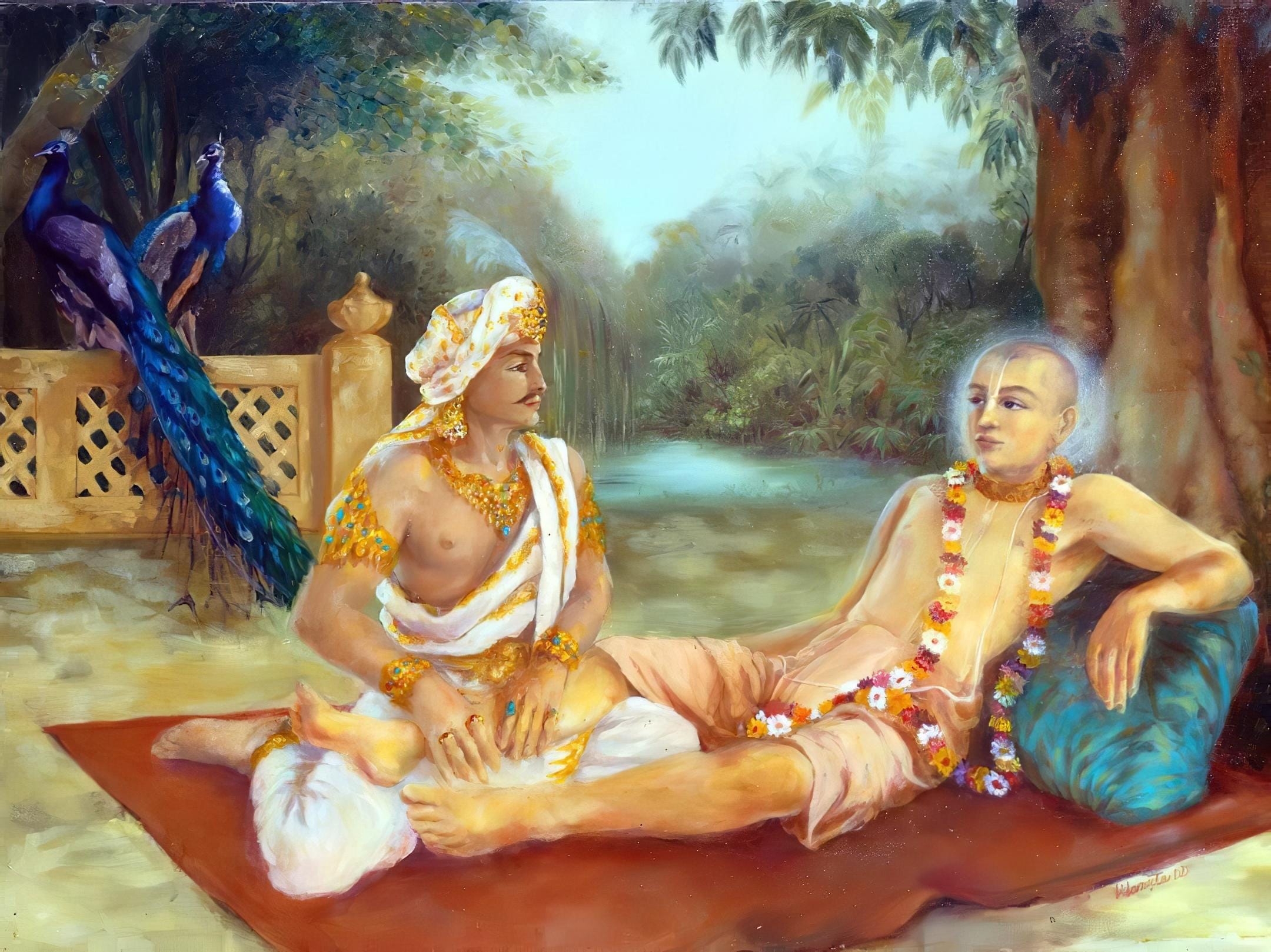
Mahārāja Pratāparudra was a very powerful king who ruled over the region of Orissa from 1497 to 1540 CE, which included the whole period Śrī Caitanya Mahāprabhu performed His pastimes. He was the Gajapati (first servant) of Lord Jagannātha at Puri, acting not only as a king but as the chief patron for Jagannātha’s temple. During his entire reign, he checked the expansion of the Mughals in Orissa, preventing them from disturbing the pastimes of the Lord. On top of all that, he was a pure devotee of the Lord, who was eager to serve Him. In SB 2.3.21, Śrīla Prabhupāda mentions:
“Mahārāja Pratāparudra, the greatly powerful king of Orissa, was always very busy with heavy state responsibilities, yet he made it a point to sweep the temple of Lord Jagannātha at Purī once a year during the festival of the Lord. The idea is that however important a man one may be he must accept the supremacy of the Supreme Lord. This God consciousness will help a man even in his material prosperity. Mahārāja Pratāparudra’s subordination before Lord Jagannātha made him a powerful king, so much so that even the great Pathan in his time could not enter into Orissa on account of the powerful Mahārāja Pratāparudra. And at last Mahārāja Pratāparudra was graced by Lord Śrī Caitanya on the very grounds of his acceptance of subordination to the Lord of the universe. So even though a rich man’s wife has glittering bangles made of gold on her hands, she must engage herself in rendering service to the Lord.”
However, despite all these qualifications, when Sārvabhauma Bhaṭṭācārya pleaded with Śrī Caitanya Mahāprabhu to meet him, the Lord flatly rejected it, arguing that meeting with a king who is engaged in material activities would be just like drinking poison. He warned that if such requests continued, He would leave Jagannātha Purī altogether. In this way, the matter was completely closed. No one dared to mention it again.
The turning point came from a different direction. Later, Rāmānanda Rāya returned to Jagannātha Purī after being released from the government service. He came directly to meet Mahāprabhu before even seeing Jagannātha. In the course of their exchange, he explained what had happened when he informed Mahārāja Pratāparudra that he wished to retire from political life and dedicate himself to the service of Śrī Caitanya Mahāprabhu. Instead of resisting, the king became deeply pleased upon hearing Mahāprabhu’s name. He rose from his throne, embraced Rāmānanda Rāya, showed symptoms of devotion, granted him a full pension without reduction, and requested him to serve Mahāprabhu without anxiety. In this way, the king revealed that he was not an ordinary ruler interested in prestige but a sincere admirer of the Lord and a genuine well-wisher of His devotees. This deeply impressed Mahāprabhu.
Rāmānanda Rāya then went further, describing how Mahārāja Pratāparudra considered himself fallen and unfit to receive the Lord’s audience. The king was not demanding a royal privilege; he was lamenting in humility. He said that Śrī Caitanya Mahāprabhu is Kṛṣṇa Himself, the son of Mahārāja Nanda, and that if in this life he could not receive the Lord’s audience, perhaps in some future birth he might be allowed to do so. Rāmānanda Rāya even declared that he did not think he possessed even a fraction of the loving ecstasy found in Mahārāja Pratāparudra. Previously, Śrī Caitanya Mahāprabhu had discussed with Rāmānanda Rāya the devotional sentiment of the Gōpis. Mahāprabhu accepted Rāmānanda Rāya as the most trusted and loved associate. Therefore, this was a powerful testimony.
Here, the mood of the pastime changes. Before, Sārvabhauma Bhaṭṭācārya had advocated for the king, but Mahāprabhu did not accept the request from that angle. Being a king or demigod is not a qualification to meet the Lord. If anything, it is a disqualification, because the higher the position, the more one will be prone to being proud.
However, when Rāmānanda Rāya spoke, the situation became different. This was no longer a mere attempt to arrange a meeting. Now, Mahāprabhu was hearing from a highly exalted devotee that the king was sincere, humble, devoted, and dear to him. The king had become dear to Rāmānanda Rāya through his conduct, and therefore, his case acquired a different spiritual weight.
Mahāprabhu’s reply reveals exactly what convinced Him. He told Rāmānanda Rāya, “You are the foremost of all the devotees of Kṛṣṇa; therefore whoever loves you is certainly a very fortunate person.” He then added, “Because the King has shown so much love for you, Lord Kṛṣṇa will certainly accept him.”
Of course, Mahāprabhu is Kṛṣṇa Himself; therefore, “Lord Kṛṣṇa will certainly accept him” effectively means that He Himself had internally agreed. The external meeting had not yet happened, but the decision had been made. The pastime was now in motion.
He quoted the Ādi Purāṇa: “[Lord Kṛṣṇa told Arjuna:] ‘Those who are My direct devotees are actually not My devotees, but those who are the devotees of My servant are factually My devotees.’”
One cannot properly approach the Supreme Lord independently of His pure devotees. A person may cultivate spirituality on his own and progress to some extent, but entrance into a personal relationship with the Lord comes through the mercy of devotees. Therefore, Mahārāja Pratāparudra’s direct desire to meet Mahāprabhu did not, by itself, bring success. What brought success was that he became dear to Rāmānanda Rāya. Once that happened, access to Mahāprabhu opened.
The king’s humility and determination also played an essential role. When Sārvabhauma Bhaṭṭācārya later informed him that the Lord had refused to see a king, Mahārāja Pratāparudra did not become offended. He did not react with royal pride. Instead, he lamented that Śrī Caitanya Mahāprabhu had descended to deliver all kinds of fallen souls and lamented that he alone would remain excluded. He considered his kingdom, body, and worldly position useless without the Lord’s mercy. He even declared that if he could not obtain Mahāprabhu’s mercy, he no longer wished to continue living. This determination astonished Sārvabhauma Bhaṭṭācārya, because such intensity is not expected from a worldly monarch surrounded by wealth and power.
A king usually has many opportunities for material enjoyment, and therefore, one would not expect such deep renunciation or humility, much less ecstatic sentiments. Still, Pratāparudra regarded all material facilities as worthless if they did not culminate in Mahāprabhu’s mercy. Sārvabhauma Bhaṭṭācārya recognized from this that the king’s devotion was genuine. He then assured him that because of his firm determination, Mahāprabhu’s mercy would certainly come. He understood that the Lord is conquered not by position, but by pure love.
The mercy of the spiritual master and Kṛṣṇa work together. Sārvabhauma Bhaṭṭācārya, acting as the king’s spiritual guide, blessed him and affirmed that Mahāprabhu would be merciful. Because Mahārāja Pratāparudra had faith in the Bhaṭṭācārya and accepted Mahāprabhu as the Supreme Lord, he began worshiping Him internally. Thus, his approach was no longer political, external, or self-seeking. It became the approach of a devotee, grounded in humility, dependence, and the mediation of advanced Vaiṣṇavas.
So, how did Mahāprabhu get convinced to meet Mahārāja Pratāparudra? Not by diplomacy, and not by insistence. He was convinced by the king’s love for His devotee, Rāmānanda Rāya, by the king’s genuine humility, and by his intense desire for mercy. At first, the king wanted to meet Mahāprabhu and was rejected, because being a king is no qualification to meet the Lord. Later, however, through service to Rāmānanda Rāya and deepening humility, he became the kind of person whom Mahāprabhu was willing to meet. That was the real transformation. The Lord did not simply change His mind arbitrarily. The king approached Him in the proper way: through the devotees, with surrender, and without pride. That’s how the impossible became possible.
This is a publication for thoughtful readers who want to go deeper into Kṛṣṇa consciousness. I publish daily, trying to offer high-quality spiritual content, and all posts are available to free subscribers. If you wish, you can also choose a paid subscription to support this work.
You can also receive the updates on WhatsApp or Telegram.
If you would like to contribute further, you can find the donation links here.
Thank you for Article
Very inspiring for developing devotional service
Such an uplifting Pastime of Bhagvan Sri Sri Chaitanya Mahaprabhu and His dear Devotee Maharaja Prataprudra