

When we study the Śrīmad-Bhāgavatam, we are faced with a description of the universe that sounds challenging, to say the least. In the description of Śukadeva Gosvami, the universe is divided into 14 planetary systems, and we live in the 7th one from top to bottom: Bhū-loka.
Our planetary system is then described as being composed of a structure of cosmic islands called Bhū-mandala that don’t fit anything we can see when we look to the sky.
Taking the description literally, our planetary system is supposed to look something like this:
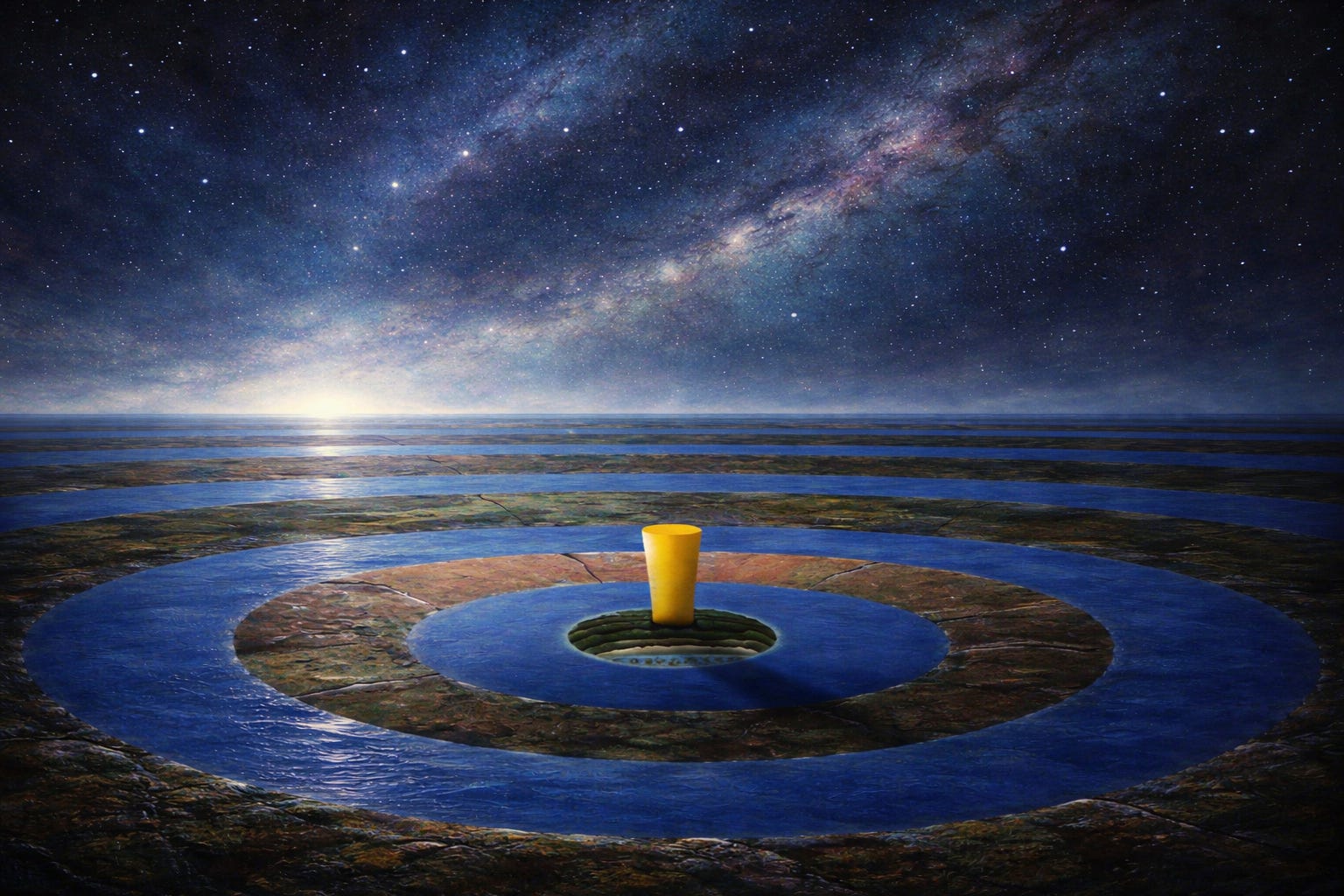
This, however, is not what we see when we look to the sky. How to understand that?
In his purports, Prabhupāda concludes that Bhū-mandala is not formed by solid islands but is in reality formed by different planets, compared with islands floating in space. The islands that compose Bhū-mandala thus describe the general positions or orbits of these planets. They are not exactly solid blocks of land.
Another point is that the model is multidimensional. For example, it is described that below the orbit of Rāhu, there are planetary abodes of the Siddhas, Cāraṇas, and Vidyādharas, the lower demigods. These planets are very close to us in the Vedic model, less than 10,000 yojanas (80,000 miles) above, but they are invisible to us. Between these abodes and our planet are the subtle realms of the Yakṣas, Rākṣasas, Piśācas, and evil spirits, which start in the upper atmosphere. However, we can’t see any of these abodes. For us, these regions are composed of just rarefied air. This indicates that their bodies and their abodes are composed of some sort of subtle matter that we can’t interact with in our current bodies. The same appears to apply to the rest of Bhū-mandala, as well as the abodes of the demigods. These are all higher-dimensional abodes we don’t have direct access to.
Śrīla Bhaktisiddhānta Sarasvatī Ṭhākura provided many details about the Vedic model of the universe in his Siddhānta-śiromaṇi, his early work on Vedic astronomy. In his purport to CC Madhya 20.218, Prabhupāda quotes two verses that provide details on the islands that form Bhū-mandala and the varṣas that compose Jambūdvīpa:
“The seven islands are mentioned in the Siddhānta-śiromaṇi:
bhūmer ardhaṁ kṣāra-sindhor udak-sthaṁ
jambu-dvīpaṁ prāhur ācārya-varyāḥ
ardhe ’nyasmin dvīpa-ṣaṭkasya yāmye
kṣāra-kṣīrādy-ambudhīnāṁ niveśaḥśākaṁ tataḥ śālmalam atra kauśaṁ
krauñcaṁ ca gomedaka-puṣkare ca
dvayor dvayor antaram ekam ekaṁ
samudrayor dvīpam udāharantiThe seven islands (dvīpas) are known as (1) Jambu, (2) Śāka, (3) Śālmalī, (4) Kuśa, (5) Krauñca, (6) Gomeda, or Plakṣa, and (7) Puṣkara. The planets are called dvīpas. Outer space is like an ocean of air. Just as there are islands in the watery ocean, these planets in the ocean of space are called dvīpas, or islands in outer space. There are nine khaṇḍas, known as (1) Bhārata, (2) Kinnara, (3) Hari, (4) Kuru, (5) Hiraṇmaya, (6) Ramyaka, (7) Ilāvṛta, (8) Bhadrāśva and (9) Ketumāla. These are different parts of Jambūdvīpa. A valley between two mountains is called a khaṇḍa or varṣa.”
He continued this description later, on his purport to CC Antya 2.10:
“In the Siddhānta-śiromaṇi, chapter one (Golādhyāya), in the Bhuvana-kośa section, the nine khaṇḍas are mentioned as follows:
aindraṁ kaśeru sakalaṁ kila tāmraparṇam
anyad gabhastimad ataś ca kumārikākhyam
nāgaṁ ca saumyam iha vāruṇam antya-khaṇḍaṁ
gāndharva-saṁjñam iti bhārata-varṣa-madhye“Within Bhārata-varṣa, there are nine khaṇḍas. They are known as (1) Aindra, (2) Kaśeru, (3) Tāmraparṇa, (4) Gabhastimat, (5) Kumārikā, (6) Nāga, (7) Saumya, (8) Vāruṇa and (9) Gāndharva.”
In this way, Bhū-mandala, the intermediate planetary system, is composed of seven dvīpas: (1) Jambu, (2) Śāka, (3) Śālmalī, (4) Kuśa, (5) Krauñca, (6) Plakṣa, and (7) Puṣkara. Based on the description of the Śrīmad-Bhāgavatam (with the dvipas being separated in distinct tracts of land with particular features), each of these dvīpas appears to be a collective of numerous planets. We live in the central island, Jambūdvīpa, which is also subdivided into smaller tracts of land: (1) Bhārata-varṣa, (2) Kinnara-varṣa (Kimpuruṣa), (3) Hari-varṣa, (4) Kuru-varṣa (Uttarakuru), (5) Hiraṇmaya-varṣa, (6) Ramyaka-varṣa, (7) Ilāvṛta-varṣa, (8) Bhadrāśva-varṣa and (9) Ketumāla-varṣa. Each of these divisions also appears to be formed by several planets, so we can’t say how many planets in total form Bhū-mandala.
Our planet is part of Bhārata-varṣa, which is, in turn, subdivided into nine smaller tracts of land: (1) Aindra, (2) Kaśeru, (3) Tāmraparṇa, (4) Gabhastimat, (5) Kumārikā, (6) Nāga, (7) Saumya, (8) Vāruṇa, and (9) Gāndharva.
This explains the differences in size between our planet and the description of Bhārata-varṣa. The equatorial circumference of our planet is about 24,901 miles (3,113 yojanas), while Bhārata-varṣa is described as being 9,000 yojanas north to south 80,000 yojanas east to west. If we consider our planet as just one of the nine divisions of Bhārata-varṣa, the description makes perfect sense.
This is a publication for thoughtful readers who want to go deeper into Kṛṣṇa consciousness. I publish daily, trying to offer high-quality spiritual content, and all posts are available to free subscribers. If you wish, you can also choose a paid subscription to support this work.
You can also receive the updates on WhatsApp or Telegram.
If you would like to contribute further, you can find the donation links here.
Hare Kṛṣṇa prabhu
All glories to Śrīla Prabhupāda
Nice article actually
It's generally said that elites who controlling this world are reptilians. Enough proof is out there online, which proves these things that they aren't humans but reptilians. Regarding the naga section of bharata varsa it seems they have access to our region but we don't have or we are restricted by elite forces. There is great fuss Abt great ice wall of antartica. Maybe we have the access but aren't allowed to explore. Admiral Richard byrd is live eg of exploring the other rigions of Bharata varsa. Just an opinion. You may pls correct.
Hare Kṛṣṇa
Jai Śrīla Prabhupāda