

Subscribe to receive all new articles directly by e-mail. It’s free, but if you like, you can pledge a monthly or annual donation to support my work. There is also Telegram.
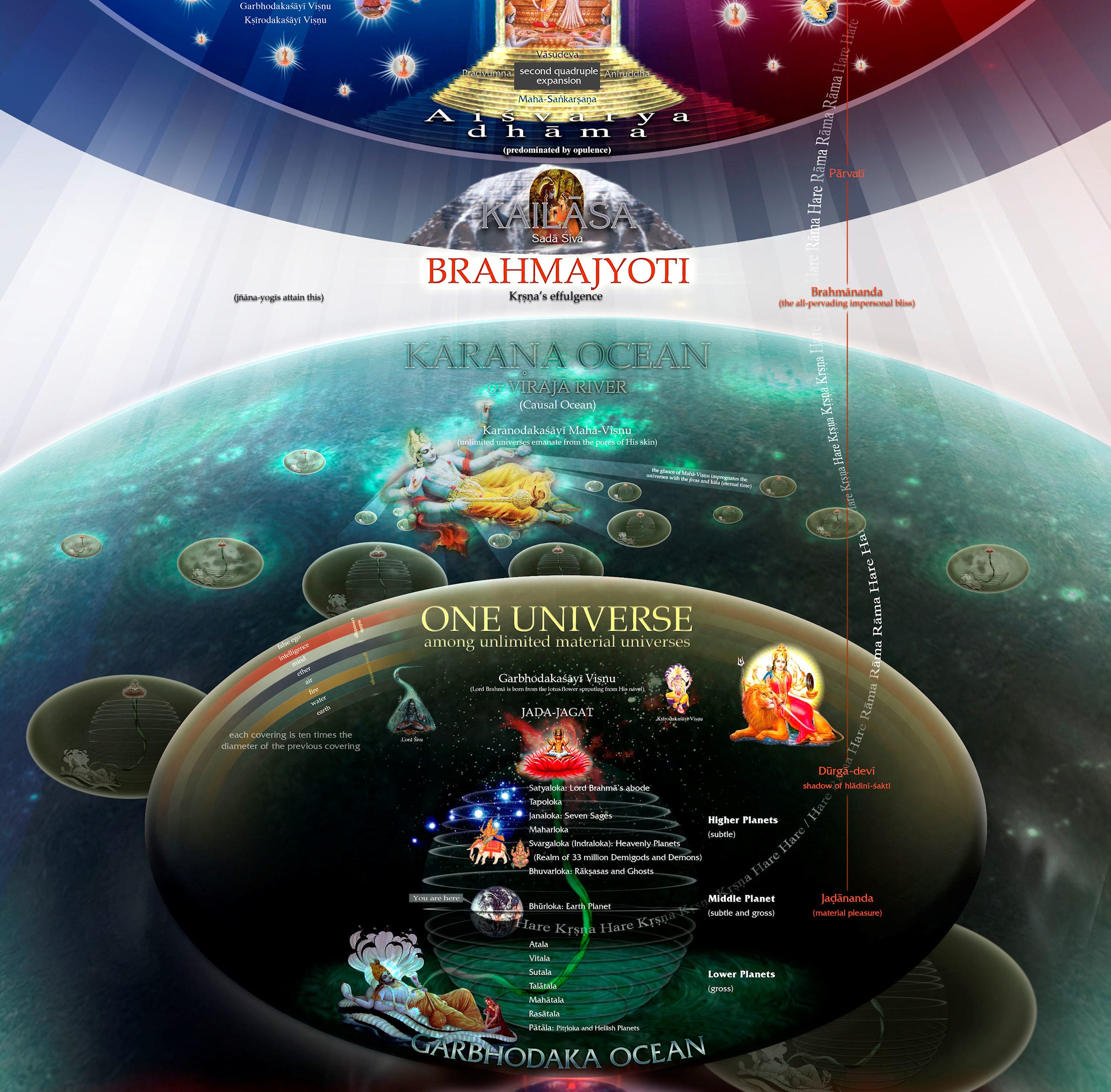
We may think that our universe is very vast and comprises everything that exists, but in fact, there are many universes floating on the causal ocean. They are called brahmāṇḍas (cosmic eggs). Just as in a coconut, half of the space inside each universe is filled with water. This is, however, not regular water we can detect with our telescopes, but subtle water, over which Lord Garbhodakaśāyī Viṣnu lies on the bed of Śeṣa-nāga. The other half is empty; that’s the space where the cosmic manifestation happens.
This is, however, a tiny portion of the whole universe. The central space occupied by the creation of Brahmā is just the central part of the universe. This core is covered by seven layers of primordial elements.
The first layer, composed of elemental earth, is ten times the diameter of the universe itself. The second layer, composed of elemental water, has ten times the diameter of the earth layer, and so on. After passing the first five coverings, composed of the five elements, one reaches the 6th covering, composed of mahat-tattva, the total material energy. After passing it, there is still the layer composed of false ego, the first and the subtlest of all material elements.
With each of the seven layers being exponentially greater than the previous, the total size of the universe is practically incalculable.
However, from the perspective of Mahā-Viṣnu, the universes are very small. From His perspective, all the universes clustered together appear like atoms in a huge combination that are constantly created and destroyed, following His cycles of inhalation and exhalation. Thus, not only do we live for an insignificant amount of time, but we are also incredibly small on the universal scale.
There are not many details about the coverings of the universe in the Śrīmad-Bhāgavatam. They are just briefly mentioned in a few passages. However, we can find a first-hand account in the Bṛhad-bhāgavatāmṛta, where Gopa-kumāra travels through the coverings and describes what he experienced there. This brings us a better understanding of these elemental coverings.
“The first covering I entered was that of earth. There I saw the Supreme Lord in the form of a great boar being worshiped by the goddess Earth, the deity presiding over that covering and its wealth. She worshiped Him with riches not to be obtained within the universe itself, while all the opulences of the universe whirled within every pore of His body. Within the goddess Earth, who embodies the subtle causes of creation, I saw the creation itself, with all its ingredients.
After she finished worshiping the Lord, the goddess honored me as her guest and begged me to remain there to enjoy for a few days. Taking her leave, I quickly crossed beyond that covering, as if pulled by some force, and reached the other six. One after another, I saw Lords Matsya, Sūrya, Pradyumna, Aniruddha, Saṅkarṣaṇa, and Vāsudeva, each with one of the great manifested deities of those coverings worshiping Him with the element over which that deity presided — water, fire, air, ether, ego, or mahat. Each covering was the subtle cause of the one before it, and had a greater object of worship, a greater worshiper, and greater sense gratification, opulence, and importance.
As before, I crossed over each of these coverings, and finally came to the covering made of primordial nature. Composed of the most subtle form of ignorance, it was dark blue, and attractive to the eyes and mind. Seeing spread everywhere a color like that of my worshipable Lord, I was very much delighted. I had no desire to go further.
As I arrived, the goddess Prakṛti had just finished the worship of her Lord, the Lord of that region, the refulgent Śrī Mohinī-mūrti. The goddess at once approached me in her own superlative form. She offered me gifts such as aṇimā-siddhi and other great yogic powers. And like the goddess Earth and the other deities, she asked me to stay. She sweetly told me, “If you want to achieve your goal of liberation, then please be kind to me, because I am the bestower of liberation. “Or if you want devotion to Viṣṇu, still you should be kind and worship me, the giver of devotion, for I am His maidservant, His sister, and the embodiment of His energy.”
Declining all these enticements, understanding them to be the potency of Lord Viṣnu, I bowed down to the goddess and then wandered for a while to see that beautiful-colored region. That place was delightful and self-luminous, splendid with the most excellent wonders. Enjoying it were multitudes of living entities, their bodies made of primordial matter. It was inconceivable, utterly enchanting in opulence, and displaying many forms all at once. The whole material creation dwelt within it, with all the elements of creation, subtle and gross. By the desire of the Lord, I then crossed beyond that vast region of dense ignorance and came to a place flooded with a light so brilliant, so unbearably beyond looking at, that it forced me to close my eyes. With utmost devotion I struggled to look ahead. And then I saw the Supreme Lord, effulgent like millions of suns.”
In the first cover, Gopa-kumāra met Bhūmi Devi, worshiping Lord Varāha. This is the primordial Bhūmi, who expands herself into the Bhūmi who is the predominating deity of the earth. From there, he met an even more exalted ruler, worshiping a different form of the Lord. Moving to each successive covering, we get closer to the spiritual realm, and thus, in each covering, the Lord reveals more of His transcendental opulences.
In the first covering, the Lord appears as Varāha, in the second as Matsya, in the third as Sūrya, and then as Pradyumna, Aniruddha, Saṅkarṣaṇa, and Vāsudeva. In each covering, a different predominating deity, a manifestation of one of His eternal potencies, worships Him in full devotion.
After passing through the seven coverings, he reached pradhāna, the original potency of unmanifested matter. That’s the original potency of the Lord, from which comes the mahat-tattva. There, he met Prakṛti herself, worshiping the Lord in the form of Śrī Mohinī-mūrti. She appears in the lila as Subhadrā, the sister of the Lord, who helps devotees to advance in devotional service.
After passing through pradhāna, Gopa-kumāra finally reached the luminous part of the creation, where he got the darśana of Lord Mahā-Viṣnu.
In this way, the first misconception about the coverings of the universe is that they are just solid blocks of solid rock or layers of water or lava. The second is that they are sterile, uninhabited spaces.
The coverings are composed of primordial matter. It is still matter, but not matter in the sense we normally understand it. Practically speaking, it is considered matter in the sense that it has certain properties that are experienced by the inhabitants, but not matter in the sense of being composed of atoms. One example that can be given is that objects in the celestial planets are still composed of matter, but it is some kind of subtle matter that we can’t see or touch. The matter in the coverings is still subtler than in the celestial planets. It can be experienced by people who obtain bodies composed of the same type of matter, but not by us.
We can see that Gopa-kumāra’s experience is of each covering being a separate world, with a predominating deity, a different form of the Lord being worshiped, and a different set of objects and experiences that can be enjoyed.
You can also donate using Buy Me a Coffee, PayPal, Wise, Revolut, or bank transfers. There is a separate page with all the links.
Hare Krishna!
Please accept my humble obeisances.
All glories to Srila Prabhupada!
Fantastic description of the universe and material existence! The unimaginable thickness of each element that covers just one of the many universes emanating from Maha Vishnu truly makes me think how small and insignificant I am :-)
Srila Prabhupada argued that human beings could not have gone to the moon because, according to Vedic literature (specifically Srimad-Bhagavatam), the moon—or Chandraloka—is a higher-dimensional, most likely in Svargaloka.
Prabhuji, I have read about the Vedic cosmology, but couldn’t grasp the scale and structure of the bhu-mandala. Apparently, Vedic astrology as described in Brihat Parashara Hora Shastra views the planetary positions similar to current and modern astronomy. Moon in the modern astronomy is orbits Earth in about 27.3 days (a tropical month and a sidereal month). And based on this understanding, the auspicious events and days are calculated in the Vaishnava calendar. If Chandra is located in Svargaloka, how can it orbit the planet earth? I am a little confused… Could you please kindly explain?
Happy Gaura Purnima!
Your servant,
Rama Raghava dasa