

Subscribe to receive new articles by e-mail. It’s free, but if you like, you can pledge a donation:
Prahlāda’s father, Hiraṇyakaśipu, was originally the ruler of Sutala-loka, one of the subterranean heavens. We often think of the lower planets as miserable places, but this is not entirely true. Although they certainly include miserable places, they also include the Bila-swarga, which are very opulent places, where pious demons live. Hiraṇyakaśipu, for example, practiced great austerities, which gave him great power and material opulence. Similarly, other demons, although envious of Viṣnu and His devotees, often attain positions of great opulence by practicing austerities or honoring the brāhmanas.
In this way, after practicing his austerities and receiving the boons of Brahmā, Hiraṇyakaśipu defeated the demigods and became the ruler of the three worlds. This happened in the sixth Manvantara, after Hiranyākṣa was defeated by Lord Varāha. When he became inimical to Prahlāda and tried to kill him, the Lord appeared as Nṛsiṁhadeva from the pillar to put an end to his life.
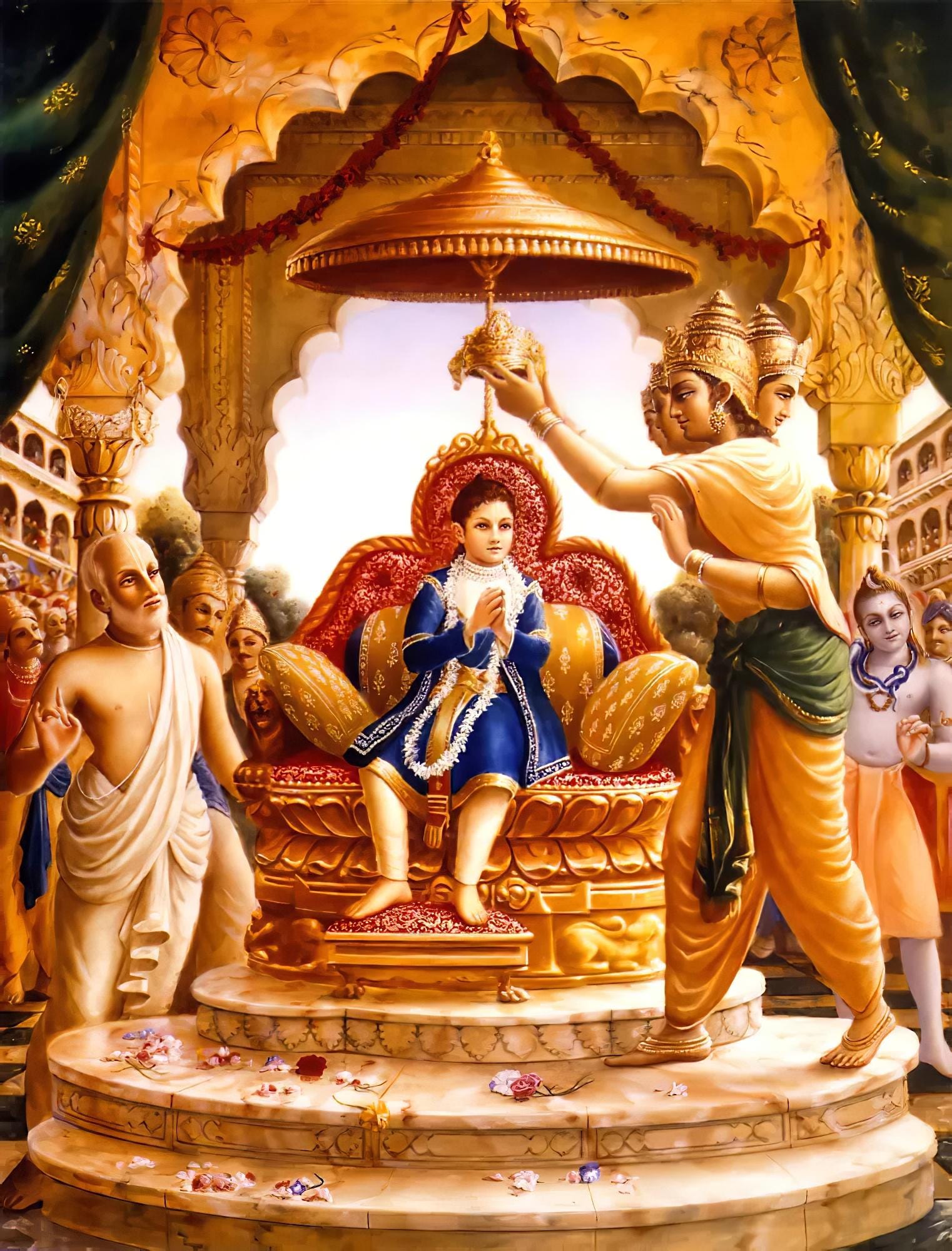
The celestial planets were then returned to the demigods, and Prahlāda Maharaja was installed as the ruler of the demons, ruling over the lower planetary systems as a saintly king until the end of the 6th Manvantara (as described on SB 7.10.11). Later, he passed the rulership to his son, Virocana, and eventually to Bali Maharaja, his grandson.
Bali Maharaja was able to defeat the demigods during the 7th Manvantara, which led to the appearance of Vāmanadeva, who took everything from him, under the pretext of begging for three steps of land. Bali Maharaja was a disciple of Śukrācārya, the guru of the demons, who was more of a caste brāhmana. However, because of the association of Prahlāda, he was a pure devotee, and rejected Śukrācārya when he instructed him not to give the three planetary systems to the Lord when He asked.
After covering the three planetary systems with His first two steps and piercing the coverings of the universe, the Lord blessed Bali Maharaja by placing His third step on his head. A settlement was thus reached: the rule of the celestial planets was returned to Purandara (the current Indra), and Bali Maharaja was again installed as the king of the lower planetary systems, ruling from Sutala. Being so satisfied with him, the Lord remains as his doorman, protecting him from all danger. When Rāvana tried to invade the lower planetary system, for example, the Lord kicked him, sending him very far away.
Because Bali Maharaja had the desire to be the ruler of the three planetary systems, the Lord decided that he will become Indra in the next Manvantara (the 8th), succeeding Purandara, the current one. In this way, a settlement was reached, satisfying everyone.
What about Prahlāda Maharaja? On SB 7.10.12, Lord Nṛsiṁhadeva instructed him that, “It does not matter that you are in the material world. You should always, continuously, hear the instructions and messages given by Me and always be absorbed in thought of Me, for I am the Supersoul existing in the core of everyone’s heart. Therefore, give up fruitive activities and worship Me.”
Prahlāda was surely worshiping the Lord while ruling the lower planetary systems, giving his association to the demons, so they could also be delivered. We can see that not only is Bali a pure devotee, but other members of the family also came to eventually attain a platform of pure devotional service. The Garga-saṁhitā, for example, reveals that Pūtanā was, in her previous life, Ratnamālā, the daughter of Bali Maharaja. It is described that she felt affection for Lord Vāmana when he entered the assembly of Bali Maharaja, and desired to be his mother, but angered by the Lord taking all the possessions of His father, she vowed to kill Him if she would become his mother. This mixture of devotion and anger led her to take her next birth as the demoness Pūtanā, coming to Kṛṣṇa with the purpose of killing Him, but ending up being accepted as His mother because she fed Him with her breast. The Lord thus freed her from her demoniac nature by killing her, allowing her devotional maternal attitude to manifest, and granting her a position in Goloka Vṛndāvana as one of the assistants of mother Yaśodā.
What happened to Prahlāda after he relinquished the rulership of the lower planets at the end of the previous Manvantara? Srimad Bhagavatam 5.18.7 explains that he continues to worship the Lord in Hari-varṣa (one of the nine tracts of land that compose Jambudwipa), along with his servants and all inhabitants, where the Lord is present in His deity form as Nṛsiṁhadeva.
His devotional sentiments are also described in the Bṛhad-bhāgavatāmṛta, where he meets with Nārada Muni and reacts to his praise:
“I have never performed any real service for the Lord like Hanumān and others. I have only remembered the Lord sometimes, when my mind was troubled. You praise me because He caressed me and showed other signs of affection. But some consider such affectionate behavior merely a false show of Māyā, and others just a display of His pastimes.” (BB 1.4.20-21)
“We can say that by your mercy the Supreme Lord developed some love for me and so I appear glorious. But my greatness is just like a tiny speck before the heaps of mercy the Lord bestows on His newer devotees. O Nārada, your heart overflows with causeless compassion. Why should I go on describing all my misfortunes, which simply make you unhappy? Instead please consider the Lord’s mercy on Hanumān of the Kimpuruṣas. (BB 1.4.36-37)
Prahlāda Maharaja is the topmost devotee, but in his humility he refuses to be acknowledged as the recipient of the Lord’s mercy, and instead sends Nārada to meet Hanumān in Kimpuruṣa‑varṣa, who in turn sends him to the Pāṇḍavas in Hastināpura. In this way, Nārada traveled all over the universe to finally understand the excellence of the selfless devotional mood of the inhabitants of Vṛndāvana, especially the supreme devotion of the Gopis.
You can also donate using Buy Me a Coffee, PayPal, Wise, Revolut, or bank transfers. There is a separate page with all the links. This helps me enormously to have time to write instead of doing other things to make a living. Thanks!