


You can receive new articles directly in your inbox. Subscription is free; donations are welcome.
In the 6th chapter of the Gītā, Kṛṣṇa explains the process of mystic yoga, which is based on fixing the mind. In reality, all processes of self-realization are based on controlling the mind (as we can also notice in the process of Kṛṣṇa consciousness); therefore, the words of Kṛṣṇa are broader than we may originally think.
Arjuna then raises his objection: the process of mystic yoga is not suitable for modern people, who are full of anxieties and are not serious about self-realization, and he himself admits his incapacity to perfectly follow this system.
Kṛṣṇa agrees that the mind is indeed difficult to control but insists that it can be subdued through suitable practice and detachment. The higher meaning is that one can control the mind through the process of Kṛṣṇa consciousness, which Kṛṣṇa will explain in detail starting from chapter seven.
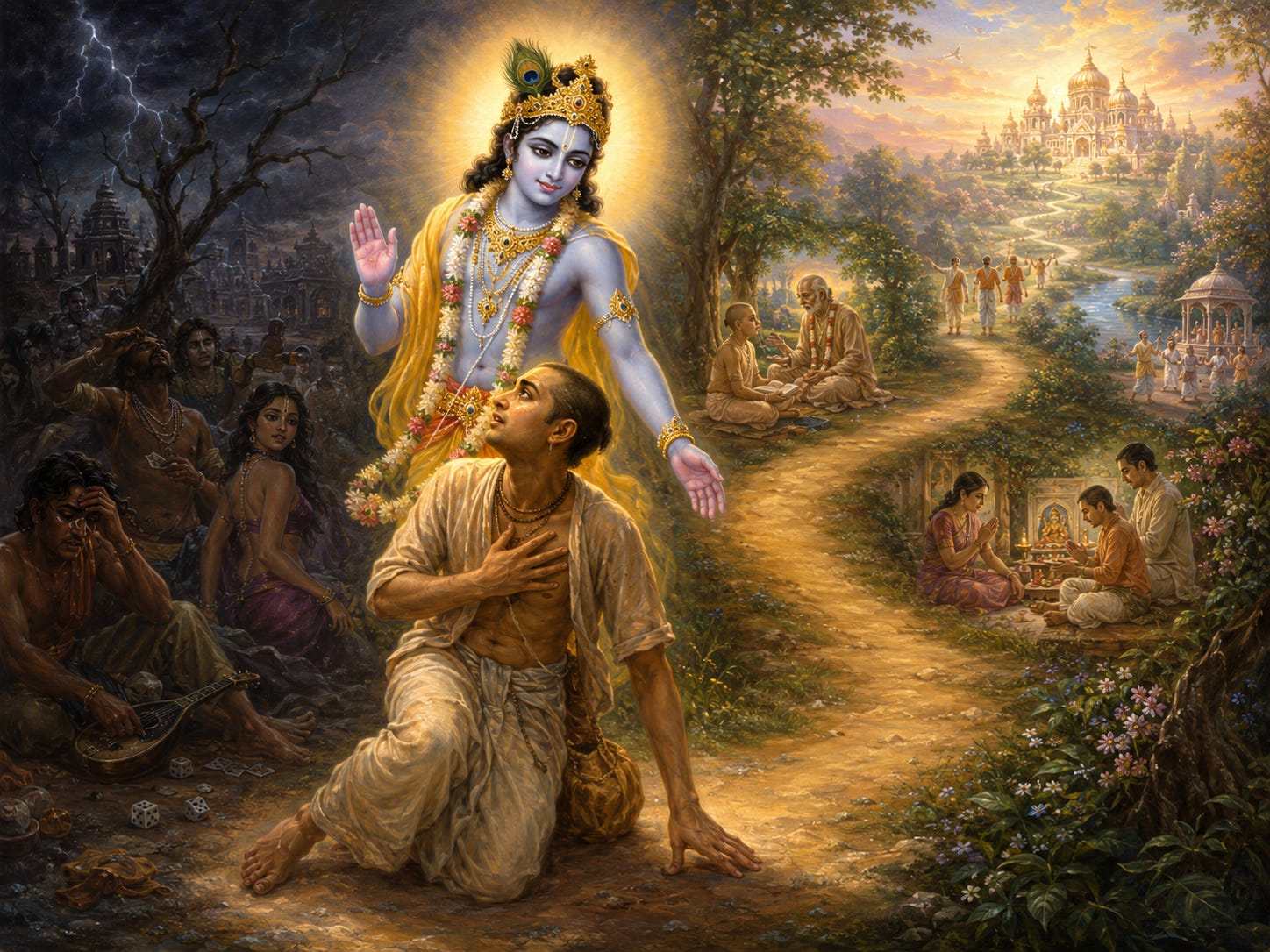
Arjuna then asks a very intelligent question: What happens to a person who commits to the spiritual process but falls later? Does he still benefit somehow, or does one just end up losing both the chance of self-realization and material happiness?
“Arjuna said: O Kṛṣṇa, what is the destination of the unsuccessful transcendentalist, who in the beginning takes to the process of self-realization with faith but who later desists due to worldly-mindedness and thus does not attain perfection in mysticism?
O mighty-armed Kṛṣṇa, does not such a man, who is bewildered from the path of transcendence, fall away from both spiritual and material success and perish like a riven cloud, with no position in any sphere? This is my doubt, O Kṛṣṇa, and I ask You to dispel it completely. But for You, no one is to be found who can destroy this doubt.”
In traditional Vedic culture, people would perform fruitive activities with the goal of improving their material position, just as in modern life, people study and work. A transcendentalist, however, abandons this pursuit to dedicate himself to the spiritual path. It seems thus that if one is unsuccessful, one loses in both ways, achieving neither material nor spiritual success.
Kṛṣṇa answers emphatically that, “a transcendentalist engaged in auspicious activities does not meet with destruction either in this world or in the spiritual world; one who does good, My friend, is never overcome by evil.”
The synonyms given by Prabhupāda give us additional detail. The word iha means “in this life” or “in this world,” while amutra means “in the next life” or “in the next world.” Vināśaḥ means “destruction” and durgatim “to degradation.”
Together, these words result in a very broad meaning, indicating the extent of the protection of the Lord. A devotee, even if unsuccessful, faces no destruction or degradation, neither in this life, in the next life, nor in any other life. This leads to Prabhupāda translating amutra as “in the spiritual world” in the main translation. The devotee is thus protected while still in the material world, and, once attaining liberation, is also protected from spiritual annihilation by merging into the impersonal Brahmajyoti. A devotee who serves Kṛṣṇa is thus guaranteed to eventually attain the service of the Lord in one of the spiritual planets.
How is it that a devotee is protected against degradation? We can see many examples of devotees who, after some time, stop their practice and fall again into worldly life. There are two verses that can help us to understand:
“Even if one commits the most abominable action, if he is engaged in devotional service he is to be considered saintly because he is properly situated in his determination.” (Bg 9.30)
“My dear Vyāsa, even though a devotee of Lord Kṛṣṇa sometimes falls down somehow or other, he certainly does not undergo material existence like others [fruitive workers, etc.] because a person who has once relished the taste of the lotus feet of the Lord can do nothing but remember that ecstasy again and again.” (SB 1.5.19)
These two verses make clear that the situation of a devotee who sincerely serves Kṛṣṇa for some time, but later falls, is not the same as that of a materialist. Prabhupāda explains this point in his purport:
“There are certainly many instances where devotees of the Lord have fallen down due to uncongenial association, just like fruitive workers, who are always prone to degradation. But even though he falls down, a devotee is never to be considered the same as a fallen karmī. A karmī suffers the result of his own fruitive reactions, whereas a devotee is reformed by chastisement directed by the Lord Himself. The sufferings of an orphan and the sufferings of a beloved child of a king are not one and the same. An orphan is really poor because he has no one to take care of him, but a beloved son of a rich man, although he appears to be on the same level as the orphan, is always under the vigilance of his capable father.”
A materialist is alone, suffering the reactions of his previous activities, while a devotee, even in his fallen position, remains under the protection of the Lord, who continues to make plans to save him. The son of a wealthy man who ran away from home may meet an orphan in the street, but their situations are not the same.
We can find another example in the 6th canto of Śrīmad-Bhāgavatam, in the story of Ajamila. Even though he fell with a prostitute, he was later saved by the transcendental arrangement of the Lord, and returned home, back to Godhead, at the end of his life.
Prabhupada reinforces this same point in his purport by quoting SB 1.5.17:
“If someone gives up all material prospects and takes complete shelter of the Supreme Personality of Godhead, there is no loss or degradation in any way. On the other hand a nondevotee may fully engage in his occupational duties and yet not gain anything.”
In this way, Prabhupāda translates na hi kalyāṇa-kṛt kaścid durgatiṁ tāta gacchati as “one who does good, My friend, is never overcome by evil.” A devotee may lose a few battles, like in the case of Ajamila, but ultimately, these are temporary difficulties. Once one comes to the service of Kṛṣṇa, there is no possibility of being unsuccessful. Any defeat is only temporary.
Another significant word used in the verse is kalyāṇa-kṛt (one who is engaged in auspicious activities). This is how Kṛṣṇa defines the devotee or transcendentalist who is protected from destruction or degradation. Kalyāṇa-kṛt means “one who is engaged in auspicious activities,” but, as Prabhupāda explains in the last paragraph of his purport, this doesn’t apply to worshippers of demigods and performers of other Vedic auspicious activities. “Auspicious” in this context means spiritual activities that bring us to Kṛṣṇa, or devotional service. “Transcendentalist” in the context of the verse, thus, means “devotee.” A devotee may be directly serving Kṛṣṇa, or may be meditating on Him while following the path of mystic yoga. In both cases, he or she is protected, regardless of which specific process one is following.
“Activity in Kṛṣṇa consciousness is the only auspicious activity, and anyone who voluntarily accepts all bodily discomforts for the sake of making progress on the path of Kṛṣṇa consciousness can be called a perfect transcendentalist under severe austerity. And because the eightfold yoga system is directed toward the ultimate realization of Kṛṣṇa consciousness, such practice is also auspicious, and no one who is trying his best in this matter need fear degradation.”
In this way, the literal meaning of text 6.40 is “Son of Pṛthā, a devotee does not meet with destruction either in this life, or in the next life. One who is engaged in devotional service never faces degradation.”
Prabhupāda gives the higher meaning in his translation, adding also the point that a devotee does not face the risk of impersonal liberation, and that any defeat in the process is temporary: “The Supreme Personality of Godhead said: Son of Pṛthā, a transcendentalist engaged in auspicious activities does not meet with destruction either in this world or in the spiritual world; one who does good, My friend, is never overcome by evil.”
After giving the conclusion, Kṛṣṇa elaborates on it in texts 6.41 to 6.45:
“The unsuccessful yogī, after many, many years of enjoyment on the planets of the pious living entities, is born into a family of righteous people, or into a family of rich aristocracy. Or [if unsuccessful after long practice of yoga] he takes his birth in a family of transcendentalists who are surely great in wisdom. Certainly, such a birth is rare in this world. On taking such a birth, he revives the divine consciousness of his previous life, and he again tries to make further progress in order to achieve complete success, O son of Kuru.
By virtue of the divine consciousness of his previous life, he automatically becomes attracted to the yogic principles – even without seeking them. Such an inquisitive transcendentalist stands always above the ritualistic principles of the scriptures. And when the yogī engages himself with sincere endeavor in making further progress, being washed of all contaminations, then ultimately, achieving perfection after many, many births of practice, he attains the supreme goal.”
With this, Kṛṣṇa makes clear that a devotee remains protected, not only in this life but also in the next lives, until we can complete our path and return to Him. This should not be used as an excuse to not be serious, but it illustrates the extent of the Lord’s mercy and how He is eager to have us back.
This is a publication for thoughtful readers who want to go deeper into Kṛṣṇa consciousness. I publish daily, trying to offer high-quality spiritual content, and all posts are available to free subscribers. If you wish, you can also choose a paid subscription to support this work.
You can also receive the updates on WhatsApp or Telegram.
If you would like to contribute further, you can find the donation links here.
Krishna is so kind. Feels very reassuring reading all this. Thank you.
Hare Krishna 🙏
If you think of Ksrna at the moment of death , Ksrna will be the destination. If you truly believe that all is Ksrna then you can never be separated from Ksrna in this life and beyond. That is what the Bhagavad Gita and the Mahabharata have taught me.